
FEATURE:
I've Changed Me Face, I've Changed My Name
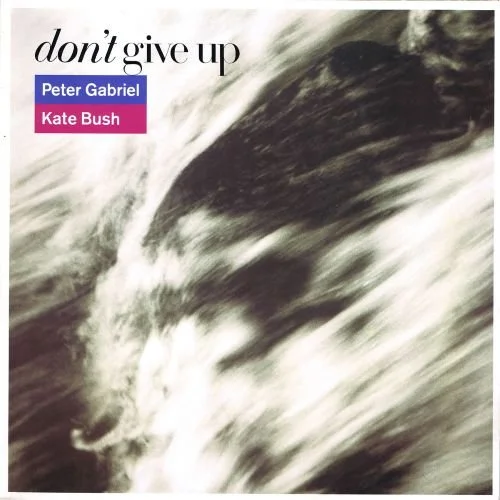
Peter Gabriel and Kate Bush’s Don’t Give Up at Forty
__________
EVEN though it…

IN THIS PHOTO: Kate Bush in an outtake from The Whole Story shoot in 1986/PHOTO CREDIT: John Carder Bush
is a Peter Gabriel song, Kate Bush is a key component. A duet between the two, Don’t Give Up featured on Gabriel’s 1986 album, So. The album’s third single was released on 27th October, 1986, so I am looking ahead to its fortieth anniversary. A top ten hit, this is arguably one of the most effecting duets ever. Peter Gabriel initially wanted Dolly Parton to sing with him but, after she turned it down, Kate Bush was approached. I think she did a better job than Parton would have done. As much as the late great would have brought so much to the song, I can’t hear Don’t Give Up with any other artist but Kate Bush in mind! In terms of her performance and the emotions we get from her voice. I will get to some writing about the song. However, I want to start out with this background from Peter Gabriel’s official website:
“Written by Peter Gabriel, the song was produced by Daniel Lanois and Peter and engineered by Kevin Killen and Lanois and features the guest vocals of Kate Bush. Bush had previously provided vocals for the tracks Games Without Frontiers and No Self Control on Peter’s third solo album.
The song was inspired by a Dorothea Lange photograph, but was also informed by the high levels of unemployment under the Conservative government of Margaret Thatcher of the 1980s, as Peter told the NME at the time of the release of So:
“The catalyst for ‘Don’t Give Up’ was a photograph I saw by Dorothea Lange, inscribed ‘In This Proud Land’, which showed the dust-bowl conditions during the Great Depression in America. Without a climate of self-esteem it’s impossible to function”.
This is a song that has saved people’s lives. The messages of hope and holing on. Not to give up. So many people across the world have said how it has saved them. Given them new perspective. Whilst perhaps not powerful enough to rouse me from slumbers of depression, it at least does give me some focus. I listen to the song and get something from it each time. I am writing this on 26th July and sharing it closer to its anniversary on 27th October, as I have so many Kate Bush features so this joins the back of the queue.
In terms of when the single arrived, you could argue Kate Bush and Peter Gabriel were at the peak of their powers. Bush released Hounds of Love in 1985. Her greatest hits album, The Whole Story, would come out in November 1986 and be a massive-selling success. So was a huge commercial breakthrough for Peter Gabriel. Two artists who first met in 1979 and shared a studio previously, combining for a song that resonates to this day. It is still helping people and saving lives. Earlier this year, PROG took us inside a song that might not have happened were it not for a tragedy that occurred during Kate Bush’s The Tour of Life:
“When Kate Bush embarked on her groundbreaking The Tour Of Life in spring 1979, it turned the notion of a live concert on its head. Fully choreographed by Anthony Van Laast, the sold-out 28-date tour was a visualisation of her first two albums, The Kick Inside and Lionheart.
Much was made of the road trip costing up to £250,000 and employing 40 people. It took place at the cusp of touring being taken seriously. Such was the furore that BBC TV magazine show Nationwide reported on the opening night at Liverpool Empire.
But the experience was to be overshadowed by the tragic death of Bill Duffield, her 21-year-old lighting director. On April 2, after a warm-up gig at Poole Arts Centre, Duffield was undertaking the reoutine “idiot check,” where the final crew member in the venue inspects makes sure nothing has been left behind. He fell 17 feet through an unlit open stage panel onto a concrete floor, and died a week later from his injuries.
A memorial concert for was arranged for May 12 at Hammersmith Odeon. It was an emotional tour de force, with Bush joined by two artists who’d previously worked with Duffield – Peter Gabriel and Steve Harley. They joined Bush on Them Heavy People and The Man With The Child In His Eyes. Then Bush duetted with Gabriel on his yet-to-be released I Don’t Remember, and they all delivered The Beatles’ Let It Be to close.
If Duffield had not died, Bush and Gabriel would not have met that night. They hit it off immediately – his painstakingly free approach to his work was to inform her in a way few artists ever had. Within months she’d be singing on Gabriel’s third album, and through the sessions she first encountered the Fairlight CMI synthesiser.
Years later she accompanied him on one of his most powerful statements. An evocative ballad, Don’t Give Up was partially inspired by the startlingly evocative Dorothea Lange pictures of Americans during the Great Depression. Gabriel had initially envisioned Dolly Parton singing with him. But instead he turned to Bush, who was then enjoying huge commercial success in the wake of Hounds Of Love.
Over the gentle swell of Richard Tee’s gospel-influenced piano part, the song was a masterpiece of understatement that was in step with the straitened times lurking beneath the shiny veneer of the mid 80s, speaking directly to a disaffected population.
In 1981, British prime minister Margaret Thatcher’s employment secretary, Norman Tebbit, infamously used an analogy about his father being out of work in the 30s. Instead of rioting – as many were doing at the time – Tebbit Senior got on his bike and looked for work, said the politician. The quote was popularly interpreted as telling the unemployed to “get on their bikes” to find jobs.
Gabriel’s tale of a dispirited man at the end of his tether looking for work touched a raw nerve with millions of listeners in the UK and, latterly, the world. With Gabriel’s despair in the verses and Bush’s words of hope in the chorus, the 1986 single became arguably Gabriel’s most-loved composition. The fact that it had its roots in a union which grew from such tragedy only adds to its poignancy”.
There is not much written about Don’t Give Up. However, I think people have their own interpretations of the song and what it means to them. Even if Don’t Give Up was not especially personal to Peter Gabriel, the way he delivers the song makes it feel deep within him. Kate Bush offering this comforting and soothing voice. But her voice has so much power to it. This article looks inside a song that still connects with people almost forty years after its release:
“Don’t Give Up,” a duet with Kate Bush, is an intimate look inside a marriage dealing with the husband’s layoff and unemployment as part of Thatcherism’s war on trade unions and its calculated transfer of wealth from the lower and middle classes to City of London bankers (see also, Elvis Costello’s Tramp the Dirt Down’s lyrics: [w]hen England was the whore of the world, Margaret was her madam; when they finally put you in the ground I will stand on your grave and tamp the dirt down).
Gabriel’s lyrics are searing:
No fight left or so it seems.
I am a man whose dreams have all deserted.
I've changed my face, I've changed my name.
But no one wants you when you lose.
Kate Bush’s sublime voice desperately seeks to reach him through the pain, to remind him of the love that filled his life and will fill it again if he can find a way up from the depths of his misery.
Don't give up, you still have us.
Don't give up, we don't need much of anything.
Don't give up, 'cause somewhere there's a place where we belong.
Sadly, our hero’s humiliation is complete. He had previously summoned all of his strength for a new start in a new place only to fail once more.
Moved on to another town,
Tried hard to settle down.
For every job, so many men.
So many men no-one needs.
Like life, the song refuses us the happiness we crave.
Got to walk out of here, I can't take any more.
Gonna stand on that bridge, keep my eyes down below.
Whatever may come and whatever may go,
That river's flowing, that river's flowing.
As the waters swallow our hero, Kate Bush frantically issues her final, desperate pleas to a sinking, depleted soul:
Don't give up 'cause you have friends.
Don't give up, you're not the only one.
Don't give up, no reason to be ashamed.
Don't give up, you still have us.
Don't give up now, we're proud of who you are.
Don't give up, you know it's never been easy.
Don't give up 'cause I believe there's a place.
There's a place where we belong.
The songs ends with a chorus singing “don’t give up,” fading, with our protagonist, into the murky depths”.
I am going to end things here. On 27th October, we mark forty years of Don’t Give Up. Not only one of Peter Gabriel’s best songs, it also features one of Kate Bush’s most affecting vocal performances. It is a song that means a lot to me, and I know it has helped so many people through the years. Elton John and the late Matthew Perry have spoken about the personal meaning of the track to them. For anyone who needs to find messages of support and resilience in a song to help them, they should listen to Don’t Give Up. This phenomenal song remains…
SUCH a powerful music moment.