
FEATURE:
Kate Bush: Them Heavy People: The Extraordinary Characters in Her Songs
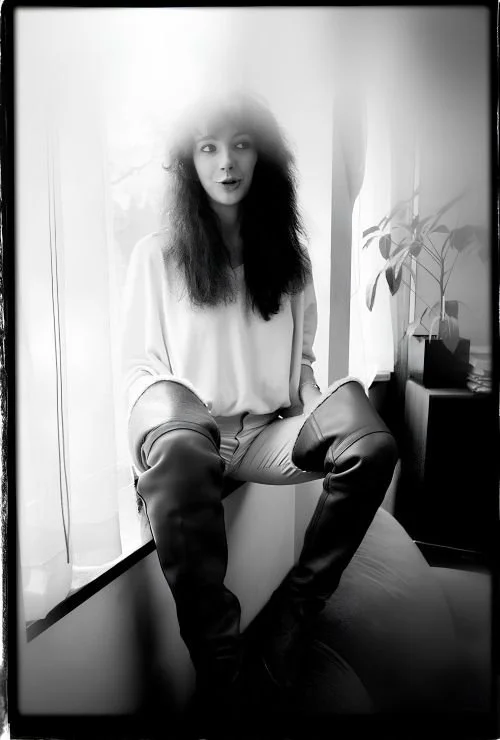
IN THIS PHOTO: Kate Bush in 1978/PHOTO CREDIT: Jill Furmanovsky
This Girl (Scares Me Silly (Really Gets Me Going)/The Fools (Breathing)
__________
I don’t have that many more…
instalments of this series before wrapping up. This is the final time I am looking at a very early pre-The Kick Inside song. It is one that could have made it onto that 1978 debut album, from Kate Bush. For someone reason, it was omitted. However, it is one of the most revealing and personal songs, as it is Kate Bush singing about herself recording in the studio. I want to start out with This Girl, from the incredibly Scares Me Silly (Really Gets Me Going). Some people have used other words in the parenthesis but, as you see from Gaffaweb, it is (Really Gets Me Going), but they put the parenthetical part first, but I feel I am right in terms of the order/which way around it goes. I am going to end with Breathing from 1980’s Never for Ever. There is a lot to discuss when it comes to this song. I have a couple of other songs from The Kick Inside to cover off. I am ending with Them Heavy People. I do wonder how far along Scares Me Silly (Really Gets Me Going) got before it was left where it was. Maybe a little too meta or weird to put on the album, I don’t think many artists have written about the experience of being in the studio real-time and singing about fear and anxiety. Most sort of weave that anxiety through their lyrics. In this gem, Kate Bush was very much on this tightrope throughout. You can see the song very much as a performance. This teenage artist, who would have been scared at AIR Studios recording The Kick Inside, putting all her fears throughout this song. It is an experience that gives her energy and excitement. Though there is this feeling of dread coming to the microphone. I have never read an interview where Bush talks about this song. It is a gem that a lot of fans might not know about. The only song in this run where Kate Bush is the character, it is fitting that we turn the lens onto her!
There s actually a character, Romeo, who may or may not be based on someone real or historic. I think that Kate Bush discussing herself is rare. On The Kick Inside, you feel she was disguising her desires and emotions through other characters and fantasy. Here, we seem to get an early insight into her feelings of being in the studio. The lyrics are fascinating: “Here in the studio/As they’re turning down the lights/I lick my lips to start the first line/How can this girl be me?/“Oh, little thing, are you looking lost?”/The vertigo, the need to lose”. There must have been a feeling in 1977 that this whole experience of being an artist was brief. That she would record an album and that would be it. Bush wanted more than this. But going into a studio and recording songs was expensive and intense. How long could she keep doing this? Scares Me Silly (Really Gets Me Going) is a window into her. Whilst it does seem to be a first-person examination of the dread of putting your voice onto tape, there is an intriguing line that got me wondering: “Don’t even know you but I need you to love me, too”. Who is Kate Bush referring to? Is it producer Andrew Powell or someone in the studio? That feeling of being alone and isolated in the booth. The chorus bringing in this Romeo: “Scares me silly, but it gets me going/Like a Romeo/Scares me silly, but it gets me going/Like a Romeo/Scares me silly, but it gets me going”. I am not sure whether it is referring to a male lover and that sexual energy. It is an interest in selection on her part. These are some of Bush’s most fascinating early lyrics. That she sings “I wonder can I goad myself into another take/And keep the mood?”. The feeling of doing multiple takes and having to make each brilliant and the same. Bush sings about music being like a film and doing these takes to get the performance right. How “The music will never let me blow away”. It is a song of intensity and fear, though one where she is very much doing what she loves. Clever wordplay and imagery – “You know the feeling when you’re on the right track/You fall in love and you’re never gonna turn it back/It’s recording you, they’re so sensitive/Oozing without me, spilling over with secrets” -, it is like a diary entry.
This songs is one that might have seemed to be as bit like self-sabotage on a debut album. An artist writing about the studio experience and all the emotions that go through your mind. Perhaps a little advanced or clever at the time, I do think of Scares Me Silly (Really Gets Me Going). That subject of anxiety. Something that Kate Bush faced right through her career. I know that 1979’s The Tour of Life was pretty daunting. Her only tour, she was performing around the U.K. and Europe. Going on stage in front of thousands and it all being on her. If the experience of being in the studio recording was scary and caused worry, that was magnified so many times over on the stage. She would not get multiple takes and a chance to redo a routine. There are no other outtakes from The Kick Inside. Scares Me Silly (Really Gets Me Going) seemingly was intended to be on the album, though it seems like something that would have fitted on Never for Ever. By that time, Bush was writing new songs. I do wonder why it was not considered for Lionheart. It could easily have ended the album and made for this incredible finale. As it is, Scares Me Silly (Really Gets Me Going) is this rare gem that many do not know exists. The fact is that not many people have written about the song. I think it is stronger than an outtake. It could have found its place on The Kick Inside, as it is very much is Kate Bush talking about herself. Dreams of Orgonon covered the tracks and felt that Kate Bush was singing about a character. She was very much singing about herself. This is a teenage artist embarking on this huge debut album and feeling a sense of pressure and vertigo:
“The Kick Inside sessions seem to only have one outtake: “Scares Me Silly,” a bootleg rather than a bonus track from some official release. Listening to it in 2019, it’s not hard to understand why it was never released. “Scares Me Silly” is loopy, particularly in its calypso-esque It’s a ridiculous track, something Elton John might have cut on a drunk night at the Château d’Hérouville. “Scares Me Silly” is loopy, beginning with frantic up-tempo glam rock, moving into a wordy calypso of a pre-chorus (“they try to put me on the tapes begin to spin/I feel a little sick and hope my notes are in”), and slowing down for a poppy chorus, repeatedly declaring “it scares me silly, but it gets me gooooiiiiin’!” There’s no sense Bush is disciplining herself, and the result is firmly outtakes material.
Curiously, the lyrics of “Scares Me Silly” are a pretty straightforward reflection of what kind of song it is. Bush describes a character working in a recording studio for the first time, feeling the anxiety that comes with pop music and how it separates the artist from themselves (“I lick my lips to start the first line/how can this girl be me?”). The prevailing mood is one of giddiness and dizzy nausea, with Bush singing energetically of “vertigo, the need to lose.” Music is a force which carries her away — “I feel a little sick and I hope my notes are in” — to some other place. In “Scares Me Silly” the journey is the focus, and it’s more of a speed trip than an odyssey. Terror and exhilaration often go hand-in-hand for Kate Bush — go back and read my favorite post “Hammer Horror” to see more of that on display. Bush’s melodic experiments, off-beat songwriting, and idiosyncratic vocals all unite to create one major statement: that pushing your limits is fun and worthwhile”.
It got me thinking about Kate Bush and outtakes. Obviously, there are demos that will not be remastered and endorsed. There are a few tracks that were recorded but never made it onto albums. Never for Ever’s title track actually recorded during the Lionheart sessions in late-1978. Producer Andrew Powell recalled how gorgeous it is and what a vocal Bush delivered. She did not like her voice or the song I think, so it never materialised beyond the studio. It did lend its name to her third studio album. Scares Me Silly (Really Gets Me Going) could have been a B-side. I do think that this is a song that is unique in her cannon. Referencing herself and This Girl. Looking into the studio and seeing everything unfold. Before moving to the second song for this feature, I did want to end with some interview exert from 1978. This was a young artist who released her debut album and was instantly thrust into the world. When she was recording Scares Me Silly (Really Gets Me Going), she would not know how intense things would get so quickly. In early-1978, Record Mirror spoke with Kate Bush. This nervous artist recording her first album was now on the press circuit:
“Kate Bush is, as she never tires of emphasising, a member of the human race, not a musical hybrid of the girlie mag fantasy woman. She's clinging onto that humanity with obsessional determination despite her circumstances sliding further and further away from that "normality" she holds desperately and dearly.
Her abnormality has never been more apparent than in this setting; a £100 a night, two floor leather-and-flowers suite at the Montcalm Hotel, Marble Arch.
She has just been interviewed by Ritz and Vogue. Attended by two press officers, she is, despite her protestations, a star, a true star, by virtue of her immense success, her pink skin and her Page 3 curves.
A number one single (an international hit) a number one album and immense publicity; Kate Bush is a phenomenon. The fate that befalls such animals — arrogance, self-indulgence, mania — has yet to manifest its symptoms, partially because this particular phenomenon is dedicated to the preservation of her personal reality.
Nervous
"I'm not really aware of being subjected to any starmaking machine."
She taps her fingers on the chrome and glass table in the only nervous gesture she possesses.
"I know that might sound odd, but I've really no idea about it. The record company thought this hotel would be practical, I thought it would be nice. It's quite a trip for me to be here.
"I didn't walk in here and say 'where are the flowers? Where is my champagne?'
"I hope I haven't become a prima donna yet. I really mean that. I really, really resent that a lot.
"It's nice if you're on the road that you should have somewhere nice to sleep. But I'm not into the 'Oh Dahling!' bit, and everybody having a Rolls Royce".
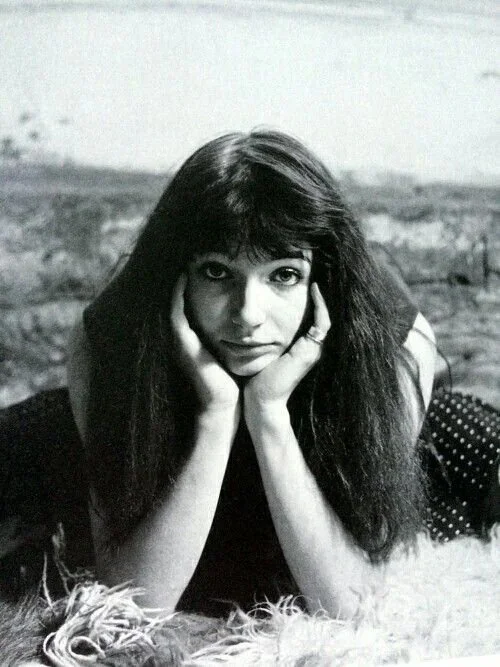
IN THIS PHOTO: Kate Bush in 1977/PHOTO CREDIT: John Carder Bush
It sounds almost defensive, but one subject that Bush is totally convincing about is how critical she considers her grasp on her own situation.
She has reached a point already of being such a valuable property to EMI Records that she is at the point of being able to control her immediate destiny.
The interviews she does are her own choice — "I want to get into as many areas as I can. So I did the fashion magazines and Vegetarian, and The Sun. I'm testing the water."
She says that she is, quote, into people. People, of course, reciprocate, and therein lies the danger. A surfeit of attention killed Janis Joplin and, more lately, put Poly Styrene into a mental home.
"I have some personal principles I stick by, though they are pretty free. They don't just apply to the press. They are my way of living.
"I have tried to avoid an 'image'. If you have an image you intend to maintain, it's going to be very difficult, because you're going to get holes in your image. I may be that animal 'Kate Bush' a bit when I'm offstage, but mostly, I am me."
Kate spends most of her time with a smile on her face and eyes that look straight at you. but she looks away and almost shudders for a moment.
"The things I don't like doing is... is... going to these sort of parties that you hear about. I don't go to parties. I find that sort of thing very unhealthy. In fact I find them disgusting."
She pronounces the word 'parties' like you or I might pronounce some vile disease or weird sin.
"It's not me. I'm basically a quiet person. When I get the time, I like to go home. I clean up the flat — which is a mess, because I'm never there. And I get some friends around that maybe I haven't seen for a long time”.
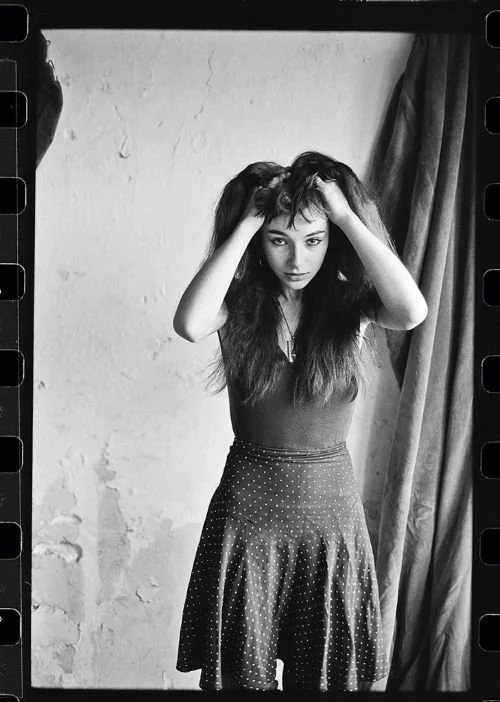
IN THIS PHOTO: Kate Bush in 1977/PHOTO CREDIT: John Carder Bush
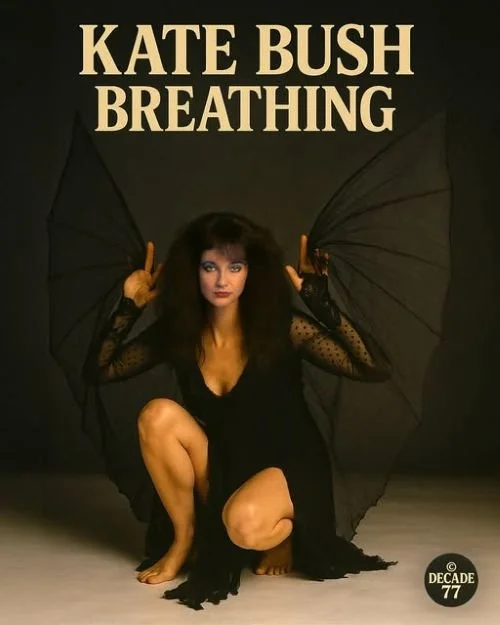
From Kate Bush putting herself in an outtake from The Kick Inside, we move to 1980 and the first single from Never for Ever. Breathing was perhaps an unexpected lead single. Babooshka was the second single, though it seemed like Bush was making a point. I could talk about the mother and foetus in Breathing. They are both causalities of nuclear war and destruction happening. The foetus protected by the womb but still breathing in plutonium and smoke. It is a scary image. You do not see the horror of what is outside of the womb. You get the feeling that it is a holocaust and nuclear wasteland where everyone is doomed. This was Bush writing politically. Accused by many of being apolitical and lacking bite and relevance, there was a sense of her answering those critics. In terms of the most striking characters from the song, The Fools seem to refer to governments. This was the biggest and most epic song Bush had written to this point. It was very much a song of fear of what was happening in the world. Let’s start with some interview archive, where Bush discussed Breathing and why she wrote it:
“From my own viewpoint that’s the best thing I’ve ever written. It’s the best thing I’ve ever produced. I call that my little symphony, because I think every writer, whether they admit it or not, loves the idea of writing their own symphony. The song says something real for me, whereas many of the others haven’t quite got to the level that I would like them to reach, though they’re trying to. Often it’s because the song won’t allow it, and that song allowed everything that I wanted to be done to it. That track was easy to build up. Although it had to be huge, it was just speaking – saying what had to be put on it. In many ways, I think the most exciting thing was making the backing track. The session men had their lines, they understood what the song was about, but at first there was no emotion, and that track was demanding so much emotion. It wasn’t until they actually played with feeling that the whole thing took off. When we went and listened, I wanted to cry, because of what they had put into it. It was so tender. It meant a lot to me that they had put in as much as they could, because it must get hard for session guys. They get paid by the hour, and so many people don’t want to hear the emotion. They want clear, perfect tuning, a ‘good sound’; but often the out-of-tuneness, the uncleanliness, doesn’t matter as much as the emotional content that’s in there. I think that’s much more important than the technicalities.
It got to the point when I heard [Pink floyd’s The Wall] I thought there’s no point in writing songs any more because they’d said it all. You know, when something really gets you, it hits your creative centre and stops you creating… and after a couple of weeks I realized that he hadn’t done everything, there was lots he hadn’t done. And after that it became an inspiration. ‘Breathing’ was definitely inspired by the whole vibe I got from hearing that whole album, especially the third side. There’s something about Floyd that’s pretty atomic anyway.
Colin Irwin, ‘Paranoia And Passion Of The Kate Inside’. Melody Maker (UK), 4 October 1980”.
There was a point in people’s lives when the imminent prospect of war was scaring the shit out of them, and that resulted in a lot of anti-war songs. At that time it was worthwhile. When I wrote ‘Breathing’ it seemed like people were sitting waiting for a nuclear bomb to go off. Nuclear power seemed like… Someone was getting set to blow us up without our consent. I felt I wanted to write a song about it. If it was something that was bothering so many people then yes, I think it was worthwhile. Songs or films or little individuals don’t do anything on a big level. Big things need bigger things to change them.
I do think that Kate Bush is taking aim at world leaders. The lines when we get a sense of the incompetence and inhumanity of those who make decisions: “I love my/Beloved, ooh/All and everywhere/Only the fools blew it/You and me”. What is striking about this is how progressive it is. For a female artist in 1980, there were few who were writing songs like this. It does very much lean on Pink Floyd in terms of its sound. She nodded to them on The Saxophone Song on The Kick Inside. That is one of two songs from the album – the other is The Man with the Child in His Eyes – which were recorded at AIR Studios in June 1975. David Gilmour of Pink Floyd, mentor and Executive Producer. Bush was a fan of Pink Floyd and I feel The Wall was one that she gravitated towards. That was released in 1979. It would have timed nicely with the recording of Breathing. Hitting out against those who felt that she was vacuous, empty or this silly Pop artist. Battling misogyny and sexism is something women face to this day. In 1979, she was being interviewed and pretty much dismissed as a hippy or someone who could not write anything serious. Not only did Bush release Breathing at a time when there was nuclear fear and this worldwide anxiety. I think she created something more urgent, sophisticated and accomplished than artists that were being heralded as heroes. Those that teenagers idolised. Breathing was released in April 1980 and reached the top twenty. In June 1980, there was the start of this anti-nuclear movement. It is interesting reading this article and seeing what the mood was in the U.K. in 1980. Songs like Breathing very much reflecting a wider fear and anger:
“In June 1980, during the Cold War, it was announced that 160 American nuclear cruise missiles (guided nuclear missiles), would be stationed in Britain. They would be based at RAF/USAF Greenham Common and RAF/USAF Molesworth, Cambridgeshire.
Public opposition to this move led to an increase in support for the British anti-nuclear movement, which began a sustained protest campaign lasting many years.
British documentary and portrait photographer Edward Barber captured aspects of this campaign while working as a freelancer 1980-1984. Peace Signs, his collected body of work, was originally created to publicise the anti-nuclear movement. It has now been re-interpreted in a new exhibition at IWM London.
CND Demonstration
Anti-nuclear protesters staged mass demonstrations around the country.
Die-In.
'Die-ins' were a popular form of performance protest in the 1980s. Protesters pretended to be dead in order to obstruct and attract attention.
Picket
Picketing enabled protesters to apply non-violent pressure on individuals associated with key organisations”.
I do think that The Fools in Breathing were those ensuring things escalated or were too busy trying to destroy one another and not realising what they were doing. There is an argument that Breathing arrived at the start of a new Cold War in the early-1980s. Even if Kate Bush was safe and unlikely to be caught in any blast, nobody knew what would happen. This article talks of a terrifying time. I think that is why Breathing came first. Babooshka was released in June 1980 and proved a more popular single. Though I feel Breathing was the most important song Bush recorded to that point. The video her best and most cinematic:
“The 1970s were marked by a period of détente, or an easing of tensions, between the West and the Soviet bloc. By the late 1970s, however, détente was increasingly strained. The Soviets embarked on a number of foreign interventions, most notoriously by invading Afghanistan in December 1979, which were condemned by the West. From the American perspective in particular, détente had also allowed the Soviets to increase their relative military strength vis-à-vis the United States, thereby weakening American power. Particularly destabilising was the Soviet decision to deploy new intermediate-range nuclear forces, missiles known as SS-20s, in Eastern Europe. For NATO, this gave the Soviets a worrying advantage and upset the strategic balance of nuclear weapons across Europe. In December 1979, NATO aimed to restore this balance by adopting its ‘Dual-Track Decision’: one the one hand, arms control negotiations would be pursued to try to secure the removal of the SS-20s; on the other hand, unless the SS-20s were removed, NATO would prepare to deploy its own, modernised nuclear weapons in Western Europe beginning in the autumn of 1983. Specifically, Cruise and Pershing II missiles would be stationed in the UK, West Germany, Italy, the Netherlands, and Belgium. These developments led to heightened tensions between East and West and rhetoric on both sides became more aggressive, particularly following the election of American President Ronald Reagan in November 1980. This return to East-West tensions and the renewed prospect of nuclear war led this period to be referred to as a ‘Second Cold War’, comparable to the era that witnessed the 1962 Cuban Missile Crisis.
These growing tensions and the looming deployment of new nuclear weapons in Western Europe was met with alarm by millions of citizens. In the UK, the government’s decision to station Cruise missiles at two military bases – Greenham Common and Molesworth – was accompanied by the separate decision to modernise the British nuclear deterrent by replacing the ageing Polaris with the new Trident system. These decisions, against the backdrop of what British Foreign Secretary Lord Carrington called the ‘megaphone diplomacy’ between the superpowers, raised fears that an unimaginably destructive nuclear war was increasingly possible.
It was in this context that unprecedented numbers of citizens from countries across Western Europe, and indeed around the world, engaged in different forms of activism to express their anxieties and demand a change of course from their governments”.
Bush claimed not to be a political writer. Perhaps not wanting to be called out or questioned, there is no denying a track like Breathing is political. It instead was her emotions and feelings coming out in song. As Dreams of Orgonon note, Bush political. Emotions and politics are interlinked:
“Breathing” contains the body horror of crass jingoism’s mutation of human life. “Breathing my mother in” summates what fetuses do normally while warping it into a desperate gasp for breath. A fetus contains nascent vestiges of human form — we all have to start somewhere. But we have to end somewhere too. “Breathing” offers no hope for survival. Its coda is a macabre apocalypse — Middleton’s dolefully frightened keyboard and Bath’s grimacing, sustained guitar licks underscore predator Roy Harper’s calls of “what are we going to do without?” as Bush’s gasps of “LEAVE ME SOMETHING TO BREATHE!” tear the world asunder. Earlier, the second verse is similarly pessimistic about the possibility that “we’ve lost our chance/we’re the first and last.” This is where it starts and where it ends — the bomb destroys bodies and ends the possibility of life.
Bush claimed that the political content of “Army Dreamers” and “Breathing” only served to “move [her] emotionally.” Characteristically, Bush is both wrong and insightful here. The idea that songs are less political because you’re emotionally invested in the political issues they discuss is utter nonsense. But… of course political issues are emotional. Bush even acknowledges this in the next part of the quote, saying “it went through the emotional center… when I thought ‘ah, ow!’ And that made me write.”
Perhaps nothing is more political than personal emotions. Emotions are always present in a person’s values, decisions, choices, and aesthetics. Human beings are ventilation devices for emotions. Perhaps without realizing it, the entity that moved Bush is the radical politics of emotion in the service of bodily liberation. Emotions are political. Everything is political, as no man is an island. And crucially, breathing, and who gets to do it, is political”.
I will leave it there. From Kate Bush casting herself in a song on an outtake from The Kick Inside to The Fools in Breathing, we do get two very different situations. I do love this run of features and it will be sad to see it end. I only have…
A small selection left to go.