
FEATURE:
Running Down That Hill
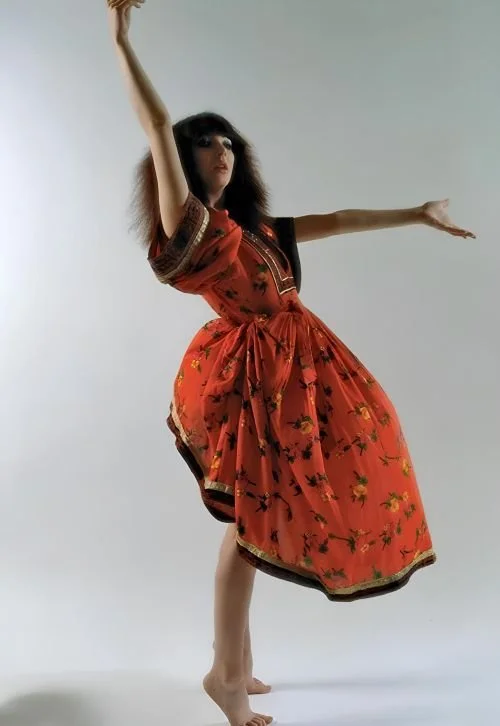
IN THIS PHOTO: Kate Bush in 1980/PHOTO CREDIT: John Carder Bush
How Kate Bush’s Integrity and Multifaceted Brilliance Has Affected So Many Artists and Influenced a Lot of Modern Pop
__________
I do still feel…
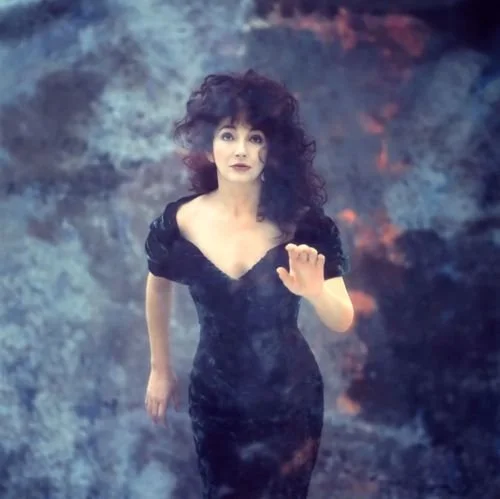
IN THIS PHOTO: Kate Bush in 1989/PHOTO CREDIT: Guido Harari
that there is a book to be written that solely examines Kate Bush’s influence. Artists who are either inspired by her or are fans of her music. Perhaps impossible to list all through popular culture, there has not really been anything like it. Modern artists such as PinkPantheress and FKA twigs are definitely fans, as is Olivia Rodrigo. In another feature, I did say how Charli xcx was the modern embodiment of Kate Bush. In the sense that she evolves between albums and is someone that does not listen to other people’s music when creating her own. Her attitude and fearlessness. So many aspects of her music and personality are reminiscent of Kate Bush, yet she is an original. Perhaps the greatest modern Pop artist. You can see how so many artists have been influenced by Kate Bush. We often think about the music solely. All these diverse elements have affected scores of artists. Though I think there is an attitude and aesthetic that is alluring. How many different sides there are to Kate Bush. I can imagine the Pop landscape was quite bland when she came through in 1978. Mainstream Pop not as exciting and meaningful as it would become. Many artists writing cheesy, depressing or cliché love songs. I feel this is a reason why so many people piled onto Kate Bush and ridiculed her. Someone who was not like everyone around her and there was something special there. It is true that there are artists today who adopt different sides and personas. In the sense that Kate Bush could be witchy and weird. A queer icon or someone who goes beyond the normal and commercial. I will come to an article from PROG that was published in July. They quote from a 2010 book about Kate Bush called Adventures in Kate Bush and Theory. Perhaps one reason why she has such a wide fandom and captivates so many different people is that she never conformed or was this singular artist. In the sense that you could not define her or lump in with other artists.
One of the things that was clear is that Kate Bush was being touted as a sex symbol. The press practically drooling over her. So many questions and comments based around her beauty and sex appeal. This prurient and disgusting attention that has afflicted female Pop artists for decades. How they are reduced to their looks and bodies. In addition, Kate Bush was offered acting roles, big opportunities and sexy photo shoots. Bush rejected these because she did not want to be a commodity. Or what people felt a star of the day should do. Now, you do get artists who record Bond themes, star in films, have their own product lines and do all sorts of different things. They create their brand and diversify. It can be beneficial to their music, though you see them as celebrities and perhaps it does distract slightly from their primary passion. Kate Bush could have been one of the list of artists that would have made great actors but turned down roles (I always wonder what could happened if Gwen Stefani was offered a tonne of film roles). Although she did do the occasional advert, for the most part, Kate Bush was focusing on her music. To her, the brain and mind was more important. Her beauty a biological thing that has nothing to do with music. Let’s get to that PROG article. EMI, like labels today with artists, trying to make Kate Bush part of an assembly line. She had other ideas:
“While the marketing men and mainstream media were far from subtle in their slavering celebration of Bush’s obvious sexual appeal, she was already proving to be more enigmatic and far smarter than the mindless pop star hoped to make her. When The Man With... won her an Ivor Novello Award and she swiftly followed The Kick Inside with second album Lionheart, the critical acclaim grew.
“EMI really had no idea,” says Carder Bush. “It was run by salesmen who saw her as part of an assembly line – they had obviously never studied her lyrics! So once Kate became a success, they barged in with sexy photo shoots, offers of Las Vegas residencies and Bond themes. She said ‘no’ to all of them because it was the brain and not the body that was Kate’s real quality.”
Rush-released in November 1978, Lionheart was accompanied by a rigorous six-week tour of heavily-choreographed shows involved multiple set and costume changes, along with an onstage magician. They represented the most ambitious live extravaganzas since Bowie’s earlier in the decade.
“The tour was utterly exhausting and utterly successful,” says Carder Bush. “That success changed all of us – we were wary and we kept everything close. Kate has never dealt with bullshit; and promotion is 99 per cent bullshit. She hated it. So after that it didn’t matter what the record company said – she paid no attention to them.”
Spent, she vowed never to tour again. Instead she and her family took control of all her affairs, and relations with the media were similarly pared back. And so a dichotomy emerged: at the age of 21, she was a bona fide pop star about to embark upon a hugely successful creative run of albums; yet one who would become less publicly visible the more famous she became.
As she retreated to the studio, rumours abounded and she did little to dispel them – like the apocryphal anecdote about EMI executives arriving at her house, demanding to know what she’d been working on, to which she’d produced some cakes from the oven. Ultimately though, her reclusive tendencies would be the making of her. As chart music went through a period dominated by glossy pop that was all veneer and little content, Bush’s outsider status worked to her advantage.
A string of albums throughout the 80s went to Nos. 1, 3 and 1 respectively – Never For Ever (1980), The Dreaming (1982) and Hounds Of Love (1985). No one song was easy to pin down as she drew on murder ballads, the childhood wonder of nursery rhymes, her part-Celtic genealogy, the mythology of a lost Albion favoured by some prog and pastoral folk singers, the ethereal end of goth, the organic tones of early music, digital synth pop and emerging sequencing technologies.
Hounds Of Love alone spawned three classic singles – Running Up That Hill, Cloudbusting and the tumultuous, dramatically-heightened title track – and further reiterated her prog tendencies by devoting the entire second side of the album to a an experimental opera, The Ninth Wave, the name taken from a Tennyson poem. She also helped define the 1980s whilst being unlike anything else in that era: her skill was not to experiment in the live arena but by embracing emerging technologies in the studio.
“For three or four years it was a rollercoaster,” says Carder Bush. “She was being sent all over the world, and fortunately she had stockpiled a lot of songs. But when that stockpile ran out she was expected to come up with an album, then promote it, go on TV, all within a year. The type of artist Kate is meant that just couldn’t work. That’s why each album has taken longer and longer to come to maturity.”
It mattered little: many agree that anything she does is always of interest. In an age of over-exposure, her relative seclusion offers a continued sense of intrigue and mystery.
Twelve years of Garbo-like silence fell between between 1993’s The Red Shoes and 2005’s Aerial. Bush has managed to maintain her position for over three decades without ever once being sucked into the creative vacuum of celebrity culture. The less we see of Kate Bush, the more we want to know.
Writer and academic Deborah M Withers recently published an analysis of Bush entitled Adventures In Kate Bush And Theory that considered “the polymorphously perverse Kate, the witchy Kate, the queer Kate; the Kate who moves beyond the mime” and in essence suggested that Kate Bush is many things to many people.
“She supplies me with all the clues and it’s up to me to put the answer together – well, that’s like the Quran of music,” says John Lydon. “Surely that’s what we’re all looking for? No easy answers to anything. It’s not about rolling in the money, it’s about the joy of knowing that what you’ve done really touches people’s hearts.”
There’s not enough room to list those who Bush has influenced – but she can certainly be heard in prog singers such as The Reasoning’s Rachel Cohen and Mostly Autumn’s sometime triumvirate of Anne-Marie Helder (who says “Kate’s legacy is one of total creative freedom, taking risks and keeping her integrity”), Olivia Sparnenn and Heather Findlay and beyond the genre to Bjork, Tori Amos, PJ Harvey, Bat For Lashes and thousands of others”.
That blend of integrity, purity and no compromise. How many major artist today can claim that holy trinity?! She retains all of these to this day. As we speak, Kate Bush has not released an album in almost fifteen years (2011’s 50 Words for Snow). The last time she was photographed in public was at Elton John’s marriage to David Furnish. That was December 2014. That was thew same year Bush’s residency, Before the Dawn, was staged at the Eventim Apollo in Hammersmith. And yet, she has given interviews since then. Such a groundswell of new fans. Hordes of artists and those beyond music that share their admiration of Kate Bush. It is because she has all of these aspects and characteristics. Different sides of Kate Bush that appeal to a variety of communities and people. I find so many Pop artists one-dimensional and lacking in real intrigue. Perhaps they are moulded by their label or feel they need to follow others or make music that appeals to a TikTok demographic. Whilst there can only be one Kate Bush, you can see so many artists today embodying so much of her. How easy is it for artists now to do what Kate Bush did and focus on music and not be turned into something commercial and regular?! You can see some homogenisation and so many short-term or limited artists. There are some who are very much focusing on music and not being led into a world of film offers and anything like that. That being said, artists like Charli xcx can balance a variety of interesting acting roles and also put out this unique and incredible albums. She is a massive film fan, like Kate Bush, so it is understandable that she has stepped into acting. However, the way she makes music and conducts her career does remind me of Kate Bush. There does need to be a documentary or coffee table book that deeply explores Kate Bush’s influence and why she is so beloved and popular. Those various sides to her mean she can speak to a massive demographic. Her strength of will to eschew trappings and shallow ventures to focus on music. See herself as a serious artist with a great mind and not what the press wanted her to be. I feel this is why Kate Bush’s influence will grow and expand…
FOR decades more.