FEATURE:
Spotlight

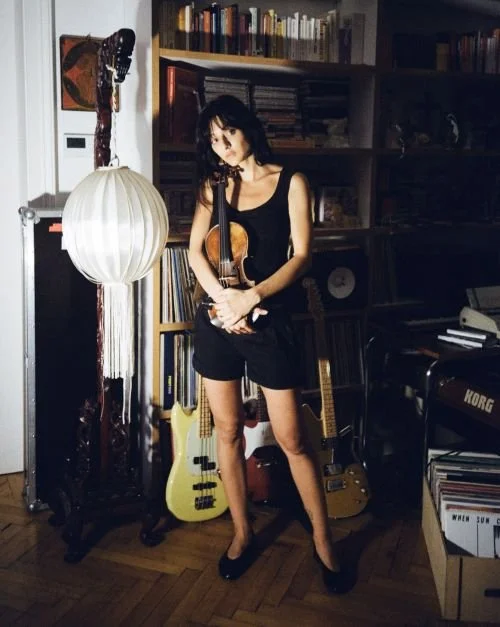
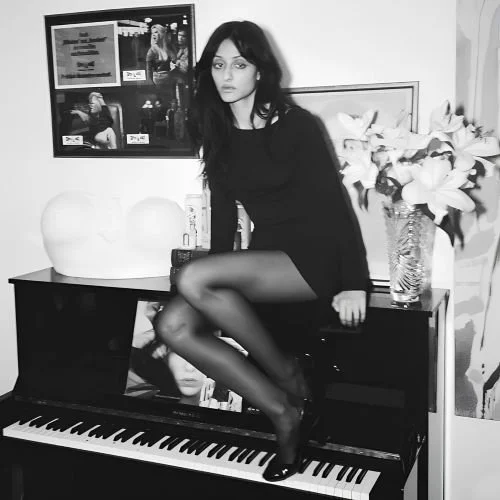
with the brilliant Sofie Royer. She is a Californian-born, Austrian-Iranian multi-instrumentalist and producer who I am new to. Her new album, before/after, came out on 4th September. There were some new interviews published around that release which I want to get to. I am starting out with DORK and their conversation. This interview actually is from June:
“A conservatory-trained violinist who grew up in Vienna, she later moved to California, helped build Boiler Room's LA presence and worked at Stones Throw before launching a solo career that has steadily developed across 2020's 'Cult Survivor', 2022's 'Harlequin' and 2024's 'Young-Girl Forever'. Along the way, she's built a catalogue that pulls from high and low culture in equal measure, pairing sharp observations with references to everyone from Rainer Werner Fassbinder to Falco.
That background helps explain why Royer is difficult to pin down. On new album 'before/after', due in September, she turns her attention inward, examining the patterns, contradictions and recurring cycles that shape her own life. It's a record concerned with time, identity and the habit of measuring ourselves against imagined versions of who we once were and who we might become.
"I was in a little bit of a limbo last year," she says of the period that informed the record. "I was all over the place geographically (my year began with shooting a movie on the Czech border) before being in Los Angeles and then New York for the better part of the year when I wasn't touring. Perhaps that's evident on the record”.
Royer remains sceptical of how cultural industries handle artists who resist easy categorisation. "I think regardless of category, it has to be marketable, the art has to easily provide multiples," she says. "I just crave something unimaginable sometimes."
The refusal to fit neatly into a box has coincided with increasing recognition. Royer has opened for artists including Lana Del Rey and Belle & Sebastian and worked with producers whose credits include Charli xcx, Sabrina Carpenter, SZA and BLACKPINK. Yet she doesn't see external milestones as a reliable source of confidence.
"I'm happy and grateful about all the opportunities I've had, and they've been really exciting," she says. "This February, when playing shows back to back opening for Belle & Sebastian, who'd been one of those bands that I've listened to for so long since I was a pre-teen – that's always thrilling!"
Still, she adds, "real security in identity (whether as an artist or otherwise) fluctuates and remains removed from what can be identified as a milestone or whatever. There's confidence in knowing oneself that allows you to seize opportunities with certainty and not anxiety. There are far more annoying internal factors that end up making me question my existence/identity".
I am moving to The Line of Best Fit and their interview from this month. If you have not heard before/after, then do go and listen. The new single from the album, Actress, is fantastic. The Line of Best Fit note how Sofie Royer “confronts the all-too-familiar ways we can become our own biggest obstacle; while finding humour in the endless pursuit of artistic success”:
“Rather than adapting its characters, Royer draws on the theatrics around performing and the ways it can shift identity. Her mysterious constructed character, named Angel Jane in the song, commands the microphone before something begins to feel off: the faces staring back are suddenly unfamiliar and, soon, she’s stranded in the spotlight, looking to the “stage cues” to tell her what she’s meant to be. The accompanying video extends that fascination with inhabiting different roles. Inspired by a photograph Jim Jarmusch posted of an abandoned box of shoes, it sees Royer trying on different pairs before taking the stage in angel wings. Trying on somebody else’s shoes becomes a literal expression of the different roles we inhabit.
For Royer, that visual extension is inseparable from the fun of making records. “In an ideal world, every single song would just have a music video, but there’s no money for that,” she laughs. Visuals, she says, offer “a really fun and special way to be able to visually communicate what your songs are about, which I think is sometimes easier than talking about it.” When I bring up her tongue-in-cheek description of being caught between pop, indie and the art world, as referenced in “Sold out the jazz club” she quickly zooms outward from her own career. “We live in postmodernity,” she argues. “Everyone’s cross-referencing, everyone has this wealth of references to draw upon,” she adds, before wondering aloud what innovation even looks like under those circumstances.
An example she cites is a track by Shoreline Mafia’s Phoenix Flexin, “Rubberz,” which had recently caught her attention. Delving into ’80s disco-style with a voice and sound that did not resemble Flexin’s previous hip hop sound, prompted online speculation about generative AI, which the artist vehemently denied, and, of course, generated further discourse about artists using AI in this way to boost publicity for their tracks. Royer doesn’t express much interest in litigating whether the song actually used AI, but rather what the conversation says about originality. It leaves Royer deliberately unresolved: “I get nervous because I’m hesitant to say, ‘Oh, there’s absolutely no innovation right now, and everything’s just post-postmodern,’ because it makes me sound jaded and cynical, when I’m actually not,” she says.
Royer doesn’t shy away from the ways she is similarly suspicious of easy answers on before/after. Even recognising our tendency to measure the present against what comes before or after doesn’t necessarily release us from it. “It’s like, ‘Hey, great. Like, I realise that I’m not in the moment, but what now?’” Royer says. “The whole way that society operates and is structured is set up to be anticipatory. We’re always in anticipation of the next day.” Contentment, she suggests, is hardly profitable: “If everybody’s content and happy and able to exist on very maybe simpler terms, capitalism wouldn’t really work”.
The final interview I am bringing in is from The Guardian. Sofie Royer is a truly unique artist. Someone who you cannot compare with anyone else out there. The Guardian state, in their headline/sub-header how “writing some of today’s wittiest music – though she’s ‘too pop for the art world, too indie-darling for the mainstream’”. On 17th September, Sofie Royer plays London’s Rough Trade East:
“Her debut album, Cult Survivor, was released in 2020, but performing it live “was like reopening an old wound”, so she started broadening her writing. She dressed up as a pierrot character for 2022’s Harlequin, “a different persona to help me get over the fear of being perceived as a singer on stage, maybe”, and based 2024’s Young-Girl Forever on a French philosophical tract about culture’s obsession with young women. “The beauty of age is that you care less and less about it. You couldn’t pay me to go back to my 20s.” She reconsiders. “I mean, you could pay me, because I’m self-employed, so I’m down for money.”
She is much admired by her peers, with Lana Del Rey, Air and LCD Soundsystem all getting her to support them on tour, but she’s not headlining the same venues. She addresses that relative lack of financial success and fame uproariously on the new album. “Always a nominee, never a winner / The longer I keep this up the less I can afford dinner,” she sings on Sold Out the Jazz Club, just one of many references across the album to how Royer is, as that song’s chorus has it, “too pop for the art world, too indie-darling for the mainstream”.
“Very few professions are as measured in metrics as people working in the arts,” she says, “specifically music, and these metrics are publicly available” – Spotify listeners, tickets sold. “And not only that, then you’re being interviewed: ‘Where do you see yourself in five years? What does success mean to you?’ That’s what I wanted to perhaps release when it came to these songs.”
She has also released herself from therapy, singing “I spent five years on that couch, and I’m not ever going back again” on another new song, C’est la D. “I was actually in therapy for longer than five years, but it just sounded so cool to sing five instead of seven,” she deadpans.
She says she certainly needed therapy to begin with, but when she reached the cap to her free hours from the Austrian state, her therapist said she could continue, but he didn’t think she needed it any more. She agreed with him: “We as humans have a certain semblance of resilience, but there’s a lot of financial value placed in today’s market of psychoanalysis. In a lot of other cultures, that maybe aren’t as socialist as the one I currently enjoy living in, there’s more value in keeping somebody unhappy and dependent on therapy for the rest of their life.”
I cannot any reviews for before/after. It is a brilliant album from an artist that you should know about. I am already a fan of her and her work. She is so utterly fascinating. In terms of her background and sound. I am really interested to see where she goes next. Go and follow Sofie Royer. A wonderful artist who I think we are going to hear about for years to come, it has been great finding out more about her. She is definitely one of the finest out there. Someone who you…
NEED to know.
___________
Follow Sofie Royer