FEATURE: Second Spin: Muse – Simulation Theory

FEATURE:


Second Spin
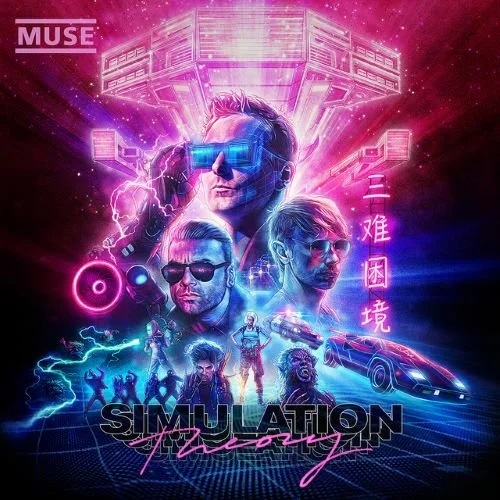
 

Muse – Simulation Theory

_________

MUSE released…

 PHOTO CREDIT: Jeff Forney

the amazing Will of the People last year. They are a tremendous and legendary band, but I think that their music can divide people. Maybe some feel they peaked around 2006’s Black Holes and Revelations, but the Devon band have been producing excellent albums since. One that is underrated and warrants more love is 2018’s Simulation Theory. Unlike some of their more Rock-based albums, their eighth took in influences from Science Fiction and 1980s pop culture, with a much greater use of synthesisers. I think that the album deserved much bigger acclaim from critics. That said, Simulation Theory got to number one in the U.K. and twelve in the U.S. I will get to a couple of the more positive reviews for this excellent Muse album. I really love Simulation Theory, so I wanted to shed positive light on it. Before coming to some reviews, the BBC spoke with the band’s lead, Matt Bellamy, in December 2018 ahead of live shows to promote Simulation Theory:

“This album riffs on the sounds of the 80s. What led you down that path?

When I started making the album, I purchased a virtual reality headset and gaming system. I've never really been much of a gamer - but it blew me away, the feeling of transportation into an alternate world. I found that really fascinating. That correlated with my interest in the TV series Black Mirror and my love of sci-fi - and so it triggered memories of my childhood in the 80s.

What sort of things?

When I was eight or nine, I watched a few films that perhaps I shouldn't have watched at that age - Aliens or The Thing or Blade Runner. And those films had a bigger impact on me than I realised. So the first song on the album, Algorithm, is my invented sound track to a sci-fi film from the 80s.

Then I also got interested in my memories of family films such as Star Wars and Back To The Future and Teen Wolf and I thought to myself, "On the videos for this album, why not create our own little virtual world, where we can go back and visit some of our favourite things from our early childhood?" So it's all linked together.

You can't have been expecting that when you bought a games console...

I think simulated reality is something that'll become more common in the coming decade. We'll soon be able to live in these online gaming surroundings.

The other thing that fascinated me while I was playing these computer games was that I could talk to random strangers in Russia, Korea or somewhere in America. There was a whole social aspect - and I think that really influenced the sound of the album and gave it the mixture of nostalgia and that futuristic feel.

I immediately thought of Back To The Future when I listened to the album. It was like you'd taken Doc Brown's DeLorean and gone back to the 80s. Especially on a song like Propaganda where it sounds like you're trying to connect to the soul of Prince.

Yeah, basically! And this isn't the first time. We did that on Supermassive Black Hole, too.

But the thing is, I think nostalgia not the same as it used to be. That's a strange thing to say. But when we were in the 90s and 2000s, looking back wasn't something I did very often. But I feel in this decade, nostalgia gives you this funny feeling - you can bring something back but also make it feel like it's for the future. So the feeling is like, "Oh, actually this thing isn't dead. I'm bringing it back to life".

The album seems a lot more optimistic than the dystopian nihilism of Drones and Second Law. Have you changed your mind?

For sure. It might be age, getting slightly older, but there have always been songs of hope buried in Muse albums. Some of our most popular songs, like Uprising, have a positive message for strength and resistance against oppression. Perhaps its been buried under the dystopian nightmares - but on this album, that positive side is definitely coming through”.

I will get to a couple of the more positive reviews for Simulation Theory. LoudWire where Impressed by the new sonic direction and the way the album captures the listeners’ imaginations. Compared to the colder and more political Drones (2015), Simulation Theory is definitely brighter and broader. It is an album that I would recommend everyone to listen to:

“This is not a test. We encourage you to find a pair of headphones and escape into Muse's world of high stakes heaviness known as their Simulation Theory album. The trio of Matt Bellamy, Chris Wolstenholme and Dominic Howard have continually pushed boundaries, becoming more and more theatric with each album and Simulation Theory continues that trend, taking listeners into a world that feels both nostalgic and futuristic at the same time.

For their latest effort, Muse employed a different release strategy, initially choosing to go the "singles" route, offering the first taste of new music -- the ominously heavy and slinking rocker "Dig Down" -- way back in May 2017. The better part of a year passed before "Thought Contagion" followed, with the dynamic rocker challenging listeners not to get caught up in the party line that often comes with news reporting. While both tracks were issued initially as stand alone singles, they eventually became the building blocks for a new album.

And build is exactly what Muse did, employing all sorts of musical gadgetry to capture the imagination of listeners while thematically attempting to hold on to humanity in an increasingly technologic world. It feels like a bit of a musical playground at times, with bluesy slide guitars, scratching, church organs, pianos, robotic vocals and more joining the kitchen sink in the mix, but the guitars, synths and drums still power most of what the band does and does well.

The album opening "Algorithm" is not what you might consider a traditional song structure, starting with an instrumental bit that employs tension-building synths and strings and a bit of classical piano that Bellamy once likened to "'80s synth computer game music." A minute and a half passes before the opening vocal, but the lyrics are worth waiting for, setting a very visual tone for what's to come -- a war with a creator as humans are viewed as more of a simulation. That seemingly falls in line with the videos for "Dig Down" and "Thought Contagion," which teased a virtual world that has played out as more videos have been released from the album.

Bellamy and the band have created an album that flows together musically and creatively, while delivering songs feel like they come with high stakes. "Break me out / break me out / Let me flee / Break me out / break me out / set me free," begs Bellamy with impassioned intent, while later showing some insane falsetto on "The Dark Side."  "Life is a broken simulation, I'm unable to feel / I'm searching for something that's real / I am always seeking to see what's behind the veil," later offers the singer in "Blockades," showcasing a bit of what lies at stake in the driving, "Knights of Cydonia"-esque rocker. Meanwhile, the album closer, "The Void," finds the band at one of their most defiant moments, with Bellamy proclaiming, "They'll say, no one can see us / That we're estranged and all alone / They believe nothing can reach us / And pull us out of the boundless gloom / They're wrong / They're wrong / They're wrong."

While the lyrics may paint a picture of isolationist angst, the music drives home the point. Howard shines on this highly percussive collection of music, bringing some heavy beats to the more intense tracks on the album, while keeping things swinging and catchy on songs like "Pressure" and "Break It to Me." Other highlights include the radio ready single "Something Human" and the triumphant "Get Up and Fight."

Though Muse have made their name in the alt-rock world, Simulation Theory ups the ante on heaviness and intensity, making it well worth checking out for those who prefer something a little heavier in their sound. Invest in some headphones and enjoy this journey”.

It is a shame that there were some mixed reviews for Muse’s brilliant Simulation Theory. Singles such as Pressure and The Dark Side are some of the band’s best, and it is an album that you come back to time and time again. Pressure is my favourite song from the album. It is such a funky and banging song that stays in the head! In their review, this is what NME had to say about one of the best albums of 2018:

“In a bid to escape boredom in the early ‘90s, three awkward teens from Teignmouth, Devon, wearing Ned’s Atomic Dustbin and Nirvana t-shirts, channelled their adolescent angst – and the drive to be as weird as possible – to form what would become the institution and stadium powerhouse that is Muse.

In those early interim days of artsy grunge experimenting, they went by the names Carnage Mayhem, Gothic Plague and Rocket Baby Dolls. Muse geeks will have experienced a titter of gleeful fandom when the band adopted ‘Rocket Baby Dolls’ as their moniker in the ‘80s pastiche-themed video for recent single ‘Pressure’. Given this self-referential nod, are we to assume that Muse are looking to rekindle their past?

With the artwork of ‘Simulation Theory’ designed by Stranger Things artist Kyle Lambert, and each of the videos so far showing them entering virtual reality recreations of different times and realms, Muse are very much decamping to the imaginations of their childhood bedrooms. Following the blacker-than-black war-mongering dystopia of 2015’s ‘Drones’, they have found an escape from the mire of the here and now.

Opener ‘Algorithm’ carries all the pomp and promise of the best Muse album openers (see ‘Newborn’, ‘Apocalypse Please’ and ‘Take A Bow’), questioning the reality of a world “caged in simulations”, “rendered obsolete” by “evolving algorithms”. It’s the stuff of Charlie Brooker’s Black Mirror nightmares, right down to the Tron-esque ‘80s computer game meets John Carpenter soundscape. The neon escapism flows through the Depeche Mode stomp of ‘The Dark Side’, the George Michael balladry of ‘Something Human’ and eight-bit battlecry of ‘Blockades’.

As is the case with anything Muse do, there are plenty of eyebrow-raising moments on ‘Simulation Theory’. With long-time collaborator Rich Costey on production duties – he’s been leant a hand from pop and hip-hop dons Mike Elizondo (Dr Dre, Eminem), Shellback (Taylor Swift, Britney Spears) and Timbaland (Missy Elliot, Justin Timberlake) – the band have altered the route of their bombast, stepping away from operatic prog. Instead, they indulge their guiltiest pleasures.

There’s the space-age rockabilly delirium of ‘Pressure’, while ‘Propaganda’ is Muse taking the piss to the Nth degree; it’s a vision that sees Matt Bellamy attempting to sound sexy atop EDM machine gun beats and Prince-esque liquid R&B. You’ll be too ashamed to tell anyone just how much you love it. Same goes for ‘Break It To Me’, which is the sound of KoRn covering the Pussycat Dolls. Who knew we needed that? Driven by a sugary hook akin to Ann Lee’s 1999 bubblegum hit ‘Two Times’, ‘Get Up And Fight’ floats with a lightness that Muse aren’t always credited for, before clobbering you with a shameless, monolithic Eurovision-style chorus.

“They’ll say the sun is dying, and the fragile can’t be saved,” Bellamy croons on the shimmering, cinematic closer ‘The Void’, an album highlight, before seeing the light at the end of the tunnel: “But baby, they’re wrong”. Muse have found hope in another world.

Overall, no, ‘Simulation Theory’ is not blessed with the madcap class of their 2001 masterpiece ‘Origin Of Symmetry’, or the pure rock abandon of ‘Drones’. Actually, though, it’s wrong to compare this record to the band’s back catalogue. Yes, this is still Muse, but here they’re trying to be something else – well, everything else. They are avatars in a ridiculous simulation of teenage nerdery, inviting you to steal away from the nightmare, and into an electric dream”.

A brilliant album that did not get the love from critics that it deserved, I think that Simulation Theory should be given another spin. A wonderful album with some of Muse’s best material on, if you have not heard it (or done so in a while), then make sure that you do. From the opening of Algorithm to the end of The Void, it is…

AN epic work.

FEATURE: Kate Bush’s The Kick Inside at Forty-Five: Where the Magic Begun…

FEATURE:


Kate Bush’s The Kick Inside at Forty-Five

IN THIS PHOTO: Kate Bush in 1978/PHOTO CREDIT: Alamy/ABACAPRESS.COM


Where the Magic Begun…

_________

I did a run of features…

about The Kick Inside last year. The album was recorded over the summer of 1977, so I marked forty-five years of its completion. The official release date for Kate Bush’s stunning debut album is 17th February, 1978. I wanted to acknowledge the approaching forty-fifth anniversary by having a look an album peaked at number three in the U.K. album charts and has been certified Platinum by the British Phonographic Industry. It is my favourite album ever – as I have said many times -, and whilst it is not Bush’s most experimental or ambitious album, I think it is her most beautiful. In terms of the themes she was addressing, it was a lot more daring and original than most other albums around in 1978. A teenager who came onto the scene with the spectacular and unusual Wuthering Heights, The Kick Inside explores love and passion, philosophy and menstruation, death and incest, and a lot more besides! Never a conventional or predictable album, Bush worked alongside experienced musicians like Duncan MacKay, David Paton and Ian Bairnson and producer Andrew Powell. For those who adore her 1985 album, Hounds of Love, need to go back to the start and see where Bush came from. This remarkable and hugely gifted songwriter, I don’t share the opinion The Kick Inside was great but it was not Bush’s true voice and talent coming to the fore. Her debut album is as arresting and spectacular as any in her catalogue!

If it is not as weird and wild as The Dreaming (1982) or as ambitious and accomplished as Hounds of Love, it has different qualities and an alternate purpose. It is beautiful and hugely feminine. It has a potency and nuance that means songs unfurl new layers with each level. It is the documentation of a young and eager artist who was realising a dream. I wonder whether Bush, on 17th February, will think about The Kick Inside, forty-five years after it was released into the world. Before moving on, there are a couple of interview snippets from the archives I want to include where Bush discusses The Kick Inside:

“There are thirteen tracks on this album. When we were getting it together, one of the most important things that was on all our mind was, that because there were so many, we wanted to try and get as much variation as we could. To a certain extent, the actual songs allowed this because of the tempo changes, but there were certain songs that had to have a funky rhythm and there were others that had to be very subtle. I was very greatly helped by my producer and arranger Andrew Powell, who really is quite incredible at tuning in to my songs. We made sure that there was one of the tracks, just me and the piano, to, again, give the variation. We've got a rock 'n' roll number in there, which again was important. And all the others there are just really the moods of the songs set with instruments, which for me is the most important thing, because you can so often get a beautiful song, but the arrangements can completely spoil it - they have to really work together. (Self Portrait, 1978)”.

As far as I know, it was mainly Andrew Powell who chose the musicians, he'd worked with them before and they were all sort of tied in with Alan Parsons. There was Stuart Elliot on drums, Ian Bairnson on guitar, David Paton on bass, and Duncan Mackay on electric keyboards. And, on that first album, I had no say, so I was very lucky really to be given such good musicians to start with. And they were lovely, 'cause they were all very concerned about what I thought of the treatment of each of the songs. And if I was unhappy with anything, they were more than willing to re-do their parts. So they were very concerned about what I thought, which was very nice. And they were really nice guys, eager to know what the songs were about and all that sort of thing. I don't honestly see how anyone can play with feeling unless you know what the song is about. You know, you might be feeling this really positive vibe, yet the song might be something weird and heavy and sad. So I think that's always been very important for me, to sit down and tell the musicians what the song is about. (Musician, 1985)”.

I think The Kick Inside is one of the most important and impactful debut albums ever. It was released at a time when Punk and Disco were popular. Not really fitting into any scene or sound, the fact that it was a chart success around the world and saw two huge U.K. singles released shows that it is a wonderful record! There was a lot of positivity around The Kick Inside when it was released, but many others were confused by the lyrics and this unconventional artist. Maybe expecting something basic and similar to Pop albums of the time, that is not what you get with The Kick Inside. It is such a deep and compelling album that is heightened and made classic by Kate Bush’s stunning voice and musicianship. She would bring more instruments, angles and experiments into her music when she started to produce (for 1980’s Never for Ever), but her 1978 debut is one I would recommend to everyone. The Skinny provided a fortieth anniversary retrospective in 2018, where they made some interesting observations:

“The song that gets the most attention on The Kick Inside is, of course, Wuthering Heights. Now a bona fide classic, endlessly gushed over as an exemplar of 70s art pop (against the grain of the then-ubiquitous disco and punk). It's also destined to be forever remembered for its equally famous visual of Bush dancing in a white dress with cheesy post-production effects (or the 'red dress' American version, with equally theatrical dancing on some real-life moors), still a few years before MTV would make the music video a mainstream creative medium.

Wuthering Heights was the first self-penned number one for a female artist in the UK, written when Bush was 18 (released a year later). Bizarrely, EMI had decided that James and the Cold Gun would be the first single from the album, but Bush was determined that Wuthering Heights should be the first release and – amazingly for a young woman in the music industry in the 70s – she got her way. This imperturbable drive towards her own creative vision is something that Bush would continually exhibit throughout her career.

Lyrically, the song deals with the ghost of Catherine (Cathy) Earnshaw – from Emily Brontë's novel Wuthering Heights – pleading to be released from her purgatory and let back in from her post-death wandering on the moors. Despite the novel's ambiguity when it comes to Cathy's affections (for either Heathcliff or Edgar), Bush asserts that Cathy longs for Heathcliff, 'I'm coming back to his side to put it right / I'm coming home to wuthering, wuthering, wuthering heights' – i.e. the wild, passionate side of her character that she supressed during her lifetime. As a mission statement for an artist unmoored from conformity, social mores or traditional expectations, it's more or less perfect.

The Kick Inside was unafraid to dip its toe into more experimental waters. While it held sure-fire hits like The Man with the Child in His Eyes and Wuthering Heights, it also dealt frankly with sexuality and eroticism (Feel It, L'Amour Looks Something Like You), throws in a little reggae on Kite and doubles down on the gothic occultism that peppers the album on Strange Phenonema (a song once described by The Guardian as a “frank paean to menstruation”).

Listing all those who've been influenced by Kate Bush is a near-impossible task and her impact on contemporary music is impossible to deny. The most obvious current touchstone is Lorde, another artist who came to prominence as a teenager writing pop music that veers away from the norm, similarly fearless in her imaginative musicality (not to mention a predilection for interpretative dance moves). But her influence can also be glimpsed in the avant-garde compositions of Jenny Hval, the eclectic experimentation of Charli XCX and the bombastic future-pop of St. Vincent.

40 years ago, The Kick Inside began a musical journey that continues (hopefully) to this day. Kate Bush did not arrive fully formed – she has used constant renewal and rebirth as the tenets of her artistic evolution – but her auspicious debut album did showcase an artist with enough conviction, confidence and creativity to more than warrant her position as a once-in-a-generation musician”.

In future features (I will another couple), I want to explore different sides, songs and aspects of The Kick Inside. I wanted to use this feature to highlight how brilliant, bold and original this magnificent 1978 debut is. I know that Bush’s music has connected with a new generation thanks to Stranger Things, and I do hope that people are listening to The Kick Inside and not limiting themselves to Hounds of Love. I wasn’t alive when The Kick Inside was released, but I did hear it at a young age and I was transfixed by how gorgeous and different the album was. It introduced me to the fact music was able to transform you and take you to different places. It had this instantly transfixing quality. I was moved and seduced by The Kick Inside when I first heard it – and I am every time I play it. Once Bush’s debut was released, she began this whirlwind of promotion that took he through most of 1978. It was an exciting (if exhausting) time for this artist who almost instantly became this star. Someone who was unlike anyone around her. The power and transcendence of her debut is still being felt to this day! It was the start of a career that has now lasted more than forty-five years. From the beautiful and spellbinding whale song that opens the album (and Moving) to the lingering and haunting final words of The Kick Inside’s title track, Kate Bush’s debut is full of magic and mystique. Released on 17th February, 1978, this amazing album is…

WHERE it all began.

FEATURE: Fields of Gold: Remembering the Great Eva Cassidy at Sixty: Her Essential Tracks

FEATURE:


Fields of Gold

PHOTO CREDIT: Norman Watkins/Blix Street Records 


Remembering the Great Eva Cassidy at Sixty: Her Essential Tracks

_________

IT is safe to say…

 IN THIS PHOTO: Eva Cassidy’s January 1996 Blues Alley show was recorded less than a year before her death/PHOTO CREDIT: Matthew Dols/The Washington Post

that the music world has not seen an artist like Eva Cassidy since her sad death in 1996. We lost her at the age of thirty-three of melanoma. Born on 2nd February, 1963, Cassidy was renowned and celebrated because of her wonderful Jazz, Folk, and Blues music, her immaculate soprano voice gave new life to a range of incredible songs. Known more for her interpretations as opposed original recordings, her versions of Fields of Gold, Over the Rainbow and Autumn Leaves are breathtaking and timeless! Her debut album, The Other Side, came out in 1992. It is a shame Cassidy was not known outside of her native Washington, D.C. until after her death. British audiences became aware of her remarkable talent as Fields of Gold and Over the Rainbow were played by D.J.s such as Terry Wogan. There have been numerous Eva Cassidy compilations since her death in 1996. I think the most known and popular is 1998’s Songbird. That got to the top of the album chart in the U.K. I wanted to end with a playlist of Eva Cassidy songs because, on 2nd February, it would have been her sixtieth birthday. There have been various plans and aborted attempts to bring Cassidy’s life and story to the big screen. I think that it is a time that a film should be made that shows what a remarkable artist she was. Before getting to a playlist, I want to bring in some biography from AllMusic:

“The heart-tugging story of Eva Cassidy reads almost like the plot of a "Movie of the Week" tearjerker. A native of the Washington, D.C., area, the painfully shy Cassidy earned a local reputation as a masterful interpreter of standards from virtually any genre, blessed with technical agility and a searching passion that cut straight to the emotional core of her material. Despite the evocative instrument that was Cassidy's voice, record companies shied away from her, unsure of how to market her eclectic repertoire; for her part, Cassidy adamantly refused to allow herself to be pigeonholed, prizing the music above any potential fame. In 1996, just when she had begun to record more frequently on a small, local basis, Cassidy was diagnosed with cancer, which had already spread throughout her body and rapidly claimed her life. But her story didn't end there; her music was posthumously championed by a BBC disc jockey, and amazingly, the anthology Songbird became a number one million-selling smash in England.

Cassidy was born February 2, 1963, in Oxon Hill, Maryland, and grew up (from age nine on) in Bowie, Maryland. She loved music from an early age, particularly folk and jazz (as a girl, her favorite singer was Buffy Sainte-Marie), and learned guitar from her father Hugh. At one point, Hugh put together a family folk act featuring himself on bass, Eva on guitar and vocals, and her brother Danny on fiddle; Eva and Danny also played country music at a local amusement park, but Eva's sensitivity eventually made performances too difficult on her. Something of a loner during her teens, Cassidy sang with a pop/rock band called Stonehenge while in high school. After graduating, she studied art for a short time, but soon grew dissatisfied with what she was being taught, and dropped out to work at a plant nursery. She sang occasional backing vocals for friends' rock bands around Bowie and Annapolis, but was never comfortable trying to overpower the amplification. In 1986, longtime friend Dave Lourim persuaded Cassidy to lay down some vocals at a recording session for his soft pop/rock group Method Actor. (The results were eventually reissued in 2002.) At the studio, Cassidy met D.C.-area producer Chris Biondo, who was immediately struck by her voice and agreed to help her put together a demo tape she hoped would get her more backup-singing work.
Cassidy became a regular presence at Biondo's studio, where he recorded a wide variety of music; incongruously enough, Cassidy performed backing vocals on D.C. go-go funksters E.U.'s Livin' Large album (singing all of her own harmony parts to give the illusion of a choir) and, later, on gangsta rapper E-40's "I Wanna Thank You." At Biondo's urging, Cassidy formed a backing band to play local clubs, where her singing began to win a following in spite of her discomfort. In 1991, Biondo played Cassidy's demos for Chuck Brown, the originator of D.C.'s swinging go-go funk sound (which never really broke out to a national audience). Brown had been wanting to record an album of jazz and blues standards, and found his ideal duet partner in the sophisticated yet soulful Cassidy. Their collaborative album, The Other Side, was released in late 1992, and in 1993, the two began performing around the D.C. area together; helped by Brown's outgoing showmanship, Cassidy finally began to lose some of the insecurity and intense fear that usually kept her away from live performance. Several record labels showed interest in signing her, but her recorded submissions always covered too much ground -- folk, jazz, blues, gospel, R&B, pop/rock -- for the marketing department's taste (or limited imaginations), and the labels always wound up passing.

In September 1993, Cassidy had a malignant mole removed from below her neck and neglected her subsequent checkup appointments. Shortly thereafter, she broke up with Biondo, who'd been her boyfriend for several years, but they continued their professional relationship. In early 1994, the Blue Note label showed some interest in teaming Cassidy with a jazz-pop outfit from Philadelphia called Pieces of a Dream; they recorded the single "Goodbye Manhattan" together, and Cassidy toured with them that summer, but didn't really care for their style. She returned to D.C. and began playing more gigs on her own, though she still made the occasional appearance with Brown. At the end of the year, she won a local music award for traditional jazz vocals.

Cassidy remained unable to secure a record deal, and Biondo and her frustrated manager decided to put out an album themselves. In January 1996, Cassidy played two gigs at the D.C. club Blues Alley; despite her dissatisfaction with the quality of her performance, the album Live at Blues Alley was compiled from the recordings and released that year to much acclaim in the D.C. area. Sadly, it would be the only solo album to appear during Cassidy's lifetime. She moved to Annapolis and took a job painting murals at elementary schools; during the summer, she began experiencing problems with her hip, which she assumed was related to her frequent use of stepladders at work. However, X-rays revealed that her hip was broken, and further tests showed that the melanoma from several years before had spread to her lungs and bones. Cassidy started chemotherapy, but it was simply too late. A benefit show in her honor was staged in September, and Cassidy found the strength to give her last performance there, singing "What a Wonderful World." She died on November 2, 1996. Cassidy virtually swept that year's Washington Area Music Awards, and the album she'd been working on with Biondo prior to her death, Eva by Heart, was released by Liaison in 1997.
D.C.-based Celtic folk singer Grace Griffith finally found some interest in releasing Cassidy's music at the label she recorded for, Blix Street. 1998's Songbird was a compilation culled from Cassidy's three previous releases, and when BBC Radio 2 disc jockey Terry Wogan started playing the version of "Somewhere Over the Rainbow," Songbird started to sell in the U.K. The British TV show Top of the Pops aired a home-video clip of Cassidy performing the song, quite intensely, at the Blues Alley, and were deluged with requests for further broadcasts. Thanks to all the exposure, Songbird steadily grew into a major hit, climbing all the way to the top of the British album charts and selling over a million copies. In 2000, Blix Street followed Songbird with Time After Time, a set of 12 previously unreleased tracks (eight studio, four live) that proved an important addition to Cassidy's slim recorded legacy. The same year saw the appearance of No Boundaries, an unrepresentative set of adult contemporary pop released by the Renata label over strenuous objections from Cassidy's family. Subsequent collections like Wonderful World (2004) and Simply Eva (2011) included more studio demos and live recordings, further cementing Cassidy's posthumous reputation, along with 2012's The Best of Eva Cassidy and 2015’s expanded and remastered edition of Nightbird, a collection of all 31 songs that Cassidy performed at the Blues Alley in 1996”.

Looking ahead to what would have been the sixtieth birthday of Eva Cassidy, below are a selection of songs that show just what an artist she was. Much-missed and one of a kind, I hope that her music gets a bigger audience and people pick it up. With such a beautiful and soulful voice, the memory and brilliance of Eva Cassidy will resonate…

THROUGH all time.

FEATURE: Spotlight: TiaCorine

FEATURE:


Spotlight


TiaCorine

_________

A hugely exciting artist…

 PHOTO CREDIT: Brianna Alysse

who has been making music since she was in the third grade, North Carolina’s TiaCorine is someone that should be on everyone’s list of who to watch this year. A huge fan of Quentin Tarantino’s filmmaking, and someone who combines Anime and Trap in a dazzling and cinematic way, this is an artist that is going to keep on rising and rule. I will come to some 2022 interviews with TiaCorine. First, heading to 2020, she was promoting her debut eight-track E.P., 34Corine. Coming from North Carolina, one can only imagine how hard it is to get noticed and progress. I recall hearing her name mentioned when her When her 2018 single Lotto caught up and founds fans in A$AP Rocky, SZA, and Rico Nasty. She delayed the E.P. from then, perhaps feeling she was not ready or it was not the right time. Around the time of 34Corine’s release, Interview Magazine spoke with the rapper. It is great to know that her hometown inspired her music and drove her:

“On 34Corine: “[The title] comes from my hometown, Winston-Salem. We call Winston-Salem the tre-fo, so the 3 and 4. A lot of people in our city look at me as the city hero, because no one has made it out of Winston and gotten this far. It’s like I’m carrying my city on my back right now. And everybody here believes in me. And they’re like, ‘You’re going to get people to pay attention to Winston-Salem.’ I’m like the city’s savior.”

On getting praise: “When you see the cover [of 34Corine], you see people handing me my flowers. There’s a saying where people are like, ‘Oh, let me give my flowers to SZA, because she’s just an amazing artist,’ and things like that. So I feel like for a while, a lot of people have avoided giving me my credit. So I feel like when I drop this project, it’s like, ‘You don’t have a choice but to give me my flowers. You have to show me more respect.’ This is the time where everybody is just going to be like, ‘Wow. She is just great! We don’t have no choice but to respect this.'”

On North Carolina: I do feel like my hometown has inspired the music I make. I really think it’s a mixture of my hometown and my parents. My mom was playing ’80s and ’90s music, and then my dad was playing more hip-hop, like The Sugarhill Gang and things like that. My favorite part about my hometown is the fact that I can be anywhere in the city within 15 to 20 minutes. With no traffic. I’m always late and somehow I still get there on time.”

On social media: “It’s a love-hate relationship. I do love it because you get to meet so many people, and you can get connected so fast. You just see so many different and creative things, and it just is inspiring. But at the same time, you have to watch what you say. It’s just so toxic sometimes. It leads people to think you have to live your life a certain way, and it’s just a lot of smoke and mirrors. I don’t really care for it. If I didn’t have to use it, I wouldn’t”.

The stunning I Can’t Wait was released year. A remarkable album (or mixtape) from one of the most talented and phenomenal artists in the world. I feel this year will be another tremendous one from the North Carolina native. TiaCorine has transformed Rap and Drill and taken it to a whole new audience. Pioneering and in a league of her own, Swindlife spoke with an artist who, with regards to her new album, wanted to make it undeniable - and leave people in no doubt that she was hard and a force to be reckoned with:

“TiaCorine, the immersive North Carolina-born artist’s road to stardom, has allowed her to reach a goal most independent artists dream of. After crashing on the scene with her 2018 hit “Lotto” (16m+), Tia has proven her ability to push the boundaries of contemporary rap with her versatile flow, commanding cadence, and vibrant personality. Her unique artistry and storytelling have allowed her to carve her musical path in an era where it’s hard to stand out. With accolades that continue to put her in the limelight, through it all, Tia stays grounded and lets her music do the talking because every time she drops, she makes it her priority to make a statement—and she did just that with her new album “I Can’t Wait.”

At 15-tracks, Tia displays her undeniable talent and how versatile she can be as an artist throughout “I Can’t Wait.” There are songs like “FreakyT” produced by legendary Honorable C.N.O.T.E., where Tia shows she has the swagger to ride any beat. But at the same time, a track like “Kite” with vibrant hyper-pop production proves Tia is expanding her sound and refuses to be stagnant as an artist. Everything about this release backs up my theory. Tia doesn’t have anything else to prove to doubters, yet she’s still determined to make an example of them and succeeds on this project.

I have to talk about the concept. How did this album come together?

I just put it together because I record many different sounds and songs. I wanted to do something where there’s at least one song for you if you don’t like the whole project. I tried to put different genres on there because I’m a genre-bending artist. I didn’t want it to be just one thing. A lot of times, I see artists make one sound, and later in their careers, they want to do something else. Then people are like, “I want the old you.” So I wanted to make sure I gave them every flavor so they know always to expect something different when it comes to me.

What is the meaning behind the Kingdom Hearts-themed artwork?

It was a collaboration of Kingdom Hearts, mixed with Wizard of Oz and Final Fantasy. It all goes with the theme of “I Can’t Wait.” If you’ve ever played the Kingdom Hearts series, you know how they tell a story and ask you to choose what you want to do in your life—I have the first Kingdom Hearts on PS2, so it asks what direction you would like to go in your life. That was the reason why I had the pink trail. I feel like throughout my music career, I’ve been through a lot of stuff. I wouldn’t say I’ve been fighting demons [laughs], but I have been through many negative things and dark times. I feel like now I’ve reached that point where I have seen the light, and I could see the “land of Tia,” the “land of Oz,” the “land of everything I always wanted,” and what I actually am. And not just this grey area between being underground and being mainstream. So this was my way of saying, “I can’t wait to get there.”

That’s fire that you kept the NC connection. What was the hardest part of the journey working on the project?

Probably picking the songs to go on there. I have so many, and choosing them and putting them in the right order was tough. Usually, when I do a project, I want to add transitions and sounds. But this time, because I had so many different songs, I just wanted to make sure that it vibes. Like it goes up, then it goes down, like a rollercoaster. I wanted to keep people in. So making the tracklist and picking the songs were hard for me”.

I am going to wrap things up soon. I wanted to finish up with an interview from Alt Press. As so many were keen to find out more when it comes to I Can’t Wait and TiaCorine, I wanted to highlight this great interview. It shows where TiaCorine has come from and how, as a teenager, you could tell that the seeds had been planted. A determined and hugely talented artist who has now evolved into a powerhouse who is going to influence a generation of women:

“Tia found her sauce when she first entered the booth at 16 years old. Surrounded by aspiring rappers as friends, Tia was a singer known for her childhood Aaliyah karaoke sessions at neighbors’ houses and love for everything from Usher to Queen. When it came time for her to do her thing in a makeshift studio at her friends’ mom’s house, her peers were already impressed with her abilities.

Hip-hop came to Tia easily thanks to her affinity for Minaj, Weezy and Juelz Santana, and while most people in her circle applauded her and her Auto-Tune-laced early cuts, not everyone was on board with the TiaCorine movement at first.

Back when she was working at a clothing store at her local mall in Winston-Salem, North Carolina, Tia stumbled into work 10 minutes late one morning after a late-night recording session. Her boss at the time wasn’t too thrilled.

“He always got on my ass. He's like, ‘You won’t get paid for that shit. You ain’t shit. You ain’t nobody.’ Like going in on me,” Tia remembers. “Now he be in my messages. He be like, ‘What’s up?’ It’s like, ‘Bruh, you really said I wasn’t gonna be shit. Fuck you.’”

Tia didn’t enter the position to curse out her former employers until around 2020, when her 2018 track “Lotto” (which Drake may or may not have infamously bit off of) began to pick up some momentum nationwide. At the time, she was wrapping up a degree in exercise physiology, which made focusing on music a little tricky. And even on the same day of her college graduation, Tia traveled eight hours to Ohio to perform at yet another college. “I was nervous. I only had three songs out,” she remembers. “And it was going crazy. I couldn’t believe it.”

Since “Lotto” amassed its current 6.9 million streams on Spotify and since the release of her 34Corine project in 2020, Tia’s made it her mission to show fans just how different her stuff can get. Case in point: her 2022 single “FYK,” which not-so-secretly stands for “fuck your kids.” Of course, Tia loves her own child, but the song was made during a time when she was outright pissed at someone else entirely, and that’s when she freestyled the lines “I don't give a fuck about shit/ I'm not your bitch/I just get money, ho, fuck yo' kids.” It was jarring at first, but explosive.

“I had a Mike’s Hard Lemonade and a fucking vape, and I go in there," she says. "That was real. I just thought, ‘I can’t believe I said that.’”

The video for “FYK,” a track that she effectively screams on, portrays her showing off a dangly choker, bob hairstyle complete with a knife on top and two active middle fingers. She knows it’s punk as hell, too. “I just do what I want, how I feel,” Tia says. “And you can like it or you can not. I don't care. It's just letting loose, like that feeling of walking around naked. You know when you walk around naked at your house and be like, ‘Hell yeah, it’s my house.’ Like that”.

I am going to end here. Go and check out the brilliant and stunning TiaCorine. I think we will get a lot of magnificent music from her this year. Following the sensational and hugely memorable I Can’t Wait, all eyes are aimed the way of the North Carolina Rap/Trap artist. The future is hers for the taking. Make sure that you follow this…

WONDERFUL artist.  

____________

Follow TiaCorine

FEATURE: Revisiting… Darren Hayes - Homosexual

FEATURE:


Revisiting…


Darren Hayes - Homosexual

__________

I wanted to revisit…

Darren Hayes’ fifth studio, Homosexual, for a few reasons. I missed it the first time around and did not give it a proper spin. My first experience of Hayes as a performer is through Savage Garden. The Australian duo has massive success in the 1990s, and he and Daniel Jones parted ways in 2001. I was not a massive fan of the duo, but I was always impressed by Hayes’ vocals and songwriting. I think his solo work is much more personal and rewarding. Perhaps his most important album to date, Homosexual was met with critical acclaim. Although not a lot of mainstream sites and papers in the U.K. reviewed it, it did make number six in the UK Independent Albums chart. With all songs on the album written composed and produced by Hayes, this is a real bid for independence. It is liberating and the sound of an artist claiming freedom. Released through Hayes’ label, Powdered Sugar, I think this is an album not just for Darren Hayes fans. Even though it is deeply personal and important to Hayes, it is broad and accessible enough so that it will appeal to a wide spectrum of music fans. I have dipped in and out of Hayes’ solo discography, but Homosexual struck me, not only because of the quality of the music, but because you can feel and hear how much it means to Hayes. He has thrown his heart and every ounce of his soul into making the album what it is.

I am going to come to a couple of positive reviews for an album that can be included among the best of last year. Released back in October, I want to start out by quoting sections of an interview with Rolling Stone Australia. Trigger warning to those who read the whole thing, as it might be upsetting for survivors of trauma – so do proceed with caution if this applies to you. I wanted to know more about Hayes’ career prior to Homosexual and how the album came about. Aside from the reader sympathising with the struggles Hayes has gone through and what he has wrestled with, the sense of relief and pride Hayes expresses having composed and played everything on his finest solo album to date is hugely satisfying:

“Savage Garden went on to become one of the most successful pop groups Australia has ever produced, selling over 12 million copies of their self-titled debut album – an album that just last year ranked at no. 9 on Rolling Stone AU/NZ’s ‘200 Greatest Albums of All Time’.

Darren Hayes was in his early 20s, married to his childhood sweetheart, and living in a cramped one-bedroom apartment in Sydney’s Kings Cross writing that seminal Savage Garden album when his life changed irrevocably.

“Innocent, naïve Darren Hayes picked up a street mag that was like a gay magazine, and I remember just looking at the images and being simultaneously turned on and horrified that I was turned on by the images,” he recalls. “One day I remember venturing into a porn theatre, and I saw gay porn for the first time in my life. And somewhere in the shadows, people were having sex.”

Mortified, Hayes ran from the theatre to a nearby phone booth, where he called Lifeline to ask a phone counsellor for advice.

“Thankfully it was a gay person, and the person just said, really frankly and in the most Australian way: ‘Look, love – you need to go home and tell ya wife you’re gay’,” Hayes says.

By the time Savage Garden released that now-iconic music video for “I Want You”, he had told his wife, Colby Taylor, that he thought he might be gay.

“My coming to terms with my sexuality were completely shrouded in – honestly – suicidal thoughts,” Hayes admits. “If you listen back to the album Affirmation, there’s a song on there called “I Don’t Know You Anymore” – that’s because I came out to my wife, and I came out to both of our families, and I’d never even held a man’s hand.”

Flash forward to now, and at 50, Hayes is truly comfortable in his own skin, confident with his sexuality, and has begun his first album release cycle in a decade. The music video for Homosexual’s first single, “Let’s Try Being in Love”, is the visual representation of the anguish 24-year-old Hayes had felt coming to terms with his sexuality.

“I felt so aware that in one way there was this doorway to a possible future for me that was a way to be happy and to love myself and to be my true self,” Hayes explains. “But at the same time, I was going to have to destroy something I loved.”

Although Hayes didn’t truly come out to the rest of the world until he announced his marriage to husband Richard Cullen in 2005, he had spent years dropping clues into his music.

Hayes has composed, produced, performed and arranged everything on this album. He has released it on his own label, Powdered Sugar Productions, and although he is the first to admit he isn’t a Grammy-award winning producer – he doesn’t care.

“It means so much to me that every single sound that you hear on this record: I did that,” he explains. “Every lyric. Every synthesiser. Every guitar lick. Every EQ. Every decision was made by me with love, and I pored over it. And everything is symbolic; everything has a meaning and it all is like a hard wire from my brain straight to the person that’s going to listen to it.”

Hayes says there isn’t anything on Homosexual that is untrue, which, as a music fan himself, is something he expects from all artists.

“It’s so obvious when someone’s phoning it in,” he says. “And there’s been a couple of moments in my career – and I only mean a couple of songs – where I’ve phoned it in, and I cringe. I was phoning it in because I was depressed. I felt like I had a barrier up. because you don’t want someone to touch that place in you that’s so vulnerable.”

Hayes’ intention with this record was to make music that he loved first and foremost that hopefully people could connect to.

“It’s been fun seeing some really hardcore fans freak the fuck out, to be like, ‘Is there going to be a ballad?!’” Hayes laughs. “Because I love everyone and I love my fans, but I also subscribe to the idea that you can’t give people what they want – you have to give them what they need. And what they need is an artist that’s happy and is telling the truth”.

I am going to wrap things up with a couple of reviews. As much as it is liberating and personal, Metro Weekly noted how Homosexual is a celebration. It is an album that should be thought of as uplifting and powerful as much as it is revealing and soul-bearing. You do not have to identify with Darren Hayes and his struggle to be able to appreciate and bond with Homosexual:

“Hayes opens the album on a bright note with the thumping synths of lead single “Let’s Try Being In Love,” a song. His soaring falsetto reflects his stated purpose in the song: to “love the feminine” within himself. He gets more literal with the second single, “Do You Remember,” a straightforwardly lustful nostalgia trap of a song that frames desire for another body around some cheekily on-the-nose Gen-X reminiscing. “No cell phones/if you want to meet someone you had to leave your home,” Hayes sings.

With an upbeat pop sound and fun disco elements, the album’s production underscores the cathartic sense of nostalgia that Hayes indulges. With lyrics like, “It’s not a blessing and not a curse,” the peppy “Homosexual: Act One” and its coda “Homosexual: Act Two” sound almost like relics of the recent past when bouncy viral songs emphasizing the basic humanity of gay people proliferated. The lyrics are full of self-indulgent corniness, but somehow, in Hayes’ hands, it works. The grinning flippancy with which he tosses out lines like, “It’s not correctable/It’s homosexual!” is absolutely infectious.

Hayes avoids the prudish reluctance around sex and the sanitized view of the gay experience that marked so much of the straight-facing material he nods toward in the two title tracks. Notwithstanding his 17-year marriage to the man who was the muse for “Let’s Try Being In Love,” Hayes is no stranger to gay sadness, and nowhere is this more apparent than on “Hey Matt.”

Hayes drops his voice and indulges in over nine minutes of tortured angst, replete with self-aware reflections on the damage that can be done by repressing desire. The sentiment is driven home in the standout line, “My daddy issues still ache.”

The runtime of “Hey Matt” sets it apart as a bit of an outlier, but not by much. “All You Pretty Things” and “Birth” clear the 8- and 7-minute mark, and are incidentally two of the strongest tracks in an album that has few lackluster moments.

He is a seasoned pop artist, after all, and is at the top of his game on Homosexual, stretching the register of his voice between his bright, well-known falsetto and the low, maudlin register he adopts on “Hey Matt” and again on the latter half of the album.

Captivating as it is, the upbeat tone Hayes strikes on the album does not prevent him from exploring some dark places, taking a scalpel to the origins and nature of trauma on “Nocturnal Animal” and indulging in some visceral imagery over some tense industrial pop riffs of the album’s closer, “Birth.”

His dedication of disco-inflected “All You Pretty Things” to the victims of the Pulse massacre is a sobering reminder that the issues of the past are still the issues of the present — the fight for rights is far from over, and winning them is not a foregone conclusion.

The practice of quietly closeting artists will probably remain too prevalent in the music industry and in entertainment writ large for a while. But the proud, endearing gayness of Homosexual feels like a refreshing middle finger to a self-congratulatory entertainment industry complex that still has a lot more catching up to do than it lets on.

Hayes is well aware he is far from the first artist to reclaim a word used as a slut against him, but in his capable hands, the album succeeds beautifully as a full-throated celebration of what it means to him to be a raging homosexual”.

I will end with another review. Renowned for Sound also had their say about an album from last year that should have got more attention from the press in the U.K. I think, on a musical level, it is a wonderful album that has true standalone moments. Singles like Let’s Try Being in Love and non-singles Hey Matt and All We Are Alchemists keep you coming back again and again:

“Darren Hayes first album in over a decade, Homosexual, sets to re-write the gay-shaming trajectory of his life by reclaiming his homosexual identity with pride. Hayes laces the fourteen-track record with upbeat pop melodies and synthesisers right out of the eighties, to tell a heartbreakingly honest account of his past struggles with his sexuality, self-identity and homophobia.

It is known that during Hayes’ well-celebrated Savage Garden years and beginning of his solo career he was forced to hide his true sexuality by music execs, even being made to re-shoot his debut solo single Insatiable, back in 2002 for fear of being too ‘gay’. Fast forward to 2022, and Hayes is taking back control of his music on Homosexual, with him impressively producing, composing, arranging and playing every instrument on the record.

Hayes draws inspiration from 80s icons such as George Michael, Madonna and Prince to create a nostalgic album featuring fun pop and disco elements. This can be especially seen on the Prince-inspired track Music Video, which features a classic Prince-style guitar solo and varispeed vocals. Hayes even references popular eighties song titles throughout the track such as Billie Jean and Love is a Battlefield, really helping to successfully evoke the eighties.

To begin with, Hayes opens the album in a light-hearted place with Let’s Try Being In Love, full of 80s synths and falsettos, before moving into darker territory throughout the record. On Hey Matt, Hayes lives out his dark suicidal fantasy, matched by his much deeper vocals, and touches upon his childhood trauma on Nocturnal Animal over pop riffs. What keeps the listeners engaged is Hayes’ unique style of contrasting his sad tales of despair with cool eighties-sounding grooves that could be played in clubs.

A highlight of the album is Hayes’ special tribute on All You Pretty Things for the victims of the Pulse Nightclub shooting. Throughout the track Hayes can be heard repeating ‘Dance to remember them’ as a way to celebrate and honour the lives of the lost. Hayes then cleverly turns the second half of the track into an 80s dance beat which could be mistaken for a Patrick Cowley and Sylvester collab. The song helps to create a safe space for individuals to dance and celebrate club culture, a fitting way to honour those that have passed in such a positive way.

Hayes has really gone above and beyond for his first album in over a decade, from creating the record all by himself to covering his past trauma with his most authentic, genuine lyrics. Hayes avoids any downbeat, sad melodies and puts his efforts into creating a modern dance album which celebrates the eighties and his sexuality. However, it is a sad realisation learning about what Hayes has gone through his life because of his sexuality, especially when Homosexual comes at a time when LGBTQ+ artists are now celebrated for their queerness, such as Lil Nas X and and Sam Smith. Hopefully Homosexual has allowed Hayes to find peace with his past, which he truly deserves”.

An album that I think people should check out, Darren Hayes’ Homosexual is the sound of an artist truly happen in his own skin – and someone who has reached a place he has tried to get to for many years now. It was a risk writing and producing all the songs, as the weight of responsibility falls solely on his shoulders of the album is a failure. As it is, Homosexual is a triumph! As we are now in 2023 – and following the success of Homosexual -, it will be interesting to see…

WHERE Hayes heads next.

FEATURE: Spotlight: Tommy Lefroy

FEATURE:


Spotlight

  PHOTO CREDIT: Chelsea Balan


Tommy Lefroy

_________

BUILDING from the incredible…

 PHOTO CREDIT: Chelsea Balan

Flight Risk EP of 2021, Tommy Lefroy had a storming 2022. There is so much promise and hope for thus year. A duo who have been tipped for success and riches this year, everyone needs to go and check them out. I am actually going to go back to an interview from last year, before hopping back to 2021, then coming back to last year - before finishing on an interview from this year. I wanted to start with Tongue Tied, as they sort of introduced the transatlantic duo; speaking with them around the time of the single release for Dog Eat Dog. It couldn’t have been easy for the duo to build and record music during the pandemic (2020-2020), and sort of rebuild and adapt coming out of it:

“Composed of singer-songwriters Tessa Mouzourakis and Wynter Bethel, Tommy Lefroy found its footing as a quarantine project turned success story. The duo initially met in Nashville in 2017 working as songwriters for others, and when COVID hit, they found themselves split between London and LA with nothing to do. Instead of sitting complacent within the world’s isolation, Tessa and Wynter found themselves writing and producing music over zoom, eventually finding themselves releasing their debut EP Flight Risk in November of 2021 and putting Tommy Lefroy on the map as an emerging artist to watch out for. Now that they’ve reveled in their own exploration of love, loss, and exploring their new artistry, Tommy Lefroy is back with their newest single “Dog Eat Dog”, out today. I got the chance to catch up with Tessa and Wynter pre-release to chat about “Dog Eat Dog” and the new era of Tommy Lefroy.

 Creating music in the same city is a new experience for the COVID-created Tommy Lefroy, who previous to “Dog Eat Dog” had created almost all of their music virtually over zoom. Having the ability to be in the same place has granted Mouzourakis and Bethel a variety of benefits in their creation process, between the ability to bounce ideas more readily off each other, collaborate in real time, or even just be in the same time zone, but their unique DIY beginnings still affect their process even now.

“Writing is such a big part of how we process our experiences, so with Tommy, it's been just a pretty safe space to bring that first instinct stream of consciousness of what we're going through, how things feel, or what we want to say. On this next project, we've challenged ourselves even more to let go with our writing. We would literally just sit at my kitchen table in LA and just write a stream of consciousness for like 30 minutes and then go back and pick out what we like from it. I think we needed that type of release because of everything that's happened. We have an audience which we're so grateful for, and we wanted to make sure that we didn't overthink these songs  because we are overthinkers. It’s really important to us that the writing for the project just stays this sort of protected thing, this safe space that we can return to that isn't affected as much by expectations, whether it be our own, or the team, or the fans. It really is important that there's just a purity to it, so that's what we've tried to keep and protect.” - Wynter Bethel of Tommy Lefroy, for Tongue Tied Magazine”.

“I think so much of the process of making Flight Risk was very apprehensive. We had to work through a lot of insecurity and imposter syndrome to just prove to ourselves that we could do it at all. With the year that we've had and the trajectory that the music has taken, everything has completely blown our minds. Now we're no longer fighting as many of those roadblocks of if we even have a right to tell a story, because there is an audience and people are excited to see what we have to say. We’re able to tell our stories without that entry barrier, but now our lives are totally different. When we wrote a lot of the songs of Flight Risk, we weren't living in the same city, but now we've had a lot more shared experiences. So much is informing this next season, and I I think it feels a little bit more grown up. It's more reflective and more, we say, taking accountability because yeah, there's a difference between an early experience of heartbreak versus looking back on a situation two years later and processing it. Looking back, what did you gain from that heartbreak that you're taking forward with you into the next step and the next relationships? We're kind of growing up and figuring out as we go, and all of the music is reflective of that.” - Wynter Bethel of Tommy Lefroy, for Tongue Tied Magazine

“The biggest feeling I have looking at this upcoming body of work is it feels a little bit more empowered. I think we're just really coming into ourselves in being Tommy through this process. And I think these songs are reflecting that sort of ownership we're taking. I like to say it's kind of like taking back the narrative in a sense. It's like. Someone actually on the Discord server we have was asking me a question about the meaning behind the lyric “hopeless wordsmith” from “The Cause”. Looking at this new song, I'd like to think this era is a little less hopeless, a little more wordsmith.” - Tessa Mouzourakis of Tommy Lefroy, for Tongue Tied Magazine”.

I have focused a lot on solo artists for the Spotlight series, so I wanted to correct that by speaking about a duo. You get that closeness and connection, in addition to focus. Bands can be quite unwieldy or seem a little disconnected at time. Solo artists have to burden everything themselves and are naturally limited when it comes to vocals and songwriting. A duo offers that perfect blend that you can hear with Tommy Lefroy. They are definitely going to endure and be around for a very long time. I do want to hop back to 2021, as Guitar Girl Mag wanted to know about the single, Vampires, but we got to discover some background and influences of the amazing duo (whose name derives from Jane Austen, whose former lover was the infamous, original ‘fu*kboy’, Thomas Lefroy):

“What inspired your new song, “Vampires?”

W – My roommate and I walked to the grocery on Halloween morning of 2019, in LA. He was actually nursing a cold and bought garlic. I think I bought a Reese’s. I was having a hard season and was so grateful for him that morning. He was navigating a challenging relationship at the time and was really down about himself. I recorded a voice memo in my phone later that day, literally in the walk-in fridge of my day job, “You can fall in love a thousand times, I just want for you to love your life”

I brought the idea to Tessa a couple of weeks after when she was visiting in LA, and we were writing at our friend Justin Lucas’s quaint garage studio in Venice Beach. We knew we needed to write a song for our friends, as they have shaped us so much as people. We had so often seen them through situations where they doubted themselves, but we never once did. The second verse came from conversations with a couple of our best friends, about big life transitions and recoveries from losses.

What’s your songwriting process? Melody first, or lyrics?

Most often, both come at the same time. When we write for Tommy, we usually start with a verse one of us has or a title that feels relevant to what we’ve been experiencing lately. We write a lot of poems, and we love to reference other writers, history, and myths in our lyrics. We usually start with a concept and then really dig into it.

What do you hope your fans/listeners take away with them when they listen to your music?

T – I want them to feel heard. It’s so special when people reach out and say they resonate with something we wrote.

W – Definitely. Want to offer a bit of relief and solidarity haha.

T – That’s also one of my favorite parts of performing – watching people sing the lyrics back to us, and with just as much conviction haha.

W – Totally. I hope the music can provide listeners a space to feel their feelings fully. Producing the music ourselves allows us to cultivate that space, to build a world that a listener could spend time in. If these songs can be the soundtrack to a thoughtful time in just one person’s life, I’ll feel like we’ve succeeded haha. Writing-wise, this project has become such a safe space for us, to tell our stories both bluntly and cheekily. I hope people feel the humor in it because that is such a coping mechanism for us. It allows us to talk about some really heavy experiences while also laughing at ourselves a bit.

How did you get started in music? What’s the backstory there?

W – My parents and my dad especially are huge fans of music. One of my first coherent memories is listening to Fleetwood Mac’s ‘Rumors.’ I’ve always been coming up with little stories and I started doing musical theater when I was 5. My sister was an artist and a songwriter, and I grew up watching her. I started my first band in the 8th grade and played with the same few friends throughout high school. We toured around Michigan in a GMC van. Then I got a degree in music business, in Nashville where Tessa and I met.

T – I’m not sure how or why I fell into music, neither of my parents were especially musical, but I’ve been obsessed ever since I was a kid. I was always writing, I loved making up poems and stories, and started keeping a notebook of songs I’d “written” when I was 8. I taught myself to play guitar when I was 12 (Taylor Swift’s ‘Teardrops On My Guitar’ was the first song I learned) and spent the rest of my teenage years gigging around my hometown of Vancouver, BC. Eventually, I landed in Nashville.

What kind of guitar do you play?

T – I play a black HSS American Fender Strat.

W – I play a white fender jaguar. It’s an American Reissue from like 2016. I replaced the pick guard with a pearl one”.

Before coming relatively up to date, I actually want to squeeze in an interview NME. Chronologically, this came in 2022, before the release of Dog Eat Dog. The duo were speaking about their latest track, The Cause. I was interested to know more about that track, in addition to how their name came about:

“NME: Your band name Tommy Lefroy comes from Jane Austen’s love interest. Why did you settle on that name?

Wynter: “It started as a joke. A friend of mine was genuinely joking and said you should call it Tommy Lefroy. We were contemplating it for a while, but that was the name that we kept coming back to.”

Tessa: “I love Jane Austen and I love that era, but the other thing I loved about the name is that it’s a boy’s name: it’s like our own nom de plume. A lot of female writers from that era were  initially published under boy’s names, like the Brontes and George Elliot. There’s a history there, so it felt like a nod to that as well. The Austen era was such a man’s world and she was giving a voice to the experiences of women. She’s also an author who was quite radical within the constraints of the time. She wrote strong female characters who were just living their lives, and that’s what we’re trying to do as well.”

‘The Cause’ is a criticism of the men you have dated with “god complexes and liberal arts degrees“. Is songwriting in this humorous tone a way to process the hurt of your past relationships?

Tessa: “Totally. Our sense of humour is very similar. It’s quite self-deprecating. We know that we have similar tastes to these men that we’ve dated. We don’t want to pretend like we also haven’t read Jack Kerouac because we have. We also listen to Elliott Smith. I personally deal with a lot of grief and sadness through humour.”

Wynter: “We need humour. Life is so heavy. For us, humour has been a really foundational aspect of survival. With this project, even the name started as a joke. We are serious people, but, also, we laugh at ourselves all the time. When you get your heart broken it is funny, especially when you consider the person who broke your heart. They have so much power and you’re looking at them like, how did this happen? What is this sorcery?”

Having divided your time between London and LA, how do you deal with not letting the pressure of living in big cities affect you as artists?

Tessa: “My experience of London has been very positive, because I feel like there’s a lot of community here looking to help and lift each other up. People are really interested in the music: if they like what you’re doing, they will talk to you and you can get their respect.”

Wynter: “Compared to other cities we’ve been in, London, for us, is less of a music city because I have friends here who don’t work in music. In other places I’ve lived, everyone I knew was also working in music, and that’s when it can get a little hard. Finding good, grounded people has been so helpful in remembering that there’s so much more than this. At the end of the day, we care very much about the project, but we’re also just making silly little songs.”

When you played at The Lexington recently, the crowd were singing the songs back to you word-for-word. How did that feel?

Tessa: “Surreal. The first time the crowd screamed the lyrics I was completely taken aback. I felt like I was in a fever dream.”

Wynter: “It feels like you can’t believe it’s happening. I have to try really hard to stay in it and focus on playing. Like, ‘Don’t cry!’. It’s really special. It makes me realise it’s bigger than us. The songs are so important to us, and we never could’ve imagined that they would also have so much importance to others. The songs have a life outside of us now. We say that we’re just writing silly songs, but people are listening to us and we want to be there for them”.

I will finish off by highlighting section of a great new interview from The Forty-Five. A big hope for this year, Tommy Lefroy are growing with every song release. They put out the single, Worst Case Kid, recently, and it is another gem from a duo should be known by all. I would love to see them live this year, so I will keep an eye on their social media sites to see where they are heading off to. I suspect there will be an E.P. later this year. Maybe an album:  

“You guys got together after Tessa posted a boygenius cover online. What was it about their music that resonated with you?

Wynter: We saw them live on the same tour. For me it was a pivotal moment because I grew up playing in bands with boys. No one outright told me that I was less entitled to making rock music as a woman, but there was always this subversive feeling that it would be harder because there were more barriers to entry. Seeing boygenius solidified this idea of women not only making raw and emotional rock music, but also being individual songwriters with awesome things going on in their own rights coming together to make this supergroup. We were both writing for other artists at the time, so we wanted to have this project that was a culmination of that whilst continuing to be individual writers and producers.

Tessa: It was also an emblem of friendship in the industry. They came together as friends and that was a huge part of their story that I found inspiring.

What do you guys think of the “sad girl” trope? Do you find it reductive at all?

Wynter: I love the sad girl trope, but I can see how it might be reductive, especially since we both struggle with our mental health. We don’t want to diminish it by playing into a reductive stereotype, but it’s been an interesting era of music. I think those key artists in the genre have opened a lot of doors for us to make the kind of music we make.

Tessa: There’s a special community there as well, of people finding company in that sadness. If you do too much of anything it feels overdone, but it’s integral to our experience so it feels true to us.

Wnyter: From my experience, it’s often up to women to start conversations. Our generation is moving towards having open conversations about mental health, and I think the sad girl trope is just women leading the conversation as they usually would.

 There’s a lack of female producers in the industry in general. Do you have any advice for women starting out that might lack confidence because of how male-dominated it is?

Wynter: Don’t be afraid to start. Growing up, all my guy friends were audio nerds and I had this subversive feeling it was something for them and not for me. I was hesitant to start because I felt like I had to do it well. But you have to start, because you have to be a bad producer before you can be a good producer. One of the hardest things about making this project was that we’d spend days pouring over these songs and they’d still sound like shit, but we just had to keep going. Some of the best advice I was given was that “your skillset might not always align with your tastes, so you have to work up to it”. Have patience with yourself throughout the journey.

Where do you see Tommy Lefroy’s place in the pop landscape, and what are your goals for 2023?

Tessa: For next year we’re hoping to play more shows in the States. We’re doing a support tour for Samia, who we’re huge fans of, so that’s a real full-circle moment. Hopefully writing more songs and releasing more music too.

Wynter: It’s funny, we never intended Tommy to feel like a pop project. It’s fun to be friends with and collaborate with pop artists whilst staying on the fringes of it. We want to exist in the indie landscape because we love the community so much. People are cooler and more lowkey – we can meet a fan and have a real conversation because there’s not hype in the same way.

Tessa: We’ve found an amazing community with the music so far. Everyone we’ve been meeting after shows have been so thoughtful and kind. It’s been one of my favourite parts of the tour”.

A terrific duo who I absolutely love and know will be a huge act to watch through this year, Tessa Mouzourakis and Wynter Bethel’s Tommy Lefroy is amazing! Go and follow them and check the music out. Such a brilliant act who are going to be with us for many years, I am really interested to see…

WHAT comes next.

____________

Follow Tommy Lefroy

FEATURE: Like a Fine Wine: The Agelessness of Kate Bush’s Voice

FEATURE:


Like a Fine Wine

PHOTO CREDIT: Steve Rapport/Photoshot/Getty Images 


The Agelessness of Kate Bush’s Voice

_________

THERE are a couple of reasons…

 IN THIS PHOTO: Kate Bush in 2011 for 50 Words for Snow/PHOTO CREDIT: John Carder Bush

why I wanted to spend some time speaking about Kate Bush’s voice. I have explored it many times before but, as a singer, I think few in history have had the same dexterity and versatility. One reason why I have been compelled is because Rolling Stone recently published a feature about the greatest singers ever. Listing the best two-hundred Bush came in at sixty. She came ahead of George Michael, but she was beating by the likes of Lady Gaga. These polls always provoke discussion and division. I would objectively state Bush should be placed much higher. I would put her in the top forty without question. You never look at the artists below (lower positions) her do you? It is always those who are deemed ‘better’. The fact that Ariana Grande and others are seen as better is a bit perplexing. I am not sure what they are baseing things on! This is what Rolling Stone wrote about Kate Bush:

“Kate Bush was only 15 when she recorded a demo tape that made its way to Pink Floyd’s David Gilmour, who helped her get her first record deal. “I definitely thought she was a true original and a great talent,” he said. With no traditional label expectations tethering her, she performed acrobatic feats with her voice in the explosive ardor of “Wuthering Heights,” the determination of “Cloudbusting,” and the sense of feminine humanity of “This Woman’s Work” and “Running Up That Hill.” Even on “Wild Man,” a song she recorded in her 50s, after her voice deepened, she pushed herself into brilliant contortions in the chorus. “You have to break your back before you even start to speak the emotion,” she once said. —K.G.”.

I suppose there are a number of factors considered when deciding on the best singer ever. Contemporary popularity, emotional range, power etc. The Rolling Stone publication is subjective of course, but I think the fact Bush is still not properly understood in America results in a lower placing. They still know her for Hounds of Love and a certain vocal range. I do think, if you look at her albums, her voice is vastly different on each. From the ghostly and beguiling Wuthering Heights in 1978, through to the deeper register of 2011’s 50 Words for Snow, she has this ageless vocal brilliance. Listen to albums like 1980’s Never for Ever, and she captures so many moods. Her voice has grown and expanded by then, and there is the ethereal beauty of Blow Away (For Bill) paired to something more guttural and dramatic in Breathing. Her Irish accent on Army Dreamers, and the superb acting performance through The Wedding List. The Dreaming – which followed Never for Ever in 1982 – is her most extreme set of vocals to that point. Inhabiting so many characters and shades, there is almost a different artist on Sat in Your Lap compared to Get Out of My House. That latter song is one of Bush’s most fierce and dramatic readings ever. Listen to the nuance in her voice on Pull Out the Pin. She does accents in The Dreaming (Australian) and There Goes a Tenner (cockney). Hounds of Love (1985) is almost her tour de force in terms of the pure power and expanse of her voice. There is determination and passion on Running Up That Hill (A Deal with God); joy and jubilation on The Big Sky, and something chilling on Mother Stands for Comfort. We then have the suite, The Ninth Wave, which runs an emotional gamut from surrender, fear, hope and salvation. It is so full of wonderful moments, all held together, elevated and made spellbinding by Bush’s voice!

If her voice matured and was more controlled on subsequent albums, it did not lose its power and brilliance. Heartbreaking on The Sensual World’s This Woman’s Work, and huskier on Aerial’s King of the Mountain in 2005, each performance and album has their own skin. Look at the most recent album, 2011’s 50 Words for Snow, and it is a deeper register. With longer songs, Bush is given more space to explore and let her voice work like an instrument or character. From the teen who made songs like Moving (The Kick Inside) so intoxicating, to the woman in her fifties epic and stunning through Snowed in at Wheeler Street (50 Words for Snow), this is an artist whose voice has aged sublimely. I think there are few who match her flexibility and range. Able to go from a whisper and gentle call to something almost deranged and frantic, her gift for accents and different vocal tones is a big reason why she is such a beloved and groundbreaking artist. I cannot be mad Rolling Stone placed her at sixty in their recent poll. That is a high position, but I feel thew American publication still has a lot of work to do when it comes to recognising Kate Bush. Whether you see or hear her live performance on The Tour of Life (1979) and Before the Dawn (2014) or listen to her studio albums, I think it is her voice that defines everything! Her lyrics and production are magnificent, but it is the way Bush inhabits songs and puts so much soul, passion and commitment into the material that marks her out as an all-time great singer. In my mind, she is up there with the absolute best! We may well get to hear her voice on an album again. I do think a lack of deep diving and proper explorotion means many do not understand what a brilliant singer Kate Bush is. Go and listen to her back catalogue…

AND see for yourself.

FEATURE: Make Dreams a Reality: Can Margot Robbie’s Comments About Playing Stevie Nicks Lead to a Fleetwood Mac Biopic?

FEATURE:


Make Dreams a Reality

IN THIS PHOTO: Fleetwood Mac’s Stevie Nicks in Rotterdam in 1977/PHOTO CREDIT: Barry Schultz


Can Margot Robbie’s Comments About Playing Stevie Nicks Lead to a Fleetwood Mac Biopic?

__________

I am on a bit of…

 IN THIS PHOTO: Margot Robbie/PHOTO CREDIT: Mario Sorrenti for Vanity Fair

a music biopic kick at the moment! I have written about Michael Jackson, and Amy Winehouse recently. Both sadly-missed artists have biopics about them coming soon. I have also, as I often, been musing as to whether we will ever get a Blondie biopic. This is a drum I like to beat quite a lot! I am not sure what other music biopics are planned this year, but there are not too many big ones on the horizon. I guess more will come to light but, as I say when writing about music biopics, it is not as easy as writing a script, casting your lead(s) and off you go. Whether that artist is alive or not, you need to get permission and approval. I do know there is a Carole King biopic coming where the lead, Daisy Edgar-Jones, seems like an interesting choice. I am sure she will be fantastic but, as a non-Jewish actress, there is a bit of criticism towards the makers of Beautiful in terms of their casting. I have mentioned this before, so I shall not cover old ground. What I mean is casting and getting the tone right is tricky. Also, in terms of the artists you bring to the screen. It can be unpredictable when it comes to box office and whether that film will make a lot of money. Some biopics, such as Bohemian Rhapsody fly, whilst others, such as the recent biopic, Whitney Houston: I Wanna Dance with Somebody, struggle.

 IN THIS PHOTO: Fleetwood Mac circa 1977/PHOTO CREDIT: Mick Hutson/Getty Images (via Rolling Stone)

Everyone has their dreams of biopics that do not exist (or have done in the past but need to be redone). For me, I would say Blondie, Jeff Buckley, Public Enemy, and Beyoncé would be in the top places. One biopic I have talked about relates to Fleetwood Mac. Seeing as one of their members, Christine McVie, recently died, it would be a remarkable tribute to have a biopic where she features! Such a pivotal member and exceptional songwriter, I think there would be desire and demands for a Fleetwood Mac biopic. With such a long career (and line-up changes), it is hard knowing where to start or focus on. I do feel the period leading up to and after Rumours (1976-1978) would be fascinating. Such a time of turbulence, genius and change, a well-balanced biopic could be a massive hit. Fleetwood Mac are a band with a wide and loyal fanbase, so it would make a lot at the box office. I also feel the reviews could be really good if they cast well. My favourite member of Fleetwood Mac is Stevie Nicks. There are a few potential choices when it comes to who should play her. An actress I keep suggesting should play Debbie Harry in a Blondie biopic has inadvertently put her name in the frame to play Stevie Nicks (who is soon embarking on a solo tour). Margot Robbie would be a wonderful choice. Even though she is taller than Stevie Nicks and is not a dead ringer, they are similar in looks. Robbie is such a versatile actress, she could portray Nicks with nuance, warmth and remarkable skill.

Far Out Magazine are among those who documented recent news. Robbie talked about playing Nicks in a potential biopic about Fleetwood Mac – and she also suggested another fascinating music biopic idea that should come to life:

“Margot Robbie is interested in playing Fleetwood Mac singer Stevie Nicks in a biopic.

The actor, whose big break came in Martin Scorsese’s The Wolf of Wall Street alongside Leonardo DiCaprio, has recently been promoting her newest film, Babylon. Directed by La La Land’s Damien Chazelle, the movie is an epic period comedy-drama which charts the rise and fall of an ensemble cast of characters during Hollywood’s transition from silent to sound cinema.

Robbie plays aspiring actor Nellie LaRoy alongside Brad Pitt, Diego Calva, Jean Smart, Li Jun Li, and Tobey Maguire. So far, the film has received mixed reviews, criticised for being overstuffed and excessive.

During a recent interview with NME, the star, also known for her roles in I, Tonya and Suicide Squad, was asked which musician she’d most like to play in a musical biopic. With the success of recent films such as Elvis, Bohemian Rhapsody and Rocketman, it seems likely that Hollywood will churn out another big-budget biopic soon, and who better to play the leading role than one of the industry’s current biggest stars?

Robbie responded: “Stevie Nicks would be fun. I think everyone has been trying to do a Janis Joplin [biopic] for a long time too.” Fleetwood Mac have not been portrayed in a biopic before, although there were rumours in 2011 that Lindsey Lohan would be playing the singer, which Nicks later denied.

In the same interview, Robbie’s co-star Calva suggested the creation of a Frank Zappa biopic: “Can you imagine a biopic of Frank Zappa? I don’t know if I’m the guy, but that would be a cool movie. I’d have to grow the ‘tache”.

I like the fact Robbie also mentioned a Janis Joplin biopic. That would be a really great project and, as someone who I think has her heart in the late-1960s/early-1970s, you can see Robbie embodying Joplin and turning in a stunning performance! I am piqued by the idea of Robbie as Nicks. I am not sure who would play Mick Fleetwood, Christine McVie, John McVie, and Lindsey Buckingham. Maybe Paul Mescal (with a wig and facial hair) could play Buckingham? I think that dynamic between Nicks and Buckingham is important, as they were splitting and very tense recording Rumours. So too were Christine and John McVie. Mick Fleetwood was also experiencing relationship troubles, so it was a very boiling and tense camp to be part of. To me, Nicks’ Dreams is the standout of Rumours. I can picture Margot Robbie as Nicks writing that song and then nervously taking it to Buckingham. It is a beautiful song that has compassion and positivity at its heart – whereas Buckingham’s songs about Nicks were a lot crueller and spiteful. I love Nick’s compassion and incredible talent! She was also quite troubled and struggled with addiction to cocaine. The entire band were doing a lot of it during Rumours, but it seemed to impact Nicks more. A complex, compelling and one-of-a-kind human, the fact that she is still with us and recording music (she will appear on Dolly Parton’s forthcoming album). I am not sure whether rumours and any speculation will result in a Fleetwood Mac biopic (or one featuring just Stevie Nicks), but it has lit a bit of a spark. I can well see it coming together, with Margot Robbie playing Nicks. With that timeless and remarkable soundtrack backing the action, I think a biopic would be…

A huge success.

FEATURE: Celebrating a Modern-Day Music Queen… The Brilliant Arlo Parks, and Why My Soft Machine Will Be Another Award-Nominated Album

FEATURE:


Celebrating a Modern-Day Music Queen…

PHOTO CREDIT: Alex Kurunis

The Brilliant Arlo Parks, and Why My Soft Machine Will Be Another Award-Nominated Album

_________

I remember when Arlo Parks…

won the Mercury Prize back in 2021. Her debut album, Collapsed in Sunbeams, was released in January of that year. In fact, on 29th, it will be two years since that album came out. It is no wonder it won such a coveted prize. With shortlisted artists including Laura Mvula, Parks triumphed over some seriously amazing talent that night! I will come to an interview with Parks from last year where she discussed the moment her name was read out at the Mercury ceremony. I wanted to celebrate and highlight one of our great artists. The London-born twenty-two-year-old is still early in her career, but I feel she is already a sensational and icon-in-the-making. With lyrics that are personal and yet seem to speak for and to so many people, her music has been taken to heart by so many people. A record both versatile and vulnerable, Collapsed in Sunbeams announced an artist who is going to be on the scene for years to come. I wanted to tie this feature into the fact that her second studio album, My Soft Machine, arrives in May. Here are some more details about the album – and you can also pre-order your copy today:

“Twice Grammy-nominated, Mercury Prize and Brit Award-winning artist Arlo Parks is returning with her second album, My Soft Machine on Transgressive Records. My Soft Machine is a deeply personal body of work; a narration of Parks’ experiences as she navigates her 20’s and the growth intertwined. Explained ever-articulately in her own words below...

“The world/our view of it is peppered by the biggest things we experience - our traumas, upbringing, vulnerabilities almost like visual snow. This record is life through my lens, through my body - the mid 20s anxiety, the substance abuse of friends around me, the viscera of being in love for the first time, navigating PTSD and grief and self sabotage and joy, moving through worlds with wonder and sensitivity - what it’s like to be trapped in this particular body. There is a quote from a Joanna Hogg film called the Souvenir, it’s an A24 semi-autobiographical film with Tilda Swinton - it recounts a young film student falling in love with an older, charismatic man as a young film student then being drawn into his addiction - in an early scene he’s explaining why people watch films - “we don’t want to see life as it is played out we want to see life as it is experienced in this soft machine.” So there we have it, the record is called....My Soft Machine.” - Arlo Parks”.

I am going to wrap up in a bit, but there is an interview with THE FACE from last year that I think adds some context. Arlo Parks was among many artists last year who announced they would take a break from touring because of exhaustion. Sam Fender, and Wet Leg were also among those who needed time to concentrate on their mental and physical well-being. Parks, understandably, needed a break after such extensive touring. After a fun yet grueling time on the road, she announced that things had to change. Parks discussed this with THE FACE, but she also mentioned what the Mercury win for Collapsed in Sunbeams means to her:

“So Arlo Parks toured, and toured some more, and did that all over the world. By summer this year she was back home(ish), supporting Billie Eilish and Harry Styles (“uhhhhh im playing a stadium tomorrow…” she tweeted, ​“the last time i played in Dublin it was in a pub…thank you Mr Harry Styles”). And she was smashing it at Glastonbury – amongst other appearances at the festival’s own glorious, post-pandemic comeback, she and Clairo joined Lorde for the New Zealander’s Pyramid Stage performance of Stoned at the Nail Salon.

Then, on 16th September 2022, one year and one week since we’d published her tour diary and she’d sung the praises of her first ever tour bus, the wheels fell off. ​“I am broken,” Arlo said in a lengthy post on Twitter and Instagram.

PHOTO CREDIT: Ásgeir Helgi

“I’ve been on the road on and off for the last 18 months,” she wrote, ​“filling every spare second in between and working myself to the bone. It was exciting and I was eager to grind and show everyone what I was capable of, how grateful I was to be where I am today. The people around me started to get worried but I was anxious to deliver and afraid to disappoint my fans and myself.

“I pushed myself unhealthily, further and harder than I should’ve. I find myself now in a very dark place, exhausted and dangerously low. It’s painful to admit that my mental health has deteriorated to a debilitating place, that I’m not OK, that I’m a human being with limits.

“I don’t take decisions like this lightly but I am broken and I really need to step out, go home and take care of myself.”

Her team (who call her Isa, a tangential nod to her birth name, Anaïs Oluwatoyin Estelle Marinho) cancelled gigs in Boston, Minneapolis, Milwaukee, Denver and Salt Lake City, giving her a week’s respite, with the tour resuming at The Crystal Ballroom in Portland, Oregon on 26th September.

“Touring can be beautiful and restorative as much as it can be spiritually and physically taxing. Conversations with friends about the energy touring saps, and the headspace it can drive you into, has made me feel like something has to change in terms of the pacing of shows, mental health support and general pressure cooker culture around touring.

“My hope for the future is that we, as artists, find balance, that people are protected from burnout, that health is put first before all else. I think a gentler, more empathetic approach to artists and their limits would re-infuse touring with the joy it so naturally contains.”

You inspire intense devotion from the fans because of your lyrics – there’s a fundamental relatability to what you do. Has that been nourishing for you, seeing how much fans get from what you’ve written about?

Mmm, definitely. That’s honestly been my happiest thing. It’s my favourite thing about doing shows: seeing people, especially young people, their faces light up, and the community-building aspect of music. Getting messages from young kids who I’ve given the courage to start writing poetry. Or they’re young black kids who love the Pixies but they were like: ​“OK, I didn’t think I was allowed to enjoy this [music]. But I want to make indie-rock music, and I see you, and you inspire me.”

That chain of inspiration is why I do all of this. It truly feels like my purpose is to make music that feels true to me, but then is also a gift that I can pass on to younger people.

Your first album was based on thoughts from your bedroom, at home in West London, and on teenage experiences, school experiences. Now you’ve had, literally and figuratively, a world of experiences. Will that sense of travel and exploration and interaction with fans all around the world feed into the songs you write for the second record?

There’s no way it couldn’t. The context leads into what I write. Especially going to countries and cities that I’ve never been to before, [for example] spending time in Tokyo. When I visit a country, I dig into the subcultures a little bit. That also opens my musical horizons.

And having conversations with fans, spending more time in the States, talking to people within my peer group and making new friends [there] – all those experiences do subconsciously feed into the music that I make.

The Mercury Music Prize win: how meaningful and impactful was that?

I remember doing Christmas carol services at the church where we did the press [for the award] when I was seven. I did some reading that I probably completely butchered because I was nervous. I cycled past that church on the way to school every day for years!

The Mercury Prize especially has always represented and celebrated just how eclectic and profoundly good British music is. That’s why it was always a prize I followed super-religiously. I would check out the longlist and download it and listen to everything.

For that reason, I would say that has been the highlight of my career. Now it’s sat in my parents’ house, and I still walk past it slightly disbelieving that it happened to me”.

There is no doubt that Arlo Parks is a truly phenomenal artist who will release many more albums. I know that she is feeling a bit more reinvigorated and energised than she did last year – following such a long run of live shows. Her latest single, Weightless, is the first real taster of what we can expect from My Soft Machine (which is a great title!). I think it will be quite similar in lyrical tone compared to Collapsed in Sunbeams, but there are signs that there will be an expansion in terms of Parks vocals and compositions. Of course, the album will have a huge amount of love thrown its way! Parks will doubtless tour the album around the world, and there are going to be awards coming her way. I do think that My Soft Machine will get another Mercury nod. I also feel it will be even bigger. Her debut is a remarkable and rich release, but I feel Parks’ second studio album will be a step up in terms of its revelations, insight and visionary scope. I am excited to hear what is to come from the amazing Parks. She has a voice that has this natural warmth, yet it is so deep in terms of its emotional spectrum. The songwriting reflects that. One of the best lyricists in music today, I think that My Soft Machine is going to be a revelation. Go and pre-order a copy. Arlo Parks is a treasure and phenomenal musician who is going to be a legend in the future. I think we should all…

HAIL her brilliance.

FEATURE: Spotlight: Elanor Moss

FEATURE:


Spotlight


Elanor Moss

_________

WITH the fantastic…

Cosmic E.P. out in the world, it is a perfect time to focus on the tremendous Elanor Moss. There is a beauty, power and atmosphere about Moss’ music that draws you in. It creates and inhibits its own world. New single, Catholic, is from Cosmic. It was co-written with The Howl & The Hum’s Sam Griffiths. It is a gorgeous and potent song that lingers in the mind. As DORK documented:

“On the track, Elanor explained: “’Catholic’ isn’t truly a song about being Catholic, or leaving the Catholic church… not really. It’s a song about grappling with your identity and realising you’ve relied on validation from others most of your life, whether that’s friends, family, or romantic partners. It’s also about realising you have the power to change and doing that.”

“It’s cathartic to play and sing live, and I felt like I was tapping into something new in my writing. We tried recording it a bunch of different ways; acoustically, more lounge-y, slower… it didn’t feel right until it was big and loud. It was an interesting moment for me in my writing and sound. I wanted to be loud for once and see what it was like to be in an indie-rock band. I love it”.

I would urge everyone to go and get the new E.P. from the wonderful Elanor Moss. She has not given too many interviews over the past year, but there are a couple that I wanted to bring in, so that we can find out more about her. I think that Moss is someone who is going to have big success through this year.

Early last year, ourculture spotlighted and spoke with the wonderful Elanor Moss. They asked her about the pandemic and whether it had changed the way she writes and approaches music. I was interested in Moss’ response when she was asked when she started writing songs. I do think that she is one of our very best artists. One that you need to watch very closely:

“Elanor Moss, a singer-songwriter originally from Lincolnshire, started crafting her first body of work while living between York and Leeds as an undergraduate in Medieval Literature. Although she grew up in a musical household, it wasn’t until university that she began writing and performing her own songs as well as collaborating with artists including Benjamin Francis Leftwich, The Howl & the Hum, and Rosie Carney. Ahead of the release of her debut EP, Citrus, last Friday, she had only shared one song, ‘Soundings’, a devastating track that showcased her ability to evoke powerful emotions against spare acoustic instrumentation. As a whole, the 5-track collection, which was co-produced by Brooklyn producer Oli Deakin, further highlights Moss’ knack for intricate, resonant storytelling, dealing with themes of depression, substance abuse, and violence that are offset by lush arrangements and delicate melodies. As dark as her songs can be, Moss always seems aware of achieving that balance – not just in an effort to make them lighter, but also to carve out space for hope and catharsis.

Have the past couple of months changed your perspective on the songs you’ve written or making music in general?

The past year since making the EP, I’ve focused on writing. I haven’t had much time to write recently, I wrote a little bit while I was in isolation but the COVID brain fog is so thick you can barely string sentences together. But the past year, really, was all about craft. The Citrus EP, a lot of it was stream-of-consciousness-y, they’re some of my earliest bits of writing. At that point, it was entirely what I would call instinctual songwriting. But the focus over the past year has been on the craft of it. I think the songwriting that’s on the next record is a little bit more finessed, and trying to find that balance between that instinctive sort of writing that is entirely feeling and the more crafted writing that is a little bit more intentional. I think that’s probably the main difference. I’ve collaborated with a bunch of people, I work a lot with my friend Sam Griffiths of the Howl & the Hum. He helped me write some of the songs that are coming out on the next record. I just feel like I’ve been learning a lot about writing.

Was there a specific moment that made you realize you were interested in writing songs?

I don’t think there was ever like an aha moment. I think that music has always been a form of play, and it’s always been playful in its nature to me. It was always so natural that it never felt like a big reveal. I wrote my first full song when I was in university, I actually came to it some might say relatively late. I started writing songs when I was 18 whilst I was studying English. Before that, I performed a lot and I played guitar a bit and sang. And I’d written – I’d written short stories and scraps of poetry and things like that.

Why do you think songwriting specifically came later on?

That’s a really good question. I’m not sure. I think that songwriting is a very different discipline to short stories and any other kind of writing. And I think that the musical element means that you can communicate something beyond words. For me, that’s the magic of it. As a tool for storytelling, it’s kind of unmatched. There’s a level of, you don’t necessarily need to be explicit to effectively tell a story with a song. And I think that for the sort of confessional vignettes that I was doing at the time, it helped me communicate things that were almost too difficult to say completely explicitly, perhaps. I think it came when I needed it. I don’t know if that sounds weird, but like I said, it’s always been a form of play that is quite natural, the musical aspect of it. Writing songs themselves came a bit later but I think it was necessary at the time, and it was something that had captured my imagination. I was doing it because it was new and exciting, but also a tool for expressing myself at a time when I needed it.

What appeals to you about making music that’s intimate and vulnerable while also focusing on the female gaze?

I think that in the kind of music that I make, the way I’ve described it before, as a woman you don’t often control how men look at you. How you are gazed at determines an awful lot, and there isn’t a lot that you can do about that. But a form of subversion is inviting people to look at you, and inviting people to look at you on your terms, and in a certain way, and in your own words, as it were. And I feel like the kind of music that I make invites you in to look at me in a certain way. And I think that being vulnerable and trying to tell the truth in some ways is a quiet act of resistance and quietly telling your story. Sometimes a whisper is just as effective as a shout, but I think that you need both things. We need Self Esteem to be doing what she’s doing,  we need other women who are doing it brashly and loudly – and brash is a word that I’m using in a reclaimed sense. But I also think that there’s room for whispering your truth as well”.

I hope to see Elanor Moss perform live this year. She is playing St Pancras Old Church on 13th February, so that is going to be a wonderful date. In March, For the Rabbits interviewed Moss and asked her about live performances. I can only imagine how magical and evocative her performances are:

“FTR: What can you remember about your first show?

Uhhh… I think it was really terrible. I can’t remember it that well because I was drinking wine out of a plastic bottle backstage to fight the nerves! This must’ve been about five years ago now. I only had about three original songs and I was shaking like a leaf. But, y’know, it’s how you learn! I’m grateful people were willing to take a chance on me to help me get more experience and grow in confidence.

FTR: Why do you make music? Why not another art form?

I’ve always been a storyteller; when I was a kid I loved painting and drawing, and I’ve loved to sing my whole life. I used to write whole-ass short stories as a kid, too, and get my Dad to edit them. For me, though, songwriting, and putting chords together, and creating sounds feels impulsive. Personally, as a storyteller, songwriting is the easiest channel to the “other side”: it’s the easiest way to lift the veil and connect with something bigger than myself. As far as I understand it, every art form offers a way to connect with the commonality of human experience, and in that common experience I think we experience something larger than all of us together, too. If dancing, or painting, or sculpting came to me as naturally as singing and composing and writing did, then I’d do that! But it doesn’t. The combination of writing and music composition together creates something that both forms can’t achieve in isolation of one another. For me, it’s the most effective storytelling tool.

FTR: What can people expect from the Elanor Moss live show?

At the moment, they can expect just me and a guitar, my songs, and some stories from my life that I hope speak to something we have all experienced. Between songs I talk a lot of rubbish and crack a lot of bad jokes. It’s still really early days for me, and in the future I’m looking forward to workshopping a bigger live set-up with some band members”.

As the Citrus E.P. proved, Elanor Moss writes songs that invite you in. Her voice has this ability to buckle the senses. Although her sound has changed slightly since that E.P. was released, many of the elements that made Citrus so wonderful are in Cosmic. On her Bandcamp page, we learn more about the background to the new E.P. from one of our finest voices:

“A follow up in the truest sense of the word, ‘Cosmic’ picks up where ‘Citrus’ left off - finding Moss in a more secure place amidst the aftermath of the events ‘Citrus’ documented. Here the candid autobiographical writer charts her movements through the world, recovering, healing and interrogating some uncomfortable truths.

Decamping to Brooklyn to record the EP with frequent collaborator Oli Deakin (Lowpines, CMAT), with ‘Cosmic’, Moss has delivered a second astounding collection of songs. More assured and complex both musically and lyrically the songs & production are more ambitious as Moss not only explores more musical space but widens the scope of emotions present in the music. Humour & joy sitting just as much at the heart of this EP as introspection and melancholy”.

I am excited to see where Elanor Moss’ career takes her. I think we will get an album maybe later this year, and there is going to be touring demand. A stunning songwriter and artist, here is someone primed for a very long and fruitful career. Go and listen to Cosmic and discover why Elanor Moss is an artist…

WITH very few equals.

______________

Follow Elanor Moss

FEATURE: Spotlight: Meet Me @ The Altar

FEATURE:


Spotlight


Meet Me @ The Altar

_________

I feel like I am…

 PHOTO CREDIT: Meet Me @ The Altar in Orlando, November 2020/PHOTO CREDIT: Lindsey Byrnes for Rolling Stone

late to the party. Or should that be late to the wedding?! Maybe not as well-known in the U.K. as their native U.S., that is going to change very soon. The inspiring and wonderful Meet Me @ The Altar are a Pop-Punk band who formed back in 2015. I think that they have really broken through the past year or so. I wanted to spotlight them, as they are going to be a mighty force through this year. The trio consists of Edith Victoria, Téa Campbell, Ada Juare, with their members hailing from Florida, Georgia and New Jersey. Go and pre-order their album, Past // Present // Future. It is out on 10th March, and it will confirm that Meet Me @ The Altar are one of the most important and exciting groups around. I love a trio. I am not sure what it is but, whether it Meet Me @ The Altar or HAIM, there is something about the chemistry and configuration that makes the music that much stronger! I am going to bring in a few interviews with the trio. I will start by going back to 2021. It must have been hard for artists to make a name and headway during the pandemic. Whilst Meet Me @ The Altar have been on the scene for a few years now, I think that 2020 and 2021 were years when they were especially busy. They were definitely being noticed but, unable to tour much, it must have been frustrating! Rolling Stone spoke with them in 2021. Revising and updating a genre that was at its peak in the ‘90s and early-’00s, it is no surprise that they have captured a large and loving audience:

“SINCE POP PUNK broke through in the Nineties, the genre’s most prominent faces have been largely white (not unlike dozens of other scenes). But as the music industry begins waking up to its history of race and gender inequality, one band is ready to rewrite that unspoken rule: Meet Me @ the Altar, one of 2021’s most exciting new rock acts.

Guitarist-bassist Téa Campbell, 20, and drummer Ada Juarez, 22, met online in 2015 after Campbell stumbled upon Juarez’s drum cover of a Twenty One Pilots song. Despite living in different states (Florida and New Jersey, respectively), the two became fast friends and decided to start a band. They held online auditions, where Edith Johnson, 20, tried out by singing Paramore’s “All I Wanted”; the Georgia native wasn’t chosen at first, but she was persistent.  “Edith supported us throughout the two years that she wasn’t in the band,” Campbell says. “She was literally texting me every day [asking]: ‘Are you guys looking for another singer?’” In 2017, Johnson got the gig.

Last year, the trio signed with Fueled by Ramen, the Warner Music-backed label responsible for launching some of the band members’ biggest influences — including both Paramore and Twenty One Pilots, as well as A Day To Remember and Fall Out Boy —  and re-released the single “Garden.” An exhilarating blast of sticky-sweet vocals, fluttery electric riffs, and a dangerously catchy chorus (“Your flowers will finally grow!”), it’s all but guaranteed to have you longing for the days of black eyeliner and studded belts. “I don’t think any of us have fully wrapped our heads around [the record deal] yet,” Campbell says. “We grew up idolizing these people our whole lives, and now we’re on the same label as them.”

The band first caught the attention of Elektra Music Group vp of A&R Johnny Minardi after some supportive tweets from All-Time Low’s Alex Gaskarth and The Wonder Years’ Dan Campbell (“I remember screaming when I saw all the notifications,” Johnson says). The members have also benefited from Halsey’s Black Creators Fund, which offers financial support and resources for black artists in need.

Still, their rise to success hasn’t been without challenges. On many occasions, they recall feeling like they had to prove themselves worthy while booking small gigs. “We would have to play with the local bands, but they’re all white dudes who didn’t really want us there,” Campbell recalls. “They were never explicit about it, but you can just tell. So it isn’t fun. But at the same time, we had to go through it for it to pay off the way that it did.”

When it hit in May 2020, “Garden” and its uplifting spirit provided many pop-punk fans with some much-needed comfort during quarantine’s peak. “It’s OK to not be OK, and you have people who are there for you,” Campbell says. “We wanted to get that message across to everyone. We didn’t know coronavirus and protests were going to happen, but it was a message that the world really needed to hear throughout all of that.”

The band members weren’t too fazed by the new ways of communication that quarantine required: In MM@TA’s early stages, the Gen Z musicians created songs over voice notes. “We grew up with technology,” Johnson says. “So it’s just like texting normally, but having the idea, recording it, and being like, ‘What do you think about this?’”

One of their biggest hopes for 2021 is to continue shattering boundaries so that more artists of color get a platform. “When shows come back, venues need to book diverse bands,” Johnson says. “Pay attention to your scene — and make sure your show lineup is not just all white, straight cis men”.

Even though I have said Meet Ne @ The Altar are largely known in the U.S., they are actually getting a lot of taction in the U.K. For that reason, I do hope that they come and play here throughout 2023. There is definitely going to be demand for them. DIY featured the tremendous trio back in December. Completing a successful and awesome year for Meet Me @ The Altar, there is that excitement and anticipation around an album. It is clear that the group are not planning on applying the brakes anytime soon:

“Having packed in their day jobs to take the band full time, and with global tours and festival appearances under their belt, Meet Me @ The Altar have no plans to slow it down. In fact, their frustration at a current limbo between touring and the release of their debut album - due in the spring - is palpable. “We want to be a household name!” Téa exclaims with infectious ambition. “We want to be one of the greats. We fully believe with our entire being that we’re going to get to that place we want to be. We know we are going to get exactly what we want.”

That their moment has come seven years after forming doesn’t deter them either. “If anything, we’re stronger than ever before,” Edith says, mirroring Téa’s self-belief. “Once you get a little taste of something, you want a lot more. It’s definitely stronger, and very much here. You want to keep going and going and going.” “That’s literally the secret,” Téa laughs. “That’s how we got here. You have to be delusional as fuck and you have to do the work.”

PHOTO CREDIT: Ben Bentley

Their new music looks to continue that trajectory, and finds Meet Me @ The Altar still working very much on their own terms. Self-described as in the world of rock but a softer step away from easy-core, it’s set to propel them onto new stages in front of diverse audiences. They’ve recently completed shows with queer alt-pop powerhouse MUNA and are heavily inspired by Taylor Swift’s recently announced shows with Paramore, Phoebe Bridgers, HAIM, Beabadoobee and more - breaking boundaries and celebrating women in music, regardless of genre.

“I feel like artists and bands confine themselves too much in a certain box sometimes because it’s comfortable and that’s what they’re used to,” Téa expands. “I feel like you can only grow so much if you are stuck with the same thing. It’s cool to branch out.”

It’s all part of the band’s subtle mission to change the face of rock, and to show the world that music can stretch beyond and embrace all. “There’s a lot of beauty in thinking about when people will just see any band like how they see a bunch of white dudes up there,” Edith concludes. “A lot of our fans that really ride or die for us, they just see a band and we just happen to be who we are. The act of just being us is really enough”.

 PHOTO CREDIT: Jonathan Weiner

I am going to end with a very recent interview from NME. They mentioned how the debut album, Past // Present // Future, marries upbeat tunes with deep messages about empowerment, representation and a brighter tomorrow. It is the kind of music that I think that we all need to hear and learn from. There is no doubt that, when Meet Me @ The Altar on embark on their headline U.S. tour in March, they will receive so much adulation and electricity from the crowds. They, in turn, deliver absolutely incredible live performances:

“Meet Me @ The Altar’s history goes back to 2015, when Campbell commented on bandmate Ada Juarez’s Twenty One Pilots drum cover on YouTube. The two started talking, eventually coming to the decision to form a band, and they held auditions on YouTube for a singer. Lead vocalist Edith Victoria submitted a cover of Paramore’s ‘All I Wanted’ and ended up joining the band in 2017. With all three of them spread across the East Coast of the US – Campbell in Florida, Juarez in New Jersey and Victoria in Georgia – the band wrote songs remotely, meeting up to play shows whenever they could.

After years of grafting across their local touring circuits, the band went viral over the summer of 2020. After Halsey named them recipients of their Black Creators Fund, Meet Me @ The Altar’s streams skyrocketed, as audiences sought to diversify their listening following the Black Lives Matter protests in response to the murder of George Floyd. “It’s been great, but it’s also really bittersweet and a little sad that it happened this way,” Victoria told NME previously.

Simultaneously, pop punk was experiencing a revival at the time, and Meet Me @ The Altar became part of a cohort of artists, including Pinkshift, KennyHoopla and De’Wayne, that formed a newer, more diverse, incarnation of the traditionally white and male genre. Meet Me @ The Altar have since worked tirelessly to create space for women and people of colour in alternative music. “It’s really important for us to be able to make people feel comfortable in a space that they normally wouldn’t have and to be able to actually see the diversity in the crowd,” Campbell says today. “When we went to [rock] shows [as teenagers], we never experienced that. So for us to be bringing these people together is so cool. It just drives us to keep going.”

They hope to encourage future generations of alternative musicians to pursue their dreams  as well. “We are running so other people can walk,” Juarez says. “We wanted to show all of these little girls that they can do [music] too. There’s so many different ways to get to where we are today – and I feel like it’s just so inspiring”.

A trio that I cannot recommend highly enough, I think that this year is going to be the biggest year for them. Go and follow them on social media, and ensure that you pre-order your copy of Past // Present // Future. As you can hear from the songs I have included in this video, they are a monumental talented group that are going to conquer the music world! Edith Victoria, Téa Campbell, Ada Juare are truly wonderful musicians and songwriters. If you have a few moments today, check out their music and make sure that you…

SHOW them some love.

____________

Follow Meet Me @ The Altar

FEATURE: Ready to Go: Celebrating the Great Cat Burns

FEATURE:


Ready to Go

PHOTO CREDIT: Melanie Lehmann 

Celebrating the Great Cat Burns

_________

I have featured Cat Burns…

 PHOTO CREDIT: Adama Jalloh

a couple of times on my blog before. I put her in the Spotlight feature last year, and I recently include her among other great artists as part of the BRITs’ award shortlists. I am compelled to feature her again, as I think that she is going to define this year. Burns has already been placed fourth on Radio 1’s Sound of 2023 poll. She is also set to perform at the BRITs next month. I am going to come onto a couple of other interviews. First, I want to look back to earlier this month, when the BBC spoke with Burns about her career and the success of her best-known song, go:

“From busking on the streets of London, to becoming a platinum-selling songwriter and supporting Ed Sheeran on his stadium tour, Cat Burns had a pretty incredible 2022.

It was all thanks to Go, a defiant break-up song she first released three years ago, but which found a second life on TikTok,

A slow-burning smash, it entered the chart at number 57 last January, gradually moving upwards until it peaked at number two in June.

By that point, Sam Smith had added a guest verse to the song and whisked 22-year-old Burns over to the US to play the song on James Corden's The Late Late Show.

She ended the year with a nomination for the Brits Critics' Choice award; and now she's come fourth in BBC Radio 1's Sound Of 2023 - which tips acts for even bigger success next year.

"I always thought Go would be the song that introduced me to people, but not in the magnitude that it has," says the singer, who's still coming to terms with the success.

Family and music have always been intertwined. Burns grew up on her mum's record collection - falling in love with the gospel songs of Donnie McClurkin, Kim Burrell and Kirk Franklin, alongside the classic soul sounds of Stevie Wonder and Michael Jackson.

Her mum sang in choirs, and encouraged her daughter to join up, too. She remembers after-school clubs and summer camps in Wales where she'd holler the songs from Disney's High School Musical at the top of her voice.

Music wasn't her only talent. Burns was a promising basketball player, whose coach told her she had the potential to play professionally.

"And that was what made me realise I didn't want to do it," she laughs. "Because if you want to pursue it, it becomes your whole life... although I guess to an extent that happens with music, too."

By that point, she'd started writing her own songs, orchestrating everything in her head, as she hadn't yet learned to play an instrument.

"They were rubbish," she laughs, but Burns had enough raw talent to win a place at the Brit School, passing her audition with a rendition of Jimi Hendrix's All Along The Watchtower.

Many graduates are reluctant to discuss their time at the academy, fearful that its "fame academy" image undermines any semblance of cool or credibility - but Burns has no such concerns.

"The Brit School gave me the confidence to know that I can pursue a career in the arts and achieve it," she enthuses”.

Having risen to prominence and featured on shows like Later… with Jools Holland, and Graham Norton’s chat show, here is an artist primed for incredible things. Make sure that you follow Burns on Twitter and Instagram. I would suggest people check out Burns’ 2022 E.P., emotionally unavailable. It is a supreme work from one of the best artists in the country. The London-based Pop/R&B artist is going to keep rising through this year. I want to bring in sections from a Music Week interview from earlier this month. Burns talked about the success of go, TikTok, and navigating the music industry:

“We saw that it was growing on TikTok, so I want to say that I posted loads more TikToks but in reality I didn’t. I highlighted on my posts that it was growing within the algorithm and that helped push it even more. We kept talking about it on other platforms as well. TikTok can really do wonders and when the song picks up, the work gets done for you. We did loads of interviews and shoots. We wanted to make sure people knew the face behind the song.

“Luckily, I think this song lent itself to different genres. Goddard did a bootleg version, the drum & bass one. Someone took a screenshot and sent it to me and said, ‘Oh my gosh, this guy’s done a drum & bass version of your song and it sounds really cool.’ I showed my manager and he was like, ‘Wow, we should put this out.’

“There are eight official reworks. Sam Smith, Goddard, Loski and Russ Millions on the drill one, Sam Fischer’s one and then the Lower & Slower and Higher & Faster versions, the Piano Version and the Nervous Freaks house remix.

“The Sam Smith one came about quite randomly. We asked Sam if they wanted to do it then my manager messaged me and said, ‘Hey, Sam’s going to do a version of Go,’ and I was like, ‘What?!’ I finally met Sam and it was a perfect pairing because we genuinely get on and that has shown through when we’ve performed together. There have also been other bootleg versions, I know there’s an Amapiano one. I’m really lucky we were able to do the number we did and people didn’t get sick of it.

“The trick was not really letting the song die and creating different versions of it to live in different places. I’m really happy that the original has the most streams, because that’s just me by myself and it shows that people like the song full stop.

“Luckily, people didn’t really have an image of me as someone who just created a song that blew up on TikTok, because I did a good mix of teasing originals as well as posting covers, so people knew that I sang my own songs, and those went viral too.

“Labels want to create a name for the people behind the songs so that artists don’t keep having just one hit. Go is quite slow for radio, so their steering was more like, ‘Let’s create a version for radio that doesn’t have to live on DSPs.’

“That was nice because my music is acoustic pop and it is slow. There’s some that are a bit faster, but generally the songs I love are acoustic. The label hasn’t steered me anywhere bad because the song that has changed my life is the music that I want to make. So there’s no butting heads or intensity because the song has done well.

“The industry is new for me and I’m not a very trusting person, especially in the business. I always remind myself that I am the product, I have to make people money in order for them to be happy with me. I’m not under any false pretences about getting comfortable in the industry”.

One of my favourite songs from Cat Burns is free. Burns identifies as Queer. In an interview with Gay Times, she stated how she initially struggled to reconcile her sexuality with her ethnicity, stating that, as a Black woman, she wants to be seen and heard. There is a vulnerability that comes with a lot of different and complex emotions. Being Queer adds a layer to that. I want to skip to this Refinery29 interview from last year. Burns discussed authenticity and why it is important that Black Queer people talk about their experiences:

“Your new EP is out and sounding beautiful. Why did you choose ‘emotionally unavailable’ as the title track?

CB: “I came up with the name ‘emotionally unavailable’ back in 2020 because that was where I was at in my life, I was extremely closed off to love of any kind and had so much to work through. I chose it as the title track because I felt like it summed up our generation so well. We’re not just emotionally unavailable for no reason; there’s a lot we go through on a daily basis.”

You’re such a profound writer. Have you always found it easy to be vulnerable through music? When did you start writing?

CB: “Music is the one place I’ve never struggled being vulnerable. I struggle to say how I’m feeling normally and get overwhelmed when trying to express it. Music is a safe space for me to sing what I’ve always wanted to say. I started writing back when I was about twelve. The songs were awful then but I learnt so much about how I wanted to write.”

I read that you want to help “Black queer people tell their stories” — why is this so important to you?

CB: “Because I am a Black queer person and feeling seen, heard and represented means everything to me.”

How important is it to be just as authentic on your social platforms as you are in your music?

CB: “It is extremely important. I’m quite private about personal things but I still want people to feel a part of my journey because they are.”

How would you advise your generation — particularly young, Black, queer people — to show up as their authentic selves in their lives?

CB: “Don’t put too much pressure on yourself to be anything or do anything. Just take things at your own pace”.

PHOTO CREDIT: Melanie Lehmann

I think we are going to see a lot more from Cat Burns this year. Her new singles,  people pleaser and sleep at night, were released in October. It would be wonderful if there was a debut album this year. So many eyes are on the terrific Cat Burns. I want to finish with an interview from DAZED. In July, they featured an artist who went from busking to becoming one of the most promising artists in the country. Cat Burns’ stunning E.P., emotionally unavailable, is someone who has a huge and bright feature ahead of her:

“Burns’s EP emotionally unavailable has solidified her position as a rising artist who can effortlessly capture our collective, generational struggles with loneliness and finding community. The six-track project grapples with the feelings of living in the modern world, including “anxiety”, “we’re not kids anymore” (which reminisces over the end of a friendship) and “ghosting”. “All the things on emotionally unavailable are taken from personal stories, I’ve definitely felt lonely and anxious,” she says.

Vulnerability is at the heart of everything Burns does. Last year, she released one of her most personal tracks to date “Free”. “There’s no way you can tell me who I’m supposed to be / See now I’m free”, she sings triumphantly on the track which recalls her experience when coming out to her family. She hopes her supporters can benefit from connecting with each other, in the same way connection has helped her. “[Having a chosen family] means a lot. Just having people who chose to be in your life is important and they help you feel less alone, especially if you’re feeling the same kind of things they are.”

Burns wants her legacy to be one that unites people and reconnects people in a time when most of us are disconnected. “There’s lots of pressure that young people have on them,” says Burns, “which makes sense with the society we live in. I think [rates of] depression and anxiety are the highest they’ve ever been and it’s our job as musicians to just help people feel something. Music is therapy. So having a song, or a couple of songs that are out there that make you feel like it's been written for you, is always good. I want people to feel heard and listened to whenever they hear my music. I just want them to feel less alone.”

It’s been a busy year for Burns with a Late Late Show performance under her belt, an upcoming headline show at London’s KOKO and for the summer, Burns is travelling across Europe supporting Ed Sheeran on tour, performing to the largest audiences in her career so far. It’s a far cry from busking and TikTok and Burns is ready for it. “It will be my first time in pretty much all of these places and it feels good. These are the things I’ve wanted to do and I didn’t think it would happen this quickly,” she says. “When I started posting on TikTok, it was genuinely for fun and out of boredom – I wasn’t expecting anything from it. All of this is a bonus... ”.

I wanted to write about Cat Burns, as she is someone who is going from strength to strength. She is performing at the BRITs next month, and I am sure that there will be more music soon. Tipped for success through 2023, I would encourage everyone to follow her. It has been a busy and successful past year for the amazing Cat Burns. I do think that this year will be her most memorable to date. It is going to be richly deserved. That is why I wanted to salute…

A remarkable artist.

FEATURE: Spotlight: EFÉ

FEATURE:


Spotlight

PHOTO CREDIT: Patrick Gunning 


EFÉ

_________

IN a scene…

where there are a lot of boring artists and those who seem to be constructing songs based on algorithms, EFÉ is a brief of fresh air! The Dublin-born artist has supported JPEGMAFIA and Still Woozy, and her music is getting a lot of acclaim and buzz. Tipped as one of the artists to watch this year, you can see why she is so beloved. Her VITAMIN – C E.P. came out in August, and it showcases her incredible talent. Songs where the beats are at their peak and the vocals are supreme, there is so much care and attention paid to ensuring the sound and production are at the absolute peak. A fabulous artists who is armed and ready to take over the music world, you all need to get involved with the music of the artist born Anita Ikharo. Filled of energy, personality and colour, her music matches her personality. It is so compelling and physically uplifting. It is what everyone needs in their lives! I want to bring in a few interviews from last year where EFÉ is in the spotlight. Apologies if the exerts seem disconnected or there isn’t a flow. These are passages that I like and wanted to highlight. DORK featured EFÉ back in August. They underlined the fact that she has more star power than pretty much everyone else on the block:

“EFÉ is one of those brilliant pop magpies who take sounds, influences and inspirations from all manner of different places, collating them in exciting collages of sound, visuals and creativity. Born Anita Ikharo, EFÉ is 22 and based in Dublin. She’s already released one EP, the dreamy bedroom pop stylings of 2020’s ‘What Should We Do This Summer?’, but this year she’s firmly taking things to the next level and ramping up her boundless creativity with her second EP ‘VITAMIN – C’. Going right back to her childhood and formative musical memories, it was clear that EFÉ was destined to be more than just a singer singing her songs. “I love the idea of music videos,” she says excitedly. “That’s what drove me to want to make music, so I can have my own music video. I was watching 90s and 00s music videos last week, and I was like, woah, the standard back then was insane. I was watching a Black Eyed Peas video, and I was like, oh my gosh. It was ‘Let’s Get It Started’. How is that even possible?”

That’s the level she’s aiming for with her creativity, but naturally, it’s a winding journey to fully realise that for an emerging artist. If you watch the evolution of her music videos on this EP – from the sweet story of falling in love with Coco the bear on the gorgeous single ‘Kiwi’, to the melodrama of the reality-aping talent show caper of ‘Lime’ – it’s clear that we’re dealing with a singular talent with a flair for the unexpected.

“I just want to be seen as a super creative person,” she explains. “Not only having the music to just back me up. The whole vision is what’s important to me. Music and artistry is bigger than just the music for me personally. Fortunately, music allows me to do so many other things and express myself in so many different ways.”

One of her biggest influences is an artist who perhaps best represents blasting out of your own supposed lane and realising your own vision. In typically off-beat EFÉ style, though, it came with a twist. “I feel like my biggest influence was Beyoncé,” she begins before laughing. “I remember there was a time when I was like, Oh my gosh, the Illuminati is real, so I’m not going to listen to Beyoncé. I stopped listening to Beyoncé, and I stopped listening to music.

 I had huge confidence when I was younger that if I made music, I’d be famous, and the Illuminati would come and find me. It was insane. I was so scared.” Fortunately, she’s still here, and the Illuminati are still out there. Wherever they are. Another big influence for her is Tyler, the Creator. He’s someone who has a shared aesthetic for invention. “I love the cultural influence that he’s had in music,” she says. “He’s built an empire that’s so inspiring.”

‘VITAMIN – C’ is a step up and a subtle evolution of the world that she is creating. Everything is linked and woven together, from the music to the super bright and colourful imagery and artwork to the iconic music videos. “Through knowing myself more and having more experiences, I’ve definitely been able to develop my writing,” she says. “’What Should We Do This Summer?’ overall had a theme of nostalgia, but it was kind of spread out in the writing, whereas this EP is more close-knit. What’s also really cool is the producer who.killed.romeo, as well as Adam Kelleher, who directed my videos; we work all together, so we’ve all developed together as we go on to this new project. I’m growing and developing in sound, but so are they, and we elevate each other together”.

EFÉ has played internationally, and I know there will be a lot of demand this year off the back of the VITAMIN – C E.P. In every interview and feature, the effusiveness and energy that comes from the Irish queen is clear. She is someone who cannot be moulded, watered down or directed to fit a Pop market or commercial niche. This free spirit and huge burst of serotonin is what marks her out as a legend of the future. NME were suitably blown away and stunned by her when they sat down in August. Well, they interviewed her by Zoom. Even so, they were still moved and captivated by her remote presence:

“Spend five minutes in the presence of EFÉ, and you’ll see that behind her playful pop, there’s a personality just as vibrant. Even over Zoom, battling to be heard over the background builders, the Dublin-based artist (real name Anita Ikharo) is larger-than-life – full of bubbly Gen Z humour and references, plus an unbelievable amount of hilarious anecdotes; she has energy in droves.

Having just released her second EP, ‘VITAMIN-C,’ the 22-year-old’s journey up until this point has been filled with surprises. For EFÉ though, it’s something that she has known would happen all her life. That being said, the inevitable prospect of that career path for EFÉ was daunting for unexpected reasons. “I was into Beyoncé heavily but then I found out she was in the Illuminati!” gasps EFÉ, jokingly referencing the debunked online conspiracy theory. “I thought, ‘Oh no, if I continue to make music it’s a given that I’ll make it. Then the Illuminati are going to find me and I’m going to have to join!’ There’s always been that confidence from a young age, but it’s something I’ve always wanted.” Thankfully the evil overlords haven’t come calling just yet, so, for now, she’s ours.

Her first self-released EP, ‘What Should We Do This Summer?’ launched her headfirst into the industry back in 2020. And despite arriving in the blustery winds of autumn, the EP combined voice memos of EFÉ’s friends and family with idyllic, wistful vocals and hazy soundscapes; she reeled in a host of listeners much in need of a blast of summer heat.

2022, though, has proved the craziest year of them all. In April, she supported Baltimore rapper JPEGMAFIA, in spite of her concerns about their fit; she then landed two shows at this summer’s Glastonbury Festival. “I was correcting my thesis in the green room before opening for JPEG. I had to go to America the next day and I submitted it at the airport. It was the most stressful thing ever!” EFÉ recalls.

It may have been a chaotic, intense time, but it’s been an opportunity for EFÉ to learn and grow, both personally and artistically. On an EP which often focuses on ideas of codependency – within both relationships or in the music industry – EFÉ took her first steps into the world of production. With ‘Loving Girl’, she makes a statement about an industry that places doubts on young women’s technical capabilities: “I had to make sure that no matter what, I made something that I at least made myself or was heavily involved in”.

This month, The Line of Best Fit wrote about an artist they were seeing on the rise. I am fascinated to imagine what might be in store this year for EFÉ. I think there will be an album at some point. There is definitely going to be touring demand. After a year where she has got into the hearts and minds of so many people, that need to see her in the flesh is worldwide. I am quite new to her music, but it takes only a moment before you are fully invested and want to hear everything she has done. EFÉ shows what incredible talent is coming from Ireland – a nation that is renowned for its phenomenal music:

“She’s recently returned from her tour with California-based artist Still Woozy, something she’d dreamed of after the release of her sunkissed debut EP What Should We Do This Summer in 2020. Now, the Irish-born artist is brimming with plenty of creative endeavors for the future – if she can ever find the time for them.

Using What Should We Do This Summer as an intimate vessel for self-reflection, each chapter of life was gently recorded, carefully packaged, and released into a world outside her own. Nostalgic, crackly clips of children’s voices and bird chirps lull each stormy thought to an end. The children’s stories reverberate within a bubble of acoustic guitar strums and cicadas as they speak of their dreams for the future. Wind chimes and echoing, soulful piano chords provide a nostalgic backdrop for Ikharo to stumble through freshly blooming fields and share her summer wishes.

She’s reaching into the depths of simple, easygoing indie pop to uncover sharp, unwavering proclamations of her newly defined independence. VITAMIN - C, a follow-up to her 2020 release, wraps the journey of codependency and industry success in a warm, sugar-coated glaze. “All I need is my success and my ideas, that’s what it’s about, and a good team!” she explains, noting that it hasn’t always been easy to determine what’s best for her career.

The indie-pop artist is set to headlining Best Fit’s Five-Day Forecast alongside Jessica Winter and Edie Bens, next week. Ikharo racks her brain to remember what day she’ll be performing (it's Monday), counting the days one-by-one in her head. It’s been a busy year for her: “The Still Woozy tour has trained me to just go with it. So, we’ll see how that goes.” Ikharo tells me she’s excited to be able to perform – something she’s had no choice but to get pretty good at”.

I am going to wrap it up there. Many people will feel overwhelmed by the sheer volume of new music coming through. It can be hard deciphering which to stick with and commit to. EFÉ is someone who I can recommend with conviction. You need to start exploring her incredible music. It is essential and life-enhancing sounds that are rich and satisfying. EFÉ, as a human and artist, is overflowing…

WITH life and love.

__________

Follow EFÉ

FEATURE: Fight the Power: How Hip Hop Changed the World: Hip-Hop at Fifty: A Selection of Groundbreaking New and Classic Cuts

FEATURE:


Fight the Power: How Hip Hop Changed the World

IN THIS PHOTO: Queen Latifah in New York in 1990/PHOTO CREDIT: Janette Beckman/Getty Images


Hip-Hop at Fifty: A Selection of Groundbreaking New and Classic Cuts

_________

BECAUSE the BBC…

 IN THIS PHOTO: Charlie Ahearn, Grandmaster Flash, Debbie Harry, Fab 5 Freddy, Chris Stein of Blondie and friend in 1981/PHOTO CREDIT: Fotografiska New York

have a documentary series marking fifty years of Hip-Hop, I wanted to talk about it briefly. The actual fiftieth anniversary occurs in August, but you can appreciate there is a build-up and lots of events. From exhibitions in the U.S., to this three-year pledge by Showtime to bring together Hip-Hop films, T.V. shows, documentaries and podcasts, there is a lot of activity this year! Most of it will happen in the U.S. as I guess the nation gave us the movement. From its fashions and sub-genres through to its classic cuts and new artists, Hip-Hop is an empire that has given the world some of the most important music ever. It is great that we can date the birth of Hip-Hop. In this 2021 article, Christie’s looked back at an important date in music history. They spoke with Hip-Hop’s founder, DJ Kool Herc, who discussed musical evolutions and the origin of a billion-dollar business:

“It was 11 August 1973 and Cindy Campbell was throwing a back to school party. She had asked her brother to DJ the event, which would be held in the recreation room of their building at 1520 Sedgwick Avenue in the Bronx. Cindy planned to charge admission at the door — a quarter for girls, 50 cents for the boys. She wanted to use the proceeds to buy new clothes for the upcoming school year.

Cindy's brother was known by most as DJ Kool Herc — a name that alluded to the Greek God of strength, Hercules. An up-and-coming DJ looking to make a name for himself, Herc understood that a party lived and died on the dancefloor, and so he found what set it off. As Herc’s hands worked across two parallel turntables, he unknowingly ushered in a new era of musical culture, laying the foundation for what we now call hip-hop.

Introducing a technique he called ‘The Merry-Go-Round,’ Herc pioneered a way to strip down the music by isolating the percussive nature of the ‘breakbeat,’ the instrumental section that is considered a ‘break’ from the main musical pattern. It was during the ‘breaks,’ he noticed, that the crowds would hit the dancefloor. Using two copies of the same record, Herc was able to shift quickly from break to break by allowing a second back-cued record to continue the beat as the first record reached its end.

With ‘The Merry-Go-Round,’ Herc turned a seconds-long moment into prolonged minutes of dancefloor action, allowing the break boys, or ‘b-boys’ as he dubbed them, to take over the floor and battle with their bodies in rhythm to the music.

The technique he introduced that August evening became the cornerstone of hip-hop, cementing Herc as the genre’s universally recognized founder. From 4-18 August, Christie’s will present DJ Kool Herc & The Birth of Hip-Hop, an online auction of his and Cindy’s private collection that charts the early stages and ultimate rise of a now ubiquitous culture.

Beyond his turntable stylings, Herc’s influence on hip-hop was far-reaching. Known for playing music and listening to records that weren’t mainstream, Herc introduced partygoers to artists and songs they had never heard before. His own musical indoctrination began at home with his father, Keith Campbell, an avid record collector. Keith exposed his children to genres that ranged from American jazz to gospel and country. As Herc’s musical tastes evolved, he developed an interest in soul, and artists like James Brown would prove to be major influences on his DJing techniques.

IN THIS PHOTO: DJ Kool Herc/PHOTO CREDIT: Desiree Navarro/Getty Images

In items from DJ Kool Herc & The Birth of Hip-Hop, the depth and breadth of his vinyl collection is clear. Records by Jimmy Castor, Baby Huey and the Jackson Five mingle with those of Joan Baez, Cream and Curtis Mayfield. There are even some, like Rare Earth’s Get Ready or Ohio Players Pleasure, that Herc tagged himself, colouring his name in black marker across the album covers.

Another crucial element of Herc’s influence was his sound system, especially his speakers, ‘The Herculoids.’ Having grown up in Kingston, Jamaica before immigrating to the US in 1967, Herc was inspired by the loud, innovative set-ups he saw there. In the Bronx, he distinguished himself by bringing a Jamaican edge to his DJing style, hooking up microphones to a Space Echo box and making sure his speakers were the loudest around.

Several sound systems — emblems of hip-hop history and in of themselves — are part of the upcoming sale, including the original mixer and speakers used at the legendary 1973 back-to-school party.

At its core, the genesis of hip-hop is simple: it derived from a desire by young people to bring everyone together. Without pretension and open to all, this growing movement of the ‘70s and ‘80s drew crowds of all kinds from across the city’s five boroughs. ‘To me, hip-hop says, “Come as you are,”’ Herc wrote in the introduction to Jeff Chang and Dave Cook’s book, Can't Stop Won't Stop. ‘It’s about you and me, connecting one-to-one. That’s why it has universal appeal.’

Though hip-hop has gone through dramatic changes over the decades, it’s clear through early flyers, event posters and other materials from Herc’s collection that its beginnings were homespun and humble. Herc was not only channelling his creativity into music, but also through hand-drawn advertisements and customised clothing.

In examples of early street style from the collection, including bejewelled belt buckles, sneakers, necklaces and the iconic outfit Herc wore in Beat Street, Herc’s holistic vision is on full display. Completely on his own, Herc was branding himself — and hip-hop — before the idea of a personal brand even existed.

Through these homemade elements and other items from Herc’s collection, the five pillars of hip-hop — DJing, rapping or MCing, graffiti art, breakdancing and fashion — are found. They mark where hip-hop began and how it has evolved into an international, multi-billion-dollar business”.

Nearer to the fiftieth anniversary, I am going to focus on specific areas. I wanted to use this opportunity put together some of the best classic Hip-Hop cuts, together with some modern Hip-Hop, so that we can see how the genre has evolved through the decades. Few would have though that, on 11th August, 1973, we would be looking back at this date as landmark and a seismic shift. I think that, if you have an interest in Hip-Hop, go and invest in a few books. Go and listen to as many podcasts and read as many books as you can. In terms of literature, check out websites such as Waterstones and Amazon, and there will be guidance when it comes to the essential books to read. I have dropped a couple of podcasts in here, but I would urge people to look deeper and find out as much as they can. In August of 1973, something modest but magical happened that would light a fuse. It is a big and multi-layered world to immerse yourself in, but you can start with the new BBC series, as that provides a great grounding, where we hear form some of the pioneers and important artists who have help shape Hip-Hop. A genre that has taken over the world, you know there will be new books and documentaries in the lead-up to August. I will talk about the best Hip-Hop albums ever, the artists who have defined the movement, and how Hip-Hop has evolved through the years. Now, I want to start off with a  playlist of classic Hip-Hop cuts, plus some great songs from the modern time. Even if Hip-Hop has changed since 1973, the genre has remained…

TRULY phenomenal and innovative.

FEATURE: Get it Covered! Adding New Dimensions to Kate Bush Songs

FEATURE:


Get it Covered!

PHOTO CREDIT: Guido Harari


Adding New Dimensions to Kate Bush Songs

_________

I think…

 PHOTO CREDIT: John Carder Bush

we all heard enough covers of Kate Bush’s Running Up That Hill (A Deal with God) last year. It is no wonder artists wanted to celebrate a song that got back in the charts and reached new fans and younger listeners. As a result, various artists gave their take on the classic Bush single. There were some dreadful attempts (the less said about Rita Ora’s mauling the better!), and some good ones. I don’t think there were that many that strayed too far from the original in terms of the vocal performance. Many gave the song a harder edge or more of a modern Pop sound, but most who were singing it did not really change the pace of the song or the delivery. I have included one below that is actually pretty good! Featuring Sweet Megg on vocals, it is a PostmodernJukebox take on the 1985 song. It has a Jazz feel to it. Maybe like it was being performed at a New York club in the 1950s or 1960s. Something that could be played loud at Ronnie Scott’s in London today. I really like the direction and take! I have been a bit down on the covers of Running Up That Hill (A Deal with God) as there were so MANY of them! It seemed cynical for artists to cover the song, in the hope they might get some residual success and popularity. Few really gave it much of a stamp or new personality. I do like the most recent one I have found. They brand it as a Western style. It has that U.S. heart, but I also hear U.K. elements and other genres in there.

I hope we can put Running Up That Hill (A Deal with God) to bed! It did its thing in 2022 and it meant Kate Bush has been back in focus and in the ears of people who might not have heard her before. Everyone from Halsey to The Wombats did their take of the Hounds of Love song. It is not the case there has only been one decent Kate Bush cover last year. It is hard to keep on top of all of them, but I have heard some interesting takes. If you look for Kate Bush covers from last year, most do relate to Running Up That Hill (A Deal with God). Through the years, there have been some great ones, and my favourite might be a live version of Moments of Pleasure (from The Red Shoes) performed live. A lot of the covers are of the better-known tracks, but there is opportunity to repurpose those and bring them to new fans. Maybe a fresh angle on Never for Ever’s Babooshka? An artist doing something fresh with Wuthering Heights. Even a song from an album as popular as Hounds of Love, The Big Sky, has been relatively untouched. I have said before how no Kate Bush cover surpasses the originals, but that is not to say artists shouldn’t cover and interpret on her songs. I think certain songs have been saturated. Nobody is going to do anything radical with Running Up That Hill (A Deal with God) now. There are so many other options and rarer songs.

It is nice to be surprised and find a cover that takes a Kate Bush song in a new direction. As a unique and innovative artist, it is challenging doing something bold with her music! I have mooted the possibility of Kate Bush tribute and cover albums. I do think, especially as there needs to be a new documentary about Bush, having new covers would definitely add to that. I have a list of Kate Bush songs that I would love to see covered. One of my favourites, Them Heavy People (from The Kick Inside) is up there, but there are even tracks from Hounds of Love’s The Ninth Wave that would benefit new interpretation. Lesser-known songs like The Sensual World’s The Fog, and Get Out of My House from The Dreaming are in my thoughts. Artists can definitely bring magic from Kate Bush’s songs that were not there before. What the plethora of Running Up That Hill (A Deal with God) covers last year showed is that artists are connecting with Kate Bush. She inspires artists of all ages and across all genres! Every cover brings the original to someone else - so one cannot complain. It also proves how relevant Bush is today. I am keen to see which songs are covered this year and, indeed, whether we get another Stranger Things moment. This could be yet another massive year for Kate Bush and her music. We cross our fingers, but let’s hope all this new love of her work compels Bush to gift us…

WITH some new music.

FEATURE: RENAISSANCE: Should Artists Commit to Not Playing Countries Who Do Not Recognise L.G.B.T.Q.I.A.+ and Women’s Rights?

FEATURE:


RENAISSANCE

IN THIS PHOTO: Beyoncé shot for British Vogue in 2022/PHOTO CREDIT: Rafael Pavarotti


Should Artists Commit to Not Playing Countries Who Do Not Recognise L.G.B.T.Q.I.A.+ and Women’s Rights?

_________

THERE was division and controversy…

 IN THIS PHOTO: West Bay, Doha, Qatar/PHOTO CREDIT: Masarath Alkhaili/Unsplash

last year when the World Cup took place in Qatar. A nation that has abhorrent laws when it comes to same-sex relationships, their idea of morals and decency essentially wipes out and victimised the L.G.B.T.Q.I.A.+ community. I guess, if we are talking about the L.G.B.T.Q.I.A.+ spectrum and rainbow, then this feature is predominantly aimed at lesbian, gay and bi-sexual people – but the entire community and spectrum does not to be represented. To be fair, I think that anyone who does not identify as heterosexual and remains very prim and proper is subjected to the vilest and most inhumane repercussions. Artists did boycott the World Cup last year. To be fair, so should have the England football team. That is a debate and rant for another day! It can be a tricky issue when musicians are asked to perform in nations that have terrible human rights records. Countries where great sects of their society are imprisoned and sometimes killed for their sexual orientation. I was pretty much black-and-white when it came to Qatar. My feeling was then and always will be that no artist with any shred of decency and respect for the L.G.B.T.Q.I.A+ community should have gone there. The nation also has an abysmal record when it comes to women’s rights. I am, not going to blanket the Middle East as being restrictive, regressive and inhuman. Not all nations here have such repellent and Stone Age attitudes. That said, it is a part of the globe I don’t think any artist needs to perform in. It is a shame for fans there but, as I have discussed when it comes to Israel – artists have cancelled performing here because of the nation’s occupation of Palestine -, going to these places can make things worse. Artists want to please fans but, politically and morally, they need to think about the wider population and their ethics. The World Cup is an occasion where I think no artists should have gone.

 IN THIS PHOTO: Dua Lipa/PHOTO CREDIT: Getty Images

Dua Lipa was accused of playing in Qatar but, as she is someone who has these morals and has a lot of L.G.B.T.Q.I.A.+ and female fans, it would have been a hugely controversial and risky thing to do. In a lot of cases, it is labels that put pressure on their artists to go to these places. Look at the L.G.B.T.Q.I.A.+ rights in the U.A.E. Or the lack thereof! It is another nation that, whether too bound by religion or a diseased vision of human decency and what makes someone immoral and prehensive, should be a no-go zone for artists. Does money dictate and direct artists too much? Even if you are represented your country, I feel the best way to honour them is to boycott nations that treat certain people so evilly. Someone who has a legion of L.G.B.T.Q.I.A.+ fans is Beyoncé. Where footballer David Beckham recently received a barrage of criticism for helping the Qatari government advertise and promote the World Cup, Beyoncé has not received the same backlash. At the weekend, she performed in the city of Dubai. Again, this is a part of the world where gay rights are not on the agenda. If you are a westerner who is able to use their economic advantage to form communities out of danger, then things are not as bad. For everyone else, they risk their lives and liberty! The fact that Beyoncé came back to the stage after five years and performed for fans (albeit a select group) is fantastic. She always delivers an incredible set and, even though songs from RENAISSANCE (her latest album) were not played, it sounded like a great performance.

Though nothing can ever match her headlining Coachella back in 2018, I do think that she is one of the greatest artists of her generation. An inspiration to millions, there has been division around Beyoncé’s performance in Dubai. The reason for her performance is explained by the BBC in this article:

“Beyoncé has returned to the stage for her first live performance in five years - but not everyone's excited.

The US megastar headlined the private concert in Dubai to mark the opening of luxury hotel Atlantis The Royal.

Despite a strict no-phones policy at the exclusive, 1,500-seat gig, footage of the show flooded the internet.

Many fans were thrilled to see the return of Queen B, but others weren't happy because Dubai has strict laws against same-sex relationships.

Renaissance, her latest album, has been celebrated for "honouring black queer culture" and taking inspiration from LGBT icons.

It pays tribute to dance music that emerged out of the gay community and also references 1800s drag ballrooms in Harlem, New York.

So it's left some fans uncomfortable that the singer would make her live return in a nation which doesn't recognise LGBT rights.

'One rule for one'

Dubai is part of the United Arab Emirates (UAE), a Middle Eastern country made up of seven regions that follow strict laws and have rules against homosexuality.

Nearby Qatar, which hosted the 2022 World Cup, has similar rules.

It was criticised for its attitude to LGBT people, its human rights record and its treatment of migrant workers.

David Beckham faced backlash - most famously from comedian Joe Lycett - for signing a big-money deal with the Qatari government to advertise the event.

Like Beyoncé, he has been celebrated within the LGBT community and posed on the cover of best-selling gay magazine Attitude in 2002.

But so far the criticism of the singer hasn't been as fierce.

Drag Race UK star Kitty Scott-Claus asked whether there was "one rule for one and one rule for another", referring to the backlash against Beckham.

But not all fans have been critical - some have said the UAE and surrounding countries aren't alone in their stance on LGBT rights and shouldn't be singled out.

And others have pointed out differences, such as Beyoncé being paid by a business for a private event, while Beckham was paid by the government to actively promote the country”.

 IN THIS PHOTO: Comedian Joe Lycett was among those who criticised David Beckham’s decision to act as an ambassador in Qatar/PHOTO CREDIT: Rob Parfitt/Channel 4

I have boundless respect for Beyoncé. In this instance, opening a fancy hotel seems like a misguided reason to perform in Dubai. It is hard to see any real reason why it would outweigh the massive downsides of the country when it comes to the nation. It once again raises questions as to why artists – with or without as large L.G.B.T.Q.I.A.+ fanbase – perform in countries that have such horrendous laws. Beyoncé is not the only artists in recent years who has caused a stir when it comes to appearing in countries with terrible human rights records. It does make me think what the point is. Something as gaudy, crass and ridiculous and needlessly decedent as a luxury hotel. It is hard to see what the angle or motivation was beyond money. Whether Beyoncé decided to do it, or whether her label and management insisted she do, the whole situation seems very weird, random and tone-deaf. It is sad that loving and accepting fans in these countries will miss out, but surely every artist should boycott places like Dubai and Qatar without question?! If you want to protest and show your dismay and anger at their savage and disgusting attitudes and laws, then you can do so from your own country. A big artist like Beyoncé can play a huge show in the U.S. and highlight the injustices in these places! There is no doubt that she is against the stringent laws in Dubai, but she couldn’t well voice that at this corporate and high-profile event where she was very much expected to perform and nothing more.

 PHOTO CREDIT: Teddy O/Unsplash

What motivation is there for any artist to perform in countries and places that have no respect for women or the L.G.B.T.Q.I.A.+ community?! I know that Dubai is a lot better when it comes to women’s rights - gender equality is of paramount importance in the UAE -, but there is still the issue around L.G.B.T.Q.I.A.+ rights. Nobody is forcing them too and, if buckets of cash is the reason you are doing this, then that pretty horrifying! None of these major artists are in any dire needs of financial support, so is greed outweighing moral obligations? I know it more complex than that, but there does need to be change. I can imagine artists performing in the U.A.E. or Qatar or wherever are always conscious about what they say and what they wear. They do not have the freedom and reins to perform as comfortably and confidently as they otherwise would. Do these gigs raise artists’ profiles and send out a positive message? I don’t think so on both fronts. There should be moves towards positivity, inclusiveness and affecting change. Performing in nations dominated by medieval laws and barbarism seems like a massive step back! Unless I am missing something obvious? Sadly, I think we will see a lot more occasions where artists either perform one-off gigs in ‘red zone’ areas, or they include it as a leg of their tours. There are ramifications about deliberately excluding countries. Fans will suffer and lose out. That is unfair, I admit. Artists do not need to go to areas of the world that seemingly have no respect for human life. It baffles me. I hope that the debate and split in opinion following Beyoncé’s Dubai gig focuses attention to an issue that has been ongoing for decades. Why do artists feel the need to make seemingly ill-judged decisions like this?! A blanket refusal by all musicians to play in places like Qatar and across the U.A.E. sends out a message that all good people in music understand. And that is that we will not accept or tolerate any forms of human rights abuse. Whether that is against women or L.G.B.T.Q.I.A.+ people, there needs to be a united stand and solidarity. That is the only way…

THINGS will ever change.

FEATURE: Revisiting… Ari Lennox - age/sex/location

FEATURE:


Revisiting…


Ari Lennox - age/sex/location

_________

AN artist that I have…

 PHOTO CREDIT: Gizelle Hernandez

a huge amount of respect and love for, Ari Lennox is a Washington-born R&B/Neo Soul sensational whose 2019 debut album, Shea Butter Baby, is one of the best of the past decade. Even though it gained positive reviews, I wanted to revisit her much-desired follow-up age/sex/location. Released in September, I think that some people might have missed it. Lennox is definitely one of the finest artists in the world, and age/sex/location is an album that should be heard by as many people as possible. Perhaps not as well-known in the U.K. as she is in the U.S., I hope that Ari Lennox’s music gets played more on stations in this country. It is a shame that Lennox has had to encounter some disrespectful interviewers. In January last year, Lennox swore off doing any more interviews following an inappropriate comment and question by a male D.J. The Guardian explain more as they spotlighted her in September:

“In January, the outspoken American R&B singer-songwriter Ari Lennox tweeted that she’d never do another interview after being quizzed disrespectfully about her sex life by a smirking male radio DJ. Lennox’s lyrics about good sex with untrustworthy, broke or otherwise unmoored men feel so unmediated and authentic that some people confuse the Ari in the songs with the real person – born Courtney Shanade Salter in Washington DC in 1991 – who sings them.


It’s still depressingly common, it seems, for women – especially black women – who write honestly about relationships, Tinder traumas and “regretful mornings” to be reduced to sexually voracious caricatures. That demeans Lennox and her work, which drifts unhurriedly across the past four musical decades, infusing neo-soul and progressive R&B with a hip-hop attitude. The intoxicating Shea Butter Baby is her signature song, but recent drops Pressure and Queen Space, a duet with Summer Walker about the power of self-worth, are equally strong.

Before signing to J Cole’s Dreamville label, Lennox spent years working in retail, driving Ubers and posting covers online, even on her dating profile. Like Cole, her songs display a lively sense of humour, a sharp eye for a strong image and an ear for an intriguing beat. Despite the tiresome sexism, she has vowed to “continue to sing about dick when I want”. New album age/sex/location is another enlightening tour around her quirky mind”.

There are quite a few video interviews that I would recommend people check out. I have dropped a couple in here. There is no doubt that Ari Lennox’s second studio album, age/sex/location, is a masterful work that ranks alongside the very best of last year. It is one that might have been missed by some people. Rolling Stone were among those who have huge praise to an album by an artist who everybody should know about and embrace:

“WHEN YOU HEAR the hip-hop-styled piano rhythm of “POF,” the opening cut on Ari Lennox’s second album age/sex/location, the first thing you’ll notice is her voice, flowing full and wry like Erykah Badu circa “On & On.” Yes, this is a real, honest-to-God soul singer: no autotune effects, no flattening croon that approximates laptop software, no double-time rhythm meant to approximate a rapper’s inflections. Lennox isn’t a traditionalist, though, and her music feels utterly modern. Much like Summer Walker, Chlöe Bailey — both of whom guest on age/sex/location — Jazmine Sullivan and others, Lennox represents a thriving R&B community, even as the increasingly tired “R&B Is Dead” meme continues to circulate, no thanks to a recent claim by Sean “Puffy” Combs (which he later amended).

Such comments have less to do with the quality of the music than the sense that rap has permanently eclipsed R&B in popularity, leaving musicians and fans to recalibrate their relationship with a beloved and necessary Black artform. Indeed, a subtext of age/sex/location is that none of the Dreamville rappers, particularly label co-founder J Cole, appear on it. Lennox hasn’t always seemed comfortable being a part of the Dreamville boys’ club in the past, and last year she publicly requested to be released from her contract. But give Cole credit for not pulling a, uh, Puffy, and demanding airtime on her latest project. And with age/sex/location, Lennox has delivered her best work to date, one that mostly leaps past her patchy but inspired Shea Butter Baby debut in quality. “Ari Lennox album phenomenal,” wrote Cole on Twitter.

Kicking off with “POF,” which bemoans a dearth of quality men, Lennox settles into a vibe and refuses to relinquish it. “Hoodie” is all supple bass and conga percussion as she switches to seductress: “Tangled up on your waist/Dreaming about how you taste/Underneath your North Face.” She ladles the end of the track with vocal runs and exhortations. The theme continues with “Waste My Time,” but the backing track is brighter, a full-on thumper with shimmering melodies. Then there’s “Pressure,” a 2021 song that became Lennox’s first Billboard Hot 100 hit. It finds her swinging like the Pointer Sisters over a guitar-inflected track that sounds like skipping jump rope.

Lennox has called age/sex/location her version of Elizabeth Gilbert’s memoir Eat Pray Love, emphasis on the love part. The journey is mostly spiritual – no jaunts to Italy and Southeast Asia – but she imbues her tracks with emotional commitment and raw, frank language. (A few minutes of levity arrive with “Boy Bye,” where she playfully pushes back against Lucky Daye’s flirtations. “Those lines belong in 1995,” she lilts.) Yes, it’s drenched in sex – hey, it’s an R&B album – but the tone is remarkably consistent, and only flags in quality with the uneven track “Outside.” Ironically, it’s a number where she diverts from her babymaker formula for a statement of female pride, delivered over a wonky and insistent bounce rhythm. “Make that money honey however it goes/Working hard paying off them student loans,” she sings.

Time will tell whether age/sex/location wins over a mainstream audience or turns into one of those under-appreciated R&B albums that fans hoard decades later, like Amel Larrieux’s Infinite Possibilities and Adriana Evans. Unless TikTok users decide otherwise, there doesn’t seem to be a viral hit on par with the platinum-certified single “Shea Butter Baby,” even as Lennox builds a case for herself as an enthralling artist. No matter: age/sex/location deserves to be more than an overpriced Discogs collectable. She needs her flowers now”.

I am interested wondering what comes next for Ari Lennox. Maybe we will not get another album so soon after age/sex/location, but there will be singles and live dates. It is thrilling to watch Lennox take those steps. I will end with a review from AllMusic. This is what they had to say regarding the brilliant age/sex/location. If you have not heard the album, then spend some time today checking it out:

“Ari Lennox notched some personal firsts when she and fellow Dreamville affiliate Elite connected with R&B legends Jermaine Dupri, Bryan-Michael Cox, and Johntá Austin, and newcomer Jai'Len Josey, to make the lead single off her second album. The singer and songwriter's most cross-generational collaboration, "Pressure" went Top 20 R&B/hip-hop and Top Ten R&B, topped the Adult R&B chart, and crossed into the Hot 100, all milestones. Appealing as it is, teaching, teasing, and inquiring with acerbic wit and sly audacity, "Pressure" is inessential to the excellence of Age/Sex/Location. That's a testament to the strength of what surrounds the hit in the sequence. ASL begins with "POF," an indication of the creative way Lennox consistently stirs together themes of independence, sexual agency, and bullshit detection. It's Badu-ist philosophy with a lithe, neck-swaying groove to match. (The only cut co-produced by Dreamville operator J. Cole, it's one of few not involving Elite, who was key to the preceding Shea Butter Baby.) The Badu influence on Lennox hasn't been clearer, but the song is also a showcase for some of Lennox's most striking vocals and her strongest, pithiest writing -- singular qualities that remain throughout the album.

Most illuminating are the slow jams that, like a few songs off the debut, either repurpose or evoke mellow R&B and jazz grooves from the late '70s. In "Mean Mug," finished off with a gentle trumpet solo, Lennox is enraptured and vulnerable, observing "There's a magic in your eyes," then isn't above being petty or possessive, advising with "Blockin' you, baby, if I can't have you to myself." The burrowing bassline on "Hoodie" neatly complements the way Lennox seeks permission to get closer to her man, yet she makes it known her guard isn't all the way down, issuing a challenge of her own. "Boy Bye," built on a sample of the Crusaders' classic "A Ballad for Joe (Louis)," brings Lennox and Lucky Daye back together again to spar with even greater chemistry than they displayed on "Access Denied." Duet-wise, it's a very close second to the Summer Walker-assisted "Queen Space," a steady-knocking finale so authoritative that the titular appellation can't be disputed”.

Among the absolute best albums of last year, Ari Lennox’s age/sex/location is not exposed and discussed enough. Definitely this is the case in the U.K. It is a remarkable work that I absolutely love! I guarantee that you will play this album and get so much from it. It shows that Lennox is one of the finest voices of her generation. Going forward, who knows what the future holds. Whatever she does and whatever music she releases, you just know that it is going…

TO be world-class.

FEATURE: High in the Mix: Tracklib’s Growth, and the Importance of Sampling in Music

FEATURE:


High in the Mix

IN THIS PHOTO: Kadhja Bonet has been sampled by Kendrick Lamar (Die Hard samples Bonet’s Remember the Rain) via the TrackLib platform/PHOTO CREDIT: Nathaniel Wood for Loud and Quiet


Tracklib’s Growth, and the Importance of Sampling in Music

_________

THERE was some news recently…

 PHOTO CREDIT: Florencia Viadana/Unsplash

that excited me and made me think about sampling in music. In decades past, sampling was a much bigger deal. I associate it with classic Hip-Hop and the most inventive albums from that genre. A lot of the songs sampled were not cleared, so there were big legal issues. I have written about this before but, often, artists would either use a sample without permission, or there would be legal battles – where the artist or label would be sued. It has mean that, in years since, artists have sampled less and less. I don’t think it is possible to replicate the sort of kaleidoscopic albums we got in the past from the likes of De La Soul, Beastie Boys, Public Enemy or any number of groundbreaking and timeless albums. It has made its way into modern classics, but there is always that huge cost of clearing a song. It is a shame that there is not wider access to songs. I think it would revitalise and inspire genres like Pop ad Hip-Hop. As it stands, there is a platform that catalogues pre-approved songs for sampling. News broke recently that Tracklib are building and growing. Music Week report how Tracklib give options to artists and D.J.s when it comes to sampling without legal troubles or high costs:

“Tracklib has made key appointments to build on its growth in the past year.

The platform has a catalogue of pre-cleared music for sampling, which is available for artists, producers and creators to discover, license and use in their work.

According to the announcement, over the past year Tracklib has seen a “significant increase” in the number of music creators curious about sampling as an element in their creative process. 
Sampling has become a component in nearly 20% of hit songs on the US Hot 100 chart.

Targeting further growth opportunities, Tracklib has recruited new talent to be part of their expanding team.

IN THIS PHOTO: Mary J. Blige is an artist who has  used a sample from Tracklib/PHOTO CREDIT: Bethany Mollenkof for Los Angeles Times

Andreas Liffgarden has joined the Tracklib board as an advisor. Liffgarden is the founder of Soundtrack Your Brand and former global head of telecom business development at Spotify.

Michael Cassidy has been appointed chief product and technology officer. Cassidy is a former chief innovation officer at Fuga and was a consultant on strategy and technology for Downtown Music Holdings.

“Curiosity and innovation drive me,” said Andreas Liffgarden. “Through my past work, I realised the opportunity in building a platform that could support the music industry in scaling and monetising the B2B music space.”

Michael Cassidy said there are opportunities for building and monetising new verticals.

“Tracklib, with its impressive brand, producer network and YouTube following, is the perfect starting point for how original recordings can be used in music,” he said.

“We are delighted that Tracklib has been able to attract Andreas and Michael at a time when we are accelerating [in] many areas,” says Per Aspemar, CEO of Tracklib. “Producers and artists turn to Tracklib for discovery and innovation – this will only grow stronger over the next year and beyond.”

Trackib’s catalogue consists of 100,000 original recordings from over 400 record labels and publishers around the world. It includes music ranging from Isaac Hayes and Mozart to jazz artist Bob James. Samples from Tracklib have been used by artists including Kendrick Lamar, J Cole, Nas, Phantogram, Mary J. Blige, DJ Khaled and Brockhampton”.

Not that there is going to be a revival and return to the glory days where sampling ruled and was such a pivotal part of huge albums. I do think sampling not only enhances albums and provides new layers. What it also does is introduces people to artists from the past that they may have not otherwise discovered and heard. I have found new loves and fascination by hearing some big albums. The song itself hits me but, as the samples come out, that sends me searching for the artists who created those sounds! It is a great way of uniting listeners with a whole world of music. It is such a pity sampling has diminished and is not as widespread as it used to be. The fact that major artists such as Kendrick Lamar have used Tracklib shows that it is such an important platform! Rather than promote the platform too much, it has given me a chance to think about music more widely. Does this news mean that sampling will become more prevalent? If the Pop market is taking advantage of a library of music to sample, I do wonder whether other genres will follow suit. Not that Hip-Hop and Rap are weak, but I don’t think there is the same innovation and memorability that we associated with the genres. That may be something to do with the quality of artists from the past, but I feel sampling was a big part of the success and legacy of so many artists and albums. By opening doors and allowing access to pre-approved sounds and music, it does give that opportunity to fresh possibilities! As this article from December highlights, 2022 was quite a big year when it came to sampling:

“Sampling, which involves taking a segment of a recording and reusing it in a song, is becoming more common in music that appears on the Billboard Hot 100, according to a report recently released by Tracklib. Tracklib is a Swedish music service that lets music producers clear samples for legal use, according to their website. They released an annual report titled The State of Sampling, which looks at music sampling trends in the Billboard Hot 100 list, says the report.

1 in 5 songs contains samples

17% of Billboard's hits contained samples this year, whereas last year, 14% of Billboard hits contained samples, says the report. According to the report, there has been a 31% increase in sample use compared to the three previous years.

The most sampled decade is the 2000s, says the report. The report attributes this to a younger generation of producers who are starting to gain popularity.

The most sampled genre is R&B, according to the report. Last year, R&B was behind Hip Hop as the most sampled genre.

First sample-based world cup song

2022 also marked the first year that an official World Cup song was sample-based, says the report. The World Is Yours to Take by Lil Baby samples Everybody Wants to Rule the World by the pop band Tears for Fears.

However, the 2010 World Cup anthem Waka Waka (This Time for Africa) by Shakira and Freshly Ground contains an interpolation of Zamina Mina (Zangalewa) by Golden Sounds. An interpolation is when a portion of a song is used in another song, but instead of directly using the original recording, the portion is re-recorded.

Other hits that also used samples in 2022 include Wait for You by Future, which samples Higher (Live) by Tems. Die Hard by Kendrick Lamar samples Remember the Rain by Kadhja Bonet. Doja by Central Cee also samples Let Me Blow Ya Mind by Eve and Gwen Stefani.

A true art form

"The ever-changing music industry gets more fascinating by the day, and so does the world of sampling. For the last three years, sampling has increasingly become more popular," says the Tracklib report. "Ever since changing the face of genres like hip-hop and house music, the impact of sampling is present in many genres," the report says.

"Sampling has definitely played a very important part in the evolution of music and given birth to many new genres through the years," says Pär Almqvist, co-founder & CCO of Tracklib.

"Taking elements of an existing recording and crafting it into something new is a beautiful art form that needs to be highlighted and celebrated," Almqvist tells News24. "Some believe that sampling is exclusive to hip-hop and used to be much more common in the past. But our report shows that almost a fifth of today's hits contains samples, so it's beyond doubt alive and kicking," Almqvist says.

"...There are definitely some people that still don't take sample-based producers seriously, thinking they are not 'real' musicians and should 'learn how to play an instrument'," Almqvist adds. "Sampling is a true art form, and to claim that musical geniuses such as J. Dilla, Madlib or Daft Punk are not real musicians is nonsensical”.

I am glad that there is this growth in sampling. Once a real foundation for innovation and music discovery, it has been very hard for artists to sample too much, due to legal ramifications and unrealistic clearance costs. Thanks to platforms like Tracklib, there is this access and option that is leading to some awesome mixes. It means that young listeners might hear a song by Kendrick Lamar and then find Kadhja Bonet because of the sample. That then opens up branches to other music and genres. It is this mind and sense-opening thing! Sampling, quite obviously, is so important and…

SUCH a vital source of inspiration.

FEATURE: Spotlight: Lola Brooke

FEATURE:


Spotlight

PHOTO CREDIT: Felicia Abbam

Lola Brooke

_________

AN incredible artist…

 PHOTO CREDIT: Braylen Dion

who is one of the greatest Hip-Hop names of the moment, I wanted to highlight the stunningly amazing Lola Brooke. I am a new convert to her music, but I am enjoying reading about her and how she has got to where she is now. An extremely powerful artist, this is someone that everyone needs to be aware of. I am going to source some interviews so that we have some background and useful information about an artist who is going to be among the leading pack this year. NOTION chatted with Lola Brooke in September. Someone who wanted to be a rapper since she was a child, it is so rewarding to see her on the edge of glory and a huge breakthrough:

“Brooklyn-based rapper Lola Brooke has known she wanted to become a rapper since she was a child – and though finding her voice and power has been a journey, it’s one that’s made her the uncompromising artist she is today.

Lola has spent the past few years perfecting her flow and crafting her sound in the city, inspired by the culture around her and rap icons from Missy Elliott to Eve, Busta Rhymes to 50 Cent. With praise from the likes of Foxy Brown and Meek Mill, she’s already taken over her local scene, and is poised to skyrocket in the rap world – and not just in New York.

Following her latest energy charged track “Gator Season” and ahead of her performance at NY festival Rolling Loud this weekend, we caught up with the rapper to chat about her influences and journey so far, as well as what she loves about performing live and what’s next.

Hey Lola! For anyone who doesn’t yet know, can you tell us a bit about yourself and how you got into music?

What’s up y’all. I’m Lola Brooke, your new favorite rapper coming out of Brooklyn, New York! I’ve been making my presence known in music for quite a while. Some may know me from my track “Don’t Play With It,” but a few more of y’all will know me for this takeover that I’m about to make… it’s about time [laughs].

As far as the beginning, I remember knowing at eight years old that I wanted to be a rapper. I remember one summer that I spent in Birmingham [Alabama] at my grandmother’s house, and a music video from the group Kris Kross came on (she had on one of those throwback music channels)— from that point, I told my grandmother I wanted to be a rapper, and the rest is history…

What artists did you listen to growing up and how have they inspired you?

Sheesh, there’s so many people to name… I listened to Lil Wayne, 50 Cent, Meek Mill, Eve, Busta Rhymes, Missy Elliot, and DMX. I’m missing a few more, but they all inspired me because they all came into the game unapologetically and dared to be different. That’s how I’m coming, so they all are huge inspirations.

What makes your sound different?

My sound is different and familiar at the same time. I’m from New York, so I still have that Brooklyn-grounded, well-rounded Bed-Stuy aura. Of course I put my own twist on my delivery, but once you hear me speak, nine times out of ten, you’ll pick up on where I’m from.

How has your journey been breaking onto the scene?

Man, it’s been a challenge, and sometimes…honestly—depressing. But overall, the results and the outpour of love I’ve received along the way always overshadow anything I’m going through. It’s all about the process. I wake up every day knowing it’s a reason for everything”.

BROOKLYN spotlighted the amazing Lola Brooke in November. Saluting an aspiring queen of Kings county Rap, her Brooklyn pride and determined ambition comes with rugged flow and savage bars. This is someone whose music is going to cause shockwaves and influence so many others coming into Hip-Hop. She is a startling talent who is all set for icon status. If you are not familiar with her work, I would definitely encourage you to check it out. Brooke is someone whose rapping voice is so commanding and holds this incredible passion, confidence and electricity:

“Your rapping voice is so different from your talking voice. Which one is most like you?

I talk how I rap, but when I rap, I have a little pitch to it — similar to if I’m arguing with somebody. That’s how my rap voice came about. It’s my argumentative tone. So, don’t piss me off! But now, I don’t have to be mad to sound like that; I can just be on tracks and do my thing.

How did “Don’t Play With It” come about?

I was tired of people playing with me, for real. That’s really what it was.

The lyric that everyone loves is the line “I don’t even got me a hundred bands, I’m still gonna make me a hundred Ms with a hundred plans.” Talk about that.

Girl, I’m broke. I’m always going to make it. I still pay my bills, nobody takes care of me. I make sure I get up to cater to whatever I need to cater to pursuing this career.

Did something specific happen that inspired you to make this song?

Nothing ever bothers me, but I do take notice of a lot of things. I was in the house, [producer] Dizzy Banko was playing me some beats over the phone, and I think I was just like “This is the beat! Send that to me right now!” I went straight into it. I was listening to that and I was like “Don’t play with it, don’t play with it, don’t play with it!”

Was it originally a freestyle?

It was a freestyle. I didn’t have a pen, paper, or my phone. I was walking back and forth in the house, and I was like, “Don’t play with it, don’t play with it” and I just kept going. When I finally got to the studio, I probably switched some things up, and that’s how it came about.

Is that how most of your songwriting process goes — pacing around the house, letting the lyrics come to you?

Yeah, I’ll be at home and listen to a beat, get familiar with the beat, and then I go to the studio. I’ve already created the energy, so when I get to the studio, it’s time to go crazy. It’s like a K.O. moment.

What inspires your lyrics?

I just want to be heard, like, “Hello, I’m here! It’s me, Lola!” I’m so small and I feel like I’m in such a big world. I know they can’t see me, but they’re going to hear me at least.

Do you feel seen now?

I kind of do now. It feels good because it’s not the idea of being seen, it’s to be understood.

It sounds metaphorical. Is there any real-life danger reflected in any of your music?

I’ve been through situations where I felt unsafe. But there was something already embedded in me to figure it out and hold it down when you can’t get to people that most likely will always be there for you. I always say that Black women are the least protected and Black men are the least respected. So we have to have each other.

How much of your music comes from lived experience?

I’ve been around domestic violence, I’ve seen crimes, I’ve seen a lot. But the only thing I love about it is what it taught me and it didn’t fully traumatize me to where I feel disabled. It made me stronger, it made me aware of things. So now I’m always on point.

Having gotten popular recently, do you feel more or less vulnerable?

I feel a little more vulnerable because everything is so crazy. I enjoy being alone, I enjoy having my own space. But I have a lot of brothers and they always have my back. There’s some people out here willing to hurt you just because of the success you’re reaching; they want to reach it too. You have to be aware of everything.

When did rap become a passion for you?

When I saw 50 Cent’s “Wanksta” video, that’s when I fell in love with rap. It was so New York. It was the visuals. I was like, “Wow, I want to do that too.”

Do you think you’re starting to get there now?

Yeah, I’m starting to get there. That’s why I have to pay homage to 50 Cent as much as I can. “Gator Season” is a homage to 50 Cent as well. Even if I didn’t want to tap, I just knew I wanted to be a hip-hop dancer or something dealing with hip-hop–just due to him. He made it feel so fun and free”.

There is one more interview that I want to get to before concluding this feature. In a year where so many incredible artists will change and evolve the scene and add their mark, Lola Brooke is going to be right there in the mix. Gaining success on TikTok with Don’t Play With It, HNHH shone a light on a someone who is among the most eclectic and flexible artists. In the sense Broke can switch sounds and persona pretty easily. It is hard to define her music and whether it is Drill, Rap or something else. She is so fresh and versatile. That means her music is always surprising and nuanced. It never gets boring or predictable – as can be an issue with so many other artists:

“You emerged as a fierce rapper with strong lyricism but you’ve shown a more versatile sound with “On My Mind.” Why is it important to showcase your versatility at this point?

It’s important to showcase it because it’s me. I want the people to know who I am, I want them to know me. Not 100%, of course, because it’s impossible for the world to know me 100%. They don’t hang out with me or know the things that I deal with daily by my side. They just get to see what I go through.

But, I do feel that is very important as an artist to get the people to know who you are so that when they out there defending you – ‘cause your fans, they gonna go out there and make sure you get whatever you need. Whatever you deserve. You need to make sure that when they go out there, they know how to represent you.

So that’s why it’s so important for me to just tap into different genres of music because, at the end of the day, this is really how I feel. And I never want my fans to be confused about something because I don’t do it enough and I don’t want them to feel like I’m just trying things. I’m not just trying it. This is actually who I am.

PHOTO CREDIT: Felicia Abbam

What drives you to be that creatively unapologetic and fearless?

I would say my upbringing. My mom was so very solid and strong and she always told me, “if someone was to tell you something, you go research it. You don’t ever believe it.” Or she’d say, “Don’t ever take no for an answer.”

She would send me out to the store and I would be like, “they said they didn’t have anymore,” and she’d be like, “so why you ain’t tell them to go in the back and see if they have some in stock in the back?” I’d be like, “I don’t know” and she’d be like “don’t ever let no one tell you no unless you know for sure.” So now, when I do my music, it’s like, I don’t care what you think or what you say, because at the end of the day, what I’m saying is accurate because my mom always made sure that I went and researched if it was or not. And even if I am wrong, I’m still human and I make mistakes. So I shouldn’t be so apologetic to everything because we’re here to make mistakes. Before you walk, you gotta crawl.

You come from a place that obviously has such a strong hip-hop history, so I wanted to know for yourself, who are the artists in your area that inspired you?

I could say Kim, Foxy, Jay-Z, Biggie. Top four right there. I mean, it sounds biased I know but that’s what it is really.

For sure. You’ve been described as the new face of New York. I wanted to know, what kind of pressure comes with that title?

There’s no pressure at all because I’m so Brooklyn, that It’s just my demeanor. It’s just in my aura. It’s just in me. I don’t know who else to be but Brooklyn. I don’t know. It’s just so in me to the point where I forget that it’s so much in me. People remind me and are like, “yo, you sound like the most average Brooklyn girl that I could have ever in my life imagined, like, you’re so Brooklyn.” And I’m like “for real?” And then I get home and I’m like, “yeah, for real. I’m Brooklyn, for real.” It’s no pressure, just be yourself. Brooklyn raised me so it’s no pressure. Like I said, even if I make mistakes, I know they gonna have my back because they know I’m fighting for them. So they gonna make sure I correct it on the next go around.

As someone from Brooklyn, how would you differentiate Brooklyn drill compared to music coming from other boroughs of New York?

Ok so… the difference really is the tempo. That might be about it. It might just be the tempo. It’s just that – Brooklyn drill is like a New York swag on UK beats. And then you got Chicago drill, and that’s just Chicago drill. Like, that’s their lane. They have their own little beat selection like you know when it’s Chief Keef. You know when it’s a G Herbo beat. You just know. That’s their thing over there. But with Brooklyn, it’s mixed in with UK. It’s a UK beat with Brooklyn swag. That’s it. And then, the Bronx drill is a different tempo. Now, I should say that. The Bronx has the different tempo. No matter how the beat is, it’s how they cadence is on the beat. [Starts mimicking the Bronx drill flow]. It’s just a different cadence.

Outside of rap music what else would you like to do with your career in the future?

I wanna get into acting. I wanna be an actress, for sure. Like, I wanna be on a movie screen for sure.

I think I heard you discuss that you tried to land a role on Power. Am I far off with that?

No, I was telling them, ‘what’s up? Lemme get an audition or something’ [laughs]. Nah, I never applied or did shit for any part of Power but, if I get the chance to – yes, I will be there. I’m just letting them know like, “Hey look, I’m here. If you need me call me”.

Someone who will continue to put out great music and also appear in acting roles (I am pretty sure), it is going to be an exciting year for Lola Brooke. She is such a phenomenal artist, I can confidently recommend to everyone, knowing full well they will love her music and want to follow her going forward. You might not have heard about her until now or know too much about her, but you sure will do…

SOON enough.

____________

Follow Lola Brooke

FEATURE: Shine a Light, Back to Black… The Upcoming Amy Winehouse Biopic

FEATURE:


Shine a Light, Back to Black…

 IN THIS PHOTO: Amy Winehouse in 2006/PHOTO CREDIT: Dean Chalkley


The Upcoming Amy Winehouse Biopic

_________

I think that this year…

 IN THIS PHOTO: Marisa Abela will play the late Amy Winehouse in an upcoming biopic, Back to Black/PHOTO CREDIT: Lia Toby/Getty Images

is one where we will get a fair few music biopics. I have already written about the Michael Jackson biopic, Michael, and a possible one that might come relating to Fleetwood Mac. There is a Madonna biopic coming and, whilst no date for that has been announced, the fact she has announced as worldwide tour to celebrate forty years of Holiday and her debut album, maybe it will arrive in the summer. There is a definite appetite to learn more about very important artists. They do not come more important and inspiring than Amy Winehouse. It is tragic to realise that, in October, it will be twenty years since she released her magnificent debut album, Frank. We lost Winehouse in July 2011. So tragic that she will not get to celebrate two decades of a stunning debut album. She also would have turned forty in September. Maybe the new biopic about her, Back to Black, may come out around the time of her fortieth birthday, or the twentieth anniversary of Frank. Many know her best for the 2006 work of genius, Back to Black. Her defining work, this was the anticipated follow-up to Frank. Bolder, more R&B-based and bigger in terms of production and songwriting ambition, Back to Black goes down as one of the all-time great albums! Whilst Winehouse toured and recorded after that album, we never got a third studio album. It is one of music’s great losses. Imagine what a follow-up to Back to Black could have been! I think there was an immense pressure on her.

Award-winning and right in the media gaze, how could Amy Winehouse have a normal life, relax and find inspiration for a third album?! It was an impossible task. Sadly, with the press intrusion into her personal life, she was hounded and scandalised for the remainder of her life. As she suffered from addiction issues, this was almost too good for the tabloid press. Rather than allowing Winehouse alone, there was this obsessive and sick bullying and harassment. Also, with her loyal and loving fans wondering whether there would be another album, there was this impossible weight on her shoulders. Supported by her friends and family, it was still a hugely upsetting and hard time. At the age of twenty-seven, one of Britain’s greatest ever artists died. Camden’s proud daughter, we have not seen anyone like Amy Winehouse since she died – and it is clear that we never will! She has inspired so many other artists and, as we mark some big anniversaries this year, we do get to see her story played out through a biopic. Rather than it being about her decline and struggles with addiction, there is more of a focus on the rise to stardom and the path of a promising young woman to this global phenomenon. NME explains more in their recent feature:

“Footage showing Marisa Abela filming for the upcoming Amy Winehouse biopic has emerged online – check it out below.

The Industry actor will play the late singer in Back To Black from director Sam Taylor-Johnson, who is best known for directing the John Lennon biopic Nowhere Boy and Fifty Shades Of Grey.

Filming on the biopic began on Monday (January 16) in London, with footage being shared on social media.

As reported by Deadline, Jack O’Connell, Eddie Marsan and Lesley Manville have all been added to the cast. O’Connell is set to play Winehouse’s ex-husband Blake Fielder-Civil, who she divorced in 2009 two years prior to her death in July 2011.

Marsan will play her father, Mitch Winehouse, while Manville is set to play her maternal grandmother.

Matt Greenhalgh, who previously collaborated with Taylor-Johnson on Nowhere Boy, has written the script for the biopic. Alison Owen, Debra Hayward and Nicky Kentish-Barnes will serve as producers.

The film, which has the approval of the Amy Winehouse estate, will feature songs by the singer. “We are thrilled that Studiocanal, Focus Features and Monumental are making this movie celebrating our daughter Amy’s extraordinary music legacy and showcasing her talent in the way that it deserves,” read a statement from her estate.

According to a press release, Back To Black will “focus on Amy’s extraordinary genius, creativity and honesty that infused everything she did. A journey that took her from the craziness and colour of 90’s Camden High Street to global adoration – and back again, Back To Black crashes through the looking glass of celebrity to watch this journey from behind the mirror, to see what Amy saw, to feel what she felt.”

Abela is best known for playing Yasmin Kara-Hanani in HBO series Industry. She’s also set to star in Greta Gerwig’s upcoming live-action film adaptation of Barbie, opposite Margot Robbie and Ryan Gosling.

Winehouse’s life was the subject of the 2021 BBC documentary Reclaiming Amy, released to coincide with the 10th anniversary of the singer’s death. Her father Mitch appeared in the film, after he was openly critical of 2015 documentary Amy, directed by Asif Kapadia”.

More details are coming to light in terms of cast and locations, but the proof is going to come when we see the teaser and trailer for Back to Black. It is an important project that has been a long time coming. There have been aborted attempts at an Amy Winehouse biopic but, with the backing of Winehouse’s family, this is going to be fantastic. It might be a shame that there will not be more of her troubles and the way the press hounded her. Maybe there will be, but I think the family want a more positive representation of Winehouse. Focusing more on her raw talent and loving personality, rather than the way she was attacked and made the front page so often. I think that is what lingers in people’s mind. This incredible artist who, when you hear interviews, was so grounded and real. That authenticity came through in the music and how she lived her life. The biopic is going to not only give people a chance to celebrate a once-in-a-generation artist. There is going to be this window into her life and career. People will discover her music for the first time. Although there is a lot on the shoulders of Marisa Abela – in terms of portraying Winehouse right and striking the right tone -, she is an exceptional actor who will do Winehouse’s family proud. I also hope that the biopic will bring renewed interest in her work. Even if she released just two studio albums, there is a lot to discover! Back to Black is going to be a chance for us to say goodbye to Amy Winehouse, but also see her come to life. It is a remarkable likeness between Winehouse and Abela. That extraordinary music will be at the heart of things! Amy Winehouse is no longer with us, but her genius and captivating music…

WILL never fade.