FEATURE: Talk About the Passion: R.E.M.’s Murmur at Forty

FEATURE:


Talk About the Passion


R.E.M.’s Murmur at Forty

_________

A very important…
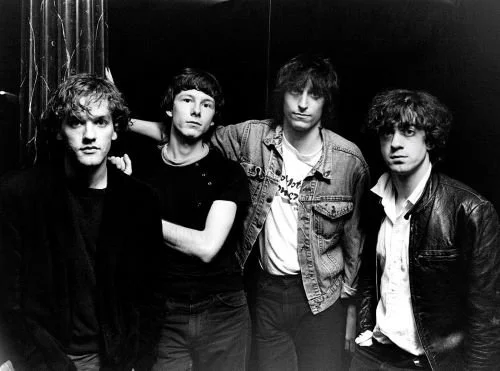
 IN THIS PHOTO: R.E.M. in 1983/PHOTO CREDIT: Chris Walter

anniversary is happening soon. On 12th April, R.E.M.’s debut studio album, Murmur, is forty. The legendary band from Athens, Georgia began work on the album back in December 1982. The I.R.S. label paired R.E.M. with producer Stephen Hague. The sessions did not go too well. More technical and keener on the band doing multiple takes, R.E.M. asked if they could resume producing alongside Mitch Easter. He produced their debut E.P., Chronic Town. I.R.S. agreed a sort of try-out/trial session between R.E.M. and Easter. They travelled to North Carolina, where they recorded with Easter and his producing partner, Don Dixon. They worked on the song, Pilgrimage. After I.R.S. heard that recording, they allowed R.E.M. to work with Easter and Dixon. The producers were quite hands-off with the band. Following the bad recording experience with Stephen Hague, that approach yielded an album that is considered to be one of R.E.M.’s best. It is one of the truly great debut albums. Songs such as Radio Free Europe, Talk About the Passion and Perfect Circle are classics. I will bring in a couple of reviews for the legendary Murmur. Before that SLANT discussed the evolution of R.E.M. on their debut album, and how Murmur sat alongside other music released in 1983:

With their first full-length release, Murmur, R.E.M. dumped the trademark jangle-pop of their lo-fi debut EP, Chronic Town, for much bleaker themes. Singer Michael Stipe took on a more cerebral socio-political stance, his distant tone casting an elusive cloud over the album’s cultural criticism. The opening line of “Laughing” (“Laocoon and her two sons/Pressured storm tried to move/No other more emotion bound/Martyred, misconstrued”) is an early indication that Murmur’s pleasures aren’t of the simple kind—its gloomy maxims about pilgrimage, spiritual sacrifice and lost time are smartly humorous and satirical.

“Talk About The Passion” finds Stipe at his most compassionate, describing a struggle to overcome despair with lyrics that are at once empathetic and pessimistic (“Empty prayer, empty mouths, talk about the passion”).

At the time, most of the folksy songs on Murmur didn’t fit within pop radio’s limitations—these were songs to be listened to, not just danced to. Despite its urgent, Chronic Town-like guitar licks and clickety-clack percussion, “Radio Free Europe,” the album’s only toe-tapper, offers up some of the most playful yet pointed political sarcasm of the band’s career. Inspired by the Radio Free Europe radio station (funded by the U.S. to promote institutional values to countries behind the Iron Curtain), Stipe’s propaganda-hating self-rule is passionate, pointed and biting without sacrificing the rhyme and ingenuity of his lyrics: “Beside defying media too fast/Instead of pushing palaces to fall/Put that, put that, put that before all/That this isn’t fortunate at all”.

One of the most distinct and notable elements of Murmur is how it does not fit in with everything around it. By 1983, there were some many synthesised and plastic sounds. Along came a band that were doing something genuinely different. Sounding more natural and original than almost anyone on the scene, it is no wonder Murmur made an impact and was so well-regarded upon its release. Retrospective reviews have been hugely positive. This is what CLASH wrote in their feature about Murmur in 2013. They looked at the album’s impact on its thirtieth anniversary:

R.E.M. was undoubtedly one of the first American bands to take the underground to the mainstream. At a time when popular music seemed destined to be awash with lustrous and synthetic production, they formed one of several pockets of bands across the country attempting to provide an aural antidote.

And, after the type of relentless touring that is almost nostalgic within today’s music culture, they triumphed. With the release of their debut album, ‘Murmur’, they created a blueprint that opened the doors to a new wave of equally deserved acts acquiring wider audiences.

After an incompatible demo session with the established producer Stephen Hague, the band reverted back to Mitch Easter, alongside his friend and co-producer Don Dixon, who had worked on their earlier ‘Chronic Town’ EP.

The result of their efforts was a record free of constraints. Peter Buck’s rhythmic guitar is stripped of cliché and conventions, intertwining with Mike Mills’ melodic baselines, and punctuated by Bill Berry’s drum beats. It is not surprising to hear that much of ‘Murmur’ was recorded first take.

Whilst its sound would go on to inspire the likes of Nirvana and Radiohead, ‘Murmur’ is something of an anti-rock record. It took elements of folk and country and added pop sensibilities to create a sound that was unique yet highly accessible to those who heard it. Above all else, it is the carefully crafted subtleties within it that have made it such a highly referenced influence of such acts.

Easter and Dixon experimented with unusual recording methods, which created an air of mystery to the album’s sound. The curious buzzing sound that introduces ‘Radio Free Europe’ was achieved by filtering Mike Mills’ bass through a noise gate, whilst the intermittent dull thud on ‘We Walk’ was a slowed-down recording of Bill Berry playing pool.

This atmosphere was accentuated by Michael Stipe’s indistinct vocals. The songs’ lyrics are often indecipherable, yet his unique style still manages to capture the listener’s attention at the right moments, as demonstrated on the exclaimed delivery of ‘Catapult’. Nothing heard on ‘Murmur’ happened by accident.

Upon returning home, there was a joint consensus of positivity. “I can remember thinking, ‘God, I can’t wait until everyone hears this’,” recalled Peter Buck some years later. “It was so different – it didn’t sound like us live, and it didn’t sound like anyth­ing else that was coming out.”

Thankfully, both public and critics agreed, and upon its release, ‘Murmur’ went on to overshadow its more established competition. This lo-fi, low budget debut topped Rolling Stone’s Album of the Year poll, succeeding over the expensive production of Michael Jackson’s ‘Thriller’. R.E.M. was catapulted into the public eye and continually evolved during a career that spanned almost three decades.

After all this time, their debut stills holds the intrigue and excitement it had all those years ago. At a time when sound can often be secondary to image, ‘Murmur’ is a testament to the success of originality in music”.

I would recommend great articles like this. They give insight and background to a classic. I am going to end with a review from Pitchfork. In 2008, for the twenty-fifth anniversary of Murmur, a Deluxe Edition was released. Although R.E.M. sadly broke up in 2011, I hope the band members recall their debut fondly. It is one of the best albums of the ‘80s, and a remarkable debut from a band who would release a few classics through their career:

There's a historical component to Murmur that often gets lost: In 1983, R.E.M. sounded unique. No bands were combining these particular influences in this particular way, which made this debut sound not only new but even subversive: a sharp reimagining of rock tropes. Twenty-five years and 14 albums later, our familiarity with R.E.M. means that Murmur has lost some of what made it revolutionary upon release. Fortunately, rather than collecting obligatory bonus tracks and outtakes-- most of which would have overlapped with Dead Letter Office-- the set includes a second disc documenting a show in Toronto from July 1983, just after the album's release. It marks the first time a full R.E.M. show has been released on CD (LIVE, from 2007, was culled from two nights in Dublin), and judging by the intensity with which the band run through old and then-new songs, it could have held its own as a separate release.

It's startling to hear some of these songs stripped down to their four basic elements, with no keyboard or guitar overdubs. Likewise, it's a bit odd to hear only polite applause after "7 Chinese Brothers", which would appear on Reckoning a year later, and surprising to hear people scream for "Boxcars" and a cover of the Velvet Underground's "There She Goes Again" (which they play) and especially "Shaking Through" (which they don't). Live, Stipe deploys an even wider arsenal of vocal tics: vamping on "Just a Touch", growling the chorus of "Talk About the Passion", and sing-speaking through a jaw-dropping "9-9", all while Mills' backing vocals soar overheard and Buck's guitar chimes reliably on every song. Because they were known primarily as a live band, and because they built their identity as such when the industry avenues of promotion failed them, this live disc, much like the remaster, goes a long way toward re-creating for listeners the context in which R.E.M. introduced themselves and making these familiar songs once again excitingly unfamiliar”.

A sensational and impactful debut album from the much missed and beloved R.E.M., Murmur is forty on 12th April. I know there will be celebrations and articles written about it closer to the time. I wanted to get in there and highlight a brilliant work. Their 1983 debut is a supreme, smart, memorable, enigmatic, powerful, and compelling album from…

THE Athens group.

FEATURE: The Digital Mixtape: This Is Her… Then and Now: The Very Best of Jennifer Lopez

FEATURE:


The Digital Mixtape


This Is Her… Then and Now: The Very Best of Jennifer Lopez

_________

I included Jennifer Lopez’s…

This Is Me… Then in Second Spin last year. That 2002 album was celebrating its twentieth anniversary. Perhaps her best-loved album, it was still one that I felt passed people by and was not played as much now. Interestingly, Lopez releases This Is Me… Now in July. The lyrics are very confessional, and she will talk about her love life and relationships. Lopez is setting the record straight, as people have perceptions about who she has been dating, what she is about, and all these rumours. Lopez is in a point where she wants to address that. I have not featured Lopez since then and, in fact, not much at all through the years. As she has a long-awaited album out soon, I wanted to compile a playlist featuring the best cuts from the New York-born legend. There are the hits and some album deeper cuts. Even if her more modern albums have not received a great deal of love and critical respect, they have sold very well. She is one of the most influential and popular artists in the world. Maybe critics are looking for the sort of ready hits and excitement that she produced on her first few albums. That said, even then they were not fully behind her and in support. It is baffling that a run as strong as (her debut) On the 6, J.Lo and This Is Me… Then did not get more acclaim considering, between them, they gave us hits such as If You Had My Love, Let’s Get Loud, Love Don’t Cost a Thing, Ain’t It Funny and Jenny from the Block!

The albums were huge commercial successes and it showed the gulf between the public’s love and the slightly less enthused critics. I hope that Lopez’s albums get re-evaluated, as they are incredible. I am going to end with a career-spanning playlist of Jennifer Lopez classics and deeper cuts. Before getting to that, AllMusic provide a biography of the actor and artist who has been responsible for some of the most recognisable tracks of the late-’90s and early-’00s:

Actress, singer, dancer, producer, and businesswoman, Jennifer Lopez parlayed her Golden Globe-nominated portrayal of tragic Latin pop icon Selena in the 1997 biopic into pop culture superstardom, including forging a career as an influential pop star in her own right. Establishing a confident, sensual style, her first single, 1999's "If You Had My Love," went all the way to number one on the Billboard Hot 100. Just two years later, Lopez became the first woman to hit number one on the album chart and at the box office in the same week, with her second album, J.Lo, and her lead role opposite Matthew McConaughey in The Wedding Planner. In 2001, she launched the long-running clothing line J.Lo by Jennifer Lopez and received her second Grammy nomination in the dance recording category. The year 2002 brought the number one hit "All I Have" featuring LL Cool J, and her first fragrance, Glow, became a top-seller. While continuing to land occasional lead roles on the silver screen, she became a fixture in the Top Ten with albums including the Spanish-language Como Ama una Mujer (2007) and her seventh full-length, Love? (2011). In the meantime, on TV, the onetime In Living Color dancer co-created the reality series DanceLife, and in 2011 she began a multi-season stint as a judge on Fox's American Idol. Lopez issued another Top Ten studio album, A.K.A., in 2014 before leaving American Idol in 2016 to star in the NBC crime drama Shades of Blue (2016-2018). In 2020, Lopez received her first Golden Globe nomination in 22 years, for her portrayal of Ramona in the previous year's Hustlers, a film that she also co-produced. She combined her passions with 2022's Marry Me, a romantic comedy for which she starred and provided the soundtrack alongside co-star Maluma.

Jennifer Lynn Lopez was born in the Bronx, New York, on July 24, 1969. After starting out in musical theater as a child, she made her film debut at age 16 in the little-seen My Little Girl, but she was later tapped to become one of the dancing "Fly Girls" on the television sketch comedy series In Living Color. A recurring role on the TV drama Second Chances followed before Lopez was thrust into the limelight co-starring with Wesley Snipes and Woody Harrelson in the 1995 feature film Money Train. Smaller roles in pictures including My Family/Mi Familia, Jack, and Blood and Wine followed before she landed the title role in 1997's Selena, portraying the slain Tejano singer. The resulting acclaim for Selena included a Golden Globe nomination for Best Actress. Co-starring opposite George Clooney in 1998's acclaimed Out of Sight, Lopez became the highest-paid Latina actress in Hollywood history. The following summer, she returned to her musical roots with her debut pop album, On the 6, scoring a major hit with the single "If You Had My Love."

Lopez didn't waste time perfecting a sophomore effort, the appropriately titled J.Lo, which was issued in early 2001. The following year, Lopez released J to tha L-O!: The Remixes and This Is Me...Then, which spawned another hit single, "Jenny from the Block." The album reached number two on the Billboard 200. Although her high-profile romance with Ben Affleck created more headlines than her recording career, her follow-up, 2005's Rebirth -- released just after she married singer Marc Anthony -- debuted at number two on U.S. album chart. The Spanish-language album Como Ama una Mujer followed in 2007, peaking at number ten on the Billboard 200 while remaining at the top of the Latin chart for seven consecutive weeks. In October of that same year, Lopez put out a more "traditional" pop album, Brave, followed by an accompanying tour. It peaked at number 12. Love?, another pop album, was released in April 2011, a few months after Lopez debuted alongside Randy Jackson and Aerosmith's Steven Tyler as one of the judges on American Idol.

Love? proved Lopez's biggest hit in years, no doubt benefiting from her role as an Idol judge. Lopez stayed for two seasons, leaving after the 2012 season. Just as the news of her departure arrived, so too did news of her divorce from Marc Anthony. Her first hits collection, Dance Again...The Hits, appeared in July 2012 and entered the Billboard album chart at number 20.

Lopez returned to American Idol for its 13th season in January 2014. During its run, she started to tease her new album, releasing its first single, "I Luh Ya Papi," in March; it peaked at 77 on the Hot 100 and seven on the Hot Dance Club Songs chart. After the season wrapped, she released her eighth album, A.K.A., which was also her first record for the Capitol label. In 2015, she voiced a character in the animated feature film Home, and also contributed the single "Feel the Light" to the movie's soundtrack. Lopez kicked off an extended live concert residency at the AXIS at Planet Hollywood in Las Vegas in January of 2016. That same month, she premiered in the role of NYPD detective Harlee Santos on the NBC series Shades of Blue.

Several months later, she marked a return to Epic Records after a six-year absence from the label with the release of the single "Ain't Your Mama." Lopez also premiered the song with a live performance on the finale of the 15th season of American Idol. In July 2017, she released the single "Ni Tú Ni Yo," which was co-written and executive produced by ex-husband Marc Anthony. "Amor, Amor, Amor," featuring Wisin, followed that November, and a bilingual single titled "Dinero," featuring DJ Khaled and Cardi B, arrived in May 2018. Shades of Blue aired its final episode that August. "Limitless," her contribution to the soundtrack of romantic comedy Second Act, followed later in the year. She also co-produced and starred in the film.

In 2019, Lopez appeared in the independent crime-comedy Hustlers, portraying strip-club dancer Ramona. It led to best-supporting actress nominations at the Golden Globes, the Screen Actors Guild, and the Independent Spirit Awards. In September 2020, she released two songs with Colombian singer Maluma, "Pa' Ti" and "Lonely," both of which were later included on the soundtrack to Lopez's 2021 romantic-comedy film Marry Me. She also released the solo track "On My Way" as a single from the film. Later that year, she teamed up with rising Puerto Rican star Rauw Alejandro for the single "Cambia el Paso”.

Ahead of the release of her ninth studio album, This Is Me... Now, I wanted to look back at the career of Jennifer Lopez and assemble some of her best music. Nearly twenty-four years after her debut was released, there is still this huge demand for and love of her music. As you will hear from the cuts in the playlist, Lopez has had…

SUCH a varied career.

FEATURE: Sprechgesang Durch Technik: Why Is Talk-Singing Becoming More Prevalent?

FEATURE:


Sprechgesang Durch Technik

IN THIS PHOTO: Wet Leg have harnessed and personalised talk-singing, as evidenced throughout their award-nominated eponymous 2022 debut album/PHOTO CREDIT: Terna Jogo for Rolling Stone UK


Why Is Talk-Singing Becoming More Prevalent?

_________

IT is not a new thing in music…

 IN THIS PHOTO: Artist and D.J. Gemma Bradley’s 2023 documentary for The Cultural Frontline asked why more and more guitar bands are speaking rather than singing - a phenomenon that is seemingly growing and expanding

but, maybe as part of diversifying and evolving genres, there is a definitely rise in talk-singing. The Germans call it Sprechgesang. For decades, we have heard songs where there are spoken lines or verses. I don’t think that there has been a particular revolution in that sense. One can definitely feel it becoming more popular and integrated into music. Maybe genres like Rock, Indie, and Pop have been quite homogenous and defined in past years. As we are seeing more artists push boundaries and find new ways to communicate with the audience, it is no surprise that many artists are mixing singing with speaking. It is not uncommon to find solo artists doing this, but bands especially (including duos) are employing speak-singing. I was compelled by a documentary from earlier in the year from musician Gemma Bradley. She asks why guitar bands are speaking instead of singing. I am quite torn over it, and I have theories as to why a lot of Rock bands especially are bringing talk-singing into things. I want to start with a couple of features that provide some background and context to this phenomenon. In 2019, The Guardian asked the question as to why many of the best bands preferred talking rather than singing:

It feels like acting,” says Florence Shaw, frontwoman – not singer – of the London indie band Dry Cleaning. “Speaking your lyrics is acting, more than singing is. Everyone knows what it sounds like in a person’s voice when they are irritated, or when they are in love. The voice changes, and it doesn’t whack you in the face – it can be quite subtle and creep up on you more.”

If you spend any time in small British venues, it is likely you have noticed there are quite a few bands like Dry Cleaning around at the moment – bands that don’t employ a singer so much as someone who declaims their words, and that are getting noticed. Do Nothing and Black Country, New Road have been winning admirers; Talk Show have been signed by Felix White, late of the Maccabees, to his Yala! Records label; Sinead O’Brien’s new single is on Chess Club, the label that brought the world Mumford & Sons, MØ, Wolf Alice, Sundara Karma and more.

It is not a complete surprise that all these artists are operating in that part of the musical spectrum marked, broadly, as post-punk. The late 70s and early 80s were when sprechgesang – literally, “spoken singing” – flourished as a means of expression, in part because of the embrace of musical limitations, in part because it was a clear point of difference from traditional rock music, and in part because it was ideal for conveying the scorn, sarcasm and disgust that performers such as John Lydon and Mark E Smith dealt in.

Smith, especially, is an inspiration for O’Brien, even if her style – poetic and allusive, with an often flowing and melodic backing – is more akin to early Patti Smith (she even started in the same way as the latter, reciting poetry to the accompaniment of a guitar). “Mark E Smith showed it’s not about perfection,” O’Brien says. “Every piece I ever listen to by the Fall can sound like a whole different mood board on another day. It completely transforms, and I’m stopped in my tracks.”

That sense of confrontation Lydon and Smith brought remains important to many of these new groups. They are all still playing small rooms, where eye contact is unavoidable, and there is something uniquely discomfiting about being singled out from a crowd to be spoken at by someone on a stage.

“There are people, understandably, who are cringed out by spoken-word stuff,” says Isaac Wood of Black Country, New Road. “It’s too direct. They think it’s like an open mic slam poetry night or something. But if you are in any way inclined towards it, it is less easy to ignore, because there are conversational elements to it. It’s more direct.” Like Dry Cleaning, whose breakthrough track was about Meghan Markle, Wood’s lyrical references to Kendall Jenner and Kanye West make him feel all the more immediate.

“They hate it,” says Do Nothing’s Chris Bailey of his own audiences. “They feel super-weird and wrong. A lot of the time I’ll stare one person down, and usually they just look away. If I’m playing a character, it makes it feel like theatre. Breaking the fourth wall always makes people uncomfortable.”

“I love being able to stand a metre away from someone and just stare at them,” says Talk Show’s Harrison Swann. “It’s really visceral and the most real thing you can get. You can’t shy away or hide behind a melody. It’s great as a performer; it’s really immediate.”

Unsurprisingly, sprechgesang did not come about as a means to enable scratchy indie bands to make their audiences feel uncomfortable. It was first used by Arnold Schoenberg in 1912, when he set 21 poems by Albert Giraud to music as Pierrot Lunaire. (Strictly, what he was doing, and what these bands are doing, was sprechstimme – which emphasises speech above melody – but outside classical music, the two terms are all but interchangeable, and sprechgesang is the one that has stuck.) Brecht and Weill developed it further, but it was never more than a novelty in rock until the post-punk years (you might make an argument that Bob Dylan deals in it, or you might say he isn’t a very good singer)”.

Whilst artists throughout music history have used talk-singing, I think what is remarkable about the last few years it the variety of genres that is exploring it. In terms of newer acts coming through, the likes of Wet Leg, Dry Cleaning, and Black Country, New Road cover a vast array of sounds and territories. I think it will be something that becomes even more common in the coming years. The Ringer investigated why Sprechgesang was very much in vogue:

Yet the present state of talk-singing (or “Sprechgesang”—yes, there is a German word for this) is anything but a monolith. Consider the vast array of talk-singing styles on display in the early 2020s. If Shaw sounds ever calm and collected, her peers in the London-based groups Squid and Black Country, New Road sound agitated and distrubed, like Mark E. Smith on steroids, delivering feverish punk monologues coated with rage at the collapsing world around them. (The great eight-minute finale of Squid’s album Bright Green Field, for instance, finds singer Ollie Judge ranting and raving about political propaganda—“Pamphlets through my door / And pamphlets on my floor!”—with mounting hysteria.)

“The more melodic the songs were, the less excited we were about what we were writing. Then, as we tried things that were less melodic and more spoken, we just got more and more excited about what we were doing.” —Greg Katz, lead singer of Cheekface

Contrast that with the flirty, winking monotone favored by English duo Wet Leg on their debut single “Chaise Longue,” in which singer Rhian Teasdale cheekily quotes Mean Girls and repeats the phrase “chaise longue” 46 times without breaking a sweat. The ferociously addictive single became an unlikely success: By late September, “Chaise Longue” had amassed nearly 3 million streams on Spotify (The Ringer’s parent company) alone, and Wet Leg announced their first U.S. shows despite having only two songs.

Across the pond, more laid-back, stylized talk-singing approaches have flourished among indie acts like Sneaks (a.k.a. musician Eva Moolchan), whose four albums revel in minimalist post-punk mantras, and the band French Vanilla, whose records French Vanilla and How Am I Not Myself? draw links between the iconic, exaggerated Sprechgesang of early B-52s and the present-day queer-punk scene.

Meanwhile, Greg Katz, the lead singer of indie-rock group Cheekface, channels his anxieties into a dorkier, more conversational mode of talk-singing on 2021’s excellent Emphatically No., employing an untrained voice that evokes everyone from Jonathan Richman (whose stock has risen so much lately that he’s being impersonated at festivals!) to Cake. A typical Cheekface song finds Katz talking his way through the verses, riffing on subjects like climate collapse (“Original Composition”) and smartphone addiction (“Got my old phone replaced / Now I do nothing faster than I did yesterday,” he quips in “Wedding Guests”), before breaking into a singable chorus. He never sounds as cool or detached as, say, Florence Shaw. He sounds like a funny, self-deprecating friend cracking jokes to ward off despair.

Like many talk-singers, Katz has no formal vocal training. He embraced the style more or less by accident. When he and bandmate Amanda Tannen began writing songs together in 2017, they tried various approaches. “The more melodic the songs were, the less excited we were about what we were writing,” Katz says. “Then, as we tried things that were less melodic and more spoken, we just got more and more excited about what we were doing.”

In Katz’s view, his vocal style conveys the jittery emotional landscape of Cheekface’s music as much as the lyrics themselves. “You can tell when your friends get overwhelmed because they start talking so fast, right?” Katz says. “You’re like, ‘Whoa, slow down. You’re tripping.’ And I think that’s something you can do if you’re not concerned about keeping the cadence of the melody the same from line to line and verse to verse. What is the polar opposite of that? It’s a Max Martin song, where he would rather the words have less meaning and the melodies stay symmetrical.”

Yet in recent months, even the upper echelons of pop royalty have dabbled in Sprechgesang. Billie Eilish sexy-mumbles her way through the bleary-eyed Happier Than Ever highlight “Oxytocin,” doing her best Madonna-circa-Erotica impression, while St. Vincent affects a saucier beat-rap delivery in her comeback single “Pay Your Way in Pain.” Back in April, Mick Jagger delivered a rather lackluster brand of shout-singing on his Dave Grohl–assisted lockdown anthem “Eazy Sleazy,” which is disappointing, considering Jagger gave us one of the all-time great, sex-obsessed Sprechgesang performances on 1978’s “Shattered.”

Even Olivia Rodrigo, the newly anointed Gen Z pop queen, unleashes a caustic mode of talk-singing on her song “Brutal”: “I’m not cool, and I’m not smart / And I can’t even parallel park,” Rodrigo snarls, as though she’s too consumed by teen angst to conform to melodic orthodoxy. Curiously, Rodrigo’s song nicks a guitar lick from “Pump It Up” by Elvis Costello, which, by Costello’s own admission, borrowed heavily from Bob Dylan’s talk-singing landmark “Subterranean Homesick Blues,” which, in turn, took influence from the fast-talking proto-rap of Chuck Berry’s 1956 single “Too Much Monkey Business.” How about that: a talk-singing lineage that directly links Gen Z all the way back to the Greatest Generation”.

One would say that an increased number of groups and new artists would lead to a rise in talk-singing. This is true, but I don’t think it is a mere numbers game. I am a little divided over the phenomenon. I am someone traditionally who prefers singing as the best way to articulate a message and capture me. I do think a talk-singing can be a little weary and ruin the momentum of a song. On the other hand, artists can bring more nuance and personality to songs. I feel a greater range of dynamics and emotions can be deployed through talk-singing. Also, for many Rock acts who might have a more political edge, providing speech can be more impactful and clearer (in terms of vocal clarity) compared to singing. I do not like songs that are mostly talk-singing, but having Wet Leg have shown how effecting and interesting music with a more conversational edge can be. I guess speaking can seem a more direct link to the fans and lyrics. Singing can sometimes be unintelligibility, so there is that desire to be understand. Rock is a genre that is seeing more talk-singing. This might beg the question whether the genre is transforming into something different. We do still have guitar bands who write huge and raucous songs, but I think the sound and culture of Rock has transformed quite notably over the past decade. Regardless of age, even Indie heroes such as Arctic Monkeys are far removed from how they sounded on their 2006 debut, Whatever People Say I Am, That's What I'm Not. Lead Alex Turner has this interesting mix of singing and speaking. More Lounge and Orchestral than their early work, maybe they have lead a bit of a revolution.

The fact is that every artist has a different reason for talk-singing. I am not sure which song or artist started the trend, but we are talking many decades ago now. Whether people err more towards a more traditional approach of Rock songs largely comprising singing, or they are pretty open to talk-singing, it is definitely becoming more prominent. I do think it is a way for artists to distinguish themselves and get their natural accents and voices heard. It also provides something more cinematic, dramatic and even comic. It adds layers and depths to genres like Rock, and certain spoken lines can come across more powerfully, naturally or engaging than if they were sung. I would recommend people listen to Gemma Bradley’s excellent documentary from earlier in the year, where bands like Squid are put under the spotlight:

Fontaines D.C., Dry Cleaning and Yard Act, as well as solo artists including Billy Nomates and Sinead O’Brien are just some of the acts using speech prominently in their music. It is not just vocal performance that has been commented on - many emerging bands have been described as having a ‘post-punk’ guitar music style and lyrics rich in social commentary.

Musician and broadcaster Gemma Bradley meets bands and vocalists to find out more about this exciting music trend and why.

James Smith, songwriter and vocalist of English band Yard Act explains why he was attracted to what he describes as ‘spoken word, politically forward’ guitar music. He reflects on the power of vocal performance and how the Covid pandemic affected his song writing.

Irish vocalist Sinead O’Brien performs on stage with a guitarist and drummer and works in poetry as well as music. She meets Gemma backstage before a gig to discuss how versatile and impactful speech in music can be.

Fionn Reilly from Belfast band Enola Gay explains to Gemma what inspires his energetic performance style, vocal delivery and the band’s song lyrics.

Gemma also visits the prolific and much sought-after producer Dan Carey at his London studio. He has worked with many guitar bands that use speech in their music including Fontaines D.C., Squid, Wet Leg and black midi, and describes the freedom available for artists unconstrained by the parameters of singing”.

I am a big fan of many of the artists included in the Gemma Bradley documentary. Whether they use talk-singing to bring poetry into music or something that builds dialogue and conversation into the mix, it is clearly providing very popular and enduring! These are artists with a rich catalogue that is setting them aside. As I say, there is a delicate balance where too much talk-singing (Dry Cleaning for instance) can prove a bit samey and unappealing to those who do like at least a bit of singing. That said, bands like Dry Cleaning are almost creating a sub-genre or sound that has a very growing fanbase. That is a good thing. New acts like Wet Leg are adding their own stamp to Sprechgesang. As it shows no signs of slowing, it will be fascinating to see…

WHERE it leads.

INTERVIEW: Jen Dixon

INTERVIEW:

PHOTO CREDIT: Francis Fitzgerald


Jen Dixon

_________

WHEN it comes to interviews…

I do not get to speak with many artists from the North of England. Teeside’’s Jen Dixon is a terrific artist whose previous singles like Save Me (2022) and Pretty Face (2021) are extraordinary and got me invested into her music. With a new E.P., Less Than a Feeling, out in June, it is an exciting time for the extraordinary songwriter. She is getting a lot of love right now, and rightly so too! I have been speaking with Dixon about that forthcoming E.P., why the Teesside music scene is growing and what defines it, and what is coming next from her. With a new single, Over You, out on 7th April, people really do need to tune into the music of Jen Dixon. Go and pre-order her magnificent E.P. and get to experience a bright and original artist who has…

A very bright future ahead.

___________

Hi Jen. How are you? How had your week been?

Hey! Good, thanks. Busy doing lots of promo. Doing the day job, and of course spending time with the dogs and chickens.

Over You is your upcoming new single. What can you tell us about the song and its inspiration?

The song was actually one of the first I wrote back in the first lockdown. It’s about a journey and new beginnings; coming out of difficult times to discover that life can suddenly change for the better. I’m hoping it’s catchy and people get it stuck in their heads! There’s also a little rap (if you can call it that!) in this one similar to my previous single, Which Way Is Down?.

You must be excited that your debut E.P. is out soon. What has the writing process been like, and what can you reveal about the themes explored throughout?

It’s been a LONG process. I wanted it to be right. So it’s a collection of songs written since 2020. In the early days, some of the songs just didn’t fit with what I was doing, But as I progressed as a writer and a person, I felt it was now the right time to get them out there! They were all written and recorded by me in my bedroom studio, then mixed by Lisa Murphy and mastered by Pete Maher. I think there’s a few themes, all personal to me and my journey - who I’ve met, what I’ve experienced. That’s all I’m saying!

Loving the obvious bands like Foo Fighters, Paramore and RHCP (Red Hot Chili Peppers), but also engaging with artists like Phil Collins and The Police

What kind of sounds are explored on the E.P.? Is it you solo for the most part, or are there are a lot of other musicians in the mix?

It’s basically all me. I record all the different instruments myself but did have a couple of guitarists feature on a couple of songs because they’re much better than me! My first instrument is drums, so I normally record that then add in bass, synths, guitars, piano, vocals, harmonies… the list goes on! I love layers.

How did you get interested in music? Were there particular artists and albums that struck you at a young age?

I started playing drums at age 11, played drums at college and did sound engineering at uni. But I didn’t actually start singing and writing until the COVID lockdown. I guess growing up I was a bit sheltered with music - mostly my dad playing Elvis -, but I do remember a Stray Cats vinyl being on repeat! When I went to college, I explored much more. Loving the obvious bands like Foo Fighters, Paramore and RHCP (Red Hot Chili Peppers), but also engaging with artists like Phil Collins and The Police.

 I think some of the best and most interesting talent comes from the north of the U.K. There is so much attention still on London. What do you think it is about areas like Teesside, Yorkshire and Greater Manchester that produces such original artists?

That’s a big question! I’m not so sure about Yorkshire and Manchester, but I know Teesside’s music scene is buzzing and has been for a long time. Maybe it’s an economy thing? People need an outlet when things look bleak? I know on Teesside the steel industry etc. closing was a big blow. There’s a lack of funding in schools for music; high unemployment rate. But maybe it’s something that just grown, so having venues/festivals to promote the original artists is so important. It’s really worrying that so many of our grassroots venues have closed recently.

Your music has been getting love and attention from the press and radio station. As an unsigned artist, how important is it to get this backing and exposure?

It’s really important! I remember Tom Robinson saying that radio isn’t an end goal, it’s part of the journey - and he wasn’t wrong. In the early days, it doesn’t really make much different to streaming figures etc., but getting your name heard and getting a team behind you of supporters is such a good feeling. Without management or a label, I’m doing everything alone. So I appreciate every person that supports, listens, and shares. It’s amazing.

It’s hard to get onto the local festivals because there’s so much talent, so the fact that I’ve been chosen for the line-up is the dream

I think a lot of people would love to see you live. Are there dates coming later in the year in promotion of your debut E.P.?

First up is Stockton Calling! Awesome local festival. There’s also another to announce later in the year. I’m working on doing something nearer the E.P. launch, but I definitely want to do an end-of-the-year gig and get as many people as possible down!

I know you are announced for Stockton Calling in April. How are you feeling about that?

Great! It’s hard to get onto the local festivals because there’s so much talent, so the fact that I’ve been chosen for the line-up is the dream. I just hope people actually come and see me and the band play on the day!

You are one of the most exciting and promising young artists coming through, but are there any other emerging artists you would recommend we check out?

Soooooo many. Ladies first: SILVI is an awesome Scottish talent. I can’t wait to see her at Stockton Calling! Also, if you want something a bit different then Amelia Coburn is a Folk-y singer songwriter that is making waves. Fellas: I saw the Citylightz lads last year and they’re a bundle of energy! Sugar Roulette are a good local band that should be checked out too.

Finally, and for being a good sport, you can select any song (from another artist) and I will play it here.

I’m going to go for the new single by Docksuns - Real Thing.

_____________

Follow Jen Dixon

FEATURE: With the Beatle… Why Paul McCartney’s 1964: Eyes of the Storm Is a Must for Every Fan of the Band

FEATURE:


With the Beatle…

IMAGE CREDIT: Paul McCartney/Allen Lane


Why Paul McCartney’s 1964: Eyes of the Storm Is a Must for Every Fan of the Band

_________

IT seems…

 PHOTO CREDIT: Paul McCartney/Allen Lane

that there is always something to talk about when it comes to Paul McCartney and The Beatles. The legend celebrated his eightieth birthday last year, and I remember, when researching, thinking how much he has achieved through the decades! One would think that, as the genius gets older, that there would be less to enjoy and find. That is never the case with Macca. Whether he brings out a book of lyrics, a children’s book, or simply posts onto Twitter, we are always aware of this beloved colossus! I was wondering what treats we would get from McCartney in 2023. I am sure he will appear in a documentary or interviews later in the year, and we all hope there is going to be a follow-up to 2020’s McCartney III. I think that we will get some material later in the year. Before any of that, there is something interesting from the archives. I often wonder about The Beatles and photos. Paul’s late wife Linda was a photographer. The Beatles were involved with press photos, but what about journaling their everyday lives? Obviously, as it was the ‘60s, it was not as convenient and easy to take a lot of photos as it is now. It seems that Paul McCartney had his own camera and spent time at the height of Beatlemania taking some interesting shots. They are going on display at the National Portrait Gallery:

An unprecedented exhibition, revealing – for the first time – extraordinary photographs taken by Paul McCartney.

In this show, we focus on portraits captured by McCartney, using his own camera, between December 1963 and February 1964 – a time when The Beatles were transitioning from a British sensation to a global phenomenon. These never-before-seen images offer a uniquely personal perspective on what it was like to be a ‘Beatle’ at the start of ‘Beatlemania’ – and adjusting from playing gigs on Liverpool stages, to performing to 73 million Americans on The Ed Sullivan Show. At a time when so many camera lenses were on the band, it is Paul McCartney’s which tells the truest story of a band creating cultural history – in one of its most exciting chapters”.

 IN THIS PHOTO: The Beatles’ John Lennon and George Harrison/PHOTO CREDIT: Paul McCartney/Allen Lane

There is something very evocative and cool looking at some of the images that will appear. In black-and-white, you get this very authentic and vintage look from the point of view from a man who was experiencing something that nobody else had and ever will again! The Beatlemania time must have been a swell of excitement, exhaustion, and nerves! Not knowing what it meant or where it would head, McCartney could not have had much downtime or chance to get away. I imagine that late-1963 period as being so full-on and crowded. Constant Intrusion and endless performances, getting these candid photos from a man who was changing Pop music forever, we also get a book with so many fascinting shots. I would advise anyone who even has a passing interest in The Beatles to pre-order it (it is available on 13th June - five days before McCartney’s eighty-first birthday):

Capturing the moment when the sixties truly began, this stunning volume of recently rediscovered photographs - boasting must-read commentary from Sir Paul McCartney - chronicles the whirlwind months from the end of 1963 to the beginning of 1964 when Beatlemania erupted, with an immediacy, vividness and authenticity unmatched by any previous works on the era.

Photographs and Reflections by Paul McCartney

'Millions of eyes were suddenly upon us, creating a picture I will never forget for the rest of my life.'

IN THIS PHOTO: Paul McCartney during his Got Back tour of 2022/PHOTO CREDIT: MJ Kim

In 2020, an extraordinary trove of nearly a thousand photographs taken by Paul McCartney on a 35mm camera was re-discovered in his archive. They intimately record the months towards the end of 1963 and beginning of 1964 when Beatlemania erupted in the UK and, after the band's first visit to the USA, they became the most famous people on the planet. The photographs are McCartney's personal record of this explosive time, when he was, as he puts it, in the 'Eyes of the Storm'.

1964: Eyes of the Storm presents 275 of McCartney's photographs from the six cities of these intense, legendary months - Liverpool, London, Paris, New York, Washington, D.C. and Miami - and many never-before-seen portraits of John, George and Ringo. In his Foreword and Introductions to these city portfolios, McCartney remembers 'what else can you call it - pandemonium' and conveys his impressions of Britain and America in 1964 - the moment when the culture changed and the Sixties really began.

1964: Eyes of the Storm includes:

- Six city portfolios - Liverpool, London, Paris, New York, Washington, D.C. and Miami - and a Coda on the later months of 1964 - featuring 275 of Paul McCartney's photographs and his candid reflections on them

- A Foreword by Paul McCartney

- Beatleland, an Introduction by Harvard historian and New Yorker essayist Jill Lepore

- A Preface by Nicholas Cullinan, Director of the National Portrait Gallery, London, and Another Lens, an essay by Senior Curator Rosie Broadley”.

There have been quite a few Paul McCartney/The Beatles-related books from the last few years. Some would say this is inessential or money-grabbing. Rather than this being McCartney looking through his old photos and archives and putting this out knowing that the book will sell big, it is actually vital and beautiful insight into days in the life of a member the greatest band ever. It is called 1964: Eyes of the Storm. That sense of thrill and absolute spectacle will be put alongside more intimate and goofy photos. Beatlemania is one of the most fascinating periods in musical history. I think that there will be a lot of new Beatles converts following the Peter Jackson documentary-film, The Beatles: Get Back, from 2021. I am going to wrap up in a minute but, in this article we get a quite from McCartney himself about why he is making these photos public:

Both collections will be titled 1964: Eyes of the Storm, both are due out in June and both will compile 275 photos taken as the band toured through Liverpool, London, Paris, New York, D.C. and Miami. McCartney himself wrote the book's foreword, as well as notes reflecting on the shots he took — which include portraits of bandmates John Lennon, George Harrison and Ringo Starr.

The archive's title alludes to the massive attention the band received, as Beatlemania took hold — as McCartney asks in his foreword, "What else can you call it [but] pandemonium?" — and the four musicians experienced life-changing upheaval. The three never-before-seen photos on this page capture not only that overwhelming change, but also moments of quiet contemplation.

PHOTO CREDIT: Paul McCartney/Allen Lane

"Anyone who rediscovers a personal relic or family treasure is instantly flooded with memories and emotions, which then trigger associations buried in the haze of time," McCartney writes in 1964: Eyes of the Storm. "This was exactly my experience in seeing these photos, all taken over an intense three-month period of travel, culminating in February 1964. It was a wonderful sensation to be plunged right back. Here was my own record of our first huge trip, a photographic journal of The Beatles in six cities, beginning in Liverpool and London, followed by Paris (where John and I had been ordinary hitchhikers three years before), and then what we regarded as the big time, our first visit as a group to America”.

I think that this is going to be one of the most interesting and essential Beatles releases. It  takes us back almost sixty years to a time that not only when Pop was changing and growing, but the world around it was also transforming. In the U.S. on 22nd November, 1963, President John F. Kennedy was assassinated. There was unrest across America. In 1964 Britain, Top of the Pops first aired on 1st January. Radio Caroline started on 28th March, and Labour’s Harold Wilson became Prime Minister later in the year. It was a changeable, turbulent, and exciting time, and Paul McCartney, John Lennon, Ringo Starr and George Harrison were right in the middle of it. How strange it must have been for these young men to be in such a weird and wonderful position. It makes Paul McCartney’s upcoming photobook (and exhibition) a must for…

IN THIS PHOTO: "The crowds chasing us in A Hard Day's Night were based on moments like this," McCartney writes. "Taken out of the back of our car on West Fifty-Eighth, crossing the Avenue of the Americas"/PHOTO CREDIT: Paul McCartney/Allen Lane

ALL fans of The Beatles.

FEATURE: Forty Years of the Compact Disc: Could We See a New Physical Format for the Modern Age?

FEATURE:


Forty Years of the Compact Disc

PHOTO CREDIT: Jorge Fakhouri Filho/Pexels


Could We See a New Physical Format for the Modern Age?

_________

THE compact disc…

 PHOTO CREDIT: cottonbro studio/Pexels

has been in our music world for forty years. Introduced in November 1982 in Japan, and in March 1983 in Europe, I wanted to mark forty years of its life here (in Europe) by thinking about its huge impact and legacy. I think that the compact disc was the last sustainable physical format. The cassette and vinyl came about before. Whereas cassettes are still used, as I have said before, they are hardly ever played. People don’t really have boomboxes or a devices they would have had in the ‘90s. It seems like many buy them to support artists. I do wonder where people play cassettes. I have also said how it would be awesome to revive the Sony Walkman and actually have a portable device one could play the cassettes on. I have always liked them, but I get that people feel they are pretty unstable in terms of durability. Whereas you get the dreaded unspooling and the tape being stuck in the machine, you also have to wind and rewind manually to skip between tracks. The vinyl has its advantages. You get this big and tactile product that you put on and enjoy. It is not portable obviously…and vinyl is still expensive. People deride the compact disc now, as a lot of the packaging used to house albums is plastic. Many feel C.D.s are too fragile and scratch easily. Also, like the cassette, where do people play compact discs?! I have a player in my car, but many do not now.

PHOTO CREDIT: freepik

Smartphones mean people hook that up in their car. Maybe people have stereos with a compact disc tray(s), but sales have steadily declined. Vinyl is the leading physical format, and that lacks a certain portability and sociability. In the sense people don’t swap vinyl in the way cassettes and C.D.s once were. The reason why the fortieth anniversary of the compact disc is so important is that it was the way that I properly discovered music. My parents’ vinyl was part of the house but it not widely played. I did do cassettes for a while when I was very young, and I do have very fond memories of playing albums in an old boombox that I got. Compact discs were a different league. I bought singles and albums, and there was a lot of swapping in the playground. The thrill of buying compact discs and taking them in. The feel of the casing and reading the inset you got too. I collected them too, and I have a vast array from across the years. They are memories and physical connections to past times. I am not against streaming and digital music, but it is convenient and inexpensive. I don’t think that sharing playlists and songs in this form is going to be as effective as physical forms. What do young music lovers do when it comes to having that same sort of connection and experience as I did when I was young?

 IMAGE CREDIT: freepik

It is not just a concern about young listeners. It is a pleasure to listen to music in physical formats. Streaming is great but, with criticism regarding how much artists receive and very slow progress, people are embracing vinyl more than compact discs and cassettes. The format is expensive and very much for a time and place. One is unlikely to have vinyl shared in playground and workplaces. There is a romance and wonder to listening to vinyl and that whole listening experience. What do you do when you not only want to enjoy something more compact and cheaper, but it also need to be environmentally conscious and ensures artists receive payment. Also, I miss singles being available to purchase physically. It may seem oldskool, but the fortieth anniversary of the compact disc has made me wonder whether we could have a new physical format. The fairly short-lived MiniDisc (MD) came out in 1992, but that did not really have the same impact as C.D.s, cassettes, and vinyl. With there not really being a popular, easily accessible, and inexpensive physical format out there, I fear so many will miss out. There is already an awareness when it comes to younger listeners not knowing certain artists and songs. If streaming is their main source of discovery, the way algorithms work mean they are being fed limits and music that is crafted for them. There is a clear demand for physical music today.

 PHOTO CREDIT: halayalex via freepik

I am not sure what the solution is, but I would like to think physical singles could be reignited (with artists more compelled to do B-sides), alongside physical albums on a new format. Something more durable than cassettes, it would be a cross between a compact disc and a MiniDisc. You need a device which is sturdy, well-designed, and compact, and you need the physical cartridge/product to be sized so that it is not too cumbersome. I love the old C.D. cases you got, but you would need to make the thing in a form other than plastic. Same goes with casing. I guess that is where the first challenge comes in. Also, it would need to be so that albums cost about the same as they do on C.D. Of course, if they could be priced the same as cassettes – which are slightly cheaper in general -, then that would take care of another issue. Not only would a new generation both be able to swap music like we did years back, in a physical and more sociable way. There would be this sense of preservation and posterity. I revisit and rediscover older music because I have the C.D.s, vinyl, or cassettes still. I am not going through playlists and being ignited and reminded in the same way. Also, as a way of passing music down, maybe there is not the same nostalgia and beauty of a cassette, vinyl, or compact disc, but there is physical archive and connection. That is so important. Being able to produce albums ethically and sustainably so they are durable, between £10-£12 (singles maybe £2-£3), and they are small enough to fit inside cases or a bag.

 PHOTO CREDIT: Yuri Manei/Pexels

Some might argue why we need an additional physical format, but I feel compact discs, in spite of enduring for forty years, are less popular and seen as old-fashionable by some. I love cassettes and would recommend them, but they have design flaws and limitations. There are no devices to play them on and, if they were, would people buy it at such a high price? Something sleek that would mix digital interactivity with the physical product and capabilities would combine the best of the digital and physical. Perhaps the device itself would be upwards of £100 but, as many would spend them on a record player, the investment is sound. It would be less problematic than the Sony Discman (which used to skip C.D.s if you so much as moved with it!), and it would enable new generations to bond with physical music in a very real way. I am not sure how practical and easy it would be to press old and new albums onto this format, but I would definitely buy more older and new albums if there was a format that was more affordable than vinyl (and one I could walk around with). It provides nostalgia and modernity at the same time. Using a material other than plastic and ensuring people could afford the device and albums/singles. I would hate to think that, in years to come, the only physical format we have is vinyl. It is a marvellous thing, but it really is for sitting at home. I think it is something for doing solo. Digital music has opened so many horizons and possibilities for so many people. I can understand why some physical formats are dwindling, but it needs to be kept alive. Having music that you can hold in your hands and play is…

 PHOTO CREDIT: freepik

SUCH a precious thing.

FEATURE: Fight for Your Rights: Is Strict and Expensive Music Licensing Hindering Filmmaking?

FEATURE:


Fight for Your Rights

PHOTO CREDIT: Ashutosh Sonwani/Pexels


Is Strict and Expensive Music Licensing Hindering Filmmaking?

_________

SOME of the best…

 PHOTO CREDIT: starline via freepik

and most iconic film moments involve music. Whether it is a song played in a scene or something on the soundtrack, we all have those standouts scenes that were aided and lifted by music. Filmmakers such as Quentin Tarantino are synonymous with their incorporation of music into films. Creating wonderful and eclectic soundtracks. I think the music can identify and define a film as much as anything else. More and more, I am reading about how various songs and artists were intended to be used in a film but they were not. Usually it comes down to one of two things. Either they could not get the permission to use that music, or the cost was just far too much. Artists, labels, and estates can charge hundred of thousands of pounds/dollars for a single song. As most films do not have a budget big enough to pay exorbitant amounts for music, less expensive options have to be considered. Here are some guidelines and clarifications when it comes to using music in films:

To celebrate our Board Member matching campaign–which, your donation (and impact!) will be doubled through our Board Members and Friends Matching Challenge, available through this Thursday, September 29–we’re reposting our retrospective series The Fi Hall Of Fame featuring refreshed, expanded and updated versions of most popular blogs of all time. Special thanks to the original author of this piece, Lorena Alvarado.

Filmmakers often feel so attached to a song that it becomes a crucial and indispensable element of their story. A scene, or even an entire film, can revolve around a single piece of music. What many directors don’t realize is that the process of clearing that song can be very difficult and expensive. Brooke Wentz, the music supervisor behind Kings Point, Bully and Bill Cunningham New York cleared up some of the confusion and little-known realities of music licensing during a recent Film Independent education event.

PHOTO CREDIT: cottonbro studio/Pexels

The most important thing to know is that there are two rights to every song. There is the person who wrote the song (who holds the publisher rights, aka “sync” rights) and the person who recorded it (who holds the “master” rights). To use this piece of music you need permission from both entities. You can listen to a song like “All Along the Watchtower” by Jimi Hendrix, but you may not know that the writer is Bob Dylan. To determine who owns the rights to songs, the websites ascap.com and bmi.com are extremely helpful.

Once you’ve determined who owns the publishing and the master, you must contact them separately and ask for permission to use the song. This can get tricky when there are a lot of songwriters involved. Katy Perry’s song “California Gurls,” for instance, has five publishers. Therefore, if you wanted to clear this tune you would need approval from all five of the writers and on top of that you would need approval from Katy Perry. If one of them says no, then unfortunately you can’t use the song.

Here are Wentz’s top six secrets for music licensing:

For festival rights, most songs can be cleared at around $500 per side.

Meaning $500 for the publishers, $500 for the master. If you don’t have enough money in your budget to pay for all the rights up front, you can clear only the film festival rights and add an option to get all media rights up to two years later.

The fee is the same regardless of the duration of the cue.

If you use a song for five seconds or two minutes, it will cost you the same amount of money. The only exception to this is if the song is used over beginning or end credits.

PHOTO CREDIT: Karolina Grabowska/Pexels

The rate for a piece of music is negotiable!

Most filmmakers don’t know that they can offer a lower price, or if the artist likes the subject matter of the film, they might offer a better rate.

If you think a song is in the public domain, double check.

“I had a client who thought ‘My Sweet Lord’ was in the public domain,” Wentz explained. “I said ‘Nope, I’m pretty sure that’s a George Harrison song.’”

No response does not mean an approval.

It might be frustrating if they are not getting back to you, but you have to keep pushing. If you do not clear the rights for a song, you could receive a “cease and desist” letter from the rights holder which could incur fees.

PHOTO CREDIT: Stephan Müller/Pexels

If you’re doing a music doc, make sure you can secure the rights.

If the estate or the artist is not on board you will not be able to use the music. Many deceased musicians’ rights are owned by their spouse or ex-spouse—or both. Certain songs might never be clearable just because of inner conflicts that have nothing to do with you or your movie.

Filmmakers can get charged higher fees because they don’t know the numbers. That’s why it’s useful to have someone that knows about clearance to be the middleman. Brooke Wentz’s company, The Rights Workshop, helps filmmakers secure the appropriate rights for any budget.

Brooke recently worked on a film that got distribution at a festival and needed to expand the rights. She was shocked to discover that the director had licensed the songs himself and got charged five times what the fees should have been. Ouch!

Here some other stuff you should know:

Sync vs. Master agreements.

There are several different types of music-licensing agreements, but the two primary ones to worry about are sync and masteruse agreements– these agreements deal with pre-existing songs and sound recordings, not ones specifically composed for your film.

Sync refers to the actual composition/song—melody, lyrics and arrangement – as synchronized in timed relation with a motion picture. In almost all cases, a sync agreement is required in order to use a song in a film.

Take the example of U2’s cover of “Helter Skelter.” A filmmaker wishing to use this specific recording of the song will need first to seek a sync agreement from the copyright holder to the original Beatles composition in addition to a master recording agreement from U2’s record label”.

Maybe this is coming back to my own frustrations but, as someone currently working on a film concept where music is all over it, the logistics, realities, and expenses are daunting! I can appreciate how artists and labels want to ensure that the music being used in a film is paid for. A lot of films do really well at the box office, so it is only right that those that contribute music towards it get some of that cut. Most films do not have a huge budget to play with. So many films I see use snippets of songs or feature lesser-known artists. It can be good when smaller acts are featured, but I see similarities between getting rights to use music in films and getting clearance from artists to sample their music in original songs. There, it can be really expensive or problematic getting permission. I have said how this is hindering great music and the chance to use older songs and introduce them to the new generation. The same relates to film. A lot of the best film soundtracks ever are not packed with huge hits and well-known acts, but I don’t think there should be a price structure or the sort of restrictions there. Whether you are using a song by Madonna or a smaller band, I feel the costs should be based on the box office takings rather than this expensive and unreasonable price. Artists can choose not to have their songs used in films, and that is very much their decision. If they are fine with someone using their music, why can it be so expensive to use songs?

It is no exaggeration to say that hundred of thousands of pounds/dollars can be asked to use a song. As I said earlier, some of the most powerful and memorable moments in cinema have been supported by a great song. A musical drop that adds new life to something. An extra character or fresh emotion, I wonder whether there does need to be revision when it comes to pricing and permissions. Filmmaking is expensive and a challenge at the best of times, but also you cannot be expected to use a bunch of songs and pay a little amount. If you are putting together a film that wants to boast a great soundtrack featuring some classic artists, then costs will be incurred. There does seem to be this unreasonable gulf between relatively unknown artists and what they would charge, and the bigger acts. By doing a deal where a cut of the box office can be paid to artists (in addition to a smaller, flat fee), that would ensure that filmmakers could use music – and artists can set terms when it comes to how comfortable they are with its placement -, but they would also pay more to them if the film took a really big amount. From the start, when you are thinking about a soundtrack, having to really limit your ambitions and imagination is a real shame. I am in that boat at the moment, and it is quite a stressful thing! Music is such a universal and important aspect of life and culture. It can be arresting, emotion-changing and iconic when used in films. It can take a scene or shot to…

A who new level.

FEATURE: The Digital Mixtape: Pharrell Williams at Fifty: A Pioneering Producer

FEATURE:


The Digital Mixtape


Pharrell Williams at Fifty: A Pioneering Producer

_________

THERE is no doubting the fact…

 PHOTO CREDIT: Erik Ian

that Pharrell Williams is a legendary and pioneering producer. Alongside close colleague Chad Hugo, he formed the production duo The Neptunes in the early 1990s. They have produced for so many different artists. Their C.V. is staggering! As Williams turns fifty on 5th April, I am ending this feature with a playlist of songs he has had a production hand in. In January 2020, The Neptunes were announced to be inducted into the Songwriters Hall of Fame as a part of the 2020 class. A remarkably influential and respected producer, songwriter, and artist, some of the greatest records ever released have been produced/co-produced by Williams. Before getting to that playlist, AllMusic give us some biography avbout the iconic producer:

Along with fellow Virginians Missy Elliott, Timbaland, and Neptunes partner Chad Hugo, Pharrell Williams has played a crucial role in the progression of post-new jack swing R&B and rap, and consequently pop. Williams actually got his start during the tail-end of the new jack era as the co-writer of Wreckx-N-Effect's number two 1992 pop hit "Rump Shaker," but he and Hugo truly distinguished themselves six years later as producers of Mase's "Lookin' at Me" and Noreaga's "Superthug," crossover hits that showcased the duo's uniquely chunky and choppy sound. Williams and Hugo built on this momentum throughout the 2000s, scoring hits that included Justin Timberlake's "Rock Your Body" (2002), Jay-Z's "Excuse Me Miss" (2003), Snoop Dogg's "Drop It Like It's Hot" (2004), and Ludacris' "Money Maker" (2006), all the while keeping their extracurricular genre-blind group N.E.R.D. afloat. After numerous accolades for the Neptunes, including a Grammy for Producer of the Year in 2004 and a Producer of the Decade acknowledgment from Billboard, the charismatic Williams remained a force in mainstream music as a producer, songwriter, tough-talking rapper, and falsetto-equipped singer. Working less frequently with Hugo, he added to his list of colorful hits songbook with Robin Thicke's "Blurred Lines" (2013), Daft Punk's "Get Lucky" (2013), and Kendrick Lamar's "Alright" (2015). Williams likewise prospered with intermittent solo material, highlighted by the Top Five albums In My Mind (2006) and G I R L (2014), and the number one pop hit "Happy" (2013). After Williams co-produced the Academy Award-nominated Hidden Figures, and contributed music for the film's soundtrack, he and Hugo reactivated N.E.R.D. with "Lemon" (2017), the group's first Top 40 hit. Following collaborations with Migos, Camila Cabello, and the Carters, he joined with Tyler, The Creator and 21 Savage for 2022's "Cash In Cash Out."

Pharrell Williams forged a long-term friendship and musical partnership with Chad Hugo while in seventh grade band camp. Among the Virginia Beach natives' aspirant peers in high school were Timothy "Timbaland" Mosley and Melvin "Magoo" Barcliff, with whom Williams recorded as S.B.I. (Surrounded by Idiots), but as the fledgling Neptunes, Williams and Hugo, joined by Shay Haley and Mike Etheridge, caught the attention of Teddy Riley. The new jack swing architect sponsored a talent show at Princess Anne High School, across the street from his Virginia Beach recording studio, and was impressed enough by the Neptunes' performance to sign the young musicians to a development deal. While producing his brother Markell's group, Wreckx-N-Effect, Riley enlisted Williams to co-write "Rump Shaker," which peaked at number two on the Billboard Hot 100 at the end of 1992. The following year, Williams could be heard calling out SWV's name throughout that group's Riley-produced "Human Nature" remix of "Right Here." Together and separately, Williams and Hugo acquitted themselves the next few years with work for Riley's Blackstreet, as well as SWV and Total. In 1996, the latter two groups were the first acts to release material crediting the Neptunes, by then the collaborative songwriting and production alias of Williams and Hugo.

The Neptunes left their first indelible marks in 1998. Mase's "Lookin' at Me," featuring Puff Daddy, became Williams and Hugo's first Top Ten pop hit that September, and Noreaga's "Superthug" -- with Williams also providing the amusing intro and a secondary vocal -- hit number 36 that October. The duo soon became among the most prolific, revered, and successful producers in commercial R&B, rap, and pop. Their sound, appealingly plastic-sounding with beats that could be replicated with a pair of fists pounding on a cafeteria table, became as identifiable and as mimicked as that of Timbaland and Missy Elliott, who had entered the mainstream a few years earlier. Among the Neptunes' most creative and popular productions during this early run were Ol' Dirty Bastard's "Got Your Money" (1999), Kelis' "Caught Out There" (1999), Jay-Z's "I Just Wanna Love U" (2000), Britney Spears' "I'm a Slave 4 U" (2001), Nelly's "Hot in Here" (2002), Clipse's "Grindin'" (2002), and Justin Timberlake's "Rock Your Body" (2003). The last of that bunch led to a Grammy award in the category of Producer of the Year, Non-Classical. As the Neptunes continued to take on commissioned work, Williams' voice became increasingly familiar. He was now more likely to provide the chorus and the background vocals of the same song, in addition to appearing in the accompanying video. Meanwhile, Williams, Hugo, and Shay Haley instituted N.E.R.D., an outlet for hybrids of rock, rap, soul, and funk that didn't conform with any particular radio format. In Search Of..., the debut N.E.R.D. album, was originally released in Europe in 2001, but when it arrived in the U.S. the following year, much of its electronic components had been replaced with live instrumentation, affirming Williams' and Hugo's desire to evade creative restrictions.

Although In Search Of... wasn't met with the same level of success as most of the synchronous Neptunes productions, the album enabled Williams to extend his reach as a frontperson, and cleared a path to his first solo single in 2003. Produced with Hugo and featuring Jay-Z, "Frontin'" built anticipation for The Neptunes Present...Clones, a compilation of all-new tracks from artists produced by Williams and Hugo, released on their Interscope-affiliated Star Trak label. The track sent the parent album to the top of the Billboard 200 and eventually reached number five on the Hot 100, thus maintaining the duo's momentum up to the release of N.E.R.D.'s second album, Fly or Die, in 2004. Neptunes' highlights across the remainder of that year and throughout 2005 included Snoop Dogg's "Drop It Like It's Hot" and Gwen Stefani's "Hollaback Girl," both of which topped the Hot 100. After a number of delays, Williams' first solo album, In My Mind, arrived in 2006. Produced by Williams alone, it featured appearances from several of his previous collaborators and debuted at number three on the Billboard 200 chart.

Williams didn't release another solo album for eight years, but his name, as well as that of the Neptunes, continued to be of high value. Successful collaborations with the likes of Mariah Carey ("Say Somethin'"), Beyoncé ("Green Light"), Jay-Z ("I Know"), Solange ("I Decided"), and Madonna ("Give It 2 Me") continued through the latter half of the 2000s. There was a handful of Grammy nominations, as well as a win for Ludacris' "Money Maker," which took the Best Rap Song award for 2006. N.E.R.D. remained an occasional diversion with 2008's Seeing Sounds in 2010's Nothing, the latter released the same year as the animated comedy Despicable Me, for which Williams provided soundtrack material and co-composed the score. During 2011 and 2012, Williams produced material for dozens of projects, most notably Kendrick Lamar's Good Kid, M.A.A.D. City and Frank Ocean's Channel Orange, two of the era's landmark albums.

The roll continued through 2013 and 2014. "Blurred Lines," a number one pop hit for Robin Thicke, involved Williams as producer, co-songwriter, and featured artist. Williams co-wrote and fronted "Get Lucky" and "Lose Yourself to Dance," two songs from Daft Punk's chart-topping Random Access Memories. The soundtrack for Despicable Me 2 contained several Williams songs, led by the worldwide smash hit "Happy," a ubiquitous soul-pop throwback for which Williams conceived a 24-hour music video. When the nominees for the 2013 Grammy Awards were announced, Williams' name appeared in seven categories. At the ceremony the following January, "Get Lucky" won Record of the Year and Random Access Memories won Album of the Year. Williams also took the award for Producer of the Year, Non-Classical. Two months later, signed as a solo artist to Columbia, home of Daft Punk, Williams released his second album, G I R L. It reached number two on the Billboard 200, by which time "Happy" had achieved yet more success, becoming one of the top-selling digital singles of all time with sales of more than five million. In addition, Williams continued hit-making as a featured artist and producer with singles such as Future's "Move That Dope," Alicia Keys' "It's On Again," and Ed Sheeran's "Sing," and he joined the television singing competition The Voice as a judge.

Williams was as busy and relevant as ever during the latter half of the 2010s. Among his biggest hits during this period were Kendrick Lamar's Grammy-winning "Alright," Missy Elliott's Top Ten R&B/hip-hop return "WTF (Where They From)," and Camila Cabello's number one pop hit "Havana." He also contributed to high-profile albums by Alicia Keys, Frank Ocean, Little Big Town, Calvin Harris, SZA, Janelle Monáe, and Justin Timberlake, as well as Beyoncé and Jay-Z's duo recording as the Carters. Williams' Hollywood connections concurrently deepened with musical contributions to The Amazing Spider-Man 2, Paddington, and SpongeBob Squarepants: Sponge Out of Water, the last of which featured new N.E.R.D. material. For Hidden Figures, Williams not only contributed original music for the soundtrack and Golden Globe-nominated score but co-produced the film, itself an Academy Awards nominee for 2016's Best Picture. In 2017, Williams reunited with the Despicable Me team for the third installment in the series, and made a full return with Hugo and Haley as N.E.R.D., who scored their first Top 40 pop hit with the rowdy Rihanna collaboration "Lemon," and released their fifth album, NO ONE EVER REALLY DIES. He continued to work actively with other artists, writing and producer Migos' 2018 hit, "Stir Fry," and working again with the Carters on their single, "Apeshit." He landed his own hit that same year with "Sangria Wine," a collaboration with Camila Cabello. In June 2019, Williams contributed the track "Letter to My Godfather" to the Clarence Avant documentary The Black Godfather. Another soundtrack song, "Just a Cloud Away," arrived in 2022 as part of Despicable Me 2, after which Williams released the song "Cash In Cash Out," featuring Tyler, The Creator and 21 Savage”.

I am going to round it off now. There are so many terrific and hugely successful songs that were produced by Pharrell Williams. A visionary and one of the most trusted names in the industry, below are songs that have the Williams…

GOLD touch.

FEATURE: Serial Successes: Never Been a Cornflake Girl? Following Kate Bush’s ‘Stranger Things Revival’, Are Other Artists Going to Follow Suit?

FEATURE:


Serial Successes: Never Been a Cornflake Girl?

IN THIS PHOTO: Kate Bush performing Hounds of Love’s Running Up That Hill (A Deal with God) in 1985/PHOTO CREDIT: United Archives/Alamy 


Following Kate Bush’s ‘Stranger Things Revival’, Are Other Artists Going to Follow Suit?

_________

I have written about this before…

 IN THIS PHOTO: Tori Amos in 1994

but there are definite advantages to Kate Bush’s Running Up That Hill (A Deal with God) being played on Stranger Things last year. That Netflix series included the Hounds of Love song in a powerful scene with one of the central characters, Max. A song that literally saved their life, the track that was originally a single in 1985 reached number one in the U.K. and many countries around the world. Most of the impact is good. The original single went to three in the U.K., so it was sort of righted in 2022 when it deservedly got to number one in the U.K. Many who had not heard of Kate Bush found her music, and sales for Hounds of Love increased. Also, it brought Kate Bush back into the spotlight. She updated her website and provided messages and thanks to fans. She even gave her first full audio interview in six years when she spoke with Woman’s Hour. If it had not been for Stranger Things that would not have happened. So, in all, it had a very positive effect. I think a few worrying things came out of the Stranger Things inclusion. If Kate Bush finally became better known in the U.S., I wonder whether it is down to big T.V. series to awaken people and actually make them conscious of an artist that has been around for decades. The show also got a lot of credit from the press for ‘reviving’ Kate Bush. Like she was obsolete and needed that oxygen.

The fact is that actually Running Up That Hill (A Deal with God) is one of her best-known songs. Prior to 2022, it was played widely on radio. Maybe a new generation found the track this way, but it was troubling that they were not already aware. It makes me wonder whether her music is rare on U.S. radio and why here so many missed out on her. Is it the case vinyl and physical music is not passed down? In an age of streaming, are we relying on younger listeners to discover music this way rather than inherit it from their parents? I also think that is sort of undermines a successful and self-made career when you hear terms like ‘the Kate Bush effect’. This assumption that she, now, will influence other T.V. shows to feature an artist or band that might not be known to all that get a new lease because of a prime spot in an episode. I guess, if it creates more awareness of an artist or song then that is a good thing. Things like Stranger Things comes along does create this laziness and ignorance from the press. I recently wrote about how the press still refers to Kate Bush as the ‘Stranger Things/Running Up That Hill singer’. Is she only known for that one song?! Maybe Wuthering Heights gets thrown in there, but many see her now as this famous artist from the T.V. show, rather than the producer and songwriter who has been around for over forty-five years!

I will not rant any more. You have to focus on the good aspects and the fact Kate Bush is being talked about. That is a good thing. The Netflix series Wednesday featured The Cramps in a prominent scene where Jenna Ortega’s Wednesday (Addams) dances to Goo Goo Muck. I am not sure that song and band will have the same sort of revival ands success Kate Bush enjoyed, as they are a bit more niche and less commercial in that sense. I do think that more and more, we are going to see T.V. shows framing powerful and wonderful scenes with iconic and big songs. This is not a new phenomenon, but the success and revival of a classic song can bring attention and popularity to that T.V. series. An artist that gets compared to Kate Bush a lot of Tori Amos. As this Australian article asks, will the T.V. series Yellowjackets help give Amos the same sort of boom and attention as was afforded Kate Bush last year?

Popular Showtime/Paramount+ series Yellowjackets has returned, with the season 2 opener premiering last Friday. The show came back with a bang, featuring music by Papa Roach (Last Resort), Sharon Van Etten (Seventeen), and the Tori Amos classic, Cornflake Girl.

Cornflake Girl was originally released in January 1994, with Amos' groundbreaking second album, Under The Pink, coming out a few weeks later. Cornflake Girl debuted at #19 in Australia, while the album hit #5 on the ARIA Albums Chart.

With Yellowjackets' increasing popularity, can Amos experience the same chart success as Kate Bush, years into their careers, with an older song? Well, with music supervisor Nora Felder on board, it very well might be possible.

Felder worked on Stranger Things season 4 and was a big reason why the show’s use of the Kate Bush number, Running Up That Hill (A Deal With God), found massive popularity on the charts.

Kate Bush first charted in Australia in April of 1978 with her debut single, Wuthering Heights, which logged three weeks at the top of the Kent/AMR charts from 22 May 1978 until 5 June, holding for three weeks at #1. 44 years and one week later, she landed her second chart-topping song in Australia, albeit with a 1985-issued single.

In a new interview with Variety, Felder outlined the fascinating multi-layered richness of Amos’ music, particularly her songwriting, as the reasoning behind featuring her music on Yellowjackets.

“When I first heard Cornflake Girl, my take on its core meaning was that it deals primarily with betrayals between women,” Felder said.

“The lyrics in connection with the ending of the first episode felt like a befitting underlying message. Cornflake Girl adds to the anticipation of things to come with these rich, multilayered and downright compelling female characters, our Yellowjackets.”

Tori Amos isn’t the only artist representing the 90s on Yellowjackets: when the trailer for season 2 dropped, it was soundtracked by Florence + The Machine’s take on Just A Girl by No Doubt.

Just A Girl has never sounded so creepy - the soft isolated piano definitely helps - but it’s perfect for a thriller television series about people who do what they must to survive, including resorting to cannibalism.

“I’m such a huge fan of Yellowjackets and this era of music, and this song especially had a huge impact on me growing up, so I was thrilled to be asked to interpret it in a ‘deeply unsettling’ way for the show,” Florence Welch commented in a press release.

“We tried to really add some horror elements to this iconic song to fit the tone of the show. And as someone whose first musical love was pop-punk and Gwen Stefani, it was a dream job”.

Both Florence Welch and Tori Amos are featured in Yellowjackets. It does worry me that this article asks whether Tori Amos will be ‘the next Kate Bush’. That is problematic for various reasons. Amos has always been compared with Bush. The former has her own identity and sound, and the latter probably is tired of hearing the comparisons made - and I am not sure whether Bush even listens to Amos’ music. I know it is meant will Amos have the same success, but it is another case of a T.V. show platforming a song and artist that people should already know about. I love Tori Amos, so I do hope that Cornflake Girl gets a new release and storms the charts. From the genius Under the Pink album, it would be great if a new generation bought that. The inspiration for the song came from a long-time friend of Amos’. They were discussing female genital mutilation in Africa, particularly how a close female family member would betray the victim by performing the procedure. ‘Cornflake girls’ was a term that Amos heard used when girls would betray and hurt close friends. Cornflake Girl’s lyrics where Amos says she is not a cornflake girl but a raisin girl. That is to do with cereal, and the fact that raisins are rarer and harder to find than cornflakes. Even if boxes of Cornflakes cereals did get released with Amos’ face on them, the 1994 single has deeper meaning. It got inside the top ten in the U.S. and U.K., but it did not reach the top spot. Like Running Up That Hill (A Deal with God), it does deserves to be number one and enjoyed by a new generation.

The eighth track on Under the Pink, that album did get to number one in the U.K. in 1994. Even though Tori Amos is American, it only charted at twelve. It seems a shame that her own country did not embrace the album the way the U.K. did! Amos now lives over here, but I would like to see Under the Pink get a new release and storm the charts. It is clear that T.V. shows have this power and influence. At a time when streaming dominates and we can scroll through songs, featuring a single song in a visual scene has this potency and pull. I wish all the best for Tori Amos, and it is good that important and popular T.V. shows are choosing to show love to older songs rather than feature someone brand-new or trending. It is about the quality and importance of the track and not how many streams it has and whether it is ‘cool’ or ‘relevant’. Tori Amos is still putting out albums, and we all hope that Kate Bush releases another album. She is someone who is continuing to influence artists in so many ways. Stranger Things did help in getting people talking about her. That is a good thing. So long as people then explore the rest of the catalogue, as radio stations still stubbornly spin Running Up That Hill (A Deal with God) in preference to anything else. It is a narrow focus and it risk an artist as important as Kate Bush being defined by a single song. Tori Amos’ Cornflake Girl will get this boost. I hope that people who discover her through Paramount+ and Yellowjackets also dig her catalogue and albums such as Under the Pink. It is evident that much influence can come from a great T.V. show. If a scene is judged just right and features a wonderful song, the overall effect can be mesmeric and seismic! Whether featuring Kate Bush’s Running Up That Hill (A Deal with God) or Tori Amos’ Cornflake Girl, it does prove…

THE power of the medium.

FEATURE: Rather Than Critics Aiming to ÷ and −, They = a Huge +: Why Ed Sheeran’s Recent Comments Are Insulting and Myopic

FEATURE:


Rather Than Critics Aiming to ÷ and −, They = a Huge +:

IMAGE CREDIT: rawpixel.com


Why Ed Sheeran’s Recent Comments Are Insulting and Myopic

_________

THIS is a debate…

 IN THIS PHOTO: Ed Sheeran/PHOTO CREDIT: Liz Collins for Rolling Stone

that I have seen raging for a while now. Ever since the dawn, growth and dominance of streaming services in fact. I think the digitisation of music has not completely dominated our tastes and how we discover music, but I do feel that it has taken something away from the music industry. Whilst music journalism can never die and will always be needed, many have argued why we need critics and album reviews at a time when people can stream albums and decide for themselves. The latest high-profile artist to do this is the incredibly privileged and successful Ed Sheeran. You will not get rising artists coming out and wondering why we need album reviews, as that would be career suicide! To be fair, Sheeran might already have set himself up for a beating ahead of the release of his fifth studio album, -. That is an ironically-titled album, as I think that there will be a lot of negativity around him and the album after what he has just said in an interview. Before going on, Rolling Stone provided snippets of that in-depth interview with him in this article. They highlighted what he said about reviews:

Sheeran doesn’t see the point of music critics in the age of streaming.

“Why do you need to read a review? Listen to it. It’s freely available!  Make up your own mind. I would never read an album review and go, ‘I’m not gonna listen to that now”.

There is a lot to unpick when it comes to that comment. Ironically, Sheeran would not be quite as far ahead as he is without the press and reviews. Although his music has courted some mediocre reviews (which is perfectly fitting), then he has got more than his fair share of praise! So many people have bought his albums because of reviews. Whether it is a review from Rolling Stone – who I do not think will be queuing to give a positive review to his next album! – to smaller publications, there are several reasons why he should not complain. Even though he has millions in the bank and can rely on his hordes of fans (is there a collective name for Ed Sheeran fans?!) to stream the sh*t out of his music and make him lots of money, he seems to suggest that quality control is not that important. He can put out anything on his new album and it will earn him a bundle. Seemingly not concerned with reviews and whether people approve of his music, that seems myopic! In his case, reviews are less for his ego and self-validation and more a guide as to what makes an album great and what can be improved on. In terms of constructive feedback, it can be very useful for an artist. If there is a consensus regarding songs that do not work or production weaknesses for instance, they can then take that and bring it to their next album. Also, it is not about inflating or criticising. Sheeran’s publicity team have used big reviews to sell his tours and albums! If people did not review his album, then that is a huge slice of publicity gone. That would decrease sales and reach. It is not about someone giving their opinions on an album, as much as it is a way of making others aware of his mere existence.

 PHOTO CREDIT: Pew Nguyen/Pexels

It is perfectly well for Sheeran to question he validity and relevance of reviews in a streaming age. He can coast by on his fame and reputation but, as I say, part of the reason he is known is because of album reviews. If – does get trashed and critics decide to show their displeasure with him basically calling them redundant and time wasters, then that will definitely not bode well if he plans on releasing any albums after that! I like Sheeran as a human, and he is someone very easy to like. I can’t for a second say I like or have time for any of his songs, but I would not review his album just to kick it and rag on the man! Looking through the archives, there have been some very lovely things said about his music. That lack of gratitude and appreciation he has shown by making that comment (above) shows a slight contempt and disrespect for journalists. His view that album reviews can naturally be replaced by some wisdom of crowds streaming thing is nonsense. For a start, as far as I can tell, there are no comments sections when you stream on Spotify. You can leave YouTube comments, but there is not an ‘album reviews club/section’ on Spotify where listeners can give their interpretation. There is a natural bias towards people streaming your album…and I doubt that Sheeran would even read comments left on Spotify about his album. It is not a practical or necessary step when you have trained and experienced journalists who are giving invaluable and perceptive interpretations of your album. Deeper, more rounded, and useful than any brief and probably positively-skewed comments you’d get online, how can he equate music criticism to the impersonal, wordless, and subjective takes on streaming?!

 PHOTO CREDIT: freepik

Fine if an artist does not read reviews or like them. That is their prerogative. It can be nerve-wracking reading reviews, but they have to appreciate that people find them very instructive and useful. Also, there are many reasons why even major artists should appreciate album reviews. Not only does it tell them what people think and gives them validation. You also get that direct and personal feedback. Artists do not release album merely for sales and for people to listen and not give their thoughts. Music criticism provides takes on songs and important feedback. Those coming through can feel so uplifted and nourished by a positive response to a work that they have spent so much time putting together. Rather than compiling positive tweets and wading through notifications, they get this physical/digital review that they can keep and reference. Reviews help album sales and can give a huge boost to an artist. Also, as is true now as it was when I was a child, this is a chance to decide which albums you want to buy. People stream an album when it comes out, so you sort of go in blindly. I admit that it is handy to stream an album so I can then decide whether I want to buy it. Reviews also literally make people aware of an album. I have discovered so many great artists through reviews – which I would not have otherwise got through streaming. Sites like Spotify do not promote albums that I like and give me custom articles, links and emails that alert me to forthcoming albums. It is a largely unfiltered and huge universe that is easy to get lost in and miss so much! Reviews allow you to sit down and read what others have to say about an album. You can then make an informed decision and decide if you want to buy that album.

 PHOTO CREDIT: benzoix via freepik

Of course, reviews are subjective. But I also buy albums based on the strength of reviews and then see if I agree with what has been said. Streaming is so impersonal and detached! You are not getting that sense of the time and passion it takes to review albums, spend time with them and then offer thoughts. There is that sense of posterity too. You have an archive of words written about an album so that artists and future generations alike can use for reference. It is great for an artist to read their own reviews and look back on them years from now. The ephemeral and transitory nature of streaming is useless when it comes to noting the qualities, nuances and worth of an album. It is simply there for listening and easy accessibility. It is not or could never replace music journalism. I am sure that Ed Sheeran has read reviews of his albums in the past, so it seems hypocritical he wants to risk critics putting down their pens. That won’t happen of course! People will review -, and I am sure that it will get a lot of positive reviews from websites and magazines. Does Sheeran not care about this or think it is useful?! It will be for people new to his music that want to get a sense of history and context. It is also something I am sure his label and P.R. will use in adverts and promotion – those four and five-star reviews and standout quotes! You going to get that sort of love and insight from streaming? Of course not! I fell in love with music and the pleasure of buying albums by reading reviews and getting excited by a journalist’s opinions about something awesome arriving. Also, you can avoid certain albums if there is this universal apathy. Nothing has changed since then. As a critic and journalist, I want to show an artist what I think of their album and why I like it. It can literally make people aware an artist exists, and I like to think the artist will find strength in my words. Compel them to keep going and make music! They need to know how their work is being perceived, and it that connection and interaction that vital for fans, journalists, and artists alike…

 PHOTO CREDIT: freepik

Remove all of that and rely on the (let’s be fair) generic and rather pithy comments you’d get online, and that is not really a substitute. I am sure there are lots of people who do not read reviews and stream albums they want to listen to. I think that reviews also compel people to buy the physical product. I’d hate to think people are ignoring the press and streaming an album and then not buying it. It is also not the case that a young generation does not look to reviews or the music press. The growth and success of long-running websites and publications show that there is such a big demand for reviews still. Look at the interactions and click rate on reviewed from everyone like NME, The Line of Best Fit, Rolling Stone or The Guardian, and it is evident people are reading reviews and getting a lot from them! Ed Sheeran has named all of his five albums so far after mathematic symbols. If he feels that albums reviews are more negative and divisive than a plus, then he has to appreciate that so many of his millions of fans found his music and bought it solely based on music reviews. I am sure it will not matter a jot, but there are so many people who will sit down and review ahead of 5th May. If he doesn’t care about reviews, so many others will! Music journalists also use reviews to promote their work and get employment. Strip that away, and you are depriving some very talented people of exposure and opportunities – and, in the process, many artists do not get that feedback and critique. It doesn’t matter. Music criticism and journalism will always exist, and I am sure that it will outlive and outrank streaming services when it comes to its value regarding albums’ value and depth. With so many terrific artists coming through right now, album reviews are more important than ever. By isolating and expanding on albums and spotlighting artists, it is a useful discovery service. You also get to know more about an artist, the album’s creation and why various songs resonate (or do not). This is something that is so precious and needed. When it comes to Ed Sheeran’s short-sighted, slightly disrespectful, and cavalier attitudes towards music criticism vs. streaming, let’s hope that his words do not come back and…

BITE him on the arse.

FEATURE: A Modest But Memorable Debut Album: Prince’s For You at Forty-Five

FEATURE:


A Modest But Memorable Debut Album


Prince’s For You at Forty-Five

_________

THERE are a couple of features…

 IN THIS PHOTO: Prince in 1979/PHOTO CREDIT: PhotoFest

I am writing ahead of the anniversary of Prince’s death on 21st April. Then, before his sixty-fifth birthday in June, I am going to publish a few other feature. I did want to write a feature about his debut album, For You, as it turns forty-five on 7th April. Whilst not ranked alongside his most celebrated albums, this was the future master and genius entering the scene. Many might not have heard of Prince in April 1978, and this was him taking his first steps. Only nineteen when the album was released, For You is a fascinating album that he would soon follow with some of his most confident and complete work. I think 1980’s Dirty Mind (his third studio album) was his first masterpiece. A couple of years before, Prince unveiled For You. Even if many reviews feel there are few highlights and there are no glimmers of the genius that would come soon enough, I do feel it is important marking forty-five years of For You. As Prince is no longer with us, it is crucial to celebrate the debut. Prince produced For You, where friend and producer David Rivkin provided support. Recorded between September 1977 and February 1978, the basic tracks took three months to come together at Record Plant in California. Whilst we would have to wait a couple of years before Prince blossomed into this clear star and pioneer, he was keen to exert control and have his say from the start. Someone who was always made to produce his own music, Prince took care of pretty much everything on For You. Maybe his material was not as sharp and interesting as it would become, but the fact he produced and played all the instruments on For You is amazing!

Tommy Vicari was chosen as executive producer, but Prince distanced himself from him. It wasn’t a relationship or support he seemed to want or need. It must have been frustrating for Warner Bros. It does seem that there was a fractious relationship between Prince and Vicari during recording, where it seems Prince was not respectful or accommodating at all. Even if it does create a bit of a black mark, I wonder how different For You would have sounded if Vicari had had more control or direction. Maybe it was more business and financial advice Vicari was offering, as the total project cost $170,500 - three times the original budget. Prince worked himself ragged, and he said at the end how he was exhausted and drained. Maybe keen to get the debut album sounding as he hoped and what was in his mind. The sort of perfectionist tendencies he would display on his future albums. An ambitious and exacting artist right from the start, I think For You does benefit from his work rate and passion. Even  if the supernatural genius he would showcase soon is absent from For You, I love the fact this was a solo album in almost every sense. Prince did relax and allow other musicians in on future albums, but his solo album is very much his blueprint and thing. Billboard examined and discussed For You in 2018 on its fortieth anniversary:

Nearly every early feature done on the Kid as a rising prodigy in late-’70s Minneapolis implored you to recognize his genius. They declared him the “teen-age virtuoso” in headlines and described him as the “young black wizard from the Twin Cities” in opening paragraphs.

Like most praise directed at him over his decades of acclaim, it wasn’t hyperbole: Prince taught himself how to play piano, guitar, drums, and bass by the time he was 14. That unassailable will to realize his divine gifts was in effect before he left high school.

Of course, Prince’s genius soon got recognized. Studio owner and producer Chris Moon discovered Prince’s seamless versatility when the future legend was with his high school band Champagne. The two laid down some demos and gave them to ad man-turned-manager Owen Husney, who quickly wanted to know who “they” were, only to be astounded when Moon told him the act was not a “they,” but “one 17-year-old kid.” Warner Bros. would end up with the wunderkind, after offering him $180,000 for three albums and creative control. Stage set and bag secured, Prince’s debut album For You dropped on April 7, 1978 with the signature credit: “Produced, arranged, composed, and performed by Prince.”

At first glance, For You is an inauspicious start for an artist with so much talent. Prince spent nearly all of that $180,000 on the project, and told Musician in 1983 that he became a “physical wreck” for an album that peaked at just No. 163 on the Billboard 200 (seven months after its release), and offered only one No. 92-peaking Hot 100 hit, in the sweet and flirtatious funk number “Soft and Wet.” Four decades later, For You is still the only Prince Warner Bros. album released in earnest that hasn’t achieved RIAA certification. (Prince pulled 1987’s The Black Album shortly before its release after declaring it “evil” and barely promoted 1996’s Chaos and Disorder in the midst of his split from Warner Bros.

This isn’t an instance where a gem gets belatedly discovered under a wellspring of more obvious classics: For You is the work of a musical virtuoso, but not an innovative mind. The rigor applied to its recording appear to confound Prince’s efforts, hemming him in rather than delivering a sense of progression. Instead of a coherent statement, we get a collection of songs that are approximations of what an afro’d up ‘70s hit should sound like. “Soft and Wet” doesn’t feel like novelty because of the obvious sexual theme; the bubbling synth that resolves the hook is too tidy, and one of Prince’s big lessons was that eroticism is anything but.

For You’s first full song, “In Love,” does contain a hint of Prince’s spontaneous bent — he reaches the back of his throat with just enough passion to convince you you’re in for a good time — but the energy peters into a low plateau after “Soft and Wet” follows it. Besides the standard yearning acoustic entries “Crazy You” and “So Blue,” For You mainly revolves around a mixture of funk and disco hallmarks. There are elements of the Minneapolis Sound (a concoction of R&B, pop-synths, and hair products) Prince would popularize through the ‘80s, but they feel exhibitionist because they don’t quite cohere.

The worst offender is instrumental outro that takes up the back half of the six-and-half-minute “Just As Long As We’re Together,” a bass-driven groove that’s just too thin for extra improvisational ingredients — the synth line that pops up in the middle of it feels like an aggressively imposed detour. The guitar soloing that became an essential part of Prince’s myth never really fits either: the performance on “My Love Is Forever” was too glam to make it into the Reagan era, and even the slight distortion on closer “I’m Yours” feels too hardcore for an album this glossy.

For You peaked at No. 21 on the Top R&B/Hip-Hop Albums chart dated Oct. 14, 1978, a listing featuring artists blazing trails Prince was just starting to tread: Funkadelic’s One Nation Under a Groove (No. 2) was a funk-rock odyssey led by the genre’s greatest conceptualizer, George Clinton; disco queer icon Sylvester’s Step II (No. 8) featured the androgynous voice that liberated many on the dance floor; Queen of Disco Donna Summer was still regal on her live album, Live and More (No. 10). Each of those acts carried their own unmistakable signatures, something a 20-year-old Prince lacked, despite his outstanding musicianship. Even the falsetto that writhed and shimmied on his later essentials “Kiss” and “Adore” started out merely as a pleasant accoutrement on its debut.

Despite its tepid reputation, For You recharted, like a majority of Prince’s Warner Bros. catalog, when the world gathered in his memory following his death — even reaching a new peak of No. 138 in May 2016. Looking back, if you squint a bit, you can see shards of what would become peak Prince’s makeup. To follow the progression through For You, his self-titled 1979 follow-up, and his sin-filled first classic, 1980’s Dirty Mind, is to hear him pull together that chart-conquering sound in real time: The stadium-rock sensibility that appealed to mainstream audience becomes inextricable from the sacrosanct treatment of R&B and funk that rooted him in black culture. Dirty Mind presented these elements in a lean package, while his subsequent ‘80s highlights (1999, Purple Rain, Parade, Sign ‘O’ the Times) took them skyward.

But more importantly, For You alludes to the central dichotomy of Prince’s art: He’s singing about sensuality in an album dedicated to God. At the core of his ‘80s prime is the idea that orgasms and spiritual transcendence can be presented in the same breath; note how Purple Rain’s “Darling Nikki” starts with a masturbating woman and ends with a literal mini-sermon played in reverse. It’s a transgressive idea for many — how many Prince trademarks aren’t? — but it gave his talents focus. For You begins with an a capella gospel chorus composed of Prince’s multi-tracked voice, hinting that he’d ultimately marry those ideas instead of playing it safe. Ultimately, the skeletal For You serves as a well-heeded reference point that reminds us when we’re talking about the legacy of Prince, we speak of both stunning musicianship and a singular worldview”.

A remarkable artist who many did not know what to make of in 1978 when headlines broke, For You is a promising is unessential Prince album that showcased his musical virtuosity and production talent. It would not be long until he favoured the world with the masterful Controversy in 1980. Even in 1978, there was this originality and extraordinary allure. As For You is forty-five on 7th April, I wanted to write about it. We sadly mark seven years of Prince’s passing later this month. It is tragic that he is not around to see how his music continues to move people. How many people in 1978 would have imagined what this teenage musician would produce and how…

HE would change the world!

FEATURE: Revisiting… Ellie Goulding – Brightest Blue

FEATURE:


Revisiting…


Ellie Goulding – Brightest Blue

_________

THIS is relevant to a feature…

 PHOTO CREDIT: Madison Phipps

that I wrote recently. Stating how BBC Radio 1 have stopped playing certain female artists over the age of thirty. One of them is Ellie Goulding. A hugely popular and relevant artist, her solo material does not feature on the playlists at BBC Radio 1. As she has a new album, Higher Than Heaven, coming out on 7th April, you’d think her music would be in demand at the station. It is a horrible policy that seems to apply to female artists only! I wanted to highlight her previous studio album, Brightest Blue, for this Revisiting… A great album that arrived on 17th July, 2020, this was released during the pandemic. A hard time to promote an album, it was a treat for fans. Full of really great songs, Brightest Blue reached number one in the U.K. and twenty-nine in America. A commercially successful album, there were some mixed reviews among the positive ones. I wanted to highlight the positive reviews, but I will start off with some interviews. Originally scheduled for 5th June, 2020, Brightest Blue’s release was delayed due to the COVID-19 pandemic. Entertainment Weekly featured an interview with Goulding to promote one of the best albums of her career so far:

In 2019, while visiting a New York City museum, Ellie Goulding stumbled into a room immersed in blue light and landed on the title for her new project — quite literally out of the blue. "I was transfixed," the English singer, 33, tells EW. "The exhibition had this feeling of bittersweet melancholy, where you've accepted sadness and are ready to illuminate it in a helpful way."

Side 1 of Brightest Blue — the singer's first album since 2015's Delirium— mirrors that sensibility, with songs like "Power" and "How Deep Is Too Deep" tackling self-discovery and romantic disillusionment. The record's opening track, aptly titled "Start" and featuring singer serpentwithfeet, delves further into the experience of post-breakup life. The collaboration came after Goulding first heard serpentwithfeet's "otherworldly, beautifully moving voice" on a Björk collaboration, which, she says, "sent shivers down [her] spine." She promptly asked the Baltimore-born artist to perform at her wedding. "She kept making sure I was taken care of on her wedding day," he says, laughing. "We smoothly transitioned from there to working on music together." When Goulding invited him onto "Start," she already had the foundation in place. For his verse, serpent wanted to add "something bold." "Her lyrics spelled out, 'I'm not this feeble person. I have a lot of will and might,' and I wanted to respond to that," he says.

"I think it's just been a journey of figuring out who I am really," says Goulding of the A side's overall theme.  "I spent the last however many years touring and I think I put my discovery on hold. I discovered more about myself as a performer, but not necessarily as a person. I've realized how much I've changed over the years, physically and mentally. I tried to unravel that. There's a couple of songs where I'm still talking about finding that perfect person and being disillusioned by love — that's still my favorite kind of writing. I love writing about heartbreak; any kind of injustice that happens in love and between two people is always interesting to me. All these songs were part of this discovery of myself, learning to love myself a bit more, respect myself and not need anyone else. I think that was really important to me."

The record's flip side, dubbed "EG.0," introduces Goulding's rebellious and fearless alter ego. "I get to play this super confident girl who leaves parties because she doesn't like anyone, and deals with egotistical guys who think they're the one," she says. "It's just fun. It's a very different side of me, but one that I wanted to include because it shows that that's still a big part of who I am." Regardless of the album side or character in play, Goulding has one goal for Brightest Blue. "I want my music to be hopeful," she says. "I want to help people through my music. It's incredible knowing that you could be that needed support for someone." Perfect timing, Ellie”.

I love Brightest Blue. It is an album that existing fans and new converts can appreciate. When speaking with Rolling Stone, Goulding discussed the writing process and some of the collaborators she worked with on her fourth studio album (and her first since 2015’s excellent Delirium). I would urge anyone who has not heard the album to give it a listen, as there is some of Ellie Goulding’s best material on it:

Ellie Goulding doesn’t mind not knowing exactly who she is yet. She’s still learning, and she’s okay with that. “I think I will never know, and I think that’s just how I am,” she says with a shrug, sipping on champagne in front of a crowd of fans at a Grammy Museum event held in Los Angeles.

It’s been over a decade since Goulding became a household name in the U.S. with her massive single “Lights.” In the years since, the British songwriter has released four albums and been streamed billions of times, thanks to hits like “Love Me Like You Do.” Now, she’s about to drop her fifth album Higher Than Heaven on April 7.

At 36, she’s lived a million lives and has sung about them. She’s proud of the work that she’s done and isn’t afraid to look back at her lengthy career’s highs, like playing right before LCD Soundsystem at Coachella in 2016, and the lows (she remembers feeling like she was going into “survival mode” when she’d visit male-dominated studios as a young artist.) But with her new album, Goulding decided to skip the introspection and instead make music that made her want to dance. After months in the studio, she made her freest album yet.

“In the best possible way, this album wasn’t taken from personal experiences. And it was such a relief to not sit in the studio going through all the things that happened to me and affected me. Because I feel things very deeply,” she says. “I got to just explore other things about myself… Right now, I just want to dance. I just want to sing, I just want to smile.”

This album process was a lot different from the last one. You mentioned before that you still didn’t know who you were with Brightest Blue. Have you finally found who Ellie Goulding truly is?

No, and I think I will never know, and I think that’s just how I am. We’re always striving to figure out who we are and figure things out through writing and through music… So no, I don’t think I do. But I’m happy in that place. I’m happy being in a place of curiosity and exploration.

I’m always searching for that. I definitely know myself a lot better now than the person I was when I was 20 years old signing a record deal and a publishing deal, suddenly thrust onto television in the UK, normalizing it. I’m meant to be doing this. But actually, my brain saying, “No you’re not. This is just mental. You can’t just go from university to suddenly just being on television, walking out my house being photographed. That’s not normal.” I didn’t ever really have a chance to process that. So the lead-up to Brightest Blue, I wandered around New York by myself for hours just thinking about everything that happened to me.

At least in that way, I feel like I’ve gotten to know myself a bit better. Maybe at some point I’ll know, but right now I don’t know what’s going on and I’m happy with that.

Finding yourself is a lifelong process. This new album just shows a very joyous and fun you though, which is very exciting.

There’s certainly something about becoming a mom that does make you explore yourself as a woman, even sexuality and all those things. I do feel like before I had Arthur — this sounds really strange, but I didn’t feel necessarily womanly. I just felt like a human that was going on stage and performing and I didn’t necessarily feel feminine or masculine. And then when you have a kid, there was something that just gets injected into you that suddenly you’re just this kind of power.

You just take this to another level of being a woman, realizing that you’ve just done this insane thing and then given birth to another human. That’s wild. Before that, I didn’t necessarily feel that kind of pull. And then on this album, I feel like there was a new kind of confidence there, in being a woman and sensuality.

Let’s talk about the songwriting process for this new album. Who were some of those main collaborators on this new album and why did you choose them for this record?

It was kind of by default. From these sessions, we’ve built a really amazing bond by accident. The first time I worked with Anthony Rossomando and Andrew Wells, the producer, I just remember being like, “This is not working.” It was very rare for me to go into the studio and feel a weird vibe, but there was something not right and I couldn’t figure it out. But something told me to go back the next day.  And then the day after, that’s when Tom Mann came in. We made “Cure for Love” and “Like a Saviour.” So many other songs were written in those sessions and it was just that one person was missing. Sometimes it takes three or four people to create this amazing dynamic to write a song. That was it. They made me feel so comfortable.

You mention being in survival mode early in your career. What would you say to that young Ellie who was just starting off in really trying to make it?

I’d say everything’s going to be fine. I was a worrier. I always have been. It’s where my anxiety comes from. I wish I had maybe someone around me that was just there to make me feel protected. But at the same time, I wrote some of the best songs of my career in those days. And I remember my first album with my friend Finn, who called himself Starsmith back then, we wrote it in his bedroom and it was just so carefree.

There was no agenda, there was no trying to please a record label, trying to make a song that fits into a certain genre. We were just so free. And I’d be playing guitar, we’d be recording all these harmonies. I slightly miss those days. But I’d like to re-find that kind of innocence now where I don’t feel like I’m trying to please anyone or trying to fit into a box. I’ve heard in the studio a few times recently, “Oh, that would be a TikTok trend.” And I’m like, “Okay.” But that stuff should just happen. You shouldn’t think about that, I don’t think, personally”.

I am going to wrap up with a couple of reviews. The Line of Best Fit noted how heartfelt Brightest Blue is. Ellie Goulding married in 2019 and became a mother in 2021. It is no wonder that the first album after these events is more personal and has this heartfelt nature to it. It will be interesting to see how Higher Than Heaven, her upcoming album, differs in terms of its sounds and lyrical themes:

Releasing, or featuring on, no less than fifteen singles in that time, while still managing to maintain her role as a UN Environment Ambassador amongst other charity work, it’s obviously been a busy five years.

A handful of these more recent singles have made it to Brightest Blue, Goulding’s latest album, and a record of two distinct parts; "Brightest Blue" and "EG.0", the latter of which is formed exclusively by these singles. Five collaborations with the likes of Diplo (“Close to Me”) and blackbear (“Worry About Me”) that offer up a bolder, brasher side of Goulding.

The first half of the record however, showcases a softer, more introspective side, more akin to the tracks on her debut than recent material. It’s arguably here where Brightest Blue is at its most arresting. “Power” for instance, throbs with an understated edge of danger, before blossoming forth into a chorus of pure pop perfection. “Bleach” on the other hand is sparsely arranged at first, though builds and mounts, retaining a sense of warmth thanks to its subtle guitar and washes of synth and strings.

Elsewhere, the likes of “Cyan”, “Wine Drunk” and “Overture” are more like vignettes than established songs. This is something which not only adds to the record’s nuance and idiosyncrasy, but its depth and maturity also. And it is a mature record, one which not only explores every facet of Goulding’s emotions, from her most vulnerable to most resilient, but accepts them as well.

Overall Brightest Blue musically shares much in common with Goulding’s previous work, and as such will do little to win over any naysayers. That said, established fans will be able to both appreciate, and relish in, the nuance and maturity she displays here. Indeed, Goulding has consistently proven she’s at her best when she resists the allure of chart-topping collaborations, in favour of the idiosyncratic pop on which she first made her name. Brightest Blue is no different. While the final handful of tracks certainly have their appeal, especially when taken on their own individual merit, it’s the first part of Brightest Blue that feels the most rounded, most accomplished. In short, it feels like Ellie Goulding at her most honest, and her most heartfelt”.

I want to finish off with a review from AllMusic. Maybe known primarily for Pop songs and a certain sound, Brightest Blue is a deeper and more emotional listen at times. It is a shift in focus and dynamic from an artist always evolving her sound and remaining fresh. I think that Higher Than Heaven will be a very different album compared to that of Brightest Blue:

Coming off her expertly produced pop extravaganza Delirium, English singer/songwriter Ellie Goulding was exhausted and jaded. After a pair of deeply intimate releases that preceded it, that 2015 set brought her international mainstream success but sacrificed her voice. Five years later, Goulding returned with her fourth album, Brightest Blue, a powerful reclamation of self that recaptures the simplicity of her debut and the vulnerability of Halcyon. A double album of sorts, the primary statement has growth and maturity at its core. Atop production that incorporates lush R&B textures and atmospheric electronics, Goulding unloads half-a-decade of personal catharsis onto these tracks, finding comfort in her own skin on the hypnotic "Ode to Myself," coming to grips with time and her decade as a stealthy hitmaker in the music business on the powerful piano-backed "Woman," and ultimately finding peace on the rousing orchestral closer "Brightest Blue." Meanwhile, on the minimalist dance bop "Tide," she channels the xx and Frou Frou while celebrating the thrills of new love. Her admiration of Imogen Heap continues with the woozy interlude "Wine Drunk," which adopts similar vocal distortion as she opines on a bad relationship ("Bleach" and "How Deep Is Too Deep" further detail that pain and heartbreak). Additional highlights on this ethereal journey include the neon synth-dream pop of "Power" -- which interpolates Dua Lipa's "Be the One" to great effect -- and the show-stopping "Love I'm Given," a rapturous dose of soul that pushes Goulding's vocals to new limits as a gospel choir backs her cries. On a second disc dubbed "EG.0," Goulding -- still aware of her position as a pop star -- cannily provides a batch of radio-friendly fare for fans in need of a quick dose of serotonin, tacking on collaborations with blackbear, Lauv, Diplo, Swae Lee, and Juice WRLD. The separation is smart, providing extra tidbits for anyone in search of "Delirium Ellie" while locking its focus on the impact of the substance found on the more rewarding main album. Brightest Blue's main disc is Goulding's deepest emotional journey yet, a triumph of empowerment and self-discovery”.

A terrific album from 2020 that should be played and heard more, I wanted to follow from my feature about BBC Radio 1 by highlighting an album from an artist who should still be a regular on their playlists. Brightest Blue is proof of her quality and relevance - and that will be cemented and underlined when Higher Than Heaven is released on 7th April. It is another fantastic release from…

ONE of our best artists.

FEATURE: For Kate Bush at Sixty-Five... A Lionheart at Forty-Five Podcast

FEATURE:


For Kate Bush at Sixty-Five…


A Lionheart at Forty-Five Podcast

_________

ON 30th July…

 IN THIS PHOTO: Kate Bush in an outtake from the Lionheart cover shoot/PHOTO CREDIT: Gered Mankowitz

the Kate Bush fan community will celebrate her sixty-fifth birthday. It is an opportunity for people to come together to show their love and respect for an absolute icon. I was initially planning to do a full week or special events and projects to mark that birthday. That would include a live show where famous and new fans come together to discuss her music. I still think that a tribute album should be brought out. Not connected with her sixty-fifth birthday, it would be a chance for artists to add their stamp to a Kate Bush song. I know that Bush does not like a huge fuss made about her. Maybe going too hard on her sixty-fifth birthday would make her uncomfortable. I know she will mark the occasion privately, and there are sure to be new articles and features to celebrate too. So much love will be shown online but, when it comes to celebrating Kate Bush, maybe things should be pared down. Instead, I am thinking ahead to 13th November. I know it is a way off but, in lieu of a bigger birthday present in July, a podcast about one of her lesser-appreciated albums would be better. Among the underrated Kate Bush albums (of which there are a few), Lionheart always struggles to get that much appreciation. I would place it about fifth or sixth (out of ten studio albums). Although it is ten tracks, you get a lot of quality and memorable moments from her second studio album!

Finding a positive review for the album is quite tough. In fact, finding anything written or said about the album is rare! I know I have written about Lionheart a lot, but that is because it does not get the respect it deserves. Seen as one of her weakest albums when it comes to rankings, I would definitely not place it last at all. Of course, given the quality of her music, placing an album last would not mean it was bad! Rather, that it was not as incredible as the others in her catalogue. Bush was not happy with the album, as she felt that it was rushed and not her best work. She assisted production with Andrew Powell (who produced her 1978 debut, The Kick Inside), but she wasn’t given sufficient time to write new material and create an album that was an evolution from The Kick Inside. EMI wanted another album to follow the successful The Kick Inside. As Bush was a unique and exciting artist who captured worldwide attention, that desire to keep the ball rolling and ensure more success was a bit overzealous and unwise from the record company. Bush wouldn’t have wanted this after such a hectic 1978. Lionheart was released on 13th November, 1978. This was six months after her debut! It did get to number six in the U.K. one of its singles, Wow, ranks alongside the very best from Bush. Recorded entirely at Super Bear Studios in Berre-les-Alpes on the French Riviera, it was he only time she recorded an album outside of the U.K. Bush would take The Tour of Life around Europe in 1979 - but this was a rare occasion where she was making music in another country.

Having travelled so much in 1978 to promote The Kick Inside, she would have wanted to stick in the U.K. and record somewhere like AIR Studios (where The Kick Inside was recorded). Perhaps designed to give her a nicer backdrop and some scenic views, the good weather and fresh air couldn’t have been too bad! There were some struggles. Bush wanted to take her own band to record the album, and she was in a position where some music was laid down with her band (including Brian Bath). They were replaced by musicians who played on The Kick Inside. This tussle between keeping the same musicians from the successful debut, and Bush wanting to use her musicians because she felt like she had earned that, it was unfortunate. The awkwardness of one band departing and the other coming in – in fact, there was a period when Bush’s guys were in France without anything to do whilst the other musicians were settling in -, and this sort of weird meeting at the airport where musicians were coming in and out and passing by one another. That transfer and awkward interaction where everyone had to make nice couldn’t have been great for Bush. Regardless, I think Lionheart is very strong because it retains a lot of the strengths and incredible performances from The Kick Inside, but there are new sounds and directions to be found. When Bush co-produced (with Jon Kelly) Never for Ever in 1980, she got the chance to right ‘wrongs’ and use her own musicians and take creative control.

This is something that began the year before with The Tour of Life. Of the ten tracks, only Symphony in Blue, Full House and Coffee Homeground were new tracks. The rest  had been reworked by Bush in preparation for the recording. Songs that she had and could have used for The Kick Inside. She has said that she felt the album was good, but she was not happy with it. Maybe it was Bush herself who reckoned she was too inexperienced to produce the album herself, but she did assist with Lionheart. You can sense her production influence coming through. Most reviews for Lionheart are about 5/10 or two/three-stars. It has never really got a lot of love. This is what Drowned in Sound wrote about Lionheart back in 2018:

One of the funny things about The Before Time when you had to buy music to listen to it is that ropey critical reputations could really put you off ever listing to certain records, even by artists you loved. It took me years to get around to Lionheart. And you know, sure, it’s the weakest Kate Bush record but that doesn’t make it bad. If anything the fact it’s routinely dismissed as a rushed follow up to The Kick Inside means it doesn’t have the pressure to compete with the stronger later records. The luminous ‘Wow’ is obviously the best and most memorable song, but seriously, check out those elaborately layered vocals on opener ‘Symphony in Blue’. The songwriting is a bit hazy compared to the laser-definition of later albums, but musically and texturally it’s a really beautiful record - the only Kate Bush album that is content to be pretty and not ask you to commit to it, and there’s something to be said for that, I think. (7)”.

I don’t think there is a weak track on Lionheart. Wow, Symphony in Blue and Kashka from Baghdad are highlights, but Hammer Horror, Coffee Homeground and Full House are great. I do feel that there should be more done to celebrate Kate Bush’s second studio album. She would bring the songs to life through The Tour of Life. I think a podcast would do justice to an album that is very important. There is a lot to discuss when it comes to context. In terms of that it followed quickly on the heels of The Kick Inside and was part of a hugely busy year. I think The Tour of Life was a response to the sense of dissatisfaction she might have felt when recording Lionheart. Although Bush gave her everything to the album, she would have liked more time and creative freedom. Her international tour of 1979 was the first opportunity to take the reins and stage her songs in her own way. Each of the ten tracks are very different, and there are some parallels to The Kick Inside. I think there is greater lyrical and musical breadth on Lionheart. The French setting is also fascinating, and you can imagine times where Bush and the band were on downtime and hanging by the pool and chilling. It would have still been an exciting time for the teenager! Knowing that she had this fanbase and commercial pull would definitely have put her mind at ease. You never know whether a debut album will resonate. The Kick Inside definitely made a mark! Rather than doing a lot for Bush’s sixty-fifth birthday on 30th July, maybe planning a Lionheart podcast would be better. Inviting guests to share their thoughts on the album. Showing praise and long-overdue affection for a truly great album. Even if Bush was unsatisfied with the final results, she shouldn’t have been! 1978’s Lionheart is…

A wonderful thing.


FEATURE: Spotlight: Léa Sen

FEATURE:


Spotlight


Léa Sen

_________

AN incredible artist…

that everyone should follow and listen to, Léa Sen is going to go far. On 21st April, she releases the highly anticipated E.P., You of Now, Pt. 2. It follows on from Pt. 1 from last year. That was a sublime and memorable E.P. that announced Léa Sen as a major force in the music world. I think the second instalment will confirm that. It makes me wonder whether an album is the next step for the London artist. Before getting to some interviews and more details regarding the E.P., here is some more information about a wonderful artist who is primed to release an E.P. that I feel will rank alongside the very best of this year:

23 year old guitarist, singer-songwriter, producer and mixer Léa Sen has today shared her new single “Luv Him (about u)” taken from her upcoming EP ‘You Of Now, Pt. 2′ - due out 21 April via Partisan.

STREAM  ”LUV HIM (ABOUT U) HERE || WATCH THE VIDEO HERE
PRE-ORDER/SAVE ‘YOU OF NOW, PT. 2′ 
HERE

Luv Him (about u)“ premiered on Apple Music 1 with Matt Wilkinson this afternoon and is the follow up to previous single “Dragonfly ʚĭɞ“ which premiered with Mary Anne Hobbs on BBC Radio 6 Music, and picked up press support from the likes of The FADERCrack MagazineNotionThe Line Of Best Fit and more.

You Of Now, Pt. 2‘ - a record that runs through themes as heavy as they are relatable: quarrel with self, contradictions, feelings of desire and more – is the follow up to Léa Sen’s acclaimed debut EP ‘You Of Now, Pt. 1‘ which arrived last year on Partisan. Entirely written, produced, mixed and engineered by Léa Sen, the EP explores experiences that are deeply real: the unsavoury parts of life and of her own mind.

 “Luv Him (about u)”  is a masterclass in restraint, driven by lilting vocals and a heartsick atmosphere to explore toxic relationships based on lust and pleasure.  Commenting on the single, and its accompanying video by “Dragonfly ʚĭɞ’”collaborators Constantine//Spence, Léa Sen says: “”Luv Him (about u)” is about the desire for a relationship to be something it could never be. Pretending that you love someone more than you actually do (or not at all). Sometimes when everything including your own emotions are contradicting themselves, pleasure (or pain) is so simple and straightforward that it’s all you can hold onto.”

Born in Cergy, near Paris, but now based in London, Léa Sen has quickly established herself as one of the capital’s most in-demand talents with gossamer vocal features and work with Joy OrbisonOscar JeromeWu-Lu, and Vegyn amongst others. While her solo work references everything from Bon Iver’s electronic timbre and folk guitars to Sampha’s impressionistic lyricism. Last year Léa also supported Nilüfer Yanya on her international tour and performed at Pitchfork London festival.

Signing to Partisan Records in 2022, Léa Sen has seen a stellar rise suggestive of a talent far beyond her years. Her introspection and vocal talent has seen her find critical acclaim with the likes of The FADERThe GuardianCrack MagazineDummyNotion (their January 2023 Off The Record artist), The Independent and more. The artist has received radio support on BBC 6MusicRadio 11Xtra and Apple Music 1, and a nomination as an AIM Award One To Watch in association with BBC Introducing.

Above all else, ‘You Of Now, Pt. 2‘ is a record that asks us to reject polishing and embrace the freedom that comes with vulnerability, in the way Léa Sen has herself. “I want people to feel like they’re not crazy,” she says. “We’re all going through it, and it doesn’t mean that you’re not worthy or you’re inadequate. And also maybe a reminder to myself”.

I adore the music of Léa Sen, so I am really ready and excited to see what we will get from You of Now, Pt. 2. Make sure you check out this E.P. and follow someone who I think is going to be a major name soon enough. Her official website offers more details about why the new E.P. from Léa Sen is going to be so special  and what makes her music stand out and stay in the mind:

On her forthcoming EP You Of Now, Pt. 2, Léa Sen runs through themes as heavy as they are relatable: quarrel with the self, contradictions, feelings of desire, and more. This new batch of deeply complex and resilient tracks showcase Sen’s extensive sonic palette as a guitarist, singer-songwriter, producer and mixer.

Often with little more than a few chords gently placed with atmospheric restraint amongst pulsing synths, Sen communicates the peace that comes with knowing that it's ok to not be perfect. Highlights like “Dragonfly ʚĭɞ” and “Luv Him (about u)” explore experiences that are deeply real, confronting head-on the unsavory parts of life and of her own mind. “On this EP, I was just a bit more honest with myself about who I am, and how flawed I am. But no matter how flawed I am, I still care for myself.” she says.

You Of Now, Pt. 2 follows last year’s ‘You of Now, Pt 1,’ which earned critical acclaim from FADER, The Guardian, Crack Magazine, Dummy, Notion, The Independent and more. Sen has received radio support on BBC 6Music, Radio 1, 1Xtra and Apple Music 1, and a nomination as an AIM Award One To Watch in association with BBC Introducing”.

There is no doubting the fact that Léa Sen is an artist on the rise. With so much competition and choice out there, it is easy to miss incredible music. It is important, therefore, that people ensure that this is an artist that does not pass you by. CRACK spoke with Léa Sen last year. It is amazing to see the progress she has made, since her tentative first steps into music were not that long ago. Léa Sen is a natural talent that is blossoming. It is fascinating finding out more about another jewel in the London music scene:

The French-Martinican singer, songwriter and producer had only recently moved to London when she landed the gig in 2020. After relocating in 2019, she began to tentatively share music online – songs like the understated folk of houseonahill and the shiver-inducing avant-R&B of Letter to Anyone. Soon she struck up friendships with like-minded producers Vegyn, Wu-Lu and Kwake Bass. Less than a year later, she was standing in the booth across from one of the UK’s best-loved electronic artists. “I remember being in there making the track and just thinking, ‘this is my dream, I’m literally living my dream right now,’” she enthuses, speaking over Zoom from her current home in Brixton.

Inspired to make music by her record-producing – who also play instruments including the saxophone and piano – Sen was given a guitar on her 15th birthday, and has “never looked back”. She has been playing “pretty much every day” since and, over the past five years or so, has attained an impressive level of musicianship while also making creative use of analogue effects. Gesturing towards the table of gear behind her, I ask her to acquaint me with her stash of pedals, which gleam away in the background like treasure.

Combining her devotion to jazz musicians like Becca Stevens with her love of Ariana Grande, Lianne La Havas and folkies like Nick Drake, Sen folds a grab-bag of influences into her own songwriting, which is rhythmic and deeply emotional. Her self-released debut single Locked In arrived in April 2020 – fusing shimmering synths and guitar to a hypnotic, slow-burning groove – with double single, Sand Radio/Brother, following in July that year.

Her debut EP, You of Now Pt. 1, out this spring, imbues deft guitar playing with a soulful touch and smart flashes of electronica. The first single, the Joni Mitchell-referencing I Feel Like I’m Blue, tips its hat to trip hop while the rest of the record sees her in reflective mood as she performs soulful yet sweet-natured and slightly off-kilter indie-folk. Lyrically, she fully lays her cards on the table and embraces heart-swelling vulnerability.

Sen wrote the EP back when she was feeling “a little depressed”. After weathering a number of changes in recent years – from moving countries and shedding friends to ending a romantic relationship, which partly inspired the release – she turned to music as a cathartic way of readying herself for a new chapter. “I needed to let go of a lot of people and things,” she explains, describing the record as empowering. “I made a lot of mistakes before I moved to London and now I need to learn from them with the new people I’m meeting and the new situations I’m in.” As such, her songwriting becomes a tool through which she is able to trap the various emotional stages of her life in amber”.

With a new E.P. less than a month away, there will be people new to Léa Sen that are listening back and also looking ahead to that release. I am going to finish off in a second. Before rounding up, there is another great interview from last year. With that debut E.P. out, there was a lot of interest around Léa Sen. DORK fired some questions at a wonderful artist. I have selected a few questions that stood out. I was particularly interested in what Léa Sen said when asked about how she got into music and what sparked that love:

When did you first realise you wanted to make music? Did you have a musical upbringing?

I’m not sure it happened in one moment, really. I can’t tell you why but when I got a guitar on my 15th birthday, I made a clear decision that that was what I was going to do for the rest of my life. No plan B. It’s probably 15 years of built-up frustrated love for music that turned into a commitment. There was a lot of music around. I would steal my brothers’ mp3 players and get lost in their playlists – from Dwele to Miles Davis to some Naruto soundtrack.

What do you most enjoy writing songs about? Are there any themes you’re repeatedly drawn to?

Not any particular themes. As I grow, heal and transform my sense of self, the music and lyrics follow… Always changing. We’ll see if I still sing about the same things in 40 years.

What’s your favourite thing about being a musician?

Aw man, ahaha there’s no one thing, but I appreciate the flexibility it gives me in life these days. But it also means I don’t really take holidays and such for now.

What would you most like to achieve during your music career?

Keeping music and sound a priority over career, money, reputation etc”.

If you have not heard the music of Léa Sen, then go and follow her and ensure you get You of Now, Pt. 2 when it is out on 21st April. I do hope that there are tour dates lined up soon. It is going to be a busy and exciting rest of 2023 for her. Even if her career is still in its early stages, there is no doubting that You of Now, Pt. 2 will spotlight and highlight this incredible artist that is going to be around for years ago. There are few out there…

LIKE the amazing Léa Sen.

____________

Follow Léa Sen

FEATURE: ‘The 30 Club’: Why Sexist Ageism on the BBC Radio 1 Playlist Is Especially Worrying and Regressive

FEATURE:


‘The 30 Club’

IN THIS PHOTO: Rita Ora (who is thirty-two) is among several female artists not being playlisted by BBC Radio 1 anymore 


Why Sexist Ageism on the BBC Radio 1 Playlist Is Especially Worrying and Regressive

_________

TUCKED away and something…

 IN THIS PHOTO: Ellie Goulding

that a social media friend of mine posted, there is something rotten happening at BBC Radio 1. I am sure that this also applies to other big stations who have a ‘younger demographic’, but it is worrying when radio stations impose age limits. Whereas BBC Radio 2 and BBC Radio 6 Music do not limit when it comes to age and which artists are played in that sense, why is BBC Radio 1 so beholden to being ‘trendy’, ‘cool’ and ‘young’? It is a station who has broadcasters over the age of thirty, and there are male artists played on BBC Radio 1 that are over thirty. Even if this does not apply to all female artists, there are some big and popular names who have passed the age of thirty who are no longer being played. The Birmingham Mail reports more:

BBC Radio 1 deemed some female singers "too old" for listeners, according to reports. BBC Radio 1 has stopped playing the likes of Katy Perry and Rita Ora, The Mirror says.

Ellie Goulding, Shakira and Pink have also been snubbed by Radio One and left off the A, B and C playlists. An industry source last night told the newspaper: “The Radio 1 senior executive team try to justify their discrimination against any female artist over 30 by attributing their behaviour to their audiences’ taste.

“In fact, the audience is far less discriminatory – that’s supported by Spotify and Apple data. For an institution like Radio 1, which holds such power in determining chart success, it’s not acceptable to have such bias. They’ll cite female artists they play, but many feature on male artists’ records, like Bebe Rexha and David Guetta, or Ellie Goulding and Calvin Harris. It’s forcing women in their 30s to feature on records they wouldn’t ordinarily do to ensure Radio 1 coverage”.

There will be people jumping in that are precise when it comes to accusations. Maybe the labels of Rita Ora and Ellie Goulding no longer want to be played by BBC Radio 1 or have come to some sort of agreement. They are not fresh artists, but they are incredibly popular and relevant. Also, are artists like Harry Styles going to slip from the schedule even though he has been a major artists for a long time?! I would expect more female artists have been ignored and pushed aside. Years ago, Madonna came out and slammed ageist stations. I doubt her music will be played on BBC Radio 1 anymore, even though she is one of the most influential artists ever – but, at sixty-four, it is way past the age of thirty! I can’t understand why female artists would be deemed too old compared to men. How does that logic work?! Male artists like Ed Sheeran are sure to still be in the mix but, at thirty-six, Ellie Goulding is seen as irrelevant. Before people jump in, I am trying to find out whether artists like Rita Ora are being snubbed for a reason. Ellie Goulding is about to release her album, Higher Than Heaven, on 7th April. At a mere thirty-two, Rita Ora is apparently too old and past it to appeal to the BBC Radio 1 audience! There is a third studio album coming this year.

Both of these women are priming new albums and would be perfect to put on the playlists. I can appreciate there is a wave of brilliant rising female artists emerging such as DYLAN, FLO, Caity Baser, and Cat Burns. But there is more than enough room for other women. Why can a station like BBC Radio 6 Music play female artists of all ages, but BBC Radio 1 reject women over thirty!? They say age is only a number, and that it doesn’t matter how old you are. When it comes to music, relevance and appeal should be ageless. Why is an artist who is twenty-nine much more meaningful and marketable than someone is, say, thirty-one?! Also, what message does that send to young women coming through. Can you work at a station like BBC Radio 1 if you are past thirty?! Even if they have staff older than that, it seems strange that their ageism applies to the music played only. Many would say that BBC Radio 1 is a station that tries to reflect changing tastes, the most current music for a younger audience. That is fair. A lot of the playlist and artists are very much primed at the TikTok generation. There is nothing wrong with a station that focuses on younger artists. Having that as your entire business model and mantra is insane. And, as I have said, why are male artists over thirty not consigned to the bin?!

 IN THIS PHOTO: Dua Lipa

If you are running a station and playing artists who are all under thirty, how do you explain male artists over the age of thirty on the playlist? I can appreciate how it literally isn’t the case that all female artists over thirty are relegated from the playlists. It is a worrying development that artists who are still very current and vibrant are somehow seen as too old or insignificant. BBC Radio 1 does not even deal solely with artists who are brand-new. You can be a twenty-nine-year-old female artist who has produced a few albums and still played, but there is this magic cut-off. I predict that other artists will soon find themselves exiled. It is heartbreaking to think that someone like Dua Lipa, who is currently twenty-seven, might be no longer favoured at BBC Radio 1 after all that she had done. Taylor Swift is thirty-three and still played at BBC Radio 1, but you suspect that her days may be numbered. It is insulting to these artists who have given so much and rely on radio playlists for exposure. BBC Radio 1 has plenty of room for artists over thirty. I don’t think there are any reports coming out of male artists over that age not being playlisted. Why then are women being targeted?! No matter what way you spin and rationalise, the simple fact is that woman have always been and are definitely now given an expiration date. It is not only BBC Radio 1. They are not seen as fashionable or sexy if they are over thirty.

 IN THIS PHOTO: Kylie Minogue

Music should not have any barriers or prejudices when it comes to age and, as sexism and gender imbalances rages still, ageism is another discriminatory practise that is hugely damaging. How depressing for a young artist like Little Simz for example worrying she may subject to ageism next year (she is currently twenty-nine). I am not sure it even applies to Pop music, but it does seem like Pop artists especially are subject to ageism. If course, women in all genres will share their experiences. Pop has always had an age issue. One cannot say that ageism doesn’t exist anymore. It blatantly and unashamedly does! It is so unfair on women in music. Festivals like Glastonbury have blamed pipeline issues for there being no female headliners. Labels are not signing women or promoting them properly. Young female artists are not being given opportunities so, when it comes to hustle and being noticed, they rely on huge stations like BBC Radio 1. If there is this ’30 Club’ where they are almost killed off shockingly young and tragically, how the hell do we solve a pipeline problem?! I will wrap up in a minute. There are loads of articles online discussing ageism in music and how everyone from Madonna to Sheryl Crow have spoken out against it. Even Kylie Minogue has. The whole industry has a sexist ageism issue, and what is being done to correct this? I want to source an article that Adam Cherian wrote for Afterglow in 2021. He writes how stars and successful female artists are getting younger and younger. Whilst he looks at forty as being an age where many women are being wiped off playlists, it is a huge middle finger to these amazing artists. It is distributing that, a) thirty is seen as too old or not cool enough for a young listening audience and, b) that relevance and appeal is being judged on age and not the quality of the music:

On Aug. 21, 2000, Madonna released one of the biggest hits of her career. “Music” is a bombastic dance-pop track that hit number one on the Billboard hot 100 charts by early September that same year, making it Madonna’s 12th and, currently, final No. 1 on the chart. At the turn of the century, Madonna was still one of the biggest artists in the industry. But even though she was on top of the world, this chart-topping achievement was impressive for a different reason: At the time, Madonna was 42 years old, making her part of the exclusive club of women over 40 with a Billboard number one hit.

The glaring lack of women over 40 snagging No. 1 hits is unsurprising. At the time, “Music” was the fifth No. 1 hit from a woman over 40. This would only be topped in 2016, with Sia’s “Cheap Thrills” finally breaking the dry-spell. Then, years later, came Mariah Carey with her smash hit “All I Want for Christmas is You.” 2019  was the last time ’til date that a woman over 40 has taken that coveted No. 1 spot. Some women in music today have been able to beat this and continue to create, however. Beyonce, for example, continues to lead the way for women in music, at her stunning age of 40. The fact that only seven women were able to make No. 1 hits is commendable on their parts. That being said, how low that number is is concerning, and begs the question: Why is it so difficult for women to gain recognition once they get well into adulthood?

The music industry — specifically pop music — has historically been ageist. Ageism is defined as the prejudice against a person on the basis of their age. When discussing how the music industry contributes to this system of oppression, the cultural attitudes towards people of a certain age are revealed. For example, the fact that it is perfectly acceptable for record labels to not sign talented artists on the basis that they are “unrelatable” and “too old,” shows that many people find this type of discrimination acceptable. Madonna is a perfect example of this phenomenon: She went from being one of the biggest female artists in the world to failing to chart her most recent album, Madame X. In a 2016 speech at the Billboard Women in Music Awards, she called out the industry on its “relentless abuse” of mature women trying to succeed in this musical landscape.

The discussion of ageism in the music industry must be intersectional, however, as it is clear that men are not held to the same standard. Just this year, the super-duo Silk Sonic debuted and blew up the charts with hits like “Leave the Door Open” and “Skate.” Both members — Anderson Paak. and Bruno Mars — are in their late 30s. In contrast, the older a woman in the industry becomes, the closer critics will look at their appearance, art, and overall personality. Even worse, women have to compete with the inevitable new crop of girls that will rise in pop music. A classic example of this is Christina Aguilera’s 2010 album Bionic. Reviewers of this album berated Aguilera for daring to make songs about sex saying that it was getting “old,” and went as far as comparing it to her older work. The most glaring way in which reviewers showed their ageist ways was the insistence on comparing Aguilera to then-newcomer Lady Gaga. Bionic tanked, and though Aguilera would go on to have some success in the 2010s, she has not been able to replicate the success of her older material.

This combination of age and gender discrimination may seem superficial when talking about celebrities. However, the way in which pop culture seems to show this intersection of people has influence on everyday people. In a survey conducted by Forbes and Out-Wit Inc., 80% of women in the workplace have experienced some form of gendered ageism. Older women often feel ignored, with younger colleagues taking precedence over them. So even if it may seem humorous to see wealthy celebrities complain about their woes, there are real-world consequences for not making older women visible in the industry.

Ageism not only affects maturing women, but actually has grave consequences for younger artists as well. The debuting pop stars of today are becoming younger and younger. Olivia Rodrigo, for example, debuted her serious music career at the age of 17 in January earlier this year. Showcasing young talent is nothing new, however, and has been seen by the likes of many stars, such as Britney Spears. This reveals an underlying obsession with youth that the music industry seems to have. Think of Billie Eilish, who debuted at the young age of 13, and has recounted in interviews the abuse she has received as a minor within the industry. Not only was she facing that abuse, but was also receiving disturbing attention by predatorial men waiting for her to turn 18. Young girls in the industry are constantly being brought up and often groomed within the industry, not for their talents, but for their relatability and looks.

Women within the industry have accepted for decades the mistreatment they will inevitably face. Gendered ageism is only one aspect of this inequity, but it is a prevalent trend nonetheless. Ultimately, though, there needs to be more accountability on the industry itself for deliberately edging out the veteran women within it. Audiences as well need to change their attitudes towards women and age for the art of women to be taken seriously”.

IN THIS PHOTO: Harry Styles regularly features on BBC Radio 1’s playlists and, even though he is twenty-nine, his place on the playlists is going to be secure for years to come

It is hugely concerning reading about BBC Radio 1. This is not a new thing. If in the past women past forty were being moved down the dial and could no longer dance alongside younger artists, the bar is being lowered even further! Thirty is seen as an upper age limit for no logical reason. Listeners are not calling for women over thirty to be slowly taken away from the BBC Radio 1 playlists. It very much seems to be driven by management and controllers. If a previous BBC Radio 1 favourite like Charli XCX was to discover that she had to rely on other stations to promote her music, in spite of the fact she is immensely popular and one of the greatest artists of her generation, then is anyone safe?! Charli XCX is thirty now, so you do fear her next studio album might not make it to the playlist as Sucker (2014) did. This is the same artist who is, arguably, even better now than she was back in 2014. The idiotic lack of logic is mind-boggling! Ageism is a problem that mostly applies to women. There is an inherent ideal of desirability. If they look young and sexy, then that is what listeners and trendy stations want. If they get beyond thirty or forty, then they may not be as attractive. It is flabbergasting! It needs to stop! The latest news around ageism striking and affecting brilliant female artists should compel change and discussion. BBC Radio 1’s latest move and discrimination is…

SO angering and sickening.

FEATURE: XY: Why Is There Still So Much Misogyny and Explicit Remarks from Men Aimed at Women in Music?

FEATURE:


XY

PHOTO CREDIT: Elijah O'Donnell/Pexels


Why Is There Still So Much Misogyny and Explicit Remarks from Men Aimed at Women in Music?

_________

ONE of the most horrifying…

 IN THIS PHOTO: The White Stripes’ Meg White (whose drumming brilliance was the recent recipient of both praise and misogyny online)

and frankly disturbing aspects of modern life is the way women are abused, mistreated and fearful of their safety and mental health. Whilst there is hatred and vitriol aimed at women by other women, the vast majority of misogyny and vile comments are from men. That is just a fact that there is no way of rationalising. All misogyny and sexism is awful, but it seems that there is no real end in sight. Things are especially bad online. Social media sites like Twitter are not doing enough to protect women and ban and discipline those that are guilty of using hateful and misogynistic language. I have been compelled to write about this subject once more because of something a social media friend of mine noted. Lert’s go back a few week when Meg White was very much in the spotlight. One of the all-time great drummers, she was defended (no less by her former bandmate and husband Jack White) against a comment by journalist Lachlan Markay. He opinioned that the tragedy of The White Stripes (the do of Jack and Meg White formed in 1997 and split in 2011) is how great they would’ve been with a half-decent drummer. He since walked back his comments (and offered an apologies to her), but it provoked outrage and attack on social media. People coming to Meg White’s defence and stating, quite rightly, how great a drummer she is. This is (sadly) nothing new. She faced criticism and sexism early in the duo’s career. Explaining that a more sophisticated and studied drumming form was not her style or beneficial to the duo. As The White Stripes’ music has always been more Blues-based, primal and loose, Meg White’s raw, primal and incredibly skilled drumming was a perfect fit! I am not sure what people expected. If she played more like Charlie Watts (the former drummer with The Rolling Stones) or Dave Grohl (Foo Fighters, Nirvana, and Queens of the Stone Age) then it wouldn’t have fitted.

Meg White brought so much personality, power and almost child-like wonder to The White Stripes’ catalogue. In a Rolling Stone 2005 feature, Jack White called out criticism of her drumming. He deemed it as pure sexism. On social media, Toni Coe-Brooker (owner of Dark Mother Management, and Campaign & Communications at Music Venue Trust) posted about Meg White. There was a feature that stated how great Meg White and what a brilliant drummer she is. There were a lot of misogynistic comments related to the post and article. Coe-Brooker noted how the misogynists came out in force. Maybe the men that came out and were hateful and misogynists felt it was sin and outrage that a woman could be seen as a great drummer. Whilst the instrument is by no means male-dominated (I put together a playlist of the best female drummers ever recently), there is still a core that feels drummers like Meg White are vastly inferior to the so-called greats. Stuck in this stone age mentality and space, White has been the recipient of so much toxicity lately. That said, there has also been a wave of love. It is a strange divide. On the one hand, so many of the supportive comments about her drumming genius was from men. Also, the vast majority of comments dispelling that and coming after her was from men. Whilst it is not entirely a male-driven thing, the vast majority of it is coming from men. Why is this still happening in 2023?! Even if you do not like Meg White’s drumming, why spit vitriol and abuse?! Since the 2000s, Meg White has been on the end of sexist and misogynistic remarks.

 PHOTO CREDIT: Andrea Piacquadio/Pexels

Meg White is by no means the only artist who has received misogyny. Nearly every day, I look on my Twitter feed, and there are reports of women in music being left inappropriate, hateful, or sexual comments. Explicit, vile, and always unwarranted, how much is being done in the industry to stamp it out? Not only are these sort of opinions and comments degraded, neolithic-minded, wrong and traumatising, but they are making women feel unsafe, undervalued and unappreciated! I want to source a few articles (one wholesale) that look at misogyny and how it still rages today. For years and decades it has been evident and unchecked. Women in the industry and speaking up and out, but how much is being done at the highest levels? How much are social media heads doing to safeguard and monitor? I think it is a low priority for so many! Alongside obvious sexism and gender imbalance that is patent (including female festival headliners being a rarity and novelty almost), there is still so much wrong-headed and dick-brained stupidity, hate and reprehensible language and attitudes being thrown at women. Before getting to other features, I want to start with a piece from 2021 by Ilana Frost. Writing for The Miscellany News (Vasser College’s student newspaper), she discussed how misogyny defined and dominated the music industry in 2021:

2020 was undoubtedly the year of the pop woman. Dua Lipa took us to the future, the past and the club with badass back-to-back electric dance bops. Selena Gomez bore her heart and soul in “Rare,” blossoming into a fully matured woman and singer/songwriter in the aftermath of a decade-long abusive relationship. Taylor Swift pulled not one, but two Beyoncés and served us dreamy, escapist folk and complex teenage love triangles. Megan Thee Stallion reminded us to love our bodies after the quarantine 15 and that there’s always some “Good News” to be had. Miley Cyrus, Ariana Grande, Halsey, Kehlani, Blackpink, Lady Gaga, Rina Sawayama, Lennon Stella, BENEE and Alicia Keys are just a few other artists that blessed us with killer albums last year.

IN THIS PHOTO: Rina Sawayama/PHOTO CREDIT: Zoe McConnell for Billboard

That list almost makes it seem like women are dominating the music industry. Unfortunately, not quite. If you pay attention, you’ll find that the majority of these albums have a few things in common. One: At least one track directly or indirectly responds to sexism. Two: The majority of the songwriters and producers are men. Three: Their audience is almost exclusively women and queer people because most men do not take pop seriously as a genre. Although we live in an exciting time full of fresh and smart female talent, misogyny remains the dark underbelly of pop music and culture, and women in pop are continually forced to emphasize that.

In the feminist banger “Golden G String,” (that one track) on her album “Plastic Hearts,” Miley Cyrus grapples with being a woman in the music industry: “There are layers to this body/ Primal sex and primal shame/ They told me I should cover it so I went the other way/ I was trying to own my power/ Still I’m trying to work it out…” In that raspy verse, she implores us to understand that she is not a sex object, but a person dealing with sexism who’s been pushed around by men in the industry. For Taylor Swift, “Mad Woman” is the dedicated track on “Folklore”: “No one likes a mad woman/ You made her like that/ …You poke that bear till her claws come out/ And you find something to wrap your noose around.” If a woman is “mad,” she sings, it’s because of some man using the gender power dynamic to his advantage. Gaga takes another unique approach in “Plastic Woman,” off her latest album “Chromatica,” describing herself as a plastic doll through vivid imagery: “I’ve got blonde hair and cherry lips/ I’m state of art, I’m microchipped/…Am I your type?” Oof. Other notable examples of women directly calling out men in their albums include Halsey’s “killing boys” and Dua Lipa’s “Boys Will Be Boys.” However, “that one track” combating patriarchy also often manifests in a celebration of the artists themselves, their womanhood and their genre. Ariana Grande’s “Just Like Magic,” Rina Sawayama’s “Comme des Garcons” and Megan Thee Stallion’s “Body” are all explicit celebrations of femininity and anthems about body image, confidence and independence.

 Female artists are always spreading these messages about misogyny loud and clear, but no matter how much fame and status they achieve, it’s not reaching men’s ears. As one popdust.com article notes: “According to data from Spotify, based on a sample of five million subscribers, male users listened to 94.2 percent male artists.” 94.2 percent male artists! In addition, a study from Amplify Her Voice reveals that only 22 percent of popular artists are women, 13 percent of pop songwriters are women and 3 percent of pop producers are women. These numbers should tell us that the music industry is not even close to gender equality and we need to do better. The statistics generally aren’t pretty on the business end either; I’ve honestly never heard of a single female or nonbinary manager. Women and nonbinary people are excluded from the room where the music is written and created, excluded from the room where strategizing promotion happens and ignored once it’s released. That’s unacceptable.

You may notice that women and nonbinary artists are most plentiful in the pop and indie pop scene. Many other genres like rap, rock and country remain fairly male-dominated. You might also recall from aforementioned data that straight men don’t really listen to pop or any women or nonbinary artists. So why don’t men listen to pop? Why is the genre not respected? It’s a complex question. I suspect the answer is thanks to deep rooted misogyny thinly veiled as “an aversion to pop” (and coincidentally, to all female rappers and rockers). The story goes like this: From a very young age, boys are encouraged to master instruments, and girls are not. However, women are notoriously more attuned to their emotions than men due to a culture of toxic masculinity. That skill generally lends itself to a strength in songwriting and expressive vocal performance. Ultimately, the gender binary translated into music equates complicated instrumentation with male identity, and strong lyricism and songwriting with female identity.

 It’s the classic sexist logic and reason versus emotion and passion dichotomy, just in music. Thus, pop is deemed feminine, rock is deemed masculine, etc. Of course, the complexity of your instrumentation doesn’t measure the greatness of a song. If it did, pop wouldn’t be one of the most popular and influential genres of all time. People don’t always want to hear 12 chords and random riffs; sometimes they want to hear simple melodies that get stuck in their heads, melodies that are relatable, that they can sing along to. Melodies and lyrics that make you feel something. In pop, melody has priority over instrumentation. That’s not “inferior.” It’s just a different type of musical expression. Because of this sexist framework, artists like Shawn Mendes, Justin Bieber and Harry Styles don’t have many male fans even though they’re men; their music is considered feminine and therefore inferior because of its pop structure. This binary doesn’t tell the whole story of course. Straight men don’t take female rappers or rockers seriously a lot of the time simply because they are women.

Misogyny is everywhere and defines everything about the music industry. At the meta-level, pop music is not respected as a genre because of its perceived femininity. At the industry level, women are denied a seat at the tables where music and decisions about it are made. At the media level, female artists are transformed into ridiculous caricatures who are always feuding with each other, serial dating, going crazy, etc. And at the personal level, all women experience sexism everyday. Female artists are shouting this from the rooftops in almost every album, and a lot of men still won’t listen. Although it’s an extremely exciting time for gender minorities in music (just think about that list of albums from 2020), there’s a long way to go for more representation. If you’re a straight guy reading this, ask yourself why you may be neglecting to listen to artists who aren’t men. If you’re a straight guy in the music industry, please consider uplifting the female and queer artists, songwriters and producers around you. It’s no wonder that for every brilliant album released by a female artist, there’s a track that has to address sexism, and although I love a feminist jam as much as the next girl, I genuinely wish there was no need for a “Golden G String” or a “Plastic Doll”.

 PHOTO CREDIT: Keira Burton/Pexels

Alongside relentless misogyny in the industry is sexism. In fact, in terms of what is deemed ‘sexist’, it can also be defined ‘misogynistic’. Definitionally confused at times, it is still very clear that there are different forms of abuse aimed at women. Whether it is sexual inappropriateness or harassment, profane or hate comments directed at their music or personality, or something else, how far have things come in the last few years? Whilst many women are sharing their experiences and trying to change things, there doesn’t seem to be enough support from people who could start to affect change. In an industry that is being raised, enriched and preserved in gold by women because of their incredible talent, originality, passion and wonderful music, there is no protection, reciprocation of appreciation and wealth of opportunities. Larger festivals struggle to promote women to headline slots, and that feeds back to a pipeline problem. With grassroot venues not being given enough support, local radio stations struggling and avenues that would promote and provide a platform for female artists shrinking, it is creating this damaging and male-heavy headline spread. Labels are not investing in women adequately and proportionally or appropriately promoting female talent. Alongside the closed doors and sense of ignorance is this poison and almost predatory behaviour that they have to face – not only online; sexual harassment, misogyny and abuse is present at gigs, in offices, venues and right across music. I am going to finish with a report and article that hints at glimmers of hope and progression.

Before that, last year, Lauren Walker commented on the changing narrative between men and women in music. Whilst there are improvements and strong and incredible women out there, there is a huge problem and issue that is relatively unchecked. Queens and icons are giving voice and hope to rising queens who want to earn respect, opportunities and the chance to perform on bigger stages and endure within the industry. Even if there are glimmers or optimism, it is evident any form of change and evolution is slow. Women are still objectified, bullied, and held to very different standards compared to men:

Primarily, the majority of female artists suffer from vast levels of objectification – perpetuated by the media and platforms such as Twitter and Instagram. With their talent and achievements overlooked, they are often reduced down to solely their appearances – such as how ‘attractive’ they are or their body image. There is a complete disparity between comments made towards male and female artists’ appearances, thus reinforcing misogynistic and sexist attitudes towards successful women. Headlines and articles such as ‘15 ugly singers that get by with their hot bodies’ by The Richest immediately objectify female artists and encourage the notion that their success is only due to their societally-determined “hot body”, despite their faces being “ugly”. Whilst we see countless instances of this attitude towards female artists, it is much rarer to find such sexist attitudes and language being used about male artists in the industry.

IN THIS PHOTO: Selena Gomez/PHOTO CREDIT: Selena Gomez

Moreover, it is well-known that many artists, of all genders, experience forms of online bullying or trolling to some degree – meaning that social media sites become another platform in which sexist attitudes towards female artists are expressed, often occurring through comments regarded as ‘fat-shaming’. There are numerous cases of this type of online abuse specifically towards female artists – photos of Selena Gomez in Los Angeles in 2021 received horrific comments such as ‘help she’s BIG big.’ Not only is this further degradation encouraging the objectification of talented and successful women in the music industry, but it also has severe and damaging effects on the young users of social media that should not be overlooked.

Nonetheless, we are also seeing a positive conversation being created surrounding body image and confidence, reducing the objectification of female artists.'' Lizzo, as an example, speaks about the scrutiny female artists are under to look a certain way, and receives many positive comments on her Instagram posts due to her body confidence – a testament to changing sexist attitudes." That said, even praising the confidence of an artist such as Lizzo may have indirect and inadvertent negative implications – as often artists’ body positivity is seen as courageous if they do not fit with societal standards. She herself doesn’t want to be seen as ‘brave’, and rather wants to be celebrated for her music, reinforcing the fact that female artists are often reduced down to solely their looks. There is still improvement needed within the music industry and general conversations towards female artists and their bodies, to ensure that they are viewed and treated equally to their male counterparts.

IN THIS PHOTO: Taylor Swift/PHOTO CREDIT: Sebastian Kim for Vanity Fair

In spite of the level of social progress being made in today’s society and the music industry, there is still a specific tone used to talk about female artists that perpetuates sexist and discriminatory attitudes. In an interview with CBS Sunday morning, Taylor Swift speaks about the difference in vocabulary between male and female artists, explaining how men are often deemed to be ‘strategic’, yet a woman can only ever be ‘calculated.’ This difference in dialogue proves there to be a deep-rooted misogynistic approach towards women’s success, as they are unequally critiqued and described negatively. This links to the narrative that female artists only write about relationships, love, and ex-boyfriends – diminishing their skills and talent compared to that of male artists. In another interview, Swift mentions how artists such as Bruno Mars and Ed Sheeran aren’t given the reputation for ‘only writing about their ex-partners’, yet this is often assumed to be the topic of many female artists’ work. While this label may sometimes be accurate for both female and male artists, the latter are not labelled as boring or dramatic – emphasising the sexist attitudes still present.

Despite the level of sexist critiques that most female artists face, this is not to say they are not incredibly successful. During the last year, many records were broken by female artists – such as Beyonce who now holds the record for most Grammy awards won by a vocalist, and Ariana Grande, who set the new record for the most songs to debut at number one on the Billboard Hot 100. However, it is this success and their talent that they should be respected for, rather than the focus landing on their love lives or what they look like. Unfortunately, sexism within the music industry is still expressed through the devaluing of female artists’ success – as they are arguably yet to be recognised solely for their talent. Moreover, looking briefly at wider roles within the music industry, a study by Amplify Her Voice found that alongside only 22% of top artists being women, a mere 3% are producers or sound engineers. There is still far to go to increase gender equality within the music industry, and having more women in powerful or managerial roles would help to eliminate the sexism still present”.

PHOTO CREDIT: rawpixel.com via Freepik

Late last year, an inquiry into misogyny in music was undertaken by the House of Commons Women and Equalities Committee. With growing conversations and spotlighting of the misogyny and sexism that women face, the objective of the inquiry was to identify what misogynistic attitudes exist in the industry and why. The next step, one hopes, is that more is done to ensure that there is improvement and real efforts to tackle a huge problem that is having a profound effect on women and the music industry:

An inquiry into misogyny in music has been undertaken by the House of Commons Women and Equalities Committee. Following the increase of more conversations around the issue, the inquiry aims to examine what misogynistic attitudes exist in the industry and why.

It aims to uncover, in more detail, how these attitudes can filter through to society, impacting attitudes towards and treatment of women and girls, including at live music events. This inquiry will explore what steps can be taken to improve attitudes and treatment of women working in music. This inquiry is part of the committee’s work into Preventing Violence Against Women and Girls. Read the call for evidence for more detail about the inquiry

The inquiry – what has been gleaned so far

The first parliamentary evidence session took place on Wednesday 26th October, where MPs heard that the music industry is not making as much progress as the film industry in the wake of the #MeToo movement. Expert criminologist Dr Cassandra Jones spoke about her findings, saying of the women in the inquiry:

“needs to be something that oversees or scrutinises or monitors the music industry that has legal statutes behind it”.

 IN THIS PHOTO: Charisse Beaumont is the is the Chief Executive of the Black Lives in Music initiative

Additionally, there is the need to acknowledge intersectionality within misogyny when it comes to protecting women of colour. Charisse Beaumont is the Chief Executive of the Black Lives in Music initiative, and she highlighted the imbalance in agreement with Dr Jones’ observation that there is a lack of consequences. Emphasising the fact that less than 5% of music producers are female, Beaumont stated:

Noting that Black women are discriminated against twice, Beaumont announced that an industry-wide anti-racism code of conduct will be launching in association with the Independent Standards Authority. Set to debut in the spring of 2023, the aim is to raise standards, tackle discriminatory behaviour and micro-aggressions, support staff and provide mandatory anti-racism training, as well as investigating equal pay and contracts, career progression, and representation for artists and technical and production workers.

The Musicians’ Union Response

The MU, which is the leading trade union organisation in the UK, has responded to the findings and the meeting, by making the following recommendations going forward:

Our response to the House of Commons (HoC) Women and Equalities Committee ‘Misogyny in Music’ Inquiry detailed our members lived experiences of misogyny and sexism whilst working in the UK music industry, and was informed by a snapshot survey of female and non-binary members that we conducted during June 2022.

Our response covered key themes of:

  • Intersectionality

  • Lack of representation of women

  • The sexualisation of female musicians

  • Misogynistic and sexist assumptions

  • Bullying and sexual harassment

  • Lack of facilities for women

PHOTO CREDIT: rawpixel.com via Freepik

Legislative change

We also made the following recommendations to the music industry and Government to tackle the issues the submission raised.

  • Introducing the preventative duty in the next parliamentary session.

  • Extend the protections relating to discrimination and harassment in the Equality Act 2010 to all freelancers so that they are entitled to the same protections as the wide range of individuals in the workplace who are already protected.

  • Reinstate section 40 of the Equality Act 2010 without the three strikes rule to protect all workers from third party harassment

  • Review the limit of two characteristics within Section 14 of the Equality Act 2010, so the law acknowledges that overlapping and interdependent systems of discrimination impacts on people who experience sexual harassment.

  • Extend limitation periods for discrimination and sexual harassment claims to at least six months

  • Legislate to make NDAs unenforceable for anything other than their original purpose, the prevention of sharing confidential business information and trade secrets

  • Introduce mandatory ethnicity and disability pay gap reporting and widen gender pay gap reporting for companies with over 50 employees

  • Supply funding to develop mental health services equipped to deliver culturally appropriate and accessible care.

Industry recommendations

  • Implement robust policies and procedures for combatting misogyny, sexual harassment, and discrimination.

  • Provide equality, diversity, and inclusion training with specific training on sexual harassment for all workers.

  • Invest in active bystander training.

  • Provide multiple, clear, and accessible reporting mechanisms, including anonymous methods so all workers can raise a complaint safely.

  • Work towards equal representation of women in decision making positions and senior leadership roles.

  • Conduct sexual harassment risk assessments and create action plans to reduce risks.

  • Support the creation of the Independent Standards Authority.

PHOTO CREDIT: Freepik

Improving awareness and education

  • Consider how misogyny as gender stereotyping impacts students’ instrument and subject choice and take steps to tackle this.

  • Implement equality, diversity and inclusion and acceptable behaviour modules as core parts of the curriculum in colleges, universities, and conservatories.

  • Consistent and regular discussions with students regarding misogyny, sexism, and gender equality”.

Even if my thoughts and feature started with Meg White and how a debate about her drumming prowess and worth was met with misogyny and hatred, it has expanded and developed into looking at the music industry and all women within it. From artists to promoters to P.R. representatives through to every corner and side of the business, there are endless stories and testimonies from women who receive the most abusive, foul and unacceptable comments. If it wasn’t bad enough inequality and sexism is present at labels, across festivals, radio and the boardrooms, misogyny is still very much alive and well. There is hope that things will change. Reports and articles identify what women are experiencing and what needs to be done to tackle things. I don’t think we will ever eradicate misogyny as the internet is a vast entity that cannot stop every keyboard troll. It is very clear that more men need to take responsibility and action. It seems that it is women themselves are trying to change things and highlight the problem with little support from men. They are doing the best they can, but there needs to be more action and speaking out from men in the industry (and those online). What so many women are experiencing now regarding misogyny is horrifying! Small steps are being taken, but there needs to be bigger action, commitment, and progress…

BEFORE 2024.

FEATURE: The Show Must Go On…and On and On… Will Longer Sets Be Beneficial for Fans But Damaging to Artists?

FEATURE:


The Show Must Go On…and On and On…


Will Longer Sets Be Beneficial for Fans But Damaging to Artists?

_________

IN a recent feature…

 PHOTO CREDIT: Drazen Zigic via Freepik

Dave Simpson was writing for The Guardian reacting to the fact artists such as Taylor Swift (whose current Eras Tour is sweeping across the U.S.) are performing epic sets. It is understandable that fans are looking to get to gigs more regularly. When they do go and see any live gigs, it is almost like they are making up for lost time after the lockdowns. When seeing smaller acts, maybe cost is not such an issue. If you go and see a major/mainstream artist, it can cost an awful lot of money! Because of that, few are going to object to a longer set than normal. Decades ago, bands and artists would play for hours and hours. Legends like Paul McCartney still do. When Madonna takes her Celebration Tour around the world later in the year, one wonders how long the set will be. I can appreciate that fans want value for money if they are paying that much. Post-lockdown and through the worst of COVID-19, artists are still recalibrating and getting used to being back on the road. The article from The Guardian explains how longer gigs and bigger sets might become more nominalised for major artists. Few fans who shell out a lot of money would object to it:

Get ready to double the babysitter’s shift: pop concerts are getting longer. Taylor Swift’s current Eras tour of the US finds the American superstar singing and playing for more than three hours every night, but she’s not the only one: veteran British goth giants the Cure, already fond of long gigs, performed 88 songs over three nights at Wembley Arena last December, averaging just under three hours every show. Other acts putting in unusually long stints on stage lately include K-pop stars Ateez (two and a half hours) and Aussie psych-rockers King Gizzard & the Lizard Wizard, who will play a three-hour marathon at Los Angeles Hollywood Bowl in June.

Lengthy shows aren’t new. The Grateful Dead played five-hour sets in the 1970s and Bruce Springsteen’s live epics are legendary (the longest, in Helsinki in 2012, lasted four hours and six minutes). The Boss’s current tour – arriving in the UK later this year – is averaging just under three hours. But newer artists have also shifted towards longer shows to showcase increasingly large back catalogues. Swift’s 44-song Eras setlist culls from 10 albums – 17 years of music. King Gizzard and the Lizard Wizard’s 23 long-players since 2010 provide a labyrinthine songbook that can’t be represented in a gig of even 120 minutes.

We’ve done a bunch of marathon shows now and our fans seem to dig it

“Playing long shows felt like a challenge and a way of digging deeper into the discography,” explains frontman Stu Mackenzie, whose recent set lists have represented about a dozen of their albums. “We’ve done a bunch of marathon shows now and our fans seem to dig it.”

Another aspect is value for money. With controversy over rocketing ticket prices (about which the Cure are very vocal) amid a cost of living crisis, there seems to be a collective recognition of the need for lots of bang – or band – for your buck.

PHOTO CREDIT: MART PRODUCTION/Pexels

“I go to a lot of shows, and seeing a longer one feels more worth the money,” says Charlotte Giese, a 28-year-old Chicago-based compliance analyst who watched Swift’s Eras tour last week in Glendale, Arizona. “I flew from Chicago, paid $144 (£117) for my ticket and parking and wouldn’t change a thing,” she said. “I got three hours plus of Taylor Swift and a great set of opening acts.” Supports in Glendale were Gayle and Paramore, who along with Beabadoobee, Phoebe Bridgers, Girl in Red, Muna, Haim, Gracie Abrams and Owenn are being rotated as Swift’s opening act.

Lengthy shows go against prevailing wisdom that the internet has lessened our attention span: TikTok, YouTube and the like are geared to short formats. However, the desire for more enduring cultural experiences clearly remains, among devoted fans at least. Giese found Taylor Swift’s three-hour epic “enrapturing”, but admitted that the more casual fans were “bored and sitting on their phones for chunks of time. Which sucks because there are thousands who would have loved to have been there as opposed to someone who has gone because they like a couple of songs”.

There is that contrast and complexity when it comes to meeting fans’ needs. If they are paying a lot for a ticket and have to travel far to get to a venue, then providing a long and comprehensive set seems fair. That said, attention spans are quite short among many. They may not want album tracks. I think that it is hard to give that longer set and keep fans’ focus. I am not sure there is an easy answer, but I feel a three-hour set for example is not a great deal of time. If there was a break or chance to refresh half-way through, it would be more sustainable. If the fans would get more and it would justify a higher ticket price, there is an obvious question: What is the impact on the artists? There are a couple of effects and potential issues. Although artists like Taylor Swift have endurance and are seasoned touring performers, delivering a long and quite intense set obviously is physically and emotionally draining. Last year, when so many artists were touring as much as possible to catch up from lost gigs, they were getting struck and having to pull out of dates. Wet Leg, Sam Fender and Arlo Parks were among those that had to cancel gigs to focus on their mental health. It is something that could inflict artists that extend their sets and do these marathon sets. Even if the longer set was more normal years ago, the culture and situation is different now. Any artist is going to feel the strain doing a string of exhausting gigs with very little time to rest and recharge between dates. With all the travelling and to and fro, that is also going to take a toll.

 IN THIS PHOTO: Sam Fender, who was forced to cancel gigs last year to focus on his mental health

Another problem comes in the form of gigs in general. If they do feel they have to cancel dates because of physical exhaustion, loss of voice or mental health concerns, that then means thousands of fans will miss out. Rather than play longer sets, maybe a more economical approach is to scale down the setlist and try to reduce the chances of early exhaustion. It does seem like these big artists love the performances and reaching the fans. That chance to connect with them directly and see the joy and feel that energy is infectious! It is a case of weighing up the pros and cons, but with ticket prices for major artists’ shows costing more and more and many fans paying over the odds on various ticket websites, will providing this longer show have a really detrimental impact on the wellbeing of many artists? I hope not! It is great that things have reopened. Even if more endurance is needed and it may be more normal to do extended sets, musicians are still human. It is going to be noticeable. With long travel and more physical performances, there is that real worry and possibility. As much as we love live music and the chance to see incredible musicians on the stage, their mental and physical health is of the utmost importance. The priority now and always is to ensure that they are…

HEALTHY and happy.

FEATURE: Revisiting… Porridge Radio – Every Bad

FEATURE:


Revisiting…


Porridge Radio – Every Bad

_________

FOR this Revisiting…

 IN THIS PHOTO: Porridge Radio (L-R: Maddie Ryall, Georgie Stott, Dana Margolin and Sam Yardley)/PHOTO CREDIT: El Hardwick

I am looking at an album that came out in 2020. On 13th March, Every Bad, the second studio from Porridge Radio, was released. I remember it coming out. It is a shame that it arrived pretty much the same time as COVID-19 did! I think it was a matter of days before we were locked down. Possibly the worst time to release an album, the Brighton band would have wanted to get on the road as soon as possible – and I am guessing they could not do that until at least 2021! Even though it was well-reviewed at the time and was shortlisted for the 2020 Mercury Prize, I do think that the album might have slipped some by since then. Three years after this incredible album came out, I wanted to spotlight it. Led by the tremendous and super-talented Dana Margolin, Porridge Radio are one of our most promising and striking bands. Every Bad is an incredibly original and memorable album. I use those words a fair bit when describing albums, but it is pretty accurate in this case! I am going to end up with a couple of positive reviews for the excellent Every Bad. A personal and often argumentative album where Margolin is often engaged in heated exchanges with herself, it is a fascinating thing. I have spoken about the timing of the release. The group – Margolin appears alongside keyboardist Georgie Stott, bass guitarist Maddie Ryall and drummer Sam Yardley – were touring when things went into lockdown. It was a very strange time when they were moving to the next level and conquer. That will happen, but it did take a while before they could take this album on the road. Every Bad did get some wonderful reviews. I am going to get to that.

The first thing I want to source is from Stereogum from 2020. They highlighted Porridge Radio as a band to watch closely. Here is a group that put out singles and other releases before their 2016 debut, Rice, Pasta and Other Fillers, arrived. Porridge Radio released their third studio album, Waterslide, Diving Board, Ladder to the Sky, last year. That was met with huge acclaim too:

The band’s debut album introduced Margolin as a compelling songwriter, penning diary entries over scratchy, lo-fi indie rock, rising alongside an ever-fertile UK DIY scene that boasts the likes of London’s Goat Girl, whose vocalist Lottie Pendlebury possesses a similarly creepy twang to Margolin. On Every Bad, though, Porridge Radio’s vision seems altogether bigger. With immaculate, muscular production, the songs themselves feel larger in scope.

Opener “Born Confused” is a poppy, punchy statement of intent that shows the band’s desire to move beyond basement venues and lo-fi adaptations of solo songs, keeping the intimacy and directness of Margolin’s bedroom concoctions before adding melodic, surging swathes of indie rock that lift them above and beyond their peers. The songs drift towards dream-pop (“Nephews,” “Pop Song”) and straight-ahead indie (“Give Take”) but any disparity in terms of genre across the album is balanced by Margolin’s remarkably consistent voice, always bringing the songs back to repeated mantras that are sung with enough fervor to ensure they can’t be dislodged.

Though Every Bad is the band’s second album, everything points to it feeling like a debut: It features a few songs dating back to the beginning of the project, and its booming production gives it the feeling of a significant breakthrough after five years of toil. Today, they’ve officially announced the album will arrive on 3/13 via Secretly Canadian. The announcement comes with a new single, “Sweet.” Following superb recent tracks like “Give Take” and “Lilac,” “Sweet” is another leap forward for the band, Margolin’s lyrical adaptability coming to the fore.

 “You will like me when you meet me/ You might even fall in love,” she sings over indie rock that swells and retreats like the ever-present sea. You can’t quite work out whether it’s an honest, endearing statement or a slightly creepy one. This intriguing middle ground continues throughout the album, with a lot of second guessing required on the listener’s part. Margolin says she wrote the song trying to imitate Lorde’s nimble, playful “Loveless,” from 2017’s Melodrama — and though musically the pair don’t have too many ties, they both possess a similar emotional dexterity.

That same phrase is repeated many times throughout “Sweet.” Across the entirety of Every Bad, the songs are often defined by what feels like endless repetition of their refrains. “Thank you for making me happy” goes the end of “Born Confused,” repeated until Margolin’s delivery becomes a ragged roar, while closer “Homecoming Song” once again centers on one phrase: “There’s nothing inside.”

“Singing that over and over, you feel like you’ve let out this demon from inside of you,” Margolin laughs. “It’s the most cathartic feeling to do that, it feels so strong and big and good. There’s a lot of repetition in the lyrics, and it feels really good to just repeat shit over and over again until it becomes something bigger”.

Even though we only got over the worst of COVID-19 last year, things were opening up a bit in 2021. The Guardian spoke with Porridge Radio that year and caught up. It did seem that lockdown afforded the group with opportunities to reach people and work on new material. You could sense the relief that they eventually got to bring Every Bad to the people – albeit, far fewer than they would have liked:

Last February, Porridge Radio were playing some gigs in Oslo and getting ready for their lives to change. They were about to release their second album, Every Bad – their first since signing to indie label Secretly Canadian – and they knew they were on the brink of something big. Originating from the Brighton DIY scene, the band had recorded their first album in a shed and spent five years organising their own tours. Now they were about to fly to the States to play South by Southwest, followed by a US tour with Car Seat Headrest, followed by a headline tour and festival season back in the UK.

“I was ready to be on the road full-time, not having a break, not thinking about myself,” says frontwoman Dana Margolin. News stories about coronavirus, then, were just background noise. “We’d heard rumours, but we were all swept up in our own worlds. You can’t really plan for the worst – you just have to plan for things to happen.”

A few things happened in quick succession. They returned to the UK, played a few more shows, and on 6 March appeared on the cover of NME, with Margolin declaring Porridge Radio “the best band in the world”. The sentiment was echoed by music critic Everett True (the man who brought Kurt Cobain on stage in a wheelchair at Reading in 1992). On 13 March, Every Bad was released to breathless critical acclaim: Pitchfork called it “sometimes twisted, often transcendent, always incendiary”, Paste magazine “an emotional and instrumental triumph”. Comparisons were made to everyone from PJ Harvey to Karen O, Pixies to Sonic Youth.

“This whole thing about buzz bands and hype and momentum – I find it quite funny,” says Margolin with a wry smile when we speak over Zoom, “because we were so outside of that world for so long. And now I look at it and I’m like: ‘Oh, that’s us – that’s hilarious. OK, sure, I’ll go along with that.’” But, a week after their album release, everything came to a grinding halt. Just as these accolades were coming in, the band had to announce that all their gigs were being cancelled. “There was this weird dissonance – it was a bit of a headfuck.”

The band was formed in Brighton in 2015 as “a space to be vulnerable and creative, where you could scream or lie on the floor or make music”. Margolin had been writing songs in her bedroom and attending open-mic nights when she joined forces with keyboardist Georgie Stott, bass guitarist Maddie Ryall and drummer Sam Yardley. Their 2016 debut, Rice, Pasta and Other Fillers, sounded cheerfully ramshackle but showcased their manifold strengths: a keen ear for melody, effective loud-quiet-loud contrasts, Margolin’s powerhouse of a voice. The promise of this early release evolved into Every Bad, a fully formed, sweeping roar of an album that dissects the joys and agonies of being young and in love, and then spectacularly not in love. On songs such as Sweet or Born Confused, the deliciously barbed lyrics change meaning with every frenzied repetition, building to a visceral release of pent-up emotion.

 Suddenly, with the support of a label behind them and all the infrastructure that came with it, they were reaching more people than ever before. In the early days of lockdown, the band did a series of livestream events – a gig, an agony-aunt session, a painting class – and Margolin connected with fans by sending out zines and merch. The positive press coverage kept rolling in, and in July Every Bad was nominated for the Mercury prize. Things couldn’t have gone much better – except it was all happening through a screen. “The critical response to our album was amazing,” says Margolin. “But as grateful as I am to have a good industry reception, it’s about actually playing the shows and meeting the people who connect with your music.”

That being said, they are not feeling sorry for themselves: in Margolin’s words, “shit happens”. Lockdown provided them with an enforced period of rest, for which she is now grateful. “I don’t think I’d have ever accepted that I needed to stop, but I needed to look after myself, physically, and also my mental health was quite bad. Part of me was secretly relieved.” She spent a lot of time writing, painting, cooking, going for walks, volunteering for a local food redistribution charity; in order to help with anxiety, she learned about breathing techniques. She recently enjoyed organising a Porridge Radio meme contest, in which fans superimposed the band’s lyrics on to images for comic effect. “When you give people a bit of a free pass to take the piss out of you, it’s great to see what they do,” she laughs. “But also, ouch.”

Lockdown gave the band time to work on their next record, as well as collaborating with fellow DIY artists Piglet and Lala Lala; a remix album is in the works. They’re hopeful that everything they had planned for 2020 will materialise either this year or the next. They might be able to play some shows this summer, outside and socially distanced; their UK tour proper is scheduled for November, with more dates and bigger venues than they had planned last year”.

Let’s wrap up with a couple of reviews. There was widespread positivity for the award-nominated Every Bad. Announcing Porridge Radio as a huge future proposition, it was not only here in the U.K. where the album resonated. Sites like BrooklynVegan put it in their list of the best albums of 2020. Pitchfork did too. Here, NME also made it one of their favourites of the year. Waterslide, Diving Board, Ladder to the Sky has firmly put them on the musical map. This is what The Line of Best Fit noted about Every Bad in their review:

I’m bored to death let’s argue” is the very first line of the record, and it immediately sets up the tempestuous personality that’s going to be leading the listener through this collection of bruised rockers.

It's Margolin’s towering presence that becomes the focus of Porridge Radio’s music, and there’s no doubt that she makes a compelling leader. This is largely thanks to her vocals, which can effortlessly sweep from hopeless dreamer to unimpressed pessimist to infuriated rebel; melodic singing to lip-curled sneer to full-throated growl.

She has a way of weaponising her different voices to convey the irony of her feelings, as on “Sweet” where she repeats “I am charming I am sweet / and she will love me when she meets me” – her deadpan tone betraying that she’s barely convinced she can keep her temperamental side under wraps. Other times she makes no bones about expressing her discontent, as on “Long” where she yelps “You’re wasting my time” – and you have the distinct feeling that you don’t want to be the person facing down the barrel of that accusation.

 These are shades that suit Porridge Radio down to the ground, as they’re able to convert Margolin’s peaks and troughs of passion in their bristling riffs and domineering drums, bulking up her moods into beastly storms of feeling. The essence of their songs vacillate between overwhelming fury and beseeching vulnerability, with the band able to pull off these right-angled turns with aplomb, and it’s a trick that never drops below hair-raising.

If there are shortcomings for Porridge Radio, one is Margolin’s reliance on repeating the same lines over and over in every song. It’s a well-worn trick in rock music that undoubtedly builds tension, but when they return to it song after song it starts to lose some of its impact. It could also be noted that Margolin’s lyrics are quite simplistic, bordering on immature, reflecting thoughts that we all had in our enraged adolescence and jaded early adulthood: “I’m never coming back”; “oh we love each other so”; “there’s nothing inside”; “I don’t know what I want, but I know what I want” (all repeated countless times).

Undoubtedly Porridge Radio have the sonic heft to ensure these statements connect on a primal level, and the simplicity can act like a sledgehammer to the heart. It’s captured in one of Every Bad’s most impactful moments on “Lilac”, where she repeats: “I don’t want us to get bitter, I want us to get better / I want us to be kinder to ourselves and to each other.” It’s a sentiment that we’ve heard expressed a thousand ways by a thousand people, but Porridge Radio imbue this mantra with new weight through their dynamic building and crumbling noise all around it.

This is what will keep people returning to Every Bad: the simple relatability and unfussy-but-exhilarating approach. There’s nothing too complex about what Porridge Radio do, but they do it very well, and Every Bad is unlikely to wear itself out soon”.

I will finish with a review from DIY. Whereas The Line of Best Fit gave Every Bad 8.5 out of 10, DIY went half a point further. A few years after its release, Every Bad still sounds remarkable! I keep getting new things every time I pass through it. It definitely should be heard and played a lot more:

Thank you for making me happy”, repeats Porridge Radio’s Dana Margolin on ‘Every Bad’ opener ‘Born Confused’, a sentiment which unsettlingly spirals from its initial whimsical delivery into a pained, otherworldly caterwaul. It sets the tone for a record that never really presents itself as either fully happy or miserable, treading the dense grey area that floats between the two. Dana’s vocal snarls jar against the startling music, itself conjuring a nightmarish atmosphere that plays with both the record’s raw feel and its many dramatic climaxes.

‘Every Bad’ deals with the conflicting emotions of existing in harmony with others. In both sound and lyric it embodies this confusion perfectly. “I don’t know what I want, but I know what I want,” she wrestles on ‘Don’t Ask Me Twice’, one of the record’s many moments as bewildered as they are assertive. All these emotions unfold simultaneously, Porridge Radio unafraid to present utter frustration, contempt, self-deprecation and despondency in its full, brutal glory.

The often-ominous soundscapes that accompany each word are as surreal as they are mesmerising. In its outpouring of emotion, ‘Every Bad’ plays with its own intensity. The cataclysmic ‘Sweet’ glides from minimal sounds to a visceral vocal explosion, while ‘Pop Song’ pairs Dana’s powerful heartbreak with a gentle melody. Each individual moment offers a new tone, a new feeling, but carries the distinct sound that Porridge Radio have made their own.

Few albums carry the raw emotion of ‘Every Bad’, and carry it with such musical confidence. Come closer ‘Homecoming Song’, Dana declares “there’s nothing inside”, having spent the previous ten tracks embracing vulnerability and purging herself of all feeling, both good and bad. That the album has the same effect on the listener is nothing short of incredible”.

I hope that people who have not heard Every Bad give it a spin now. It was played a fair bit on radio when it came out, but I don’t hear it featured that much now. Signed to the U.S. independent label Secretly Canadian, they are in good hands. Last year’s Waterslide, Diving Board, Ladder to the Sky helped get them to new ears and lands. Check that album out too. I know they will keep on releasing simply amazing music. That can only be a good thing for…

THE music world.

FEATURE: Across the Lines: Tracy Chapman at Thirty-Five

FEATURE:

Across the Lines


Tracy Chapman at Thirty-Five

_________

A tremendous and timeless eponymous album…

 PHOTO CREDIT: Dave Hogan/Getty Images (via Rolling Stone)

Tracy Chapman is thirty-five on 5th April. The Ohio-born artist released a work of profound depth and genius with her debut. Recorded at the Powertrax studio in Hollywood, I have been playing it this week and discovering new layers and lines. The story of how she came to record her debut and get signed is interesting. In 1987, Chapman was discovered by fellow Tufts University student Brian Koppelman. Koppelman offered to show her music to his father. He owned a successful publishing company. Tracy Chapman was sceptical as to the validity of the offer, so it was not persuaded Eventually, Koepplman found a recording of her singing Talkin' 'bout a Revolution, which he then promoted to radio stations, and she was eventually signed to Elektra Records. It was hard getting a producer for the album, as many were not fond or sure of her musical direction. Maybe not used to an artist like this. David Kershenbaum produced Tracy Chapman, and he was keen to record an acoustic music album. Recorded in eight weeks, Chapman’s amazing debut deals with political and social issues. So many of the themes and messages are relevant and powerful to this day. I will come to reviews of Tracy Chapman soon. Before that, there are features that give us some background to one of the great debut albums. Dig! wrote about the album last year. They highlighted the hugely successful single, Fast Car, and the fact Tracy Chapman was number one in the U.S. and U.K. It was a massive success at the time, and it is frequently seen as one of the greatest and most influential albums ever:

Tracy Chapman was, in some ways, a very traditional troubadour. She was a young, socially-conscious woman and a fixture in coffeehouses in the town where she was studying (Danbury, Connecticut). Her debut album was an outgrowth from this period of her life – all of the songs on the album, with the exception of Fast Car, came from an early demo tape. She was “discovered” by another student, who introduced her to his father, the head of a publishing company. A deal with Elektra Records followed.

But that’s where the well-trodden routes stop. What Tracy Chapman did, on her self-titled debut album, was to fuse two distinct approaches, and her genius was to go beyond the niche. Instead, she looked outwards, embracing accessibility, and in doing so her music gave voice to millions, many of them marginalised because of race, gender, class or sexuality.

The first tradition that Chapman is from is perhaps the most obvious: protest music, equal parts feminist protest music and Black radicalism. Before she was famous, Chapman picked words from the African-American poet and spoken-word artist Nikki Giovanni to accompany her entry in her high-school yearbook. “There is always something to do,” Chapman quoted. “There are hungry people to feed, naked people to clothe, sick people to comfort and make well.” Giovanni’s work, alongside that of other uncompromising folk artists, are steel threads through Chapman’s debut album. “They wrote their own songs, they played them, they performed by themselves,” Chapman said in 1988, speaking of female folk singers in an interview for Rolling Stone. “There you have a picture of a very independent person.” Chapman’s debt to 70s women-only festivals, female-led record labels and wider feminist activism is there in her subject matter (including domestic abuse, sexual assault and women’s lack of opportunities), alongside her fierce independence.

The second tradition to birth Chapman’s debut album is found in pop and rock music’s working-class intellectuals: everyone from Dolly Parton to Mark E Smith, Johnny Cash to John Lydon. Like those artists, Chapman’s childhood poverty helped her develop a clarity about the societal systems that sustained despair, ignorance and prejudice. The community of Cleveland, Ohio, where Chapman grew up, was not only poor; it was also segregated and racially tense. “The city had been forced to integrate the schools,” said Chapman in 2008, looking back at her childhood. “They were bussing Black children into white neighbourhoods, and white children into Black neighbourhoods, and people were upset about it so there were race riots.

The third track on Tracy Chapman’s self-titled debut album, Across The Lines, deals with this directly: white and Black children, transported to school, on the frontline of North America’s angry racism. Chapman saw clearly how aggression and resentment was maintained as poor people were forced to fight each other over scraps while being sold the dream of “mountains o’ things”, to quote another of the album’s songs. Chapman maintains compassion for even those who deal out violence, understanding that structural forces in society are beyond an individual’s control. Behind The Wall, for example, a track about overhearing domestic abuse, is as critical of the inert police response as it is of the man doling out the attacks”.

Opening with there of the finest run of three tracks you can imagine with Talkin’ Bout a Revolution, Fast Car, and Across the Lines, Tracy Chapman gets under the skim right away. It is beautifully balanced so that its strongest songs are distributed equally throughout, so that you get this consistency and satisfying listening experience. In fact, the final track on the album, For You, is a perfect way to end – and a song that few people discuss when they talk about Tracy Chapman’s debut album. Albumism spotlight Tracy Chpaman in 2018 for the thirtieth anniversary. We discover more about Chapman as an artist and why she brings such depth, passion, weight and wonder on her debut:

The way Chapman’s voice creaks and breaks with nearly every syllable of the verse makes her telling of life heart-wrenching without overplaying the sentiment. So when she arrives at the chorus and sings, “I had a feeling that I belonged / I had a feeling I could be someone, be someone” with a sense of power and conviction, you’ve already signed up for the journey. And whilst she offers no clear-cut answer and leaves the narrative of “Fast Car” open-ended, that’s part of its appeal. There’s realness in the uncertainty of life at play here, the push and pull of desire and reality that can leave the song feeling at once optimistic and dour.

If “Fast Car” was her take on the minutiae of our daily lives, album opener “Talkin’ ‘Bout a Revolution” painted with broader, more socially conscious strokes. And with a title like that, how could it not?

Hitting with brewing defiance “Talkin’ ‘Bout a Revolution” threatens the privilege of the status quo as she sings, “Poor people gonna rise up and take their share / Poor people gonna rise up and take what’s theirs” and later “Finally, the tables are starting to turn.” It’s fitting that she sings “Don’t you know / They’re talkin’ ‘bout a revolution / and it sounds like a whisper” with a quiet confidence that a popular uprising is looming in the unvoiced frustrations of the everyday person. This is a folk master class in narrative, arrangement and production and remains an album highlight.

Elsewhere on the album, Chapman’s social-consciousness hones in on the racial divide in America with “Across the Lines,” as she recounts a tale of racial attacks and the ensuing fallout and mourns, “On the back streets of America / They kill the dream of America.”

Similarly with the soulful a capella of “Behind the Wall,” Chapman laments the cycle of domestic violence and the inaction of the police to “interfere with domestic affairs between a man and his wife.” It’s sobering stuff, made even more powerful by having only Chapman’s vocals carry the song as the sole voice calling out in the dark, shedding light on a broken system and the helplessness of victims.

Chapman’s observations aren’t just focused on the world outside her door and some of the album’s most touching moments come through the intimate reflections on personal relationships. Songs like the beautiful “Baby Can I Hold You,” which touches on the simple things needed to sustain a relationship and “For My Lover,” which reflects on the themes of forbidden love through the guise of an interracial and/or same sex relationship — both equally vilified in the America of its era — carry an honest sweetness to them that makes them immediately intriguing”.

I am going to come to a couple of reviews to round things off. On 5th April, we will mark the thirty-fifth anniversary of the stunning Tracy Chapman. Her latest studio album, the underrated Our Bright Future, was released in 2008. I hope that we get more music from this incredible artist. Pitchfork gave Tracy Chapman 9.4 in 2019 when they sat down and reviewed it:

It was in a black neighborhood in this roiling cityscape that her mother Hazel raised Chapman and her older sister by herself. Together, the family sang along to Top 40 radio and Hazel’s collection of jazz, gospel, and soul records, including Mahalia Jackson, Curtis Mayfield, and Sly Stone. Meanwhile, television exposed a young Chapman to the country music stylings of Buck Owens and Minnie Pearl on the show “Hee Haw.” She was already playing ukulele and started writing songs by age 8, took up guitar at 11, and at 14 wrote her first song looking at the troubles in her city. She called it “Cleveland 78.”

Though Chapman left Cleveland while she was still a teenager, having earned a scholarship to a private, Episcopal boarding school in Connecticut, her debut offers a working-class, undeniably black perspective. There’s “Across the Lines,” in which Chapman describes, over halting guitar strums and a twinkling dulcimer, a segregated city breaking out in a fatal riot. Sparked by news that a white man assaulted a black girl, the incident is ultimately blamed on the victim. “Choose sides/Run for your life/Tonight the riots begin/On the back streets of America/They kill the dream of America,” Chapman sings in a stoic murmur. There’s “Mountain O’ Things” where she voices the dubious dreams sold to the American poor. “I won’t die lonely,” she sings against a soft marimba and hand drum beats. “I’ll have it all prearranged/A grave that’s deep and wide enough/For me and all my mountains o’ things.”

Yet, for all the violence and hopelessness Chapman captures in her lyrics, there’s an equal measure of radical and at times naive conviction that a more just world is on its way. “Why?” asks basic questions about widespread injustices—“Why is a woman still not safe/When she’s in her home”—before answering with an insistent assurance that “somebody’s gonna have to answer” for the destruction modern society has wrought. “Talkin’ ‘Bout a Revolution,” the opening song, is arguably the clearest view into Chapman’s political ethos. It’s a simple folk-pop anthem with a fervent, bright-eyed assurance that “Poor people gonna rise up/And get their share.” These brazen statements of faith in a better future emerge as encouragements for the downtrodden to continue on. Only someone who has seen society’s murky underbelly can convince you of its redeemability. She wrote the song when she was 16.

The dreams of social justice running through the entire album offset Tracy Chapman from its top-selling contemporaries. But with the eponymous words of “For You” resonating into the final seconds, love emerges as the underlying motivation for survival. Love is what all the figures she gives voice to ultimately want. And thanks to Chapman’s careful wording—the lover of the “checkout girl” from “Fast Car” is never gendered, while the only gendered part of the downbeat and mysteriously desperate “For My Lover” comes with the line “deep in this love/No man can shake”—it’s a body of work that one can easily read centered on queer desire. Chapman was notoriously private about her own sexuality and romantic life, even as she created love songs that welcomed all listeners to share in its subjectivity.

After its release, critics praised the album for its overtly political focus, hailing it as popular music’s return to authentic artistry. But Tracy Chapman didn’t change the course of a Top 40 ecosystem in tune with the era’s glorification of wealth and greed. Rather, the album was produced in isolation from popular music, and in defiance of it. She wasn’t a herald of change within the industry so much as she was an example of the innovation to be found outside of it. In pop music at the time, there was no archetype with which to classify the kind of artist Chapman was. And so, as she shrunk away from the spotlight, so did the gritty environment that contextualized her and her work.

Though the album showcased a descendant of white artists like Baez and Dylan, it also showed one who drew from the spiritual folks stylings of Odetta and the influence of blues singers like Bessie Smith. Nevertheless, once she rose to fame, critics debated the relative blackness of her music, her audience, and by extension herself. In 1989, Public Enemy’s Chuck D summed up a sentiment some critics touched on regarding the perceived whiteness of her audience frankly for Rolling Stone: “Black people cannot feel Tracy Chapman, if they got beat over the head with it 35,000 times.” The lack of nuance leveled at her music and identity highlighted just how far outside of the mainstream her artistry was rooted, and just how little mainstream outlets understood about black artists and audiences, even as Tracy Chapman held steady on the Billboard charts”.

I will finish off with a review from AllMusic. They discuss the political context of the album, and why it was so stirring and relevant in 1988. As I said, I think that it is very potent and relevant today. What Chapman discusses and sings about can apply to society and politics now:

Arriving with little fanfare in the spring of 1988, Tracy Chapman's eponymous debut album became one of the key records of the Bush era, providing a touchstone for the entire PC movement while reviving the singer/songwriter tradition. And Tracy Chapman is firmly within the classic singer/songwriter tradition, sounding for all the world as if it was recorded in the early '70s -- that is, if all you paid attention to were the sonics, since Chapman's songs are clearly a result of the Reagan revolution. Even the love songs and laments are underscored by a realized vision of trickle-down modern life -- listen to the lyrical details of "Fast Car" for proof. Chapman's impassioned liberal activism and emotional resonance enlivens her music, breathing life into her songs even when the production is a little bit too clean. Still, the juxtaposition of contemporary themes and classic production precisely is what makes the album distinctive -- it brings the traditions into the present. At the time, it revitalized traditional folk ideals of social activism and the like, kick starting the PC revolution in the process, but if those were its only merits, Tracy Chapman would sound dated. The record continues to sound fresh because Chapman's writing is so keenly observed and her strong, gutsy singing makes each song sound intimate and immediate”.

A startling and enormously successful album that turns thirty-five on 5th April, Tracy Chapman should be heard by everyone! Credited with reviving the singer-songwriter tradition, and defining the Bush era, there was no real big explosion or hype when Tracy Chapman came out in 1988. It was praised for combining modern themes and ideas with a classic production style. You get something vintage and heritage with urgency and fresh perspectives. That is why the remarkable Tracy Chapman will…

NEVER lose its power and brilliance.

FEATURE: Inspired By black-ish’s Masterful Prince Episode, ‘Purple Rain’… ‘Cloudbusting’: Kate Bush

FEATURE:


Inspired By black-ish’s Masterful Prince Episode, ‘Purple Rain’…

IN THIS PHOTO: Kate Bush on the set of Cloudbusting (the video was directed by Julian Doyle) 


‘Cloudbusting’: Kate Bush

_________

THERE are a few reasons…

 IN THIS PHOTO: The cast of black-ish (Yara Shahidi, Marsai Martin, Marcus Scribner, Anthony Anderson, Tracee Ellis Ross, Laurence Fishburne, Jenifer Lewis, Miles Brown (August and Berlin Gross play baby Devante Johnson) celebrated their 100th episode by honouring the late Prince/PHOTO CREDIT: ABC

I am fusing different artists and worlds. For a start, before I get to anything Kate Bush-related, I have been thinking ahead to later in the year. 7th June, in fact. That should have been the date the world celebrates the sixty-fifth birthday of Prince. On 21st April 2016, the world lost the music genius at the age of fifty-seven. It was one of the most seismic, unexpected, and hugely devastating losses that the music world has ever witnessed. I am going to write various features in the lead-up to Prince’s sixty-fifth birthday. It would have been amazing if the man himself were here to see what day. He died before his sixtieth birthday, and I feel it is tragic that the world has been denied of these years of Prince gold. His final studio album, Hit n Run Phase Two, was his thirty-ninth. Released four months before his death, you just know Minneapolis’ Prince Rogers Nelson would have had album forty ready to go. There have been posthumous releases since his death. With his studio albums and posthumous music, we are learning so much about one of the most prolific and influential artists of all-time. Prince’s debut studio album, For You, turns forty-five on 7th April. The reason I am writing this feature has links to perhaps his finest album of all: the mighty and peerless Purple Rain. Released in 1984, it followed 1982’s 1999, and it came a year before Around the World in a Day. His sixth studio album, however, is considered to be his masterpiece. That defining statement that showcased his genius fully. Aside from the epic title track, it opens with Let’s Go Crazy. There is When Doves Cry, plus Darling Nikki and I Would Die 4 U.

Exploring so many influences and emotions, it is no surprise Purple Rain is seen as this milestone. Perhaps Prince’s greatest offering to the world, there will be a lot of celebration – and perhaps an expanded reissue – ahead of its fortieth anniversary on 25th June, 2024. Before linking Prince to Kate Bush (aside from the fact they appeared on each other’s albums in the 1990s), I want to get to the root of a thought. The magnificent black-ish is an American sitcom that ran between 2014 and 2022. In fact, the final episode aired on 19th April. It is sad that it is almost a year since the show ended. Starring Anthony Anderson (he played Andre ‘Dre’ Johnson in the series), Tracee Ellis Ross, Yara Shahidi, Marcus Scribner, Miles Brown, Marsai Martin, Jenifer Lewis and Laurence Fishburne as the Johnson family, its finest episode (in my view) came during the fourth season. Turning five on 13th November, ‘Purple Rain’, was a tribute to and celebration of Prince. Written by Peter Saji and series creator Kenya Barris, it was directed by Charles Stone III. I think that ‘Purple Rain’ is right at the peak of black-ish’s power. Although I adore episodes like ‘Lemons’, ‘Hair Day’, and ‘Pops' Pops' Pops’, ‘Purple Rain’ is a creative, emotional, and comedic masterpiece! The series’ one-hundredth episode, the Johnson family is shocked to learn that Jack and Diane are not familiar with the iconic music of Prince. One by one, each member of the family works to explain Prince's tremendous impact on their lives through his music.

Although all of the performances from the cast are magnificent, I think Tracee Ellis Ross (Dr. Rainbow ‘Bow’ Johnson), Marcus Scribner (Andre ‘Junior’ Johnson, Jr.), Marsai Martin (Diane Johnson) and Yara Shahidi (Zoey Johnson) are the standout. The episode sees the family discussing Prince. The grandparents, Earl and Ruby Johnson, explain how Prince affected them and how he changed the world. The parents Dre and Bow talk about the way Prince brought them together and was important. As Jack and Diane (the youngest children; Devante is technically the youngest, but he is a bit too young to understand Prince yet) were unaware of his music, it was up to their siblings, Junior and Zoey to help relate an artist they feel is obscure to the modern time. It is an intergenerational episode where Prince’s music and legacy means a different thing to each family member. As part of the episode, each family member features in a video interpretation and one of his iconic songs. I think that Zoey (performing Sign O’ the Times), and Diane (performing Purple Rain) stands out the most. As a long-time Prince fan, it was an episode that resonated with me. I also learned a lot watching it. As a Black artist, Prince’s rise and success impacted and inspired the Black community in a different way. Prince overcame such much and was raised on very little. During a career where he battled his record company and rose to become the most important musician of his generation, black-ish produced a fitting and amazing episode that did him proud. Broadcast just over two years after his death, it was both a tribute to his gifts and legacy, but it also – through its plot and airing – brought to life his eclectic songs in a very creative and original way.

It seems ludicrous that the youngest children (who were very young yet would have encountered Prince in some form at some time one would imagine) were unaware of a music colossus that has penetrated so many areas of modern culture! The more I think about it, it is possible for someone as huge and well-known as Prince to escape younger listeners. So much of today’s music is driven by playlists and streaming. It can often focus heavily on new artists or those more commercial. This is often mirrored on radio stations. Unless young listeners tune into stations that feature more classic and legacy artists, or they dig out playlists that include Prince and artists from their generation, then they can miss out. It seems problematic, but one knows that Miles Brown (Jack Johnson) and Marsai Martin (Diane Johnson) knew who Prince was. In the episode, Diane is attracted and hooked to Prince because Purple Rain is a song about raining blood (she also liked the fact 1999 is about the apocalypse!). That darkness spoke to her. A character that has an edgier and more sinister side (in a comedic but brilliant way), that was her sold. An artist who was unexpectedly dark and intense, even on a song as beautiful and anthemic as Purple Rain. Jack was the last of the family to fall in love with Prince (and he beautifully started singing Nothing Compares 2 U). Here is one review for the spectacular ‘Purple Rain’ episode:

It is always a huge accomplishment when a show hits the 100th episode milestone. It proves that the series is a success with viewers and is designed to go the distance. This can also be a time for the creative team to reflect on what allowed the show to make it to 100 episodes. Black-ish chooses to spend this landmark episode not by focusing on some aspect of the Johnsons' lives that has been very apparent over the course of the entire series. Instead, it chooses to honor the legacy of a musical icon. This is such a simple episode in its design. The entire family is trying to teach the importance of Prince to Jack and Diane. The twins don't know anything about the musician. That's insane to the family. It's something that they need to rectify right away. But it also highlights what this show has always done best. It is acutely aware of the conversations happening amongst real families at the moment. Prince inspired an entire generation in so many ways. But it's also up to the world to keep his legacy and memory alive by inspiring others to recognize the contributions he made to the world at large through his music.

Sure, Dre can just yell at his children until they just listen to the songs and smile along. But it's much more meaningful when each member of this family can articulate how Prince inspired them in some aspect of their lives while also allowing them to perform some of his songs in an epic homage. It allows the show to be both funny and heartfelt. Sure, viewers of Grown-ish can question just how politically active Zoey is given that she is always called out by her friends for not doing enough to make a difference in the world. And yet, it's still empowering to remember how Prince used his voice and musicality to make a statement to those listening. He wasn't just trying to craft a song that would be at the top of the charts for the longest time. He didn't aspire to have people just mindlessly dancing along. He still inspired that. The family is able to just jam out to a good song by their favorite artist anywhere in the house. It's important to them that Jack and Diane also form this connection to the legacy of Prince. It's slightly odd that they just expect it to happen by sitting them down and having a serious discussion with them. It's not because of anything they say that Jack and Diane change their minds.

Diane is reading about Prince online while her family is trying to get her to appreciate him. It's through that that she realizes how dark and moody some of his music could be. That perfectly sets up her "Purple Rain" performance. Meanwhile, it takes longer for Jack to understand it. That has to be perfectly fine as well. One person can't force another to see the world in the same way. Dre and Bow feel a responsibility to teach their children about the legend of Prince. But it's also so inspired that Jack understands the hype in the moment when he least expects it. That too proves that this music comes along in the precise moment when a person needs it the most. Dre and Bow used it to feel confident in acting on their attraction to each other. And now, Jack uses it to feel more confident when he has a girl over for the first time. It's all played as such an appreciation amongst this family that extends through the generations. It's an honest discussion that addresses everyone's different perspectives while still all coming together in the end to honor a man who changed the world with what he did through music”.

My favourite black-ish episode is one that got a lot of positive reaction. The one-hundredth episode, it had to be big! Rather than focusing on something more political, instead we got this affectionate and impassioned episode that explored the many sides of Prince. It brought the family even closer together. Sweet and silly in equal measures, it was a very authoritative and loving nod to an artist that not only meant a lot to the Johnson family, but to so many sectors and communities through America. Of course, there was the 1984 Purple Rain film. That album and its songs have been brought to life. That masterpiece album was something that soundtracked a magnificent, beautifully acted and directed episode of a comedy series that I dearly miss. I know it will not happen, but you hope a black-ish film of some sort happens one day. I am trying to write and pitch a comedy film with a lot of influence from black-ish (and I very have a character in mind that is inspired by Yara Shahidi). It is a series that I could talk about all day! Instead, I want to link one of its mightiest episodes to an artist who has a link to Prince. Born in the same year (1958), Kate Bush worked with Prince on a couple of occasions, though they never shared a studio space. Both were/are very private artists, and they are gorundbreaking and hugely accomplished, inventive and original musicians. No wonder there was a connection and mutual respect there. Bush wrote about Prince following his death. The black-ish ‘Purple Rain’ episode was compelled and motivated by very young family members not knowing Prince. The shock that he was foreign at a time when everyone should know his name and music. The same could be said of Kate Bush…

There are obvious differences between Prince and Kate Bush’s music. Both are geniuses - but they took very different paths. Prince was a lot more prolific than Kate Bush in terms of album releases, and their musical styles are not quite the same. That said, ‘Purple Rain’ highlighted the fact that even a legend like Prince is not going to be known by everyone. Almost seven years after his death, there will be people who do not know much about his work. The same is definitely true of Kate Bush. Even if she did not impact and penetrate the American market in a huge way, it seems angering that there is very little knowledge of her work and decades-lasting career by so many. Courtney Love Cobain recently called out the organisers of the Rock & Roll Hall of Fame over their ignorance of many female artists, and the fact that relatively few of the inductees are women. The fact that Kate Bush has alluded entry and acknowledgement for so long does not seem to make sense. Sure, she would not perform at the ceremony were she inducted, and maybe there is a generation in America only now discovering her music. Also, perhaps songs like Running Up That Hill (A Deal with God) featured on Stranger Things last year. That has dominated and rightly gained success, but how many went away and explored her catalogue deeply? It is a complex debate that has a lot of different perspectives, but it is clear that even in the U.K. (where Bush was born), there is not as much awareness of his music as there should be – especially by a younger generation maybe discovering her fresh now.

The B-side to Prince’s Purple Rain single was called God. Kate Bush’s Running Up That Hill (A Deal with God) is about a man and woman swapping places so they can better understand one another. Swapping Prince and Kate Bush. There is something in the ‘God’ word and the fact that Kate Bush definitely deserves an episode like black-ish’s ‘Purple Rain’. The problem is that we do not have sitcoms in the U.K. as good and ambitious as they do in the U.S. Black-ish was a hugely important and masterpiece comedy that kept the quality high during its eighth and final season. We have nothing like that here. At a time when Kate Bush is hugely relevant and yet is either defined by a song or two and is not known by so many people, I long for the sort of visual treats and beautifully constructed comedy that we saw in 2018 for the ‘Purple Rain’ episode. Even if Bush’s legacy and importance is different, there is no doubt she is a genius and has influenced so many people around the world. If Purple Rain was the standout and title of the black-ish episode, I think one – for a theoretical one-off or comedy episode -for a Kate Bush-related one should not be as obvious as Running Up That Hill (A Deal with God). Both stirring and from her most popular album, Cloudbusting would link to Purple Rain. Hounds of Love came out a year after Purple Rain. The 1985 work of brilliance has a conceptual second side suite, The Ninth Wave, and incredible songs on the first side.

 IN THIS PHOTO: Courtney Love Cobain recently called out the Rock & Roll Hall of Fame for their exclison and ignorance of female artists like Kate Bush/PHOTO CREDIT: Stuart C. Wilson/Getty Images

Cloudbusting could be the song that provides a revelation for a character. I think an episode or short film should be U.S.-based. Not only would it allow Bush’s catalogue to be explored and visually represented similar to what black-ish did in 2018. I think it would genuinely open eyes and minds in the U.S. and other countries. Even her in Britain, so many do not know about the depth and variety of her catalogue. A single-episode comedy or a short film where a group of friends in America discuss Kate Bush or there is this lack of knowledge by some would lead to a black-ish-inspired dissection of her music. How it impacts various members of the group. I was awestruck by the black-ish episode and, having rewatched it a few times recently, some of its themes and inspirations can be tied to Kate Bush. Discussions about how huge artists are ubiquitous to older music lovers, recently discovered by teens and are almost invisible to the very young even at a time when their work is as accessible as ever is intriguing. Documentaries have been made about Prince, and black-ish’s one-hundredth episode dedicated to Prince was huge! I cannot recall a film being made where someone portrayed Prince, but I am sure we will get more documentary and Prince-related films in the future. As of 2023, so little has been done to ensure wider knowledge and awareness of Kate Bush. A U.K. one-hour documentary came out in 2014 but, when it comes to something more visually arrested, ambitious, and deep…that has not come to light.

If Stranger Things did at least feature prominently Running Up That Hill (A Deal with God) as a song that was especially powerful and meaningful to one of its characters, Max, then it shows that there is this affection and appetite for her music. The knowledge that she is a hugely important artist. Kate Bush turns sixty-five in July. That is a month after Prince’s sixty-fifth birthday. Her debut album (The Kick Inside) was release the same year as his (1978), and her masterpiece came out a year after Prince’s. Many would argue Prince is a bigger artist who changed the world in a way Bush could not – not least because Bush rarely visited America and had a much smaller fanbase there -, but there is a disparity and gulf that needs to be narrowed. At the very least, it would be a unique project. I have been thinking about black-ish and their ‘Purple Rain’ episode. That turns five later this year. Prince himself would have been sixty-five in June. It is an important year in that sense. It reminded me how much I miss black-ish. Such a groundbreaking and important show! I love the whole cast (and always laugh hugely at Earl and Ruby’s interaction), but I think young cast members Yara  Shahidi, Marcus Scribner, Marsai Martin and Miles Brown have huge things ahead. It would be awesome if they all appeared together in something. I also think that Tracee Ellis Ross is magnificent and a force of nature! Anthony Anderson is a magnificent comedic talent. Anyway. This is about Kate Bush! Thanks to that dazzling and inspiring episode of black-ish, I wonder if it can be applied to Kate Bush and her undeniable influence.

Even if Hounds of Love and Running Up That Hill (A Deal with God) have brought her to new people and seen her reach number one around the world, is there this awareness of her studio albums and brilliant songs? Hounds of Love’s Cloudbusting would make a great episode title and focal point, and it is not as played and known as, say, Running Up That Hill (A Deal with God) or Wuthering Heights (Bush’s debut single). In thinking the much-missed Prince, it has summoned a thought about Kate Bush. Another genius who has touched countless lives. It does seem strange that, even though we can all access any music at any time, maybe there is not the same digging and exploration as once there was. Legendary artists are still new to people even though their music is played around the world. The U.K. is where Bush was born, and yet there is still a narrow focus on her biggest hits, without people understanding her catalogue and what a pioneering artist and producer she was. A visual discussion and representation of her music would be amazing in a ‘Cloudbusting’ episode. When it comes to a show or short film that illustrates and Kate Bush’s songs, a lyric from Cloudbusting seems relevant when it comes to a desire to have something like it exist: “But just saying it

COULD even make it happen”.