
FEATURE:
Spotlight
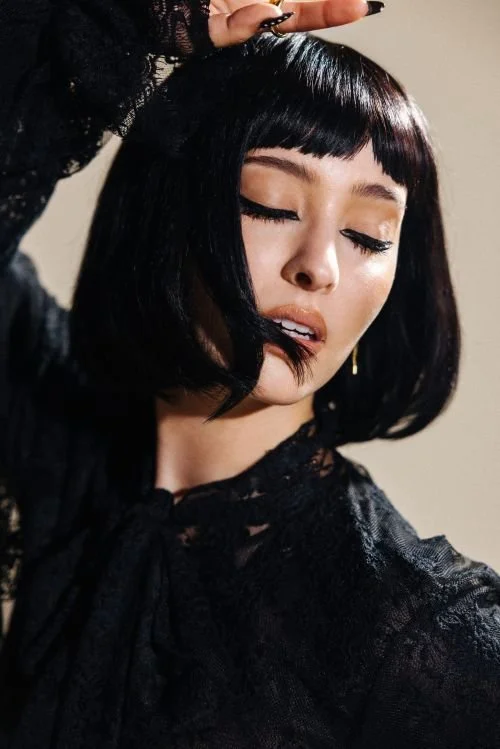
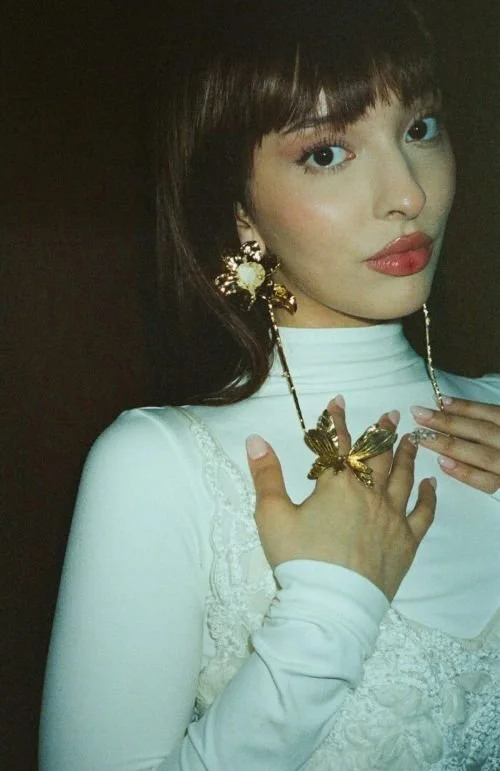
PHOTO CREDIT: Alejandra Hinojosa
Faouzia, as there is a lot of love and excitement around her. Many people are saying FILM NOIR is her debut album. I thought 2022’s CITIZENS was, though maybe that is classed as an E.P.? It is eight tracks, so I am a bit confused. In any case, I want to come to some interviews with Faouzia. The first I want to bring in is from Riff, as we get some useful and interesting background. This Moroccan-born artist and her upbringing really fascinates me. I discovered her earlier in this year and instantly connected with FILM NOIR. Dreamy, cinematic, and fusing Pop, R&B, Jazz and other sounds, it is a wonderful and instantly appealing blend. Faouzia’s Arabic heritage is key to her music. She sings in English, French and Arabic. There is so much depth and so many incredible layers and threads to her sound and artistry:
“Morocco-born, Manitoba, Canada-raised artist Faouzia Ouihya has been making music for the better part of a decade, racking up millions of streams alongside awards for her songwriting and her powerful mezzosoprano vocal range. But it took a split with her label to regain control of her vision for her sound and record a debut LP.
Faouiza’s parents moved her family from Casablanca to Montreal when the now-25-year-old was still a toddler. They quickly decided that big city life wasn’t for them, moving again to Winnipeg and then to the French-speaking small town of Carman, Manitoba, where her parents found work. Her younger sister, Kenza (her photographer and co-creative director), was born in Canada.
“My parents … restarted their lives completely from ground zero. They studied education and became teachers, and French was a much stronger language for them; they were still learning English from the ground up at that point,” she said.
The family never let go of its roots. The family home was decorated in Moroccan styles. They ate Moroccan food, wore Moroccan clothes, spoke Arabic at home and traveled back Morocco often.
“When I was at school, I was fully immersed in Canadian culture, but as soon as I stepped foot at home, which is where I spent most of my time, I was back in Morocco,” she said.
Faouiza grew up playing piano, violin and guitar, eventually starting a duo with her older sister, Samia (who’s now her manager). At home, she listened to a mix of Western pop, Arabic pop and classical composers like Chopin and Bach. All these influences appear in her own music.
She’d post original songs and covers on YouTube, which got the attention of many, including producer and DJ David Guetta, while she was still in high school. He asked her to sing on “Battle,” from his album 7.
Pursuing music in her spare time, she won first place at Nashville’s Unsigned Only music competition, and soon after, Canada’s International Songwriting Competition, beating about 16,000 entrants from 137 countries. She signed with her old label on her 18th birthday—not everything is meant to work out.
Still, she enrolled at the University of Manitoba, studying computer engineering, essentially learning to build computers from the ground up—hardware and all. At that point, the music began to take over.
“I did four years of it, and it got to a point where I was traveling too much,” she explained. “A lot of engineering is laboratories, and you have to be there in person. I pivoted to psychology because I wanted to do something that I could do by distance. Unfortunately, I actually did not finish. I just did a lot of it. I still wonder if it’s something that I will finish someday. I love school, and I think I will continue to pursue my education in other ways.”
In 2020, Kelly Clarkson asked Faouzia to remake “I Dare You” in Arabic, while Swedish duo Galantis featured her on “I Fly.” That same year, she recorded “Minefields” with John Legend. In 2022, she was nominated for a prestigious Juno Award for breakthrough artist in Canada. Since then, she released a couple of EPs and wrote a song (“Beg Forgiveness”) on Kanye West and Ty Dolla Sign’s album ¥$.
Then came last year, when her popularity exploded in the East after she appeared on a Chinese reality singing competition that pitted established artists from throughout the world (the U.S. was represented by soul singer Chanté Moore) against each other—and she made it all the way to the finals. There was even some controversy when many viewers expected her to win, but Chinese star Na Ying prevailed.
“I didn’t quite know what to expect other than it was fully live, and it was a show about showcasing your vocals,” she said. “Every week, you would sing a different song and prepare for it, but it was also like a reality TV show in the sense that there was a lot of interviews. Sometimes they would be so kind as to show you around different places in China and show you the culture, which was so beautiful. … Honestly, I’m happy that I made it this far. I’m happy that I made it to this point. As for the controversy, I really do think that it was a fair placement.”
This year has been all about getting to release her debut album for Faouzia, which includes singles “Peace & Violence,” “Unethical” and “Porcelain,” as well as nine more terrific songs, sung mostly in English but also in French and Arabic. While it’s definitely a pop album, Faouzia’s tonal inflections and musical choices, influenced by her family’s culture, make Film Noir—like much of her songbook so far—stand out.
“I don’t think about it at all. If those influences make their way into my music, it’s something that’s very natural, and I never want it to feel forced,” she said. “If it lends itself to the melody and the vibe of the song, then I think it’s important to have that in there. ‘Sweet Fever’ has hints and tastes of that, but it wasn’t something that was intentional. … That’s what I wanted for this album”.
Journalists have noted a duality to FILM NOIR. Soft, tender and velvet-like one moment, it is also guttural and explosive at times. Sung partly in French, it is an underrated masterpiece from last year. Stylish, cool, hugely accomplished and with a distinct and original sound that is rightly being heralded, FILM NOIR is such a phenomenal album. I want to move to The Honey Pot and their interview with Faouzia. This is an artist that every single music fan needs to listen to. You will be instantly struck by her music:
“Because the term film noir originally came from French critics dissecting American thrillers, the genre has this built-in idea of reflection and critique. After the three-year gap since CITIZENS and the global response to ‘MINEFIELDS,’ did you approach this record by “critiquing” what worked and what didn’t from the last era—or did you intentionally wipe the slate clean and start fresh?
After years of reflection and critique, I wiped the slate clean and started fresh. Almost in a “learn the rules to know how to break them” type of way. I followed my heart and wrote this album very instinctually. Every word stemmed from stories that were very personal to me, but crafted by skills that I learned along the way. I think my essence is present in this album because I led with my heart first, then my mind.
You speak English, Arabic, and French fluently—and we hear French spotlighted both in the voice-note outro and in ‘TOUS CES MOTS’—and you even wrote your first ever song in French at age six. What is it about French as a language that feels most creatively you?
French is my second language. I grew up speaking it at home and spent most of my education immersed in it, so many of my most formative memories live in French. It’s the language in which I first learned to express sorrow and depth, to give shape to feeling. There’s an inherent poetry in its softness and a quiet melancholy that made it the natural choice for the stories I needed to tell in this album.
Several tracks have that gorgeous cinematic build—the strings on ‘UNETHICAL’ feel like they’re doing the dramatic lighting. You’ve genre-blended before, but this time, working with Arthur Besna and F E R R O, how did you stay rooted in your sonic identity while leaning into those big, film-score moments?
A big part of my musical identity comes from big, dramatic instrumentals as well as classically-inspired pieces. It came very naturally to me to make this album in this world because it felt like “coming home” to what felt the most natural to me.
Finally, when listeners close the curtain on FILM NOIR for the first time, what do you hope they walk away feeling?
I hope they’ve connected to the music and can feel the depth and passion in it. I hope they can find solace in it”.
There are two more interviews I want to cover. EUPHORIA. spoke with Faouzia about FILM NOIR and the challenges she has had to overcome. I do really love her music and am looking forward to seeing what she does this year. FILM NOIR received so much attention. I am not sure if she is touring this year or what her next moves are. Faouzia is simply extraordinary:
“Your songs often blend emotional storytelling with powerful vocals — what’s your creative process like when you start a new song?
I have many ideas written down. Sometimes fully-fledged, and sometimes it’s just a line or even a title or word. I sit down at the piano or with an instrumental playing in the back and start to sing the first thing that comes out instinctually. I can normally tell what story these melodies beg to tell and start writing and re-writing the song from there.
Is there a particular song that feels the most personal or vulnerable to you on this album? And why?
I would say “UNETHICAL” or “PRETTY STRANGER.” Both are very vulnerable and personal in their own way, but feel tied to each other. “PRETTY STRANGER” is the bittersweet ending/response to “UNETHICAL.”
What was the most challenging song to write? And how did you overcome the challenge?
The most challenging song to write was technically “DON’T EVER LEAVE ME.” I have pages upon pages of rewrites for it, and came back to it months later after I abandoned it for a while. I just knew I had to finish it and that it had to be on this album, so I switched up the verse/pre melodies and tried over and over again until it was finished.
What has been the biggest challenge you’ve faced in your career so far?
Pushing through even when things don’t go as planned. Trying to stay true to myself with so many voices pulling me in different directions and not being able to release music the way that I wanted.
If you could go back and give advice to your younger self just starting out, what would you say?
I would tell her to trust her instincts and trust her vision because no one knows herself and her art like she does.
You often speak about empowerment and resilience — what inspires you to keep pushing forward?
Faith that what’s on the other side is always better than I could ever imagine”
I want to finish with an interview from The Luna Collective. They spoke with Faouzia around the release of the single, Hero. If you have not heard of Faouzia or are a bit sceptical of diving in, I can reassure you that her music is well worth investing in! With a lot of focus on mainstream Pop and a particular sound, maybe artists like Faouzia will go under the radar or be considered niche. However, she is so much more engaging and standout than so many other artists coming through. I feel we will see many more albums come from her:
“LUNA: What was your inspiration when it came to writing “Hero”? What was the creative process like?
FAOUZIA: I wrote “Hero” about setting healthy boundaries in your friendships and relationships. I have been in many situations where my friendships have felt very one-sided and it’s left me so drained. Over the past year I’ve learned to have people in my life that I know love will go both ways with.
LUNA: What do you hope listeners gain from “Hero”? Is there anything you are personally taking away from this single?
FAOUZIA: I hope listeners gain a sense of confidence in themselves and know that at the end of the day, they are their own hero. Self-love is so important, and I would say the most important. Once you love yourself, you can love someone else and accept the love that you deserve.
LUNA: What was your experience like with the choreography for the music video?
FAOUZIA: It was my first video doing a group choreo! I learned the dance in a few hours and the other dancers came by a little later. Once we started putting both parts together, I got so giddy since everyone flowed so beautifully. The dancers were so talented and kind and made the experience even more enjoyable. The choreographer definitely knew how to make me feel comfortable and worked around what looked best.
LUNA: In terms of who you are personally, if you could describe yourself in three words, what would they be?
FAOUZIA: Creative, passionate, loving”.
FILM NOIR was one of the greatest albums from last year. There is not much more that I can say, other than the fact you need to check out Faouzia. She has her own musical world that is so utterly engrossing. There is so much same-sounding music out there which means you get homogenisation. However, artists such as Faouzia are so much richer and more worthy I feel, as they offer the music world this much needed alternative. In a busy scene, there is nobody…
QUITE like her.
____________
Follow Faouzia
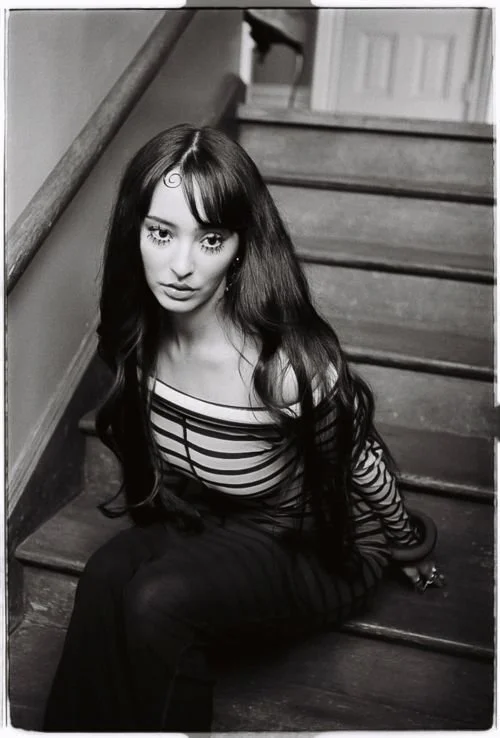
PHOTO CREDIT: Alanna Durkee
Instagram:
https://www.instagram.com/faouzia/
TikTok:
https://www.tiktok.com/@faouziaofficial
Facebook:
https://www.facebook.com/faouziaofficial/
Spotify:
https://open.spotify.com/artist/5NhgsV7qPWHZqYEMKzbYvo?si=Hn__6EsCQlSuS5IT8Ua_8Q
YouTube: