
FEATURE:
Resizing Those Red Shoes
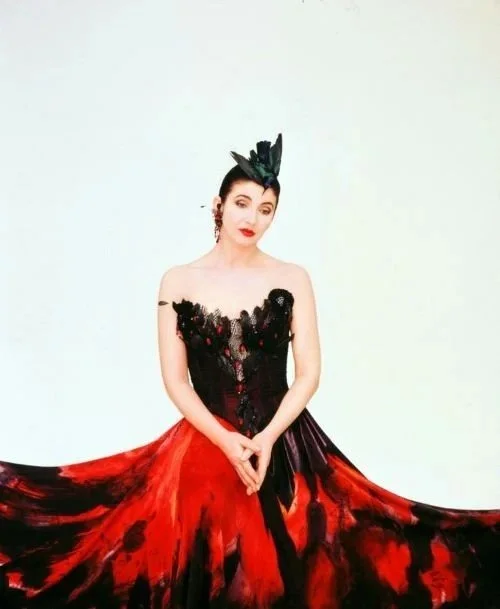
IN THIS PHOTO: Kate Bush in 1993 in a promotional photo for The Red Shoes
Reasons Why Kate Bush’s 1993 Short, The Line, the Cross and the Curve, Should Get a 2026 Screening
__________
THERE are perhaps…
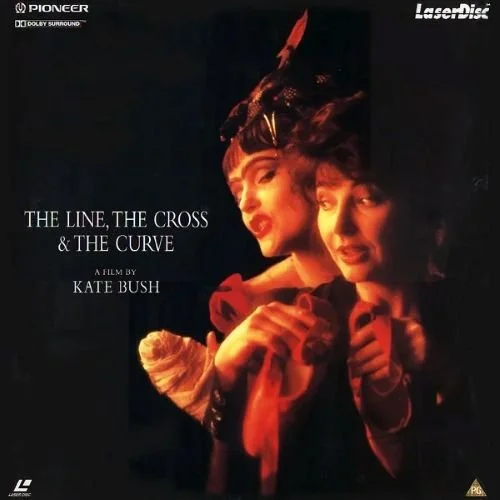
songs or moments from Kate Bush’s career that are perhaps not fantastic and do not warrant reinvestigation or upgrading to the wider public consciousness. There are not many, and I won’t name specific things, but there are maligned gems that I do feel are worthy of better. It may be a split between generations or the public/Kate Bush fans. Maybe the media dislike it more. I know Kate Bush herself is not a fan. I am not sure the last time she talked about it and whether her opinions have changed, but I think that she is seeing the thing with too much subjectiveness. Perhaps not appreciating the important and influence of the short film, The Line, the Cross and the Curve. One might ask how this practically unheard of and definitely unloved short is influential. I am going to mention this in detail when I return to Leah Kardos’s 33 1/3 Hounds of Love book. She dedicates a section on Kate Bush being the ‘First Woman’. In terms of achievements and records, Bush has set a few. One feat that I think goes beyond gender is the visual album. How many artists before 1993 had put out a short film that is essentially album tracks strung together around a story? Can you say The Beatles did that? I guess Magical Mystery Tour, Help! and A Hard Day’s Night could be called visual albums, though I would argue those are feature-length films where songs from the titular albums are woven in. Not visual albums themselves. I cannot bring to mind other artists who put out a short film that was like an album promotion rather than a separate film. We can quibble with technicalities, history and the cinematic musical archives. My point is, even if Bush feels The Line, the Cross and the Curve is a load of bollocks and not great, she is wrong! Critics have piled onto it, less because they genuinely think that it is rubbish. Their patented blend of misogyny, Schadenfreude and ignorance is a more prominent and factual explanation.
One thing I would say is that Kate Bush is an artist that desperately needs to upgrade her music videos. I noted this when specifically addressing this for a feature. Most major artists have done this. The Beatles have 4K/HD videos. Madonna has. David Bowie. Perhaps people think music videos are irrelevant now and it does not matter if they look great. However, music is and always will be a visual medium, and these videos are essential and part of history. In the case of Kate Bush, some of the videos look really shabby. Suspended in Gaffa looks particularly bad. If you search YouTube for 4K or HD videos of hers, the ones there are by fans. They are not authorised or official and, to be fair, a lot of them look really terrible. How has Running Up That Hill (A Deal with God) not been upgraded by Bush for YouTube?! Look at the thumbnail/screenshot of that video on YouTube and it looks blurry. Bush is a huge music video fan and she has remastered her albums and reissued stuff. Why are music videos not being given some much needed restoration and renovation?! Such a visual artist whose videos are so watchable, in many cases, you get these grainy, lower-quality and lo-fi examples that could be switched to HD. I know there are examples of her website that are HD, but they have not been transferred to YouTube for some reason. I am going off on a bit of a tangent! It connects into The Line, the Cross and the Curve. I know a fan has done their HD version of the short. It looks a bit plastic and inauthentic. I am not sure how they do it, though I would like to hope that Kate Bush will recognise the brilliance of the 1993-premered film and give it a modern-day overhaul and gloss. Even though it is not perfect and there are some definitely issues – Bush bringing in another director (she directed, wrote and starred in the short) would have freed her up and a more experienced film director could have given her advise on her acting and performance -, I think there are some standout, stunning moments!
Kate Bush does that, unfortunately. She is dismissive towards her first two or three albums, even though they are wonderful. I can appreciate that she took on a lot and it was perhaps not the right time to make a short film. Her view on The Line, the Cross and the Curve has become more explicit and less nuanced as years have gone by. However, she did say this in a 1993 interview with Now Magazine: “In a way, it was very restrictive because it’s not my conceptual piece from scratch. Also, I’m working around the songs and I had to put myself into the film. I would’ve preferred to cast myself in a smaller role. It wasn’t the ideal situation because it was very rushed and we had little money. But it was an intense project. And I’m very glad I went through it, even if the film is not received well, because I learned so much. The film is really interesting. There are eight tracks in it, though three of them are The Red Shoes. That is the 1993 album it is tied to. The sister project. We have two incidents of the track and an instrumental. The others are Rubberband Girl, And So Is Love, Lily, Moments of Pleasure, and Eat the Music. Like with The Red Shoes, I think sequencing is one of the issues. That album is too top/middle-heavy, so you have a final four or five tracks that are mostly made up of lesser or less-known songs. All the biggest and best are done with in the first third or two. In terms of the story arc and the music sequencing, I would have had Eat the Music higher and Rubberband Girl lower. However, not one to criticise Bush’s script and her vision! Though it got its wider release in 1994, it was near the end of 1993 when it was premiered (less than two weeks after The Red Shoes arrived):
“The Line, the Cross and the Curve is a musical short film directed by and starring Kate Bush. Released in 1993, it co-starred Miranda Richardson and noted choreographer Lindsay Kemp, who had served as dance mentor to Bush early in her career. The film is essentially an extended music video featuring songs from Bush’s 1993 album, The Red Shoes, which in turn was inspired by the classic movie musical-fantasy The Red Shoes.
In this version of the tale, Bush plays a frustrated singer-dancer who is enticed by a mysterious woman (Richardson) into putting on a pair of magical ballet slippers. Once on her feet, the shoes start dancing on their own, and Bush’s character (who is never referred to by name) must battle Richardson’s character to free herself from the spell of the shoes. Her guide on this strange journey is played by Kemp.
The film premiered at the London Film Festival on 13 November 1993. Kate got up on stage before the screening to thank “everyone who’d been a part of making the film” and to speak of her trepidation because her opus was following a Wallace & Gromit animation by Aardman called The wrong trousers. Subsequently, the film was released direct-to-video in most areas and was only a modest success. Soon after its release, Bush effectively dropped out of the public eye until her eighth studio album Aerial was released in November 2005.
Two years after UK release, due to the late promotion in the US, the film was nominated for the Long Form Music Video at the 1996 Grammy Awards. The film continues to be played in arthouse cinemas around the world, such as a screening at Hollywood Theatre in 2014 where the film was screened along with modern dance interpretations to Bush’s music”.
I mentioned it almost in passing for another feature. How there should be a screening of The Line, the Cross and the Curve. Maybe Kate Bush would not permit it. However, as there are fans that love the short, a limited run at smaller cinemas would be amazing. Not tying it to big anniversaries – as everything has to be these days, and it means we have to wait until 2028 or 2033 to celebrate it on that basis -, I think this is something that needs to be seen and re-examined. Kate Bush’s acting is not as fine as Miranda Richardson’s, but that is no shame, as Richardson is one of our greatest ever actors! I think that Kate Bush is an eminently watchable screen presence and it is incredible seeing her in a film. Outside of music videos and interviews, this is a unique experience where we get to see Bush act in something she wrote. Bush’s ‘film career’ is brief-cum-non-existent. She was offered a load of stuff but always turned it down and focused on music. It is tantalising to thing what could have been if she had made a concession for a genuinely great film role. However, as Bush wanted to do a film around Hounds of Love’s The Ninth Wave and never did – she brought it to the stage in 2014 for Before the Dawn, but there are limitations that you do not get with film -, The Line, the Cross and the Curve is a unique example of Bush being in a film – even if it is only just over forty minutes.
I think context and personal circumstances blur the lens somewhat. Bush and critics dismissing it was of its time and subjective. Lacking energy and perhaps in desperate need of stepping away from the public eye, The Line, the Cross and the Curve is not as complete and accomplished as a Kate Bush film from 1985 or 1989 would have been. However, there are some stunning visual moments and beautiful acting examples that elevate this beyond the trashcan of cinema and warrants fresh inspection. I did write about this back in 2023, but I want to add something new to the mix. Bush’s recent Christmas message saw her thank everyone who donated to War Child and watched her Little Shrew (Snowflake) video. She also shouted out the Duffer brothers and Stranger Things. Running Up That Hill (A Deal with God) is used again. Both film examples and works where Bush is very proud of what was achieved. I think we can make a connection here. Little Shrew (Snowflake) is designed to raise money for War Child. Max in Stranger Things uses Kate Bush’s music as a totem and source of strength. I think, if there was a screening of The Line, the Cross and the Curve and ticket fees went to War Child, it would appeal to Kate Bush. Also, I do think there are similarities when it comes to Max’s story and arc around Running Up That Hill (A Deal with God) and some of the visual, scenes and storyline from The Line, the Cross and the Curve. Bush is a huge film and T.V. fan. As Stranger Things especially has brought her music to a new audience, I do think it would be naïve to overlook her 1993 film and its impact regarding drawing people to her music once more. Sure, the final piece is not as good as she would have hoped, and there are problems – I still think the sequencing of the videos and the plot hindered things; a slightly tweaked narrative and running order could have led to a stronger film -, but perhaps a one-off screening in London to raise funds for charity would at least mean Bush does not have to live with the film again for too long! Fans could wear red shoes or there could be some Barbie-level cosplay and colour-specific outfits choices – the Barbie pink replaced with The Line, the Cross and the Curve red -, and it would be great to enjoy this film that remains practically unloved and disregarded. I would imagine Bush is at least more ambivalent and less narked now than she was even a few years back. Also, as she did her 2014 residency and there was a screened/visual component to that, she did not abandon film or that medium when it comes to representing her work.
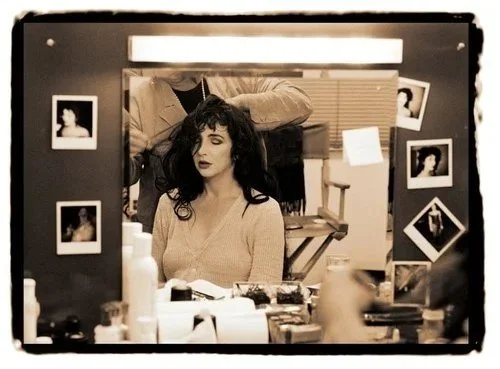
IN THIS PHOTO: Kate Bush in the make-up chair whilst filming for The Line, the Cross and the Curve in 1993/PHOTO CREDIT: Guido Harari
I would love to see The Line, the Cross and the Curve upgraded and looking great. Show it at London’s Regent Street Cinema as a matinée and give the proceeds to War Child. If that argument is not strong enough for Bush to reverse her apathy and indifference towards thew 1993 film, I will end by discussing how it may well have influenced some of the biggest modern artists. However, before that, a feature-nick verbatim. I am going back to Collider and their 2022 defence of The Line, the Cross and the Curve. A ‘defence’ makes it sound like a so-bad-it’s-good film that should only be shown in the darkest and most off-piste screens. Shane Stahl made some excellent and well-observed points about a part a film that I feel is cannon:
“Created as a promotional tool for her 1993 studio album The Red Shoes, this short film is a spin on the classic fairy tale of the same name, in which a young woman puts on a pair of enchanted shoes that cause her to dance unceasingly until and unless she can find a way to remove them. Here, we open on Bush's character in rehearsal with her band until a power outage causes them to take a break. Left alone in the studio, Bush is suddenly confronted by a dark and mystical dancer played by two-time Oscar nominee Miranda Richardson, who implores Bush to help her break the curse of the red shoes by drawing three symbols—the titular line, cross, and curve. However, Richardson's ulterior motive soon becomes clear—by receiving the symbols, she passes the curse onto Bush, and flees through a mirror. Bush pursues her and finds herself in another dimension (an Upside Down, if you will), soon greeted by an otherworldly figure portrayed by British dance legend Lindsay Kemp. He tells her she must "sing back the symbols" to break the curse. After visiting an elderly woman named Lily who gives her advice and comfort, Bush draws on the memories of her loved ones to guide her closer to Richardson's twisted prima ballerina. Giving herself over to the sounds of a jubilant choir, Bush is able to regain the symbols, rid herself of the curse, and escape through the mirror, leaving Richardson crushed under the weight of a cave in with only her feet, once again bearing the accursed shoes, sticking out.
Bush had long expressed a desire to collaborate with famed British director Michael Powell, director of 1948's The Red Shoes, itself an interpretation of the classic tale told through the lens of a modern ballet company. However, the two were unable to work together before his death in February 1990, though the inspiration she drew from the film is clear. In essence, the film is en extended music video; it would end up receiving a 1996 Grammy nomination for Best Long Form Video. A recording artist first, Bush's primary storytelling convention is the music itself, and her material is successful in helping express the short's larger narrative arc, taking us through sonic and visual peaks and valleys.
Lead single "Rubberband Girl" kicks off the film—its percussive, steady beat catches the viewer's attention immediately, accompanied by Bush being virtually puppeted by a fellow dancer through a series of simple but effective movements. The whole setup is decidedly unglamorous, a stark contrast to what awaits us shortly. Following the power outage, Bush lights a single candle, drawing us into the atmospheric and moody timbre of "And So Is Love," which also features first-rate guitar work by Eric Clapton. Sensual and dark, it's in direct opposition to the chaotic energy of Richardson's character, a vision in red and black who we meet at the song's end. As she woos and convinces Bush to help her, we hear the album's title track, "The Red Shoes," all Irish jig and pan flute, filled with frenetic and enticing rhythm. Soon, Bush is cursed with the shoes, becoming her own red and black vision, venturing into the mirror dimension and pleading for help. "Lily," named after the wise elderly woman who helps guide Bush on her journey, is a prayer of strength, promising to help Bush "protect herself with fire." Soon, we hear the instrumental strings of the title track once more, and all hope seems lost until Kemp's specter implores Bush to "call on the strength of the ones you love." This leads to the most beautiful song in the film, "Moments of Pleasure," whose lyrics about, "Just being alive/It can really hurt/And these moments given/Are a gift from time" hold perhaps even more significance in light of a world still in the clutches of a pandemic. The final track, "Eat the Music," is a joyous ode to self-expression, self-love, and falling under the spell of the drum, accompanied by Bush swaying along to the sound of an ebullient chorus and visuals of abundant fruit—a signal that the spirit has once again bloomed in her, breaking the curse and allowing her to return to this mortal coil.
Though Bush was reportedly displeased with the final product, it's an artist secure enough in her own power and vision that can create an ambitious piece of film alongside an equally ambitious album. Not one afraid of revisiting her old work, Bush would rerecord a majority of the album's tracks for her Director's Cut project in 2011, and "Lily" would serve as the opening number of her 2014 residency Before the Dawn. As more and more people begin to discover the Kate Bush library, this is the ideal time to take in this fascinating, unique piece of cinema featuring of one of music's most unique artists”.
Coming back to what I said about Leah Kardos and her 33 1/3 book for Hounds of Love. In the section where she discusses Bush as a female innovator, she mentions how The Line, the Cross and the Curve could conceivable be seen as the first visual album. Like I said, I don’t think artists were doing this prior to 1993. Think about two major artists who are definitely influenced by Kate Bush, even if they do not discuss her. One is Beyoncé. Whilst she had a larger budget and was working with arguably a better album, Lemonade (2016) is essentially a visual album. You can draw a line between that and The Line, the Cross and the Curve that goes beyond coincidence. I do think Bush influenced Beyoncé. In the same way Madonna was praised as being the ‘first’ major Pop artist to use a wireless headset for her tours (notably 1990’s Blond Ambition World Tour), Bush did it first in 1979 for The Tour of Life. Also, I saw a lot of people saying Beyoncé was the first major female artist to make a visual album. Bush got there twenty-three years before! Lemonade turns ten later this year (23rd April), and I will write about it closer to the time. You can read more about the Lemonade film here. Another global superstar influenced by Kate Bush who needs to mention it now and then is Taylor Swift. In more ways than once, Swifties owe a certain amount of love to Kate Bush. Taylor Swift | The Official Release Party of a Showgirl from last year could tie to The Line, the Cross and the Curve. Other major artists who have released albums and work that is more visual/narrative-driven include Halsey, Janelle Monáe and Frank Ocean. Could one say Janet Jackson's Rhythm Nation 1814 of 1989 was a visual album? I don’t remember it being one, though A.I. says it is. Though they are f*ckign unreliable, so I am still saying Kate Bush was at least the first woman to get there. Ed Sheeran did a visual album for Subtract in 2023. You can read about it here. Arguably among the most influential artists of the past two decades. The Line, the Cross and the Curve is more influential and worthy than critics, some fans and Kate Bush give it credit for! Screening it and raising money for War Child would not only bring fans together in a way that has not been done for many years. Conventions are not really a thing, and tribute shows or charity nights bring together maybe dozens rather than hundreds. In any case, making it an event where we could get fans together to admire a film worthy of more would be brilliant. It would also highlight its influence and pioneer qualities. Upgrading/restoring the film might push Kate Bush to do the same with music videos, and any extra money for War Child is a bonus. In a year where we do not need and will not have album remasters and anything like that, it is a perfect opportunity to remaster and reappraise something owed it…
MORE than thirty-two years after its release.