FEATURE:
Consideration
Rihanna’s ANTI at Ten
__________
PERHAPS the best album…
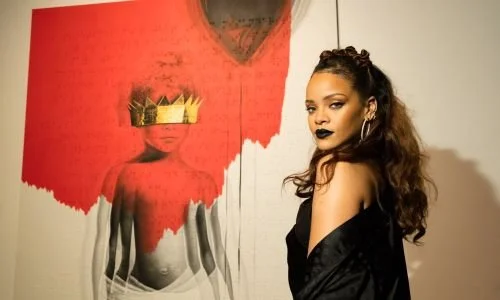
PHOTO CREDIT: Christopher Polk/Getty Images
from the legendary Rihanna, I think ANTI is at least her most significant. Rihanna started recording ANTI in 2014 after departing from Def Jam Recordings, who had released all of her albums since her 2005 debut. Released on 28th January, 2016, I wanted to mark ten years of this phenomenal album. One of the best of a year that provided us with more than a few masterpieces, I will come to the legacy of the album and explore some of its critical reviews. However, there are some features that I want to get to before any of that. Multi-platinum-selling in the U.S., ANTI reached the top of the album chart there in 2016. It is a worldwide smash that I think was a big step up from her seventh studio album, 2012’s Unapologetic. Even though that album features Diamonds and boasts one of the best album covers ever, I feel ANTI trumps that brilliant release. Also, the cover for ANTI is pretty damn good too! Also significant is that ANTI is the most recent album from Rihanna. There have been rumblings and rumours regarding a ninth studio album. However, as Rihanna has been busy with family and other commitments, maybe we will not see anything for a while. However, she could surprise us and release a new album this year! With the lead single, Work, coming out the same day as this album and creating a double hit, Rihanna dropped one of her most iconic songs to show how great ANTI was! There were critics who said ANTI was too genre-hopping and confused. I will introduce features that argue why ANTI was a lot stronger than many gave it credit for. Although there is no release date or new news for R9 and whether that will arrive, we can look back on ten years of ANTI. Last year, Rihanna did say ANTI is the only album of hers she listens to top to bottom with no shame. NME were among those who reported it:
“Rihanna has revealed that ‘Anti’ is the only album of hers that she can listen to without “shame”.
The record, which turned nine last month, featured huge hits like ‘Kiss It Better’ and ‘Work’, and topped the Billboard charts for two weeks. It went on to remain on the charts for an impressive 456 weeks.
Since then, Rihanna hasn’t released another album, though she has shared two songs – the last being 2022’s ‘Lift Me Up’, which was written for the Black Panther: Wakanda Forever soundtrack and a tribute to late actor Chadwick Boseman.
Now, in a new interview with Harper’s BAZAAR, she revealed that the 2014 record is her favourite from her discography.
“I listen to ‘Anti’ from top to bottom with no shame. I used to always have shame. I actually don’t like listening to my music, but ‘Anti’ — I can listen to the album,” she told the magazine.
“It’s like it’s not me singing it, if I’m just listening to it. That’s the one album that I can have an out-of-body experience where it’s not like … You know when you hear your voice in a voicemail, and it’s like, ‘Ugh’”.
There is a lot to cover off which I hope gives background to the album, explore its legacy and gauges what people thought of the album. How it was reviewed in the context of music and Rihanna’s career in 2016, and how that has changed in years since. I am starting with Rihanna’s cover interview for Vogue, which is one of the most interesting interviews with the Barbadian superstar. Of course, as the music media cannot resist pitting women against one another, Rihanna was being pitted against Beyoncé, whose Lemonade album came out in April 2016. This Vogue interview was published in April 2016:
“After her last tour, in 2013, for Unapologetic, Rihanna vowed to take a break from recording. “I wanted to have a year to just do whatever I want artistically, creatively,” she says. “I lasted a week.” The paparazzi got a picture of her going into the studio, “and my fans were like, ‘Oh, yes! We’s droppin’ a single.’ ” From that moment, she says, the Navy was expecting an album. It would be another two years.
Turns out it takes a while to reinvent your sound. As Delevingne says, “Anti’s got its own genre, and that genre is her.” Had Rihanna gotten bored with the pop formula? “Very much,” the singer says. “I just gravitated toward the songs that were honest to where I’m at right now.” From the first song, “Consideration,” a trip-hop collaboration with SZA, the message is clear. The chorus has Rihanna singing, “I got to do things my own way, darling.” It’s “like a PSA,” she tells me. She recognizes the risks: “It might not be some automatic record that will be Top 40. But I felt like I earned the right to do that now.”
Avoiding the bravado and easy hooks of past hits, another song, “Higher,” reveals a woman who’s been burned by love. Rihanna compares it to “a drunk voice mail.” She explains, “You know he’s wrong, and then you get drunk and you’re like, ‘I could forgive him. I could call him. I could make up with him.’ Just, desperate.” The candor is heightened by a husky, soul-inflected warmth. “We just said, ‘You know what? Let’s just drink some whiskey and record this song.’ ”
Then there’s “Work,” on which she repeats the word work until it is no longer recognizable, a flourish one critic called “post-language.” While it evokes a technofuture, it’s actually a nod to her home culture in Barbados. (Though Rihanna now splits her time between New York and L.A., her ties to the island remain strong. She is close with her mother, Monica Braithwaite, who owns a clothing boutique there, and with her maternal grandfather, Lionel Braithwaite, a frequent star of her Instagram feed.) “You get what I’m saying, but it’s not all the way perfect,” she says. “Because that’s how we speak in the Caribbean.” In the accompanying video she made with Drake—“Everything he does is so amazing”—Rihanna grinds and jerks in a knitted Rasta-colored Tommy Hilfiger dress at a raucous dance-hall party, the kind “we would go to in the Caribbean and just dance and drink and smoke and flirt,” with her real-life best friends, Melissa Forde and Jennifer Rosales.
There have been a few singles dropped along the way, including “FourFiveSeconds,” an acoustic collaboration with Kanye West and Paul McCartney. “It’s almost like no one ever told him about his success,” Rihanna says of McCartney, whom she found to be endearingly humble. “It’s like, Aren’t you busy being a Beatle?” Last spring brought “Bitch Better Have My Money,” an over-the-top revenge fantasy whose video walked the line between empowerment and misogyny. “It’s just a way to describe a situation,” she says. “It’s a way to be in charge, to let people know that you’re all about your business.”
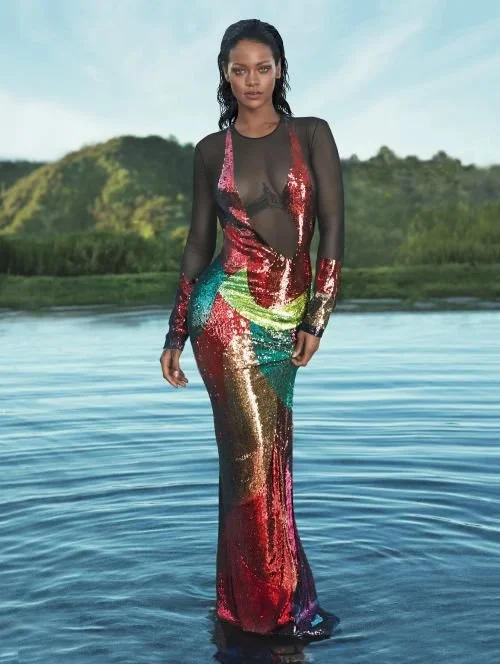
PHOTO CREDIT: Mert Alas and Marcus Piggott for Vogue
Over the past two years, Rihanna has definitely been all about her business. After fulfilling her contract with Def Jam, she created her own imprint, Westbury Road Entertainment, on Universal’s Roc Nation label. In a bold move, she then acquired the masters of all her previous albums and made a reported $25 million promotional deal with Samsung. Robyn Rihanna Fenty, the island girl plucked from obscurity at sixteen by a posse of music moguls, is becoming one herself. It’s because she’s so attuned to the seismic changes in her industry that she also bought a share of Tidal. “Streaming counts now,” she says. Like any savvy businesswoman, Rihanna knows it’s important to diversify. Last fall, she announced a new venture, Fr8me, an agency representing stylists and hair and makeup artists. She has a passionate interest in beauty and often scouts her own talent on Instagram.
In the midst of all this, she somehow found time to take a role in Valérian and the City of a Thousand Planets, a film based on a French comic series. Directed by Luc Besson, it costars Dane DeHaan and Delevingne and is due out in 2017. Speaking by phone, Besson is reluctant to give too much away about her character, except to say that her personality changes “every fifteen seconds.” “As you can imagine, because she’s number one in her business, she has a protection, like a crocodile,” the director says of Rihanna. “But she really let herself go. I was so touched by her.”
Earlier at the house, two men in suits arrived from the Recording Industry Association of America to present Rihanna with two plaques: one certifying Anti’s platinum status, the other commemorating a benchmark she reached last July, when she became the first artist in history to reach 100 million downloads online. (In another sign of the turbulent state of the music industry, reports will later cast doubt on Anti’s platinum status, pointing out that the RIAA took into account one million giveaways that were part of the Samsung deal.) Rihanna seems genuinely surprised by the accolades. “In flats and sweats!” she says, stretching out a leg. “If only I knew they were coming, I would’ve at least put on a cute little thing.”
With the sudden release of “Formation” during Anti’s week of ascendance up the charts, it’s no wonder the Internet is pitting Beyoncé and Rihanna against each other. But that’s not how Rihanna thinks. “Here’s the deal,” she says. “They just get so excited to feast on something that’s negative. Something that’s competitive. Something that’s, you know, a rivalry. And that’s just not what I wake up to. Because I can only do me. And nobody else is going to be able to do that”.
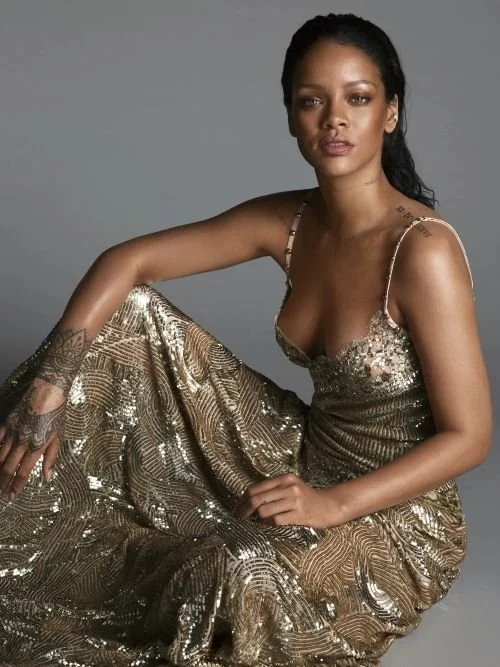
PHOTO CREDIT: Mert Alas and Marcus Piggott for Vogue
This fascinating article from NPR was published in February 2016. A month after ANTI arrived and was receiving all this attention and sometimes mixed press reaction, this was a considered and fascinating piece. Looking into the meaning of the title and why Barbados and the Caribbean is central to us when trying to understand Rihanna:
“The release of Rihanna's much anticipated Anti was a mistake. Or it was on purpose? The album is "adrift," "confused," "not what we expected at all." What's Rihanna doing anyhow? Review after review has seemed to struggle with the Barbadian superstar — the coolest girl in the world is being just plain frustrating. But maybe that's the whole point.
"That all these songs exist side by side reaffirm that Rihanna is our least aesthetically consistent — least aesthetically committed? — major pop star", wrote Jon Caramanica in The New York Times. But could it not be that Rihanna's aesthetic project might be consistently committed to representing Barbados and the Caribbean? As Rihanna's fame grows, there seems to be less and less of a reference to the relevance of her Bajan roots. Yes, she's super popular worldwide — despite the bumpy release of Anti, the album sold 124,000 copies last week, making it Rihanna's second No. 1 album — but she is also from Westbury Road, Bridgetown, Barbados. And this matters. To understand Barbados and the Caribbean is central to understanding Rihanna.
"Rihanna wants to remind us of those Caribbean, Barbadian roots," says Heather D. Russell, co-editor of Rihanna: Barbados World-Gurl in Global Popular Culture a 2015 book of scholarly essays on the phenomenon that is Robyn Rihanna Fenty, the most famous Bajan on the planet. Rihanna shouts out Barbados at awards shows, features her island home in videos, makes sure she's always back home for the annual Crop Over Carnival, and soundtracks perfume launches with local soca. These roots in the Caribbean, however, are arguably front and centre on Anti, and it's not just because there's a cover of a 20-year-old dancehall reggae riddim that's the foundation for the first single, "Work."
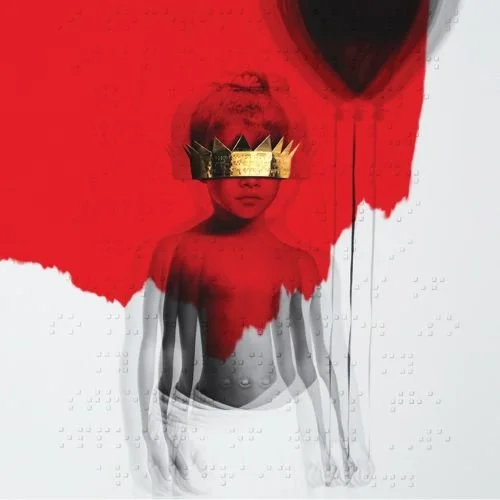
Featured prominently as part of the album art — and featured in much of Rihanna's recent self portraiture — is the crown of Neptune. It's hard not to see this as a direct reference to the trident on the Barbadian flag. And on the wall of the first "room" in the Samsung-sponsored series of "ANTIdiary" videos — a room filled with white sand that would match the beaches in Rihanna's home country — is a crayoned map of the world with Barbados, indicated in big letters, clearly between America and Africa. The historical relationships are not hidden.
The album is called Anti. It's anti-establishment, anti-expectations, but it's also anti-colonial. Is Anti also a wide-ranging commentary on relationships? Sure it is. That's part of what makes it a consistent, coherent representation of the postcolonial. It doesn't have to be (or want to be) one thing. Rihanna is a one-woman argument for the importance of cultural studies.
Jamaican-born cultural studies scholar Stuart Hall revolutionized his field by calling for the decoding of meaning from popular messages. From this perspective, Anti provides perhaps Rihanna's most obvious pop music expression of postcoloniality. There are layers to the lyrics, the videos, the imagery on her Instagram to decode. "I do advise you," Rihanna sings, "Run it back, run it on back, when you breaking it down for me".
The struggle that reviewers seem to be experiencing seems to really be a struggle with language to frame her artistic output. The use of the fraught, exoticizing term "tropical" is emblematic of this difficulty to describe. People don't know what to do with Anti and its lack of coherence. "And I think that's radically Caribbean!" exclaims Russell. "They want to fix it into defined, pre-determined categories and they can't. That resistance to conformity, that resistance to needing and pleasing and placating the global marketplace is absolutely very much situated within her context. Anti is actively telling you, song after song, that it's not trying to fit."
Rihanna plays with her positionality as Bajan and Caribbean, but also American. She's a huge star in the U.S.A., but she's still speaking from foreign. The chemistry that exists between the Canuck Drake and the Bajan Riri is well acknowledged, but could it also be explained by seeing how the two are consistently speaking from spaces as outsider insiders? Canada and Barbados exist externally to the juggernaut that is American culture, but Aubrey Drake Graham and Robyn Rihanna Fenty have been able to navigate the waters of the U.S. pop music industry. Their collaborations, with "Work" being the most recent, act as a story of negotiation and navigation: from a ditty demanding name recognition, to a promise to protect each other through to Anti's acknowledgement that continued resistance takes work. Cultural studies demands we take a look at this; saying "it's only a song" holds us back from valuable analysis. The fact that she seems to continually produce these complicated cultural products means that it's not possible to deny layers. Discussions of Anti in the context of how the pop music industry functions or should function leaves out the possibilities of situated, nuanced arguments that place her solidly within the frameworks of Barbados world girl.
Guyanese-Canadian poet Cyril Dabydeen has written of the "many selves" of Caribbean migrants. Rihanna presents a consistent, coherent aesthetic representation of this multiplicity of identities. She experiments with style, image, voice; evoking roots and staking out routes while challenging colonial, Caribbean and gender narratives, resisting fixity at every turn. And all this takes work, work, work, work, work”.
This review from 2021 is sort of mixed, though I think it is constructive. That is why I wanted to bring it in at this point. I know there will be think pieces and new assessment a decade after ANTI’s release. Especially considering recent records it has broken, Rihanna saying it is the only album of hers that she listens to, the way Pop has evolved since 2016, and the fact it has been nearly a decade since we have had an album from Rihanna. Maybe critics who were lukewarm towards ANTI when it was released might reassess their opinions:
“Anti fared well on its release, despite what was one of the messiest promos and rollouts I think I’ve seen for an album. But I do wonder if Anti would have fared differently if released now, at a time when streaming is a complete norm, and attention spans seem to be at their shortest when it comes to music and consumption of pretty much anything online. Anti being as scattered as it is, with such short songs, feels like an album for a moment in music such as now. It’s probably why the album charted for as long as it did, and why it continues to be an album that people play and discover even now - more than for the reason that people are starved for a new Rihanna album. But the sound of Anti as a whole feels more curated for now than it did in 2013, when mumble singing and rapping was nowhere near as popular as it is now. In a few short years, mumble R&B and mumble rap has pretty much become a genre unto itself, with mumble queen SZA, Travis Scott and Migos all being insanely popular. Even pop acts are catching onto it and doing their own versions of it, just listen to some of Charli XCX’s material from when she started working with PC Music.
Anti is another instance of Rihanna being ahead of a trend, and she and her team knowing who to tap at a given moment. It’s absolutely no coincidence that SZA and Travis Scott both have songwriting and production credits on this album for “Consideration” and “Woo” respectively, and that they’re huge stars now. This album also features the songwriting talents of The Weeknd, just as he was popping off. And there’s even a cover of a Tame Impala song, an act who was always known, but having Rihanna cover one of his songs undoubtedly put a fair amount of people onto him - especially considering that “Same Ol’ Mistakes” is an album highlight for so many.
Whilst it’s easy to dismiss Anti as being a mess and a little unfocused, it really does show that Rihanna has a very hyper specific taste level, and that even in moments where the plan isn’t clear, there is still a focus and an intention. She may not have always had as much control over some of her previous albums, but she definitely learned a few lessons and adopted them along the way to put Anti together. And one thing which has certainly carried over from her previous albums is amassing an impressive roster of talent to write and produce. Do not let the lack of big obvious singles or the lack of Stargate, Dr. Puke and Calvin Harris get anything twisted. The talent on this album is stacked. SZA, Travis Scott, The Weeknd, James Fauntleroy, The-Dream, PartyNextDoor, Starrah, Hit-Boy, Jeff Bhasker, Boi-1da, Noah "40" Shebib, Timbaland, No I.D, Shea Taylor, Brian Kennedy, and an up and coming Bibi Bourelly. The only other female artist who could amass talent like this for one album is Beyoncé.
Anti is an album about making a statement, and it does so in ways that I think Rihanna’s previous albums didn’t. They were fun, they had some cool songs, and each album spawned singles which were far more responsible for pop trends and shifts in music than most care to admit. But Anti is about stepping away from that. It’s about Rihanna trying to cultivate something which feels a lot more honest to her.
As much as I value the honesty in this album, there is a lack of polish about it, which is something that I’m sure will be subjective. Sometimes the roughness around the edges is fine. I can imagine that it felt liberating for Rihanna to not feel that she has to chase a song which is so prim, proper and perfect for radio. Other times I feel that it prevents songs, which are already really good songs, from being the best that they could be. Some songs feel like they’re cut short, or were straight up unfinished. “Consideration” is quite literally an album intro, clocking in at just under 3 minutes and just ending. “Higher” has Rihanna giving a vocal performance which hurts my throat just listening to it. But the main offense this song causes isn’t Rihanna’s dry throat vocals in all of the wrong keys, but how the song is like a preview. “James’ Joint” is the only short song on this album which feels like it ends when it should and was intended to just be a short lil’ interlude. The others genuinely sound like unfinished songs. And even some of the songs which are of your average song sound incomplete. “Kiss It Better” is a great song, but it feels overly repetitive, and could have done with an additional verse or a middle-8 with a killer electric guitar solo. “Pose” is a really fun song, but again, it feels like it’s cut short. Like it’s an unfinished demo. "Yeah, I Said It" is a fuck record, but its 2 minutes and 13 seconds long, when it shoulda been 5. Who is fucking in 2 minutes!? Not every song has to be 4 minutes long and take me on some magic carpet ride, but regardless of whether a song is 1 and half minutes long or 4, it should feel complete, like it has a beginning, a middle and an end. Rihanna really said ‘Fuck it, I’m done’ on half of these songs.
Then there’s Rihanna vocals. They’re all over the place. Sometimes she sounds great. Sometimes she sounds awful. Sometimes I don’t know what I’m even listening to. The saving grace is that Rihanna’s energy at the very least always matches the song. She sells every song on this album, even when she’s sounding like a piece of shit. The vocals on “Higher” are TERRIBLE. But she still has me waving my handkerchief in the air with my good Sunday hat on. It really is a testament to the conviction that Rihanna is able to sell when she approaches music, which isn’t something that she’s always had. Her lack of conviction and giving herself to her music completely is what made Rated R such a lacklustre album for me, because Rihanna didn’t really give a lot of those songs what they needed. Where-as now, I feel like she could do songs like “Hard”, “Rockstar 101” and “G4L” a far greater justice.
Anti might just be one of Rihanna’s best albums. Not only is it a collection of good songs (albeit some incomplete), but they all form a solid body of work in ways that Unapologetic and Talk That Talk didn’t. And you can feel that Rihanna’s heart is in these songs, in a way it wasn’t for the whole of Loud.
Anti is one album in Rihanna’s discography which I feel accurately captures her as she is, and not what other people want her to be. For how off the sequencing of the songs on Anti are, the narrative of it is still clear, as is what Rihanna wanted to achieve with this album, which is freedom from expectation. And what Anti also shows is that Rihanna could pivot right back to pop if she felt like it, or do something different. What will make the album isn’t so much the sound, but the energy and the vision she brings to it. Rihanna was always seen as a fearless artist, but I never really saw it in anything she’d released before. But in Anti, I see it. The bottom line with Anti is that Rihanna gon’ do what the fuck she likes, and everybody gon’ have to deal with it”.
Just before getting to ANTI’s legacy and why it is breaking records, I want to drop in this feature from last year. Highlighting the ways in which ANTI is a revelation and hugely important album, they write how “After ruling the charts for over a decade, Rihanna was ready to leave the pop assembly line and get personal on her eighth album, ‘Anti’”. I think that ANTI is one of the best and most significant albums of the 2010s:
“Despite a meticulous launch plan, Anti leaked on January 27, 2016 – the same day the singer dropped its first single, “Work,” and two days before the album’s scheduled release date.
Though “Work” shared similar dancehall DNA to Rihanna’s previous albums, it saw her pay tribute to her Caribbean roots in more than just production. Singing in Jamaican patois, Rihanna confused most international listeners, who initially wrote off the lyrics as gibberish. In the same Vogue interview, however, the signer explained how “Work” was one of her most authentic singles: “That’s how we speak in the Caribbean. It’s very broken and it’s, like, you can understand everything someone means without even finishing the words.”
While many listeners were hooked by the earworm chorus, which helped propel the song to No.1 on the Billboard Hot 100, they missed the more nuanced context.
Featuring a guest verse from Drake, “Work” operates on two counts: working hard to maintain a relationship, while also working hard to fix oneself. Just as Rihanna states, “I got to do things my own way, darling,” on Anti’s opener, “Consideration,” “Work” also refers to how the singer tirelessly worked to maintain her status.
An album of moods
Though most of Rihanna’s discography is punctuated by flashy dance-pop numbers and radio-ready R&B ballads, Anti is made up of moods. With a more scaled-back production, her voice takes center-stage over minimalistic beats as she embraces the more languid, genre-averse approach to the then-emerging strain of pop-R&B. To achieve this, she enlisted all the star architects of this sound, including The-Dream, Timbaland, and The Weeknd.
If Rated R was all bombast and arena-sized pop-rock, Anti (and its second single, “Kiss It Better”) paid homage to the sexier, funkier side of 80s pop. While not as commercially successful as some of her bigger hits, the sexed-up “Kiss It Better” was emblematic of everything that Rihanna had been working towards; channeling Prince throughout, Rihanna also gave the song the erotically-charged video it deserved.
Throughout the 2010s, Rihanna had been the outlaw of pop music, but even with her unorthodox style she managed to find hits that reached large audiences. Following “Kiss It Better” with the trap-R&B hit “Needed Me,” she returned to her gun-toting persona, flipping the script as she declares, “Didn’t I tell you I was a savage?/ F__k your white horse and your carriage,” on the Top 10 hit.
Just as Anti was an experiment with genre and production, Rihanna also used the album to explore new vocal techniques. From her Island drawl on “Work” to the staccato delivery she employed for the outlaw balled “Desperado,” Rihanna plays with different personas on each track. “Woo” features even more vocal distortion, plus a guest vocal and production by Travis Scott, as Rihanna sings about an on-again, off-again relationship.
A pop rebellion
From the title alone, it’s clear that Anti was a reaction to popular music at the time. That said, Rihanna still expressed a desire to create “timeless music,” which is where “Love On The Brain” fits in.
The doo-wop-soul ballad is darker than you realize upon first listen, as Rihanna confesses, “It beats me black and blue, but it f__ks me so good.” A year after Anti’s release, and its accompanying world tour, “Love On The Brain” reached the Top 5 on the Billboard Hot 100. Elsewhere, the acoustic ballad “Never Ending” is clearly inspired by her previous collaborators Coldplay (it would have felt right at home on that band’s Mylo Xyloto album) and borrows a vocal melody from another adult contemporary staple, Dido’s “Thank You.”
The latter half of Anti is full of more downtempo, sensual cuts. Both “Yeah, I Said It” and “Same Ol’ Mistakes” see Rihanna at her most vulnerable. Produced by Timbaland, the former is a steamy romp that nods to moody 90s quiet-storm R&B and is reminiscent of the track “Skin,” from her 2010 album, Loud.
An exploratory nature
One of biggest surprises on Anti was Rihanna’s faithful rendition of Tame Impala’s Currents track “New Person, Same Old Mistakes.” Retooled and retitled as “Same Ol’ Mistakes,” Rihanna sings the song from a feminine perspective, giving it a new artistic meaning. It’s here that she realizes she can’t dwell on the mistakes she keeps making and learns to love the individual that she’s become.
At the tail-end of the album, Rihanna displays her vocal talents on a string of ballads. On “Higher” she sings with abandon, tapping into a more raw, raspier part of her voice, while closing track “Close To You” is the kind of torch song she’d been striving for her whole career. As a whole, Anti’s exploratory nature revealed more facets of Rihanna’s creative restlessness, as she retreated further away from music, turning the album into what came to feel like a closing statement”.
Let’s quickly get to the legacy of the album. Or a selection of critical impressions. I am taking this from Wikipedia and their page about ANTI. If some felt this was a mishmash that didn’t work and was too confused and didn’t really have a central focus, theme or narrative, it is clear that Rihanna helped redefine and shakeup Pop in 2016. A year marked by musical loss and tragedy, together with dark days in U.S. politics, I do think that ANTI is an album that added something much needed to the landscape:
“Doreen St. Félix of MTV News stated that Anti was a "rock-star" album and was noted as a "banner for heterogeneity in R&B — the real range of it," continuing to state that in the early 2010s EDM was the popular genre. St. Félix stated in a more in-depth review that "Anti could even change with the seasons, depending on which tracks you chose to listen to."
Rolling Stone's journalist Brittany Spanos stated that Rihanna was one of three black women, alongside Beyoncé and Solange, who "radicalized Pop in 2016". In an in-depth review, Spanos stated "the album is a startlingly direct statement from a black female pop star, one that many are not afforded the opportunity to express. In the media, black women are often cast as either jezebels or mammies – oversexed or undersexed with no choice as to how they are received. Rihanna's resistance to typecasting and her positive affirmation of her sexual agency made her the year's slyest rebel, a maverick living life as she pleases." Taj Rani of Billboard stated "Work" has brought the genre of dancehall to the forefront of American music, as it became the first dancehall song to top the Billboard Hot 100 since Sean Paul's "Temperature" reached the feat in 2006. She opined the song is a prime example of "an unapologetic black woman proudly showing her heritage at a time when our politics are dominated by #BlackLivesMatter and Donald Trump's racist, xenophobic and misogynistic tirades."
New Zealand singer Lorde's second album Melodrama (2017), when Lorde was reportedly "moved to tears" listening to "Higher" and this helped her to write "Liability". In 2020, Rolling Stone ranked Anti at number 230 on their The 500 Greatest Albums of All Time list”.
I am going to end with a Forbes article from last month. Just before this incredible album turns ten, it has broken these records. Or has a notable distinction in terms of its chart longevity and success. Perhaps one of the most anticipated albums in recent memory will be a new one from Rihanna. Whether it will be called R9 or something different, there is so much excitement:
“In a little more than a month, Rihanna’s album Anti will celebrate its tenth anniversary. The critically-acclaimed bestseller still stands as the superstar’s most recent full-length, as it has been nearly a decade since she delivered a project. For much of Rihanna’s career, such a gap would have been unimaginable, as there was a time when she dropped a new album every year and was known as one of the hardest-working and most prolific musicians in the industry.
Since Anti, Rihanna has refocused her attention on her hugely successful cosmetics business, Fenty Beauty, as well as becoming a mother three times over with fellow artist A$AP Rocky.
While Rihanna has promised a new album multiple times, there has been no sign that she is actually planning on delivering such a studio effort. As fans continue to wait and see if Rihanna will ever properly return to music, Anti reaches an incredible milestone on the Billboard charts and makes history.
Anti reaches 500 weeks on the Billboard 200 as of this period. Billboard notes that it is the first full-length by a Black female solo artist to make it to that landmark figure on the company’s list of the most consumed 200 albums in the U.S.
Anti Slips Slightly on Billboard’s Albums Chart
This week, as Anti celebrates its historic showing, the title dips 10 spaces to No. 134 on the Billboard 200. Luminate reports that the project moved another 10,500 equivalent units throughout the U.S. between actual purchases and streaming activity.
Anti is Rihanna’s Longest-Charting Album – Twice Over
Anti has ranked as Rihanna’s longest-charting title on the Billboard 200 for years. The 2016 project has spent more than twice as many frames on the roster as her second-longest-running winner, Good Girl Gone Bad, which is up to 211 stints somewhere on the tally”.
There have been musical smatterings since 2016. A couple of fairly recent film soundtrack inclusion. Lift Me Up from Black Panther: Wakanda Forever - Music From and Inspired By (2022); Friend of Mine from the Smurfs Movie Soundtrack (2025). She is broad and unpredictable at the very least! Rihanna also featured on BELIEVE IT, a single from an artist who can’t get enough of capital letters, PARTYNEXTDOOR. Apart from that, there has not been too much music-wise. However, I do think that will change this year. Before that, on 28th January, we mark ten years of ANTI. A remarkable and massive-selling success from Rihanna, it is a hugely impressive and important album that I feel should be reevaluated ten years on. Let’s hope plenty of writers spend time re-examining and exploring this album. If anything, the phenomenal ANTI sounds more essential and relevant than it did…
IN 2016.