
FEATURE:
But They Never Take the Country Out Me
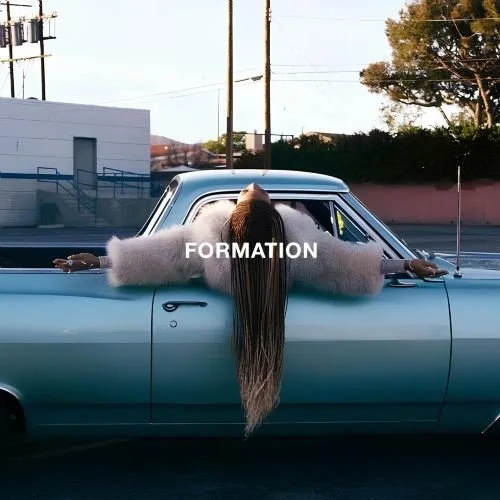
Beyoncé’s Formation at Ten
__________
THE first single from…
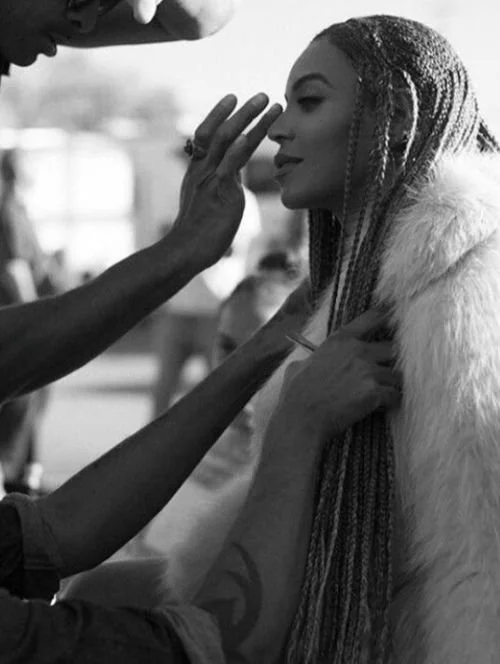
Beyoncé’s sixth studio album, Lemonade, Formation was released on 6th February, 2016. To mark its upcoming tenth anniversary, I want to explore articles that discuss its themes and lyrics, in addition to its phenomenally powerful and memorable video. Though it did not reach the top of the singles charts in the U.S. and U.K., Formation garnered so many think-pieces and discussion. Huge praise and accolades. I will end with critical reviews and its legacy. I want to come to some articles and think-pieces before that. Formation is one of Beyoncé’s greatest songs. A perfect introduction to a masterpiece album, Formation is the final track on Lemonade. Unusual to release a closing track as the first single, as most artists release songs right near the top of the tracklisting. That is the thing with Lemonade: any of its twelve songs could have been singles, Written by Michael L. Williams II, Khalif Brown, Asheton Hogan and Beyoncé, this surprise-release genius song is Trap and Bounce. It scooped awards and is seen as one of this queen’s greatest achievements. Beyoncé celebrates her culture, identity, and success as a Black woman from the Southern United States. If there was this feature that suggested the video for Formation exploited New Orleans’ trauma following Hurricane Katrina in 2005 and the catastrophe and devastation that is caused, I would disagree. It is not appropriation, as SLATE write. I want to lead with an extraordinarily detailed and thought-provoking article written by Syreeta McFadden for The Guardian published on 8th February, 2016 (two days after the single was released). Reacting to its extraordinary video that is a “inherently political and a deeply personal look at the black and queer bodies who have most often borne the brunt of our politics”, I would urge people to read the entire piece:
“Formation is both provocation and pleasure; inherently political and a deeply personal look at the black and queer bodies who have most often borne the brunt of our politics. All shapes and shades of black bodies are signaled here and move – dare we say “forward”? – in formation. Even the song’s title is subversive, winking at how we have constructed our identities from that which we were even allowed to call our own.
Formation isn’t Beyoncé’s first foray into the political but, in her latest collaboration with director Melinda Matouskas (who has directed eight of Beyoncé’s videos since 2007), Beyonce’s narrative and aesthetic comes in sharp relief. The video articulates multiple identities of southern blackness, while social critiques of the nation’s crimes against its darker skinned citizens acts as ballast.
Bookended by the flooding of the city of New Orleans after 2005’s Hurricane Katrina – and by which the city’s black residents were disproportionately affected – and a black child in a hoodie dancing opposite a police line and a quick cut to graffiti words “stop shooting us”, Beyoncé morphs into several archetypical southern black women.
The potency of Formation doesn’t come from its overt politics: it comes from the juxtaposition of lyric with the images, which organically present black humanity in ways we’ve haven’t seen frequently represented in popular art or culture.
There is in it a litany of blackness, of what we love, of our diverse selves, of our intersections – class, sexuality and gender – woven so neatly in the visual that the lyrics and music seem secondary, but are intrinsic to communicating this celebration of southern fried blackness. Even Beyoncé retells her own history and by extension, marries the contradictions of black identity in her declaration: “My daddy Alabama, Mama Louisiana. You mix that Negro with that Creole make a Texas bama” – an insult that, perhaps, only Beyoncé was ever capable of reclaiming.
Beyoncé’s use of “slay” is an additional embrace of the language of the black queer community and, in its repetition, it’s an incantation that can slay haters, slay patriarchy, to slay white supremacy.
Formation is a protest and celebration, concerned with and in love with the very particular paradox of the black American identity and experience. The images, which are deeply layered and particular to a black Southern vernacular and aesthetic, beg to be catalogued: Creole and Black American, Mardi Gras Indian, crawfish, Black cowboys, wig shops, socks and slippers, corsets and parasols, parades, high school basketball, step team moves, bounce queens Big Freedia and Messy Mya, cotillions, “twirl on dem haters”, braids, “bama”, black spirituality (church and hoodoo, maybe even a nod to Mami Wata), black mama side eyes, drawls, Blue Ivy black girl magic fierceness”.
the date of the release of this work can’t be ignored, given that February is Black History Month in the US. Mardi Gras festivities in New Orleans have already begun. More to the point, last Friday would have been the 21st birthday of Trayvon Martin, killed by George Zimmerman in 2012 in a shooting widely attributed to racism; Sunday would have been the 29th birthday of Sandra Bland, whose alleged suicide in prison in 2015 after a brutal and poorly justified arrest captured on camera led to unsuccessful calls for further investigation into her death.
Both were considered formative moments for the women and gay men who have been at the forefront of Black Lives Matter and, more broadly, the movement for black lives”.
There is argument to suggest the Formation video is history-making. It is celebratory, unifying, political, body-positive, political, and this reclamation of Blackness. So wonderful, engaging, educational, conversation-starting and eye-opening. Charlie Brinkhurst-Cuff shared her thoughts and observations on the Formation video for DAZED. Again, I have highlighted sections of the piece, though I would encourage everyone to read the entire text:
“Crucially, “Formation” is a story of reappropriation – in parts of the video, Beyoncé is the mistress of her all-black household in a southern American plantation-style house. Black portraits adorn the walls – in one instance, showing a family dressed in peony-pink traditional African dress, while another depicts a dark-skinned woman almost blending into the backdrop of the painting. This feels like reclamation of the southern slave legacy, and Beyoncé is there, regally spinning her cream parasol, and dancing in defiance. This brazen nod to African history shows that the forcible shipping of African people from their motherland hasn’t been forgotten, especially in the south, where slavery clawed on for so long.
Interestingly, the only white people to feature in “Formation” are a militarised line of police, looking on at an unarmed black boy who dances freely, and beautifully, before them. In 2015, 1,134 young black men were killed by police officers, and were nine times more likely to get killed by police officers than any other Americans, despite only making up 2% of the population. The image of the young boy set against the police is poignant and powerful. It becomes even more so when it is the police who raise their hands in apparent defence at the little boy’s signal, rather than the other way around. “Stop shooting us” reads the graffiti on the wall – the message fearless and bold in its simplicity.
It should be noted that Beyoncé, who has supported the Black Lives Matter movement (she helped bail out Baltimore protestors last year) will also be donating over £1 million to the campaign in the coming months through Tidal, the music service which she co-owns with Jay-Z. Deray McKesson, a Black Lives Matter organiser, is one of the ten people she follows on Twitter.
Her video also marks an unapologetic celebration of black women. “Okay, okay, ladies, now let’s get in formation, cause I slay,” she demands. This formation of ladies symbolises the collective power that black women have, and it’s always nice to see a diverse range of skin shades, tones and body shapes dancing rather than the flat, white norm we are used to in pop culture. As with Beyoncé’s nod to Blue Ivy’s hair, the natural curl patterns on display as the women dance in a basketball court help to emphasise the fact that Beyoncé is telling the world to accept black people’s beauty the way it is, in all of its natural and diverse glory. This is something that felt particularly potent at last night‘s Superbowl performance. While some might have expected her to dilute her political message for the American masses, there she was, dancing alongside a posse of beautiful black female dancers, who were all dressed like 1970s Black Panthers. Needless to say, her powerful celebration of blackness at such a widely-viewed event is not just iconic – it’s historical”.
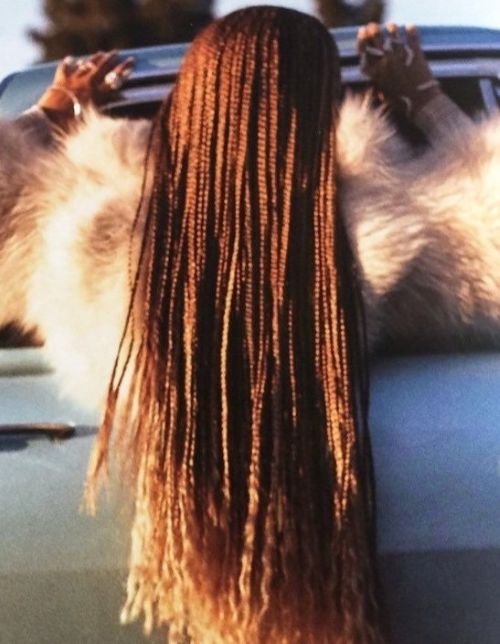
I would advise people to read this interesting discussion feature from The New York Times, where “Jon Caramanica, a pop music critic for The New York Times, Wesley Morris, The Times’s critic at large, and Jenna Wortham, a staff writer for The New York Times Magazine, discussed the song’s sound, the video’s look and the way that Beyoncé increasingly blends the aesthetic and the political”. Before getting to the final feature prior to ending with critical snapshots and the awards and honours that Formations accrued, it is worth noting that Formation is not only memorable and discussed because of its video. The surprise-released single and video on the same day caught people by surprise and the video’s imagery and plotline/arc is so arresting and compelling. Like Childish Gambino’s This Is America video (2018), the video sort of steals a bit of focus from the song itself. Though the two things are intertwined and connected, a large part of Formation’s brilliance is in the lyrics and the vocal performance. I was interesting reading this NPR article, in which NPR's Mandalit del Barco highlights reactions to the video, including thoughts from filmmaker and writer dream hampton. (hampton has a long-standing professional relationship with Beyoncé’s husband, Jay-Z.). They dissect and discuss the New Orleans-set video (though it was primarily filmed in Pasadena, California). It is incredible that Formation was released the day before Beyoncé’s halftime Super Bowl performance. By all accounts, she saved a rather lightweight performance. The BBC wrote why it was such an important performance. A phenomenal two days for this music queen! Delivering a masterpiece song and genius video alongside one of the all-time great Superbowl performance:
“And what about the video itself? Can you talk about the images and the lyrics, both?
Well, the images are very much an homage to the black South, which is often forgotten, you know, in movements. And I don't know why, because we keep having to return to the black South, you know, as we should.
It's very important that this film is not only located –- well, I say "film," it feels like ... an Oscar-worthy feature — but it's very important that it's located visually and actually in Louisiana, which, of course ... is the site of this other trauma, and a kind of freedom and resistance also. It's longstanding trauma. Louisiana is this famous slave port, where so many cultures came together and mixed, but also she references the site of Katrina, where this horrible crime was committed against black people; where its nation didn't show up for us and where this generation is having to learn that its nation continues to not show up for us. And in that, she's both centering black women — her formation is one of black women, who are proudly wearing their natural hair, and she makes a circle amongst her daughter and three girls, which is a little bit of magic and conjuring. But there's also, you know, the centering of queer folks and trans folk, and both by the vocals that we hear and of what we visually see. And that has very much been an intentional thing that's been happening in this new Black Lives Matter movement. From the very outset, there was real messaging that talked about centering queer folks and black women in leadership. So it's really amazing to see all of that reflected back to us in a Beyonce video.
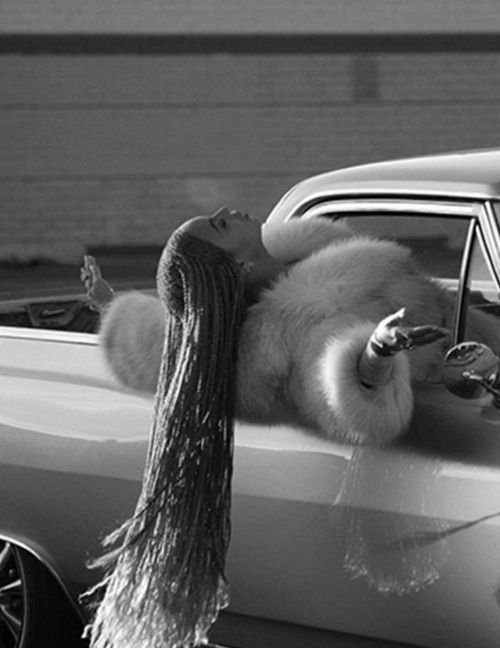
There was a big New York Times article about her being an activist. Is this something new for her? I know you talked about questions over centering her identity as a black woman, but in terms of being an activist — is this anything new, or is this a continuation?
I think it's a stretch to call Beyonce an activist. And I don't know that activist is such a compliment. What we need out here is organizers. No, what she is is a cultural force and artist and icon. She might be her own goddess, might have her own little Orisha power, but she's not an activist. I think that she's someone who is paying attention like anyone her age to what is going on. This is her generation's movement; she's absolutely a millennial, and she's tuned in to what's happening like we all are. So she doesn't live on some other planet, which I think we tend to think of pop stars, and Beyonce in particular. [Laughs.] She's very much in this world, paying attention to what's happening, and affected by it. You know, she's raising a daughter.
She showed up to the Trayvon Martin rally and met his parents, but that was disastrous for she and her husband. All of the eyes, which should have been on the dais, and they were all looking at Jay and Bey, who were kind of standing to the side of the stage. They understand what a distraction they can be. But this is all value add; this video "Formation" is not a distraction. It is a beautiful centering and a beautiful conjuring.
Do you think it's going to make a difference?
Well, what artists can do is provide narrative shifts. That is absolutely their responsibility, in fact. Nina Simone gave that charge decades ago, like, "What are you doing if you're not reflecting the times? How can you even call yourself an artist?" So in my mind, what's been happening is there's been this slumber — particularly unfortunately amongst black artists — for a long time, and now they're realizing that they can't not reflect back what their very audience is showing them.
Beyonce took that a step further; she really did. I mean, she created an anthem, a visual anthem in every way. And that's been beautiful to see. And it's been beautiful to see other artists kind of wake up around this and realize that this isn't going to cost them to put this kind of messaging forward; that it's actually going to benefit them”.
I want to collate some of the critical reactions to Formation. Wikipedia have a fascinating and really detailed page about Formation. There is a lot I have not include here, so go and check that out. It is interesting reading the critical observations. How essential and urgent the song and video is. How needed it was in 2016. A nation (the U.S.) that would see Donald Trump become President. Where Black lives were seen as unimportant (in his eyes). A time of huge division and inequality in the U.S. Lemonade came out in April 2016. Trump won the election on 9th November that year:
“Formation" was met with widespread critical acclaim upon release. Pitchfork named the song "Best New Track", with Britt Julious describing it as one of Beyoncé's "most instrumentally-dense and trend-forward productions" which is made specifically for black women, "an audience that might not receive the sort of mainstream, visually and sonically-enticing wisdom that Bey has perfected". In a review for the New Statesman, Anna Leszkiewicz praised the experimental nature of the track and wrote that Beyoncé presented "radical" sociopolitical concepts in a familial context, adding: "The more mainstream Beyoncé becomes, the more she functions as a marginal artist." Similarly, Q's Shad characterized the song's lyrics as "deeply personal and political", and praised Beyoncé for celebrating her black Southern roots on a global stage. Writing for The Guardian, Daphne A Brooks described the "brilliance of the single's sonic arc", with the tension from Beyoncé's "restrained, raspy" vocals exploding in a "euphoric release" as she expresses her pride in black identity and culture.
Omise'eke Natasha Tinsley, professor of African Studies at University of Texas at Austin, wrote for Time that "Formation" differs from contemporary political songs by celebrating the breadth and beauty of black women's lives, rather than focusing on black men's deaths. The New York Times' Jenna Wortham praised the song for its expression of black identity and wrote that it is "about the entirety of the black experience in America in 2016", encompassing topics such as beauty standards, police brutality, empowerment, and shared culture and history. In an article for The Washington Post, Regina N. Bradley wrote that the song sees Beyoncé forgoing a "more universally appealing trope of feminine blackness in favor of an experimental and boisterous black womanhood" that can voice critiques of social, political, and economic issues. A Rolling Stone journalist commented that the song "felt downright necessary" in the Black Lives Matter era, deeming it "a powerful statement of black Southern resilience".
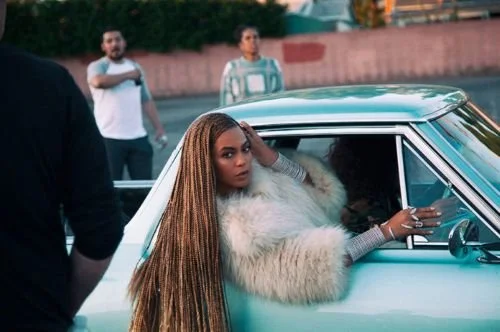
Recorded at The Beehive (Los Angeles), and produced by Beyoncé and Mike Will Made It, Formation received three nominations at the 59th Annual Grammy Awards: Record of the Year, Song of the Year, and Best Music Video, of which it won the latter award. In 2021, Rolling Stone placed the song at number seventy-three on its 500 Greatest Songs of All Time. Even though it reached ten on the US Billboard Hot 100 and thirty-one in the U.K., its relatively low chart position is irrelevant. Apart from Conservative commentators and politicians feeling the video and song was anti-police, anti-white and anti-American, decent, normal and soul-possessing humans correctly identified Formation as this positive, stirring, impassioned song about Black culture, resilience and empowerment! It directly addressed racial injustice, police brutality, and Black Lives Matter. It is this political anthem and phenomenal song that is still relevant ten years after its release. On 6th February, there will be new inspection and celebration of Formation and its video. New context and framing considering what Beyoncé has achieved since. Phenomenal albums like RENAISSANCE (2022), COWBOY CARTER (2024), and the astonishing COWBOY CARTER TOUR. I want to finish with Wikipedia again and their section on Formation’s legacy. They look at its legacy on popular culture, race and politics, academic studies and music. I want to focus on the latter:
“Critics and scholars considered "Formation" to have innovated popular music in the 21st century. The release of "Formation" was a defining moment of 2010s music, according to Billboard's Bianca Gracie, with Beyoncé setting the standard for what popular music can be. Glamour's Danielle Young wrote that the song revolutionized how music is consumed, with Beyoncé making listeners stop and experience the song together. Writing for Vice, University of Waterloo professor Naila Keleta-Mae commented that Beyoncé went from "manipulating the pop culture music industry machine to usurping it" with "Formation", setting the blueprint for how artists can explore political issues while holding mainstream attention. In his 2025 book Blank Space: A Cultural History of the Twenty-First Century, W. David Marx named "Formation" as "almost a perfect piece of pop culture", given that its creative innovation challenges the artistic and cultural decline that has defined the 21st century to date”.
This sense of surprise, shock, empowerment and joy met the Formation single and video release on 6th February, 2016. Considering how U.S. politics would change (for the worse) that year and what that did to the nation, I think that Beyoncé’s music and place in society was as essential and needed as ever. A decade on and Donald Trump is President. Someone who is racist and does not care about the Black population, the relevance and power of Formation is so huge and vital today. I think that Formation is one of the most important releases…
IN music history.