
FEATURE:
I Got Sunshine in a Bag
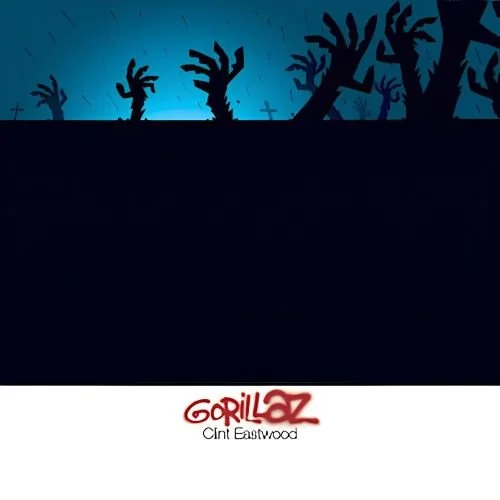
Gorillaz’s Clint Eastwood at Twenty-Five
__________
WHILST I am prioritising…

big album anniversaries this year, I also want to recognise singles that are celebrating significant anniversaries. The debut single from Gorillaz turns twenty-five on 5th March. Clint Eastwood was one hell of an introduction to the virtual band. Peaking at number four in the U.K., Clint Eastwood was written by Damon Albarn and Teren Jones and received large positive feedback. In terms of the fanbase in 2001, I guess a lot of Blur fans would have followed Damon Albarn. However, Gorillaz were a bit of an unknown quantity. A virtual band that Damon Albarn and the artist Jamie Hewlett created in 1998, Gorillaz consists of four fictional members: 2-D (vocals, keyboards, melodica), Murdoc Niccals (bass guitar), Noodle (guitar, keyboards, backup vocals) and Russel Hobbs (drums). A sense of anonymity perhaps meant that Damon Albarn could write in a different and less inhibited way. This wholly new project, Blur were still active. They would release Think Tank in 2003. However, Gorillaz was this fresh chapter. Albarn proving he is one of the most enduring, innovative and talented songwriters of his generation. Clint Eastwood is proof of his brilliance! I remember when the Gorillaz album came out on 26th March, 2001. I was in college and was already aware of Clint Eastwood. I bought the album and was not sure what to expect. 19-2000, the next single from Gorillaz, is a highlight. It would be four years until Gorillaz released their second studio album, Demon Days. I think it is a more consistent and better album, though I do love the debut. And Clint Eastwood is fantastic! There is an interesting 2001 feature from Sound and Sound I will come to relating to the recording of Clint Eastwood. Rolling Stone ranked his gem at thirty-eight on their 100 best songs of the 2000s. In October 2011, NME placed it at number 141 on its list of the 150 Best Tracks of the Past 15 Years. With a basic explanation behind the song’s title – named after Clint Eastwood, its similarity to the theme music of The Good, the Bad and the Ugly is obvious -, there is more curiosity to be found in the background and recording of Clint Eastwood.
I do want to come to Sound on Sound and their fascinating chat with Tom Girling and Jason Cox. They engineered Clint Eastwood. They also acted as producers alongside Gorillaz and Dan the Automator. One of the best debut singles in my opinion, there is something dark, cool and unusual about Clint Eastwood. I had not really heard anything like this in 2001. It was a bit of a revelation and shockwave that I felt affect people I knew. Excited by this new virtual band:
“Two years ago, when Sound On Sound last visited resident engineers Tom Girling and Jason Cox at Damon Albarn's West London studio, Albarn's band Blur had recently finished working with producer William Orbit on their album 13, a recording which involved bizarre instruments, experimental recording techniques and endless Pro Tools editing. The studio had also been used to record Albarn's equally experimental collaboration with composer Michael Nyman, the soundtrack to the film Ravenous. Since then, however, Blur have only entered the studio to record one more single, so Girling and Cox have been able to put their feet up and take it easy...
Er, no. Although the only Blur activity in the meantime has been a Greatest Hits album, Albarn had set up the studio (also named 13) mainly to handle his own side projects — and these have proliferated during the band's time off. There has been two more film soundtracks, Ordinary Decent Criminal and 101 Reykjavik, and a lengthy trip to Mali to record material for an Oxfam‑sponsored project drawing together musicians from every nation on the Greenwich Meridian. The studio has been extended to incorporate what was the adjoining unit, with the control room completely rebuilt around a new desk — a task which inevitably fell mainly to Girling and Cox. And on top of all that, there's been Gorillaz, a project which has yielded a top 10 album and a massive hit single in the shape of 'Clint Eastwood'.
The final version of 'Clint Eastwood' in Logic Audio. The track labelled 'rough blues' is Damon Albarn's original 'gibberish' vocal; 'V Comp' is the final vocal as recorded and edited in Jamaica. Kid Koala's scratching, on track 5, has been heavily edited...
The brainchild of Damon Albarn and former flatmate Jamie Hewlett, who was the artist responsible for the cult Tank Girl cartoon strip, Gorillaz have been described as the world's first 'virtual band'. The idea was that while Albarn came up with a suitable selection of songs, Hewlett would devise cartoon characters to front the band and stories for them to act out in their videos. "Once we'd started doing the tunes, Jamie got an idea of what the characters should be like, and once we'd fine‑tuned the characters, people started to think about the whole story around those characters, and it just started evolving like that," explains Jason. "So the music started first, I think. It was Damon, Tom and myself doing the music, and Jamie used to come down and see what was going on and what style of music we were heading towards. He was doing his sketching and demoing his characters while we were demoing the songs — the same sort of thing but on the drawing front."
With initial demos done at 13, the 'virtual band' managed to attract record‑company backing, and recording commenced on an album proper. Unlike the majority of Albarn's previous projects, the Gorillaz album was largely written in the studio. "The comparison would be that Blur would go into the rehearsal studio and rehearse the songs that were written, and then sometimes even go on tour with those songs before they were even recorded, and then go into a studio," says Jason. "The changing point was working with William Orbit, because he'd work in a different sort of way where he'd get the band to do jamming and then make up tunes like that, and then bring them back the next day and do some more on it. So we were slowly getting towards this way of working. It's a lazier way of working!"
"It's not a conscious effort to work in a different way," continues Tom. "I think the reason why we worked in a different way is because we've got this whole Logic thing going on, so instead of working in a linear world where you're using tape, you've got a hell of a lot more flexibility. I think it gears itself more towards this kind of thing, where you haven't necessarily got a specific goal you're after. It just gives you a chance to experiment, basically chuck a whole load of paint at the canvas and see what sticks, and weed out all the drips of paint that you don't want! I know that Damon loves working in this way now, compared to the way Blur would put a track together."
'Clint Eastwood' was in some ways an exception to the free‑form, cut‑and‑paste compositional method employed on the album as a whole. Damon Albarn's initial four‑track efforts with a drum machine and guitar were recreated in Logic at 13, before the other basic instrumental elements and guide vocals were added. Althought the structure of the song was changed, it neither lost any sections to other songs nor gained any. "In terms of sound, the way the song is and the format hasn't been changed much from day one, even though we've had different vocals on it," explains Tom. "Essentially, it's made up of stuff we put together in more or less a day, except the vocals, and then just tweaked. There were a couple of instruments in early versions of the song that were taken out later, but the final version is basically pretty much the same as the first set of arrangements, except for the structure of the song. The actual track's pretty much the same bar a couple of extra drums and the rap, and one keyboard part that's not in the final mix.
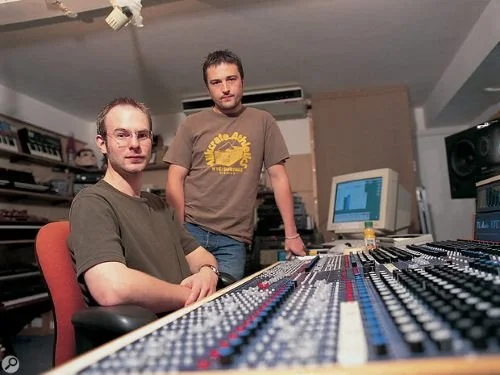
IN THIS PHOTO: Tom Girling (left) and Jason Cox in the new control room at 13
“There's no real drums on here. One's off a drum machine, and there's a sample I got from somewhere. Apart from that there's some live percussion on there. You know on a bass drum you've got the lug nuts that hold the skin on? It's actually a load of those in a carrier bag being shaken. It sounds like it's pitched down, too, but it's just EQ'd. The bass is a keyboard bass, which is the Moog Rogue, and on the big fills it's got a low sub‑note which is off a Roland JV. There's a piano in there, which is our little cheesy upright in the other room. The strings came from one of our string machines, the Solina String Ensemble."
"That should have been burned years ago," laughs Jason. "Damon gave us the OK to set fire to it on stage, but we said 'No, you can't set fire to that! It's a classic!' And it's ended up being used on two or three tunes."
'Clint Eastwood' included a rap section from its early days, but the original rap recorded by Girling and Cox at 13 ended up being replaced. "There was a rap on there before done by some English guys called Phi‑life and Cypher, which was used for a B‑side in the end," says Tom.
"That's the version that we do live, as well," adds Jason. "It's a little bit more hardcore, in that English style."
One of the most prominent instruments on 'Clint Eastwood' is the melodica. This cheap wind instrument, with its plastic keyboard, has traditionally been used mainly as a teaching aid, but has become a firm favourite with Damon Albarn for its sound, usefulness as a compositional aid, and capacity to irritate engineers...
"It's one of those school teaching instruments that needs to be brought back," says Jason.
"No, it doesn't need to be brought back, it needs to be binned!" insists Tom”.
There is an article I will finish off with. However, I want to quote from a March 2001. Lobotomy Pop sat down with Gorillaz – if you can physically sit down with a virtual band?! – and asked them about their music and fanbase. It must have been strange talking to actual people but writing them as virtual figures and not photographing them:
“The members of your band have different backgrounds. How do you manage these differences
Russel: We formed as a band in April 1998. It then took some time for our individual characters to gel together. It’s only after many punch-ups, screaming matches, and late-night colouring-in sessions that we have reached a point where we can get on stage, pull our pants up high under our armpits and shout “Hello Mr. President...”
Do you feel related to a musical scene (or a cartoon scene)?
Russel: We live in an animated alter-world where Augustus Pablo can walk into Electric Lady Studios, pick up a Gibson, and play a fuzz lead over a Cachao bassline while Dr. Dre plays the tin flute to Rag Time beatz.
How did you collaborate with such strong personalities as Damon Albarn, Dan The Automator, etc
Murdoc: It was an easy vibe with everyone, you know? We had already been working on the tunes for about a year before we started getting anyone else in, so we had such a strong vision of who we were and what we were about that anybody who came along had to acclimatise to us. Like Russel said, we’re in some animated-alter-bollocks or whatever!
Do you plan gigs? And how will it happen?
Russel: That’s the ace up our sleeves!
2D: Yeah! The world is having a hard enough time wondering how and where we exist and what happens in the studio. People go into melt down when they try and imagine us playing live.
Murdoc: People will bloody melt down when they get an ear-load of what we’ve got to give them.
Is Jamie Hewlett an important part of the group? Do you actually work with him?
Murdoc: He’s as important as any designer or director is to any band. You really put your life in these people's hands when you hand over any amount of control of your visual style to them. He’s cool, as long as you steer him off of his obsession with nudity and military headwear. It gets on my bloody wick when he sticks his ore in on interviews though. He and Albarn are the same, you do them a favour with their tired old careers and they take it as a carte blanche to start gobbing off”.
I am going to hop to this article from Music Radar. It is revealed how that incredible and loved beat on Clint Eastwood was not in fact composed by Damon Albarn. It was an Omnichord loop preset. It takes nothing away from the song, as it is still Albarn bringing that sound into the song. Even if it was not an original sound or composition. I think that Clint Eastwood sounds incredible twenty-five years later:
“Sometimes, finding inspiration can be a hard-won battle. On other occasions, it’s right there waiting for you as soon as you turn on your synth.
Case in point: Gorillaz’ Clint Eastwood. The familiar lolloping piano and drum beat from the band’s 2001 single wasn’t, it turns out, composed by Damon Albarn, but is simply a preset from the good old Suzuki Omnichord - the Rock 1 preset, to be precise.
Albarn made the revelation during an interview with Zane Lowe at the Blur frontman’s Studio 13 facility in London. There’s an impressive level of organisation going on here: each synth has its own spot on a labelled shelf.
And there are a lot of shelves. Albarn casually confirms that he has a whole roomful of drum machines, before showing off his BOSS VT-1 voice transformer and Yamaha QY10, which he used back in the day to create the bass synth line on Elastica’s 1994 single, Connection.
It’s when he turns on that Omnichord, though, that Albarn gets the biggest reaction out of Lowe, with the Apple Music One presenter seemingly amazed that Clint Eastwood’s groove was so easily come by.
“It just came like that?” he asks. “That’s it. That’s the preset. It’s the Rock 1 preset,” replies Albarn, before spicing it up with the Omnichord’s fill button.
Originally released in 1981, with the final model arriving in 1999, the Omnichord was a preset-filled groove machine that could play rhythms, chords and basslines, and had buttons that enabled you to switch between major, minor and 7th chords. The ‘Sonic Strings’, meanwhile, could be swiped to (sort of) replicate the sound of a stringed instrument.
This isn’t the only time a pre-rolled beat has been used in a hit record, of course. The drum loop for Rihanna’s 2007 smash Umbrella comes straight out of GarageBand (Vintage Funk Kit 03 is what you’re looking for) and Usher’s 2008 chart-topper Love In This Club also features Apple Loops.
While some will be disappointed to learn that Albarn and other producers have had hits off the back of what are effectively stock sounds, it just goes to show that you don’t necessarily need to sweat over every element of a song to make a great record. In all of the aforementioned cases, the skill came in recognising a loop’s potential when no one else had”.
In 2001, Jamie Hewlett and Albarn said that they had not received any feedback from Clint Eastwood himself over the song. I wonder if that has changed since. A lot of songs are named after actors (Fall Out Boy’s Uma Thurman among them), but I guess it is optimistic to expect any response from the actor in question! However, it would be nice to think Clint Eastwood has heard the song named after him. A sensational debut single from the Gorillaz album, we mark twenty-five years of Clint Eastwood on 5th March. I think 2001 was a fantastic year for music but bad one for politics and world events, so the way you felt about a song or album then has changed given events that followed. I still have a lot of love for Gorillaz. Their debut album and what they were doing in 2001. Clint Eastwood is one of their best song. A perfect opening salvo from…
A genius virtual band.