
FEATURE:
Modern-Day Queens
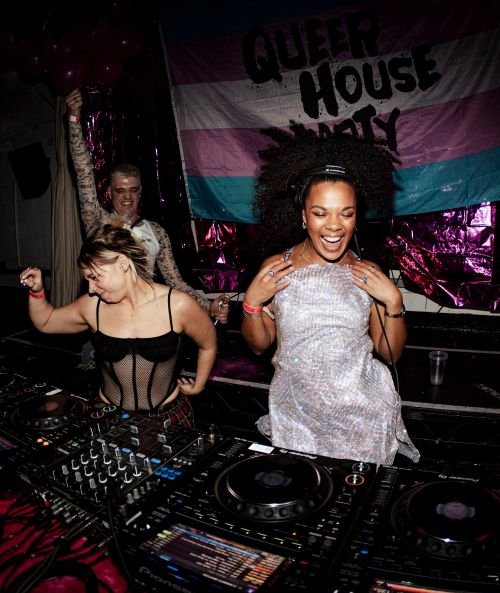
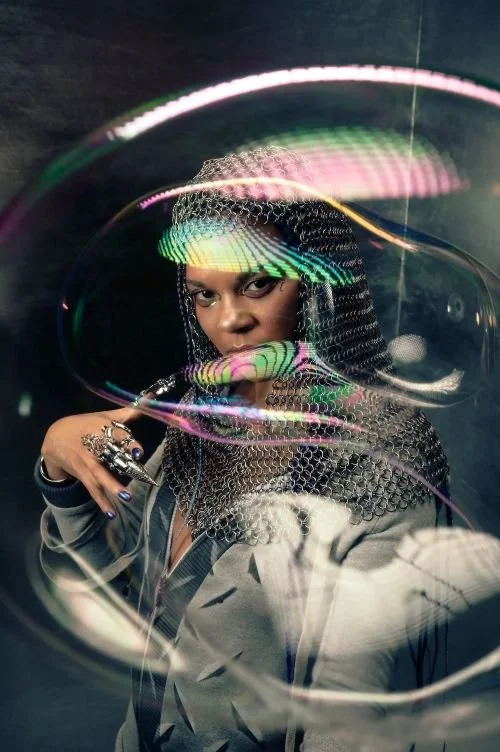
PHOTO CREDIT: Lucas Alexander Wilson
my Spotlight features are around musicians, I am keen to highlight some incredible D.J.s. Female D.J.s specifically. For Modern-Day Queens, I am spending some time with one of the most influential and respected talents in the world. Jaguar is this incredible D.J. and broadcaster who I know will have a very busy and joy-filled 2026. I normally like to bring in recent interviews with anyone I recommend. However, it does not seem like there has been anything from last year, so I am going to go back a bit further. I hope people do interview Jaguar this year, as she has done a lot since 2024, and people will want to know more. Go and follow Jaguar on TikTok and Instagram. I will come to some interviews with the D.J. and BBC Radio 1 host. I am starting out with some comprehensive biography from Resident Advisor:
“Jaguar Bingham is every bit as memorable as her name. Hailing from Alderney in the Channel Islands, but based in East London, the 27-year-old broadcaster, DJ and journalist, known mononymously as Jaguar, is among the new guard of multi-hyphenate talents steering UK dance music towards brighter waters. She’s a next-gen tastemaker instigating change through projects such as UTOPIA and The Jaguar Foundation. Jaguar’s work to date, spanning from her radio internship at BBC Radio 1 and 1Xtra in 2014 to more recent endeavours such as her landmark BBC Introducing on Radio 1 Dance show, has been anchored by a desire to spotlight new artists and minority voices within electronic music. It’s what drew her to BBC Introducing – a platform devoted to unsigned and emerging musicians – in the first place. In 2016, Jaguar joined the crew as Team Assistant at the station’s Sheffield HQ. At the time, she was studying English Literature at Leeds University. (A move, says Jaguar, spurred on by the city’s reputation for vibrant nightlife.) Each week, she would rifle through tunes submitted to the BBC Uploader by new artists. “I was listening to all the dance tracks and sending them to Danny and Monki, and Annie's shows and Pete's shows,” says Jaguar, who later worked for BBC Introducing’s Central Team in London, “so I was ready, even then, for my own show.” That moment came in 2020, when Jaguar launched the BBC Introducing Dance show on Radio 1. A defining moment in Jaguar’s career to date, the show has been met with critical acclaim. In 2021, Mixmag named her Broadcaster of the Year – a poignant accolade, given it was there that Jaguar’s voice and face became synonymous with its weekly office party, the LAB LDN. “I fell in love with dance music at the LAB LDN,” says Jaguar on her time at Mixmag, where she also worked as Weekend Editor for a time. “It was really special.” Elsewhere, she was awarded Best Radio Show for BBC Introducing Dance through a public vote at last year’s DJ Mag Best of British Awards.
The magazine had previously dubbed her “UK radio’s next gen champion”. More recently, Jaguar was tapped to co-present this year’s IMS alongside summit co-founder Pete Tong MBE. Keen to diversify her work, Jaguar has also produced and voiced documentaries for radio on topics such as LGBTQIA+ safe space clubbing and written articles spotlighting unsung Black women pioneers in house music. She was also Beatportal’s Guest Editor in August 2021, and previously helmed a show on South London community station Reprezent Radio, which she dedicated to new music and guests such as HAAi, Anja Schneider and Dance System. In September 2020, Jaguar turned her attention to parties. She launched an event, UTOPIA, with the brand later branching out into a UTOPIA Talks conference and podcast. The latter welcomed SHERELLE, Mary-Anne Hobbs, Sama’ and many more in its first season. “I describe UTOPIA as my vision of the world,” says Jaguar, reflecting on the brand at large and the very first UTOPIA club night: a sold-out celebration at London’s Night Tales. “It’s a world I'm trying to get to through all of the work I do: radio, DJing and so on. It's a community.” Speaking of communities, Jaguar was inspired by some of the queer parties and venues she’d encountered previously as a member of the LGBTQIA+ community. Dalston Superstore, say, or Leeds’ Wharf Chambers. Elsewhere, she’s thrilled to be sharing her latest project, The Jaguar Foundation, with the world. A partnership with Ministry of Sound and Sony Music UK Social Justice Fund, Jaguar described the foundation as a “home for my long-term commitment to [equalising] music through more forward-thinking initiatives and partnerships” in an op-ed she penned for the Independent. The Jaguar Foundation released its first report on the state of gender equality in UK dance music at last month’s IMS. Furthermore, the foundation’s first initiative, Future1000, saw Jaguar collaborating with in-school music education platform Virtuoso (fka FutureDJs) on a free, UK-wide DJ, production and leadership programme which introduced 1000 female, trans and non-binary students aged 12-18 to the music industry. A major move for the industry and Jaguar alike. Tackling issues such as gender imbalance, representation and accessibility within the industry at a foundational level, the initiative provided curious minds with artist-led sessions with the likes of Jyoty, Jayda G and Bklava and course modules curated by the London College of Music Education.
“I wanted the students to feel represented, supported, and comfortable,” explains Jaguar. “It can be scary learning to DJ. I wanted them to feel they were in an environment where they feel safe to explore their interests.” Future1000 was brought to life during the pandemic. It was then that Jaguar, amid the chaos of the time, recognised what her purpose was – and had been for some time, subconsciously – within the industry: amplifying marginalised and undiscovered artists and DJs. “It made me look inward,” says Jaguar on lockdown. “I realised I’m never going to be the loudest person. My way of expressing myself comes through my work and making it clear that I’m going to spotlight not just great music, but great music from women, and Black, brown, trans and non-binary people.” Born to a Ghanaian mother and English father, Jaguar cites the “lineage of Ghanaian women” on her mother’s side, along with her girlfriend, as continued inspirations. Though it was her father who taught her to always go the extra mile and dream big. (She reckons she’s also inherited his work ethic.) She looks up to fellow tastemakers such as Annie Mac and The Blessed Madonna, as well as Clara Amfo and Honey Dijon. This admiration is entirely reciprocated. Jaguar is a regular at the Annie Mac-curated Lost and Found Festival in Malta, for instance, where she treats sun-kissed ravers to her signature cocktail of genre-hopping, feel-good bubblers. She has previously supported Annie at venues across the UK, including Warehouse Project and the Pickle Factory. In 2018, Jaguar was mentored by The Blessed Madonna for the Smirnoff Equalising Music campaign. It was a spectacular ‘pinch-me’ moment that solidified her incredible career trajectory up until then. Let’s rewind though, for a second. Growing up on Alderney, it was the video games that initially piqued Jaguar’s interest in immersive electronic music and world-building through sound design. “I’d play Final Fantasy and Kingdom Hearts,” she recalls. “I loved fantasy games, they’ve got such incredible soundtracks.
I’ve actually started gaming again, since lockdown. Seven-year-old me would be excited to see it.” Her older brother exposed her to much of the music that eventually shaped her personal taste. (Her brother’s collection, that is, along with teenage summers spent raving in WWII bunkers on the island). Back when they were kids, he would transfer tunes from his Limewire-acquired collection to her iPod. “I'd listen to Kanye West and the Chemical Brothers,” she says with a grin so infectious you can’t help but smile too. “I remember hearing Timbaland's Shock Value for the first time, as well as Gorillaz's Demon Days.” A love for pop music soon blossomed, with Beyoncé, Black-Eyed Peas and emo/pop-punk outfit Evanescence, along with Aussie sisterly duo the Veronicas, among her favourites back then. Her affinity for electronic music and genres such as house, techno and disco, along with jungle, drum’n’bass and stacks more floor-filling styles, merged with an interest in student radio while in Leeds. “I loved the way talking about music, discovering music and presenting it to an audience made me feel,” she says of the days spent presenting and producing her own student radio show, Dangerous Jag.
In 2016, Jaguar won two coveted Studio Radio Awards. “It was like winning an Oscar at the time!” she laughs. Since her first stint on the airwaves, it’s been clear Jaguar possesses a natural talent for bonding with listeners via a shared love for great music. Not only that, but a determination to uplift those around her. See, Jaguar isn’t content with making a name for herself alone. Instead, she strives to rise through the ranks side by side with her peers. Take her recent run of headline UK shows with UTOPIA, which saw her inviting Future1000 alumni Badly Drawn Banana aboard the HMS UTOPIA for an intimate party on the Thames. Looking ahead, Jaguar is a resident at iconic hotspot Pikes Ibiza this season, with shows also confirmed at storied venues such as DC10 and Amnesia. Elsewhere, she’ll set out on a must-see European tour of her own, hitting up events such as Glastonbury, Circoloco and Radio 1’s Big Weekend this spring and summer. Jaguar will also fly UTOPIA out to Ibiza for a pair of unmissable White Isle shows, and make her US debut this October at CRSSD Festival. She’s also ideating on future film and documentary projects. She’d like to write some books down the line, and live out her childhood dreams by dabbling in TV presenting. She also plans to grow UTOPIA into a festival one day and aspires to host the BBC’s coverage of Glastonbury. We can expect future club sets to include specially-produced edits of tracks made by Jaguar’s friends, too. A neat touch, one that’s very much in keeping with the spirit of togetherness that permeates through all that Jaguar does. Togetherness, authenticity and the delightful purveyance of effervescent dance music: these are the calling cards of Jaguar”.
Let’s go back to 2023 for the first interview. It is from DAZED. I have seen so many other D.J.s shout out and salute Jaguar. She is someone who is loved and respected! I tell a lie. There is a 2025 interview I have found. That is important, as last year is when Jaguar released her debut E.P., flowers. Four amazing tracks from this incredible and adored D.J. It is a wonderful E.P. I wonder if she has plans for more this year:
“What drew you to dance music?
Jaguar: Growing up, I predominately listened to noughties pop and anything my older brother had on his iPod – so, that would’ve been Timberland, Kanye, or Eminem. And, I guess, the early dance stuff I would’ve listened to would’ve been some Chemical Brothers, Daft Punk, Groove Armada, Fatboy Slim, and then all the 00s trance classics. But, as a teenager, a gateway [dance music] artist for me would have been someone like Grimes and hearing [her 2012 single] ‘Genesis’ for the first time. And, then, [going to] uni: that’s when I started going to clubs for the music and being like, ‘wait, what’s this song?’ or ‘I want to play this [song] on my student radio show that four people listen to, if I’m lucky’. So, the deep love of all music was always there and, then, it refined into dance music as a teenager onwards.
What’s the difference in your approach to building a playlist for and playing a set on your radio show in comparison to DJing at club nights and parties, like False Idols?
Jaguar: I approach DJing and radio differently, but there is a lot of overlap just by default. For my radio show, we probably get sent about 500 tracks a week [via the BBC Introducing uploader] so I’m downloading maybe 60 tracks a week, maybe more. And, naturally, the stuff I’m really into I’ll put in my playlists for my DJ sets. But then, my DJ sets are also dependent on the crowd, the vibe, what mood I’m in that day – so, in the end, they’ll be more of a melting pot of my overall influences. Whereas the radio show has a [defined] brief, which is: new and emerging, UK dance music. Some records work better on the radio, too: I’ll play more chilled stuff, or ambient, or neo-classical, or super heavy stuff [on there]. And that might not be my taste for DJ set but, as a tastemaker, I’ll reflect that on the radio.
If you were queen for the day, what would be your first royal decree?
Jaguar: Equality for all.
What’s one thing you could definitely live without?
Jaguar: The patriarchy.
Describe your vision of utopia in three words.
Jaguar: Colourful, togetherness, free”.
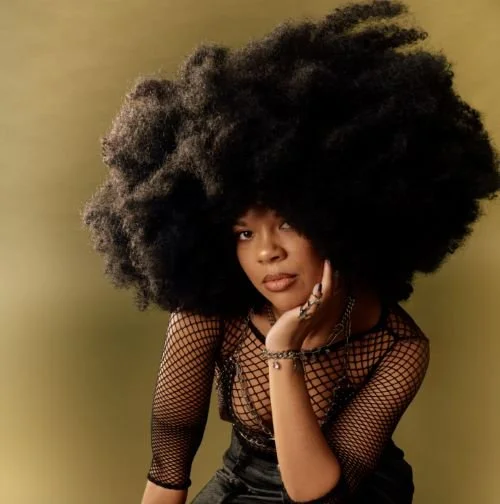
FOUR FOUR spoke with Jaguar in 2024. The statistics when it comes to Dance and Electronic music are shocking. In terms of gender imbalance and the lack of women and non-binary people represented. You can’t be what you can’t see. If women and non-binary people are not being given opportunities, having their music played and are almost invisible, it creates a very bleak future. The Jaguar Foundation has this ethos and ambition: “Our mission is to make electronic music a more equal place for the next generation of creatives and emerging artists. Through forward-thinking initiatives, we want to create a freeing, inclusive platform that inspires people from minority backgrounds to gain greater opportunities and feel represented throughout the music industry”:
“My role evolved as I told them that I loved electronic music and wanted to do more with dance music. I essentially became the dance editor. I listened to every dance track. I would send them to Pete Tong, Annie Mac, Danny Howard, and Monki. Then, in 2020, were getting so much dance music that Radio One said, “Oh, maybe we should do a show.” And I was in line to present Introducing Dance and I’ve been doing it for four years this month, which is pretty cool.”
The digital music renaissance has put pressure on radio, as listeners flock to streaming services and social media to discover new music. Algorithms have largely replaced tastemakers, placing individuals in a bizarre chokehold in which computers dictate our tastes. Previously, the radio and record stores were the only places to find new music, and DJs and broadcasters exposed listeners to new and avant-garde sounds.
Jaguar remains a passionate believer in the power of radio and tastemaking, infusing her programme with new sounds and breathing new life into BBC Introducing in an effortlessly personal way. “Obviously, I am biased. But I believe that having a tastemaker and a curator you trust to select the music is so important that it will never lose value.”
“I don’t think it’s ever going to die. I think the audience is shifting, and the way we consume is very different. But radio is always going to hold an important part and I still see that with my radio show. I have an important job, probably one of the most important jobs. I sift through 500 to 600 tracks a week on the Introducing Uploader. You have to have an ear that develops over time. I don’t think an algorithm can do that and that’s from 10 years of curating music on the radio.”
The concept of community is central to Jaguar’s work, whether it’s her BBC Introducing show, which provides a clear path for new artists to be discovered, her label and platform, UTOPIA, which serves as a voice for new ideas and artists, or her DJ sets, which capture her desire for the new, daring, and unheard.
“Community is an important word regarding my work. My show was built with a community around it. I think the kind of culture we’ve got around the show, which is mainly based around new artists is really special. And then what I do with my label, club night and podcast, UTOPIA, is a community platform, because it’s about bringing people together, it’s about representing an inclusive space on the dance floor with diverse sounds, styles, types of DJs and music lovers. I’ve also got a WhatsApp group, where the UTOPIA community is thriving full of creatives.”
“I’m obsessed with my artists, they’re genuinely my favourite artists in the world and it’s such a pleasure to work with them. I think unless you’re going to work with someone who’s as passionate as I am to put out your music, no one else is gonna be as passionate as you are. I take my job very, very seriously. I’m very, very empathetic with artists.”
The Jaguar Foundation may be one of her most important endeavours as she addresses gender imbalances in the business, going beyond raising awareness by collaborating with Sony to develop the first-of-its-kind study on documenting gender disparity in the music industry.
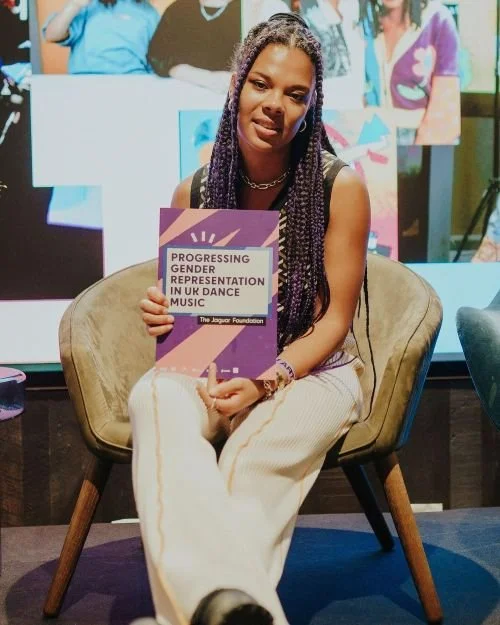
“The top line of it was that there is a lack of representation of women and non-binary people in dance music. It’s a systemic thing, we live in a patriarchy and there’s no denying that. There are multiple barriers, such as the gender pay gap, women being mothers and having to leave their careers, and whether they enter or not later on. A lot of women are being discouraged from pursuing a career in music and men are the gatekeepers. Ultimately, you can’t be what you can’t see”
“We discovered that only 5% of dance music in the charts was created by women and non-binary artists. Then, within radio, less than 1% of the top 200 tracks played were created entirely by women and non-binary artists. Only 24% of streaming places and streaming playlists were created by women and non-binary people.”
The first report is a stark and honest look at an unjust scene, that has barred so many people from entering and ostracised those who attempted to open the door. It has forced those in power to reflect on what has transpired and what should happen next. It serves as the industry’s starting point for learning.
“A lot of things came up, such as being subjected to the male gaze, feeling unsafe in the workplace or behind the decks, experiencing sexual assault while working, and navigating the club and booth safely.”
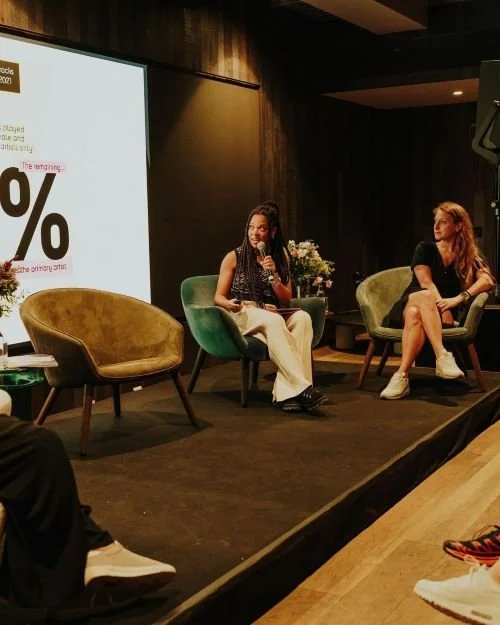
The Jaguar Foundation’s results serve as a baseline for the sector to grow and improve in terms of equity. It offered a voice to those who felt voiceless or alienated, reached out to the margins of society, and shed attention on the disparities that have plagued the scene for far too long.
“I’d love to update the statistics, as they were from 2022. So far, I’ve noticed some really positive changes. You know, just last summer, we had Peggy Gou, Jazzy, Raye, and Charlotte Plank all in the top ten of the UK charts, which was cool.”
In addition to statistics, Jaguar has advocated certain hands-on procedures to help carve out a more diverse and fair club and festival environment, one of which is rider requests, which artists may utilise to say that if they are going to play, the lineup must be balanced and fair.
“I have this clause in my contract. That simply means that whenever I am booked, there should be an effort to make the lineup as diverse as possible by including at least one other woman, transgender person, person of colour, or LGBT+ person.”
She goes on to say that it needs to start from the top. This situation cannot be resolved immediately, and while the industry is taking measures to make the environment more fair and open, true change will not occur unless people with actual weight and influence begin to show support and fight for those without a voice.
“I really just implore anyone with a bit of weight and power, which is mostly men, to include this in their contract. I believe it will make a difference because all we can do is put in more effort, work a little harder, and perform better. This is not me having a go. I never attack anyone. I never say, “This is your fault, or you are doing this incorrectly.” We are all responsible for global issues, whether they directly affect you or not. Often, the people who aren’t directly affected have the most power to change things.”
Jaguar’s success story thus far offers optimism for the future generation of dance music. Her influence in the business is undeniable, and her success can be attributed to her complete transparency about how she works, what she believes in, and who she supports. Her voice reflects the current sound and mentality of UK dance culture.
“I’m very passionate about the representation of people who don’t feel represented in the mainstream or in the world, music reflects the world and the world is by no means perfect. So one of my things is I want to help make the world a better place in that sense.”
I asked her to give some advice to those looking to break into the industry, “Be aware that it takes time to hone your sound and become truly good at what you do. If you’re making music, be as creative as possible while still having fun with it. Do not be afraid to experiment. If you’re releasing music, you should have a year’s worth of music planned out so that you can be consistent. If you can release a track every six weeks, or if you have four tracks, make sure you have a strategy for each moment. Know what you’re going to do for marketing and visuals; it doesn’t have to be an elaborate music video. You can do it for free”.
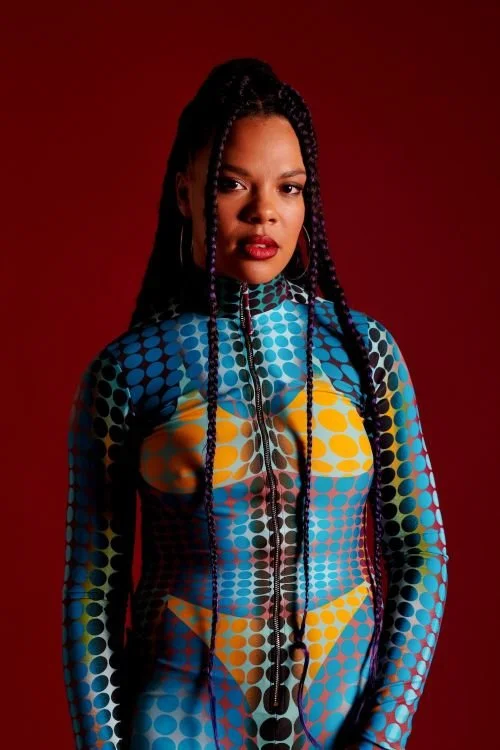
When I interviewed Carly Wilford last year she said, as a D.J., how she noticed the Electronic scene is male-heavy. In fact, whilst there were steps towards gender equality and balance, there has been a regression. This is something Jaguar discussed with FLO London last year around the release of the flowers E.P. Go and buy this glorious and stunning work. I do think that 2026 is a year when Jaguar will be discovering and spotlighting great artists. She will play amazing festivals and gigs and maybe there will be new music. An L.G.B.T.Q.I.A.+ heroine and icon and someone who is always striving towards inclusiveness and equality, one hope that The Jaguar Foundation and the essential report they published in 2022 goes some way towards fixing growing inequality. Maybe there needs to be more capital injected to lead to this regeneration of British nightlife. More clubs and spaces:
“BBC Radio 1 presenter, DJ, podcaster, and award-winning entrepreneur Jaguar is a trailblazer in the UK dance music scene. As a queer Black woman, she is fiercely committed to championing diversity, equality, and representation, using her platform to highlight emerging talent and push the culture forward. Her work spans broadcasting, DJing, producing, and advocacy, earning her accolades including DJ Mag’s Underground Hero and Mixmag’s Broadcaster of the Year.
flowers is your debut EP. What does this release represent for you at this point in your journey?
It’s about reconnecting with your inner child and recognising how far you have come through hardship. I struggled a lot during my late 20s, but picked myself up, found purpose again, and did a lot of therapy. The title track is a love letter of gratitude to my inner child who got me through this hard time.
The other tracks explore the different sides of my personality - from UK Cunty club bangers for queer clubs to peak-time rave weapons.
The EP explores your late-20s mental health struggles. How did you translate something so personal into music?
I made flowers with Jacana People, who are good friends of mine. I had the idea for writing a song to my inner child ahead of the session, and we worked on the instrumental first. They have a lot of pedals and hardware synths, which was so fun to play with.
I wanted to bring a tender energy reminiscent of being a child running around in nature to the track. We also used twinkling chords inspired by a track from my favourite Final Fantasy game. Then I started working on a poem addressing my inner child, and the spoken word vocal in the track is the initial take we recorded on the day. I felt very vulnerable but also free during this session. It was very healing, and I surprised myself by pushing myself a bit further. The Jacana People boys are amazing to work with and made me feel so comfortable, complementing my artistic vision so well.
In 2022 you published a groundbreaking report on gender representation in UK dance music. What progress have you seen since then?
The report is one of my greatest achievements to date. The impact it left was monumental - it made national news, I went on Women’s Hour, Sky News, the BBC; I saw really amazing conversations and change in dance music on line-ups and behind the scenes at labels, venues, events brands. The statistics in general showed that marginalised gendered are indeed misrepresented, but the stats showed that things were improving year on year. However, I’d say in the last 2 years that line-ups look less diverse again, and the dance space feels very male heavy again, almost like we have regressed. I believe that this is due to the nightlife industry which is currently in an economic crisis. It’s even harder than ever to sell tickets, clubs are closing and younger people are not going out as much due to change in habits and everything being so expensive. I fear the focus has shifted from pushing forward equality and more about trying to keep everything afloat. It’s a frustrating time, but I will never stop fighting for marginalised people. I hope to bring back a second edition of The Jaguar Foundation report in the next few years and reignite the movement. It feels like it is needed again.
A book or text you return to for inspiration?
Anything by Audre Lorde or Octavia Butler. Love Think Like A Monk by Jay Shetty too.
Can’t live without?
Music, a pen, and my diary.
Which artist, living or dead, would you most love to have a conversation with?
Lady Gaga or Honey Dijon.
What should the art world be more of and less of?
More support for artists! More investing in talent over followers. Less following trends and looking at metrics. Let the art speak for itself!”.
I really admire Jaguar! Her role as a broadcaster and championing new music. Her phenomenal D.J. sets and how passionate and inspiring she is. As an artist releasing music. A campaigner and advocate for equality and gender balance. Someone who also wants to unite people and make the world in general a better place, she is someone that we should put on a plinth. Jaguar was an easy choice for this Modern-Day queens, as she has achieved so much and is such a talent. I cannot wait to see where she heads and what she achieves this year. Someone who I am…
ALWAYS in awe of.