
FEATURE:
So Far Away
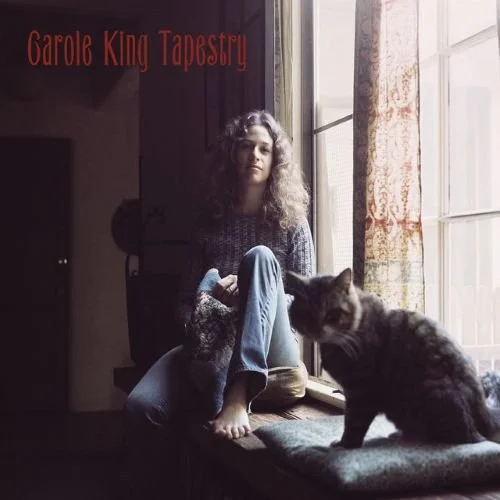
Carole King's Tapestry at Fifty-Five
__________
THE second…
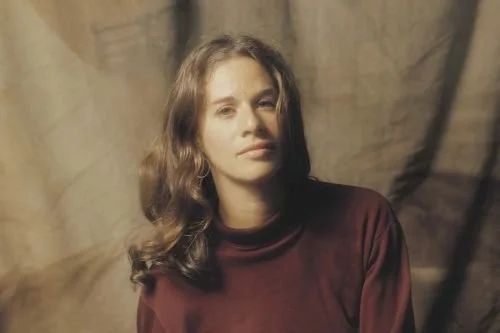
PHOTO CREDIT: Jim McCrary/Redferns/Getty Images
studio album from, Carole King, Tapestry turns fifty-five on 10th February. It is one of the greatest albums ever released. Everyone will recognise tracks from Tapestry, whether that is You’ve Got a Friend, I Feel the Earth Move or It’s Too Late. I first heard the album when I was a young child and I recall being very curious as to who Carole King was. All these years later and Tapestry still sound spine-chilling and captivating. Reaching number one in the U.S. and gaining huge critical applause, Tapestry won four GRAMMYs at the 1972 ceremony, including Album of the Year, Song of the Year, and Record of the Year. An album that changed Carole King’s life. To mark its upcoming fifty-fifth anniversary, I will spotlight a review of it. However, there are some features that are worth bringing in too. I am going to start out with this feature from Carole King’s official website. Tapestry was an album where Carole King bet on herself:
“In January 1971, Carole King, a native New Yorker recently transplanted to touchy-feely Los Angeles, entered A&M Studio on La Brea Avenue to record her first album of songs for which she'd written both music and lyrics.
With her was a family-sized crew of musicians-slash-confidants from the emerging Laurel Canyon rock scene, among them her producer, Lou Adler and James Taylor, the sexy and ruminative singer and guitarist for whom she'd played piano on tour the year before.
They worked quickly, cutting two or three tunes a day, and finished the 12-song record in three weeks. (The studio budget, according to Adler:$22,000). By June, the LP - King called it "Tapestry" in acknowledgment of its handcrafted vibe - had reached the top of the Billboard 200, where it stayed for 15 weeks on its way to finding a permanent spot in what seemed like every home in America.
"In a funny way, it was almost like Obama's first presidential run, when he sprinted through the campaign so quickly that the Republican dirt machine didn't get him in their sights," says Taylor, whose early success alongside King would propel the two of them half a century later to performances at Biden's presidential inauguration. "People didn't get a chance to say, 'Oh Carole, she doesn't really have a singer's voice.' Or, 'She's a mother.' Or, 'She's from Brooklyn.'
"The first thing you knew about it was, here's this incredible material, and people heard it and said, 'Yeah, that's for me.' It was like a first-pitch home run."
"Of course, that wasn't true," Taylor adds with a laugh. "It came after a decade of work."
Indeed, for all its energy of arrival, "Tapestry" actually marked the beginning of an unlikely second act for King, who at age 28 had left behind a life and career as half of a prolific Brill Building songwriting duo with her husband, Gerry Goffin, and had moved to L.A. with her two young daughters, Louise and Sherry. Here, nestled in the verdant hills above Hollywood, the woman who co-wrote the deathless "Up on the Roof", "The Loco-Motion" and "Will You Love Me Tomorrow" remade herself as a new kind of pop star: thoughtful, relatable, understated. The album's iconic cover, showing wavy-haired King and her cat sitting contentedly by a window in her home on Wonderland Avenue, said it all.
And the shift went beyond her: Along with Taylor's "Sweet Baby James" and Joni Mitchell's "Blue," the latter recorded just down the hall at A&M with some of the same players, King's album helped launch the singer-songwriter movement of the 1970's, resetting pop's mood and scope in the wake of the cultural and political upheaval that defined the end of the '60s.
In the years after "Tapestry," King could seem ambivalent about the stardom she'd attained. She continued to make records, occasionally in search of a convincing style, but she didn't tour or promote them as the pop industry requires. Today, nine of her 10 most-streamed songs on Spotify are from "Tapestry," and her 1974 track "Jazzman," which reached No.2 on the Billboard Hot 100, may be the best known in a version by Lisa Simpson.
"She wanted to be home with her children - and to create more children," Kortchmar says. (In addition to her daughers with Goffin, King has a daughter, Molly, and a son, Levi, with Larkey.) "And she was just seriously less interested in the fame part of the gig - the everyone-adores-me part - than in actually creating the music”.
On 10th February, 2021, to mark fifty years of Tapestry, Rolling Stone shared their thoughts on the album. They discuss how “With its masterful songcraft and backstory of personal reinvention, King's 1971 landmark remains one of pop's greatest declarations of independence”. I think Tapestry remains one of the most beautiful and affecting albums ever released:
“But sales figures, ubiquity, and Grammy Awards (Tapestry won Album of the Year and also walked away with three other awards, including Song and Record of the Year) were never the sum of what Tapestry accomplished. Within its dozen songs were any number of stories that lent it a resonance and scope rare in pop albums of the time, and some of those stories could also apply now.
As anyone who saw the Broadway show Beautiful knows, King had an entirely different life before Tapestry: living on the East Coast, married (to fellow songwriter Gerry Goffin) and having children while writing and recording demos as part of the Brill Building song factory. After breaking up with Goffin and moving to California in 1968, King transitioned into a new phase, and style of music — more Laurel Canyon and less Times Square. Tapestry told that story, slyly, by way of its remake of “Will You Love Me Tomorrow” (a Goffin-King hit for the Shirelles in 1960), which provided a connection to King’s past; the hushed, pared-down arrangement hinted at a more adult, less Top 40 sound.
Tapestry also rolled around just in time for the burgeoning women’s-rights movement. Later that year, Helen Reddy’s “I Am Woman” would become the first major, clear-cut feminist pop anthem, and 1971 also saw the arrival of not just Blue but Carly Simon’s self-titled debut. Tapestry communicated that cultural shift starting with its cover image of King, in a gray sweater, curled up near the window in her L.A. home. She was alone but looked assured, comfortable, at ease with herself. The pert hairdos and dresses seen in Sixties photos of her were now relics of the past and another life.
That newfound confidence and strength spilled out onto the record. For the first time, King wrote the bulk of the lyrics herself. The opening song, “I Feel the Earth Move,” joyfully expressed that feeling of being swept away by a new love, but King’s piano, and the back-and-forth solos between her and guitarist Danny Kortchmar, communicated strength and command. (King always knew exactly how she wanted her records to sound and always took charge of her sessions, even if Tapestry was officially produced by Lou Adler.) Similarly, the narrator of “It’s Too Late” is almost matter of fact when surveying the end of a relationship; she sounds rational, not distraught. For the 50th anniversary, an album outtake, “Out in the Cold,” has been resurrected after first appearing as a bonus track on a 1999 CD reissue. A confessional about being unfaithful to a lover and paying the price, it feels rational and adult (if not totally empowered).
With its cameos by Mitchell and James Taylor (a couple at the time), Tapestry also fit snugly into the singer-songwriter genre that was beginning to take over pop. On her “You’ve Got a Friend,” which Taylor also covered that same year, and the plaintive “Home Again,” King showed she could be as contemplative and introspective as her new peers. Her version of “(You Make Me Feel Like a) Natural Woman” — a song she’d co-written with Goffin a few years earlier — was equally stripped down and unadorned, especially after Aretha Franklin’s takeover of the song. (King was cutting spectral remakes, even of her own work, long before the indie crowd got hold of that idea.)
Yet as much as we associate the album with King’s famous friends and the balladeer-diarist style of the moment, Tapestry was above all a glorious pop record. King may have relocated and left her New York studio days behind, but she took with her a sense of hooks and craft that helped the album transcend the voice-and-guitar arrangements common at the time. “Beautiful” had a show-tune bounce, the outlaw-rebel tall tale “Smackwater Jack” was galloping R&B, and “Where You Lead” (one of several songs with lyrics by her collaborator Toni Stern) conjured the effervescent bop of the Brill Building. Singer-songwriters who tried to sound “funky” could sound wooden, but King never did”.
It is not only interesting seeing how critics and the press feel about Tapestry. For artists across the generations, Tapestry means something different to them. The Guardian spoke with various artists on Tapestry’s fiftieth to ask how this landmark and masterpiece release impacted them. It is interesting reading the various responses and perspectives:
“James Taylor
The singer-songwriter genre was named around 1970, give or take, and was said to apply to me and, among others Joni Mitchell, Cat Stevens and Jackson Browne. Why that supposed movement didn’t begin with Bob Dylan or even Woody Guthrie or Robert Johnson beats me – maybe they were still “folk”. But, if it means anything, Carole King deserves to be thought of as its epitome. I’d been deep into her songs – Up on the Roof, Natural Woman, Crying in the Rain – for a decade before Danny Kortchmar introduced us in Los Angeles in 1970. She played piano on my Sweet Baby James album while working on the songs for her own Tapestry. Our collaboration, our extended musical conversation over the next three or four years was really something wonderful. I’ve said it before, but Carole and I found we spoke the same language. Not just that we were both musicians but as if we shared a common ear, a parallel musical/emotional path. And we brought this out in one another, I believe.
It was a big change for Carole to leave New York for LA. She left behind an established, hugely successful career as a Brill Building [era] tunesmith, with her husband and lyricist, Gerry Goffin, and went west, on her own, with two young daughters. She started writing by herself, about herself – that is to say, from her own life. It came out of her so strong, so fierce and fresh. So clearly in her own voice. And yet, so immediately accessible, so familiar: you knew these songs already. I had that experience the first time I heard Carole sing You’ve Got a Friend from the stage of the Troubadour: “Oh yeah, that one.” Incredible that this song didn’t always exist. Carole’s focus was her family: [children] Louise and Sherry, and imminently, Levi and Molly. She had no time for the stuff the rest of us in Laurel Canyon were up to. She had her family and her songs. Certainly she would have her adventures, dramatic emotional switchbacks, in years to come. But in those days, she seemed to watch the dancers with a kind, wry detachment. To me, she was a port in the storm, a good and serious person with an astonishing gift, and, of course, a friend.
Sharon Van Etten
Tapestry was one of the first records my mother and I bonded over. It was so meaningful to sing in unison with my mom to a guttural, honest account performed by a stranger to whom I felt so inexplicably connected: a friend, a sister, a mother, and somebody’s daughter, a low voice and an attitude. From that point onward, I carried her music and spirit with me.
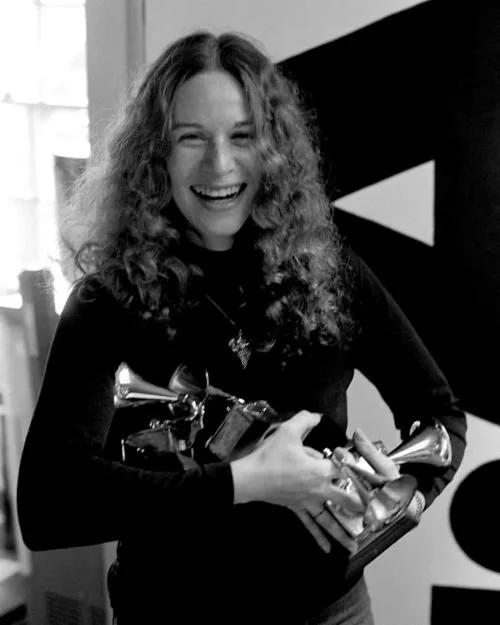
IN THIS PHOTO: Carole King in Lou Adler’s office holding the four GRAMMYs she won for Tapestry in 1971/PHPHOTO CREDIT: Jim McCrary/Redferns
I reconnected with King’s music when I was in high school. I was about to audition for choir. I always leaned toward rock in the classical world. The three songs on my list to audition with were: You’ve Got to Hide Your Love Away by the Beatles and I Feel the Earth Move and Natural Woman by Carole King. I narrowed it down to the two Carole King songs and was given the choice of show choir or madrigals.
Carole’s songs made me want to sing her melodies and her harmonies and I felt closer to her while finding my path as a singer even at that young age. In my 30s, watching her musical on Broadway, I was overwhelmed with feelings of gratitude for her story. It showed the way in which a woman can pursue her own career, have a family and achieve happiness. That is a delicate balance that I strive for in my own life every day.
Danielle Haim
When my sisters and I were growing up, Tapestry was a key record in the house. Our mum also loved James Taylor and Joni Mitchell, who played and sang on it, so it was on in the car a lot. Our mum was from Philly on the east coast, so it was always in my mind that Carole was also a Jewish east-coast girl. She’d write these amazing, emotive songs and sing them in an almost optimistic or carefree voice.
Once she left the songwriting world and started writing for herself, it got less straightforward and more personal. So Far Away is really complex. The bridge is just insane. I’ve heard that song so many times, but a few weeks ago it came on the radio when I was driving, and I was totally stunned.
When you write a song it’s almost mystical. It feels as if the words just come out and it can be months or even years later you realise: “That’s what was happening.” I’d love to know who those songs are about. I think female artists are great at just letting it all show. As artists, my sisters and I feel like having Carole always in our lives definitely inspired us.
Rufus Wainwright
Tapestry was around our house when I was growing up, but I connected with it more when I moved to California because it’s the blueprint for anybody who’s starting off in songwriting in LA. Carole King made this incredible transformation from Brill Building songwriter to performer, but she didn’t go crazy or self-destruct. She was able to remain a good parent and – especially now I’m a father – she has always been a role model for me.
Tapestry is a bundle of emotions, and she doesn’t sound like anybody else. She wasn’t necessarily the greatest singer, but she has a unique style and attack. She’s not pulling any punches: it’s a great lesson in how to be yourself and be successful. She’d worked with great songwriters and artists, and knew all the great recording engineers and session players, and was able to channel everything she’d learned in her own way. Tapestry is the ultimate in terms of doing what you want artistically and just surviving as a human being in the record business. She made this amazing milestone in music without having to sacrifice her soul to do it”.
I will finish off this anniversary feature with Pitchfork and their 2019 review for Tapestry. Awarding it a flawless ten, they commended an album that turned a “master songwriter into a music legend”. I do wonder if there will be anything new written about Tapestry on its fifty-fifth anniversary. It continues to influence artists to this day. One of the most important albums in history:
“Tapestry was King’s second album as a bandleader, primary songwriter, unvarnished singer, and tentative recording artist—an American master of melody whose introspection became a phenomenon. At 29, she had been in the music industry for over a decade, outlasting the sea change away from bubblegum music and towards the singer-songwriter. She was skeptical of stardom. (“I didn’t think of myself as a singer,” King has said, and having written for Aretha, who could blame her?) She had also divorced her lyricist. Gathering her daughters, Louise and Sherry, and her cat, Telemachus, King moved cross-country to the Hollywood Hills, where she undertook the time-honored pop-music tradition of self-reinvention by way of self-discovery. In time, she grew spiritual, becoming a follower of the artistically beloved Swami Satchidananda. Crucially, she finally began to write her own lyrics in earnest, penning more than half the songs, and all of the peaks, of Tapestry alone.
King’s lyrics are a testament to the potential of the simplest phrases when heightened by an uncluttered arrangement and an unfettered truth, the definition of classic. “You’re beautiful,” “you’ve got a friend,” “you’re so far away”—her words are conversational, economic, and nearly telepathic, as if reading our collective mind. In songs that mix girl-group longing, Broadway balladeering, blues, soul, and wonder, Tapestry used the room itself as an instrument. The producer, King’s longtime publisher Lou Adler, wanted it to sound like the understated and sought-after demos she recorded when writing for other artists, with the tactile intimacy of a woman at the piano singing straight to you. The result was precise but not overly manicured. Owing to her newfound spirituality, there is a sweet serenity to Tapestry. Here was a ’50s rock’n’roller from Brooklyn having journeyed through the ’60s to become a ’70s lady of the Canyon, making music that seemed to elude time completely.
The songs of Tapestry are like companions for navigating the doubts and disappointments of everyday life with dignity. Having composed hundreds of singles for others, King knew what they needed: raw feeling, careful phrasings, a little sparkle. She lets her voice break to show that it’s alive. The soulful “It’s Too Late”—co-written with Toni Stern, a then-unknown lyricist who King called “a quintessential California girl”—feels like a grown-up girl-group anthem, wherein the best part of breaking up is, it turns out, clarity. The gospel-tinged backing vocals of “Way Over Yonder,” sung by Merry Clayton, charge its calm with resilience, dreaming of “true peace of mind” and “a garden of wisdom.” By 1971, King was not only practicing yoga but teaching it at the Integral Yoga Institute, and an attendant sense of collectedness carries Tapestry. The Broadway-ready “Beautiful,” which came to King while riding the subway, is a loving-kindness meditation banged out to a Gershwin-like orchestra of piano chords: an appeal to the world to choose a positive outlook, to put forth what you’d like to receive.
There’s an unmistakable maternal energy to Tapestry. Throughout King’s career, she has recalled moments when her responsibilities merged, in which she’d have her baby in the playpen at the studio or be breastfeeding in between takes. Toni Stern has said that, while writing for Tapestry, King would be “playing the bass with her left hand and diapering a baby with her right.” King herself said that having kids kept her “grounded in reality,” which is audible in every loosely calibrated note of Tapestry. Her next artistic achievement was a collection of children’s music, 1975’s Really Rosie, in collaboration with author Maurice Sendak. A reworking of “Where You Lead”—rewritten, King has said, to sound less submissive—became the theme song to the mother-daughter sitcom “Gilmore Girls,” sung by King and her daughter Louise”.
On 10th February, it will be fifty-five years since Tapestry was released. Go and get the album on vinyl if you can, as this is one that everyone should own. Everyone from Amy Winehouse to Tori Amos has shouted out Tapestry and declared their love for it. In March 2016, it was announced that King would perform the album live in its entirety for the first time at the British Summer Time Festival in Hyde Park, London, on 3rd July, 2016. The performance was released the following year as Tapestry: Live at Hyde Park. Almost ten years on from that performance and the influence of Tapestry has widened and deepened. Regarding Tapestry, in my view, few other albums…
HAVE ever matched it.