
FEATURE:
What Is Life
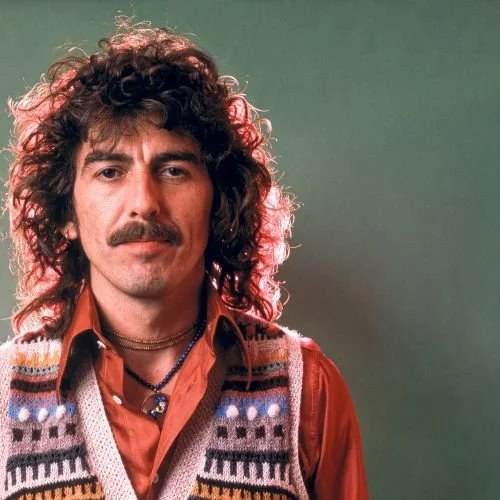
IN THIS PHOTO: George Harrison in 1975/PHOTO CREDIT: Sunshine/Rex Shutterstock
The Essential George Harrison
_________
I am doing quite a few…
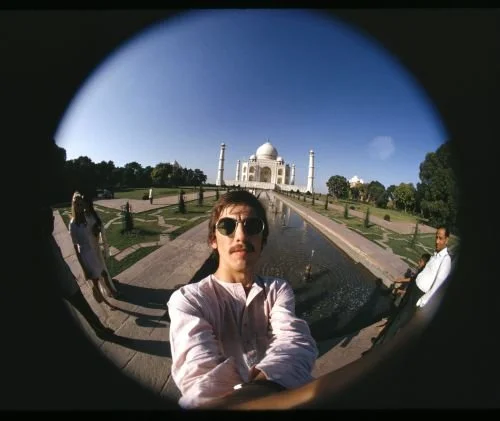
IN THIS PHOTO: George Harrison inventing the selfie in India in 1966
mixtapes for various artists. I am thinking about George Harrison. He died on 29th November, 2001. He had such a terrible last couple of years. At the end of 1999, he and his wife Olivia were attacked at their home in Friar Park. George Harrison suffered multiple stab wounds and was lucky to have survived. He died of cancer less than two years later. It was an unimaginably difficult and unfair end to the life of one of the greatest artists ever. The youngest member of The Beatles, he was part of the greatest group ever. Often seen as the quiet one, I think he was among the most interesting. So fashionable and cool, he could have a moan now and then. He was very spiritual but also had a sharper edge. Very funny and personable, Harrison often had to struggle to get his songs heard. John Lennon and Paul McCartney the dominant forces and songwriters. Although his earlier contributions to The Beatles were great, his two masterpieces arrived on the final album the band recorded together, Abbey Road (1969). Something and Here Comes the Sun are two of the most popular Beatles songs. The latter is the most-streamed on Spotify. After the band split, Harrison enjoyed a successful solo career. He was also part of Traveling Wilburys alongside Jeff Lynn, Bob Dylan, Roy Orbison and Tom Petty. I am putting together solo songs, some of his Beatles tracks and Wilbury cuts as we remember Harrison twenty-five years after his death. I know that Paul McCartney and Ringo Starr will pay tribute to him on the day. They miss him very much. There is a new book, The Third Way, that collects all these never-seen-before photographs by George Harrison. Olivia Harrison provides the foreword and has been talking about the book and George Harrison. I may have used this before, but I will end with AllMusic and their biography of George Harrison:
“Something" provided a launching pad for Harrison's solo career, but he'd already been dabbling in solo projects since 1968. That year, the Beatles launched their Apple Corps collective of businesses, one of their enterprises being an experimental label called Zapple. George released Wonderwall Music that year, becoming the first Beatle to release a solo album, and this collection of Indian music was followed in 1969 by Electronic Sound, an album where Harrison experimented with synthesizers. A better indication of the sound George chose to follow once he officially went solo in 1970 came with his on-stage cameos during Delaney & Bonnie's 1969 British tour. Along with Bob Dylan and the Band, these American blues-rockers had an influence on All Things Must Pass, a sprawling triple album produced by Phil Spector that functioned as a spectacular introduction to George Harrison the solo artist. Bolstered by "My Sweet Lord," a single that hit number one throughout the world, and the Top Ten "What Is Life," All Things Must Pass topped the charts in the U.S. and U.K., elevating George above John, Paul, and Ringo's stardom. His rise was not without controversy -- Bright Tunes Publishing sued Harrison for copyright infringement in 1971, claiming "My Sweet Lord" plagiarized the Chiffons' 1963 "He's So Fine"; George lost the case but, in a byzantine turn of events, he wound up with the publishing to both songs after his then-manager Allen Klein purchased the rights to "He's So Fine" -- but there was no question Harrison came into his own.
George followed All Things Must Pass with something equally grand: a benefit concert for the refugees of war-torn Bangladesh. Upon the urging of his friend Ravi Shankar, Harrison arranged a star-studded benefit held at Madison Square Garden on August 1, 1971, enlisting his friends Starr, Dylan, Eric Clapton, and Billy Preston to play; it was the first all-star charity show, setting the template for those to follow. Although there were problems dispersing funds, the concert was a success, as was the album, which went gold in the U.S. and won the 1973 Grammy for Album of the Year. Also in 1973, Harrison released Living in the Material World, his second studio album and his second number one, assisted by the single "Give Me Love (Give Me Peace on Earth)," a number one hit in the U.S. that topped out at eight in the U.K. He supported the record with an extensive series of North American concerts, the first tour launched by a Beatle. Upon its conclusion, he released his next album, Dark Horse (his tour shared the same title), a record greeted with mixed reviews and softening sales; it failed to chart in Britain, although it did peak at four in the U.S., where the title track went to number 15.
Harrison closed out his contract with EMI and Apple in 1975 with Extra Texture (Read All About It), an album that fared better in the U.K. and performed respectably in the U.S., due to the single "You." He quickly launched his own Dark Horse label in 1976, inaugurating the imprint that November with Thirty Three & 1/3. (Apple released The Best of George Harrison, containing solo and Beatles cuts, almost simultaneously.) Supported by the modest hits "This Song" and "Crackerbox Palace," the slightly slicker Thirty Three & 1/3 wound up a bigger hit than its two predecessors, thereby starting Harrison's Dark Horse years off on a slight rebound. This continued through 1979's eponymous album, a record highlighted by the soft rock hit "Blow Away," a single that peaked at number 16 in the U.S. but went no further than 51 in the U.K.
Harrison rebounded with 1981's Somewhere in England, thanks in no small part to the hit "All Those Years Ago," a song fashioned as a tribute to the murdered John Lennon and featuring contributions from Ringo Starr and Paul and Linda McCartney. Despite this hit -- which went to two in the U.S. and 13 in the U.K. -- the record failed to go gold in either America or Britain, and Gone Troppo, released just a year later, sank from view quickly. George slid into a relatively quiet phase, concentrating on raising his son Dhani -- he was born in 1978, the first and only son of George and Olivia Harrison, who also married in 1978. Harrison concentrated on his film company HandMade Films, a company started in 1978 with the intent of financing Monty Python's silver-screen debut Life of Brian but gained momentum in the early '80s thanks to the release of 1980's Bob Hoskins gangster drama The Long Good Friday and Terry Gilliam's 1981 fantasy Time Bandits; the company would also release the acclaimed Mona Lisa (1986) and Withnail and I (1987), before becoming mired in money problems surrounding the runaway production of the 1986 Sean Penn and Madonna vehicle Shanghai Surprise. George stayed involved in music largely through live guest appearances, popping up at charity concerts and tributes, but he also appeared on Dave Edmunds' oldies-inspired soundtrack for 1985's Porky's Revenge.
Eventually, Harrison began work on his ninth studio album, hiring Jeff Lynne of Electric Light Orchestra as co-producer. Lynne brought a lush, glossy sheen to 1987's Cloud Nine, a sound that was instrumental to the record's success. Preceded by a bouncy rendition of James Ray's forgotten chestnut "Got My Mind Set on You," a single that turned into a number one hit in the U.S. and reached two in the U.K., Cloud Nine was an undeniable comeback, reaching the Top Ten on both sides of the Atlantic and earning a platinum certification in the U.S., assisted in part by its second single, "When We Was Fab." In the wake of its success, Harrison and Lynne returned to the studio to record a B-side with the assistance of Bob Dylan, Roy Orbison, and Tom Petty. This session turned into a full album with the superstars calling themselves the Traveling Wilburys. Accompanied by the single "Handle with Care," their record, The Traveling Wilburys, Vol. 1, appeared in October 1988 and it was selling well prior to the December death of Orbison. Its second single, "End of the Line," helped cement its success and it wound up being certified platinum three times in the U.S., reaching a peak of three; it wound up in the Top Ten in every major country around the world, save the U.K., where it topped out at number 16. The Traveling Wilburys released a second album, Traveling Wilburys, Vol. 3, in the fall of 1990. While it didn't sell as well as its predecessor, the record nevertheless went to number 11 in the U.S., where it also went platinum.
Following the 1992 release of Live in Japan and some live appearances that year, Harrison once again receded from the spotlight, reuniting with the surviving Beatles to assemble their 1994 archival Anthology project, an effort that also included working two existing Lennon demos into a finished project with the assistance of Lynne. After Anthology wrapped, Harrison produced Ravi Shankar's 1997 album Chants of India, but his output slowed further following a 1997 diagnosis of throat cancer. Over the next few years, Harrison dealt with several different health issues (he also suffered a serious knife attack by an intruder in 1999), and in 2001 his lung cancer spread to his brain. On November 29, 2001, Harrison passed away from lung cancer.
After his death, his son Dhani and Jeff Lynne completed Harrison's unreleased recordings and they were released as Brainwashed in 2002. George was inducted into the Rock and Roll Hall of Fame in 2004 and, over the next decade, there were several archival projects, including a 2004 box set of his Dark Horse recordings and the 2009 compilation Let It Roll. In 2011, his life was the subject of a documentary film from Martin Scorsese called George Harrison: Living in the Material World; it was accompanied by a collection of rarities called Early Takes: Vol. 1. George's Apple recordings were remastered and released in 2014 as a box set called The Apple Years 1968-75. A hefty, handsome collection of LP reissues -- aptly titled "The 50th Anniversary Edition" -- of All Things Must Pass was commemorated by a series of deluxe reissues of the landmark album, each featuring a new mix supervised by Dhani Harrison and Paul Hicks. The Super Deluxe editions also contained a wealth of demos and outtakes”.
I will end here. Rather than feel sad that George Harrison is no longer with us, we need to celebrate the incredible music he left. As important as any artist who has ever lived. On 29th November, it will be twenty-five years since this amazing human left us. But his spirit and legacy lives on. Harrison will never be forgotten. Compiling a mixtape of his solo and band work has been…
A real delight.