
FEATURE:
Life in the Fast Lane
Eagles' Hotel California at Fifty
_________
THERE are not many…
classic albums that were released in December. Artists tend not to release in December, as things are winding up and attention turns to Christmas. It is a bit of a risk of being overlooked by people not really thinking about new albums and the proliferation of Christmas music. However, there is a notable exception. On 8th December, 1976, Eagles released Hotel California. It is one of the best-selling albums ever. It has been certified 28× Platinum by the Recording Industry Association of America (RIAA) in the U.S. From 13th November to 23rd January, the band are playing at Sphere in Las Vegas. I do wonder if they are playing tracks from Hotel California? I wanted to mark fifty years of this world-conquering album. The title track, which opens the album, has been streamed more than two billion times. I know it may be a bit late, but it would have been great for a few new videos to be commissioned to mark fifty years of Hotel California. Whether animated or live action, Hotel California, Life in the Fast Lane, and New Kid in Town getting these great videos. There will be features about the album closer to the anniversary. I wanted to sort of get in there early, as it will be exciting to see how Hotel California’s fiftieth anniversary is marked. Because there was a fortieth anniversary reissue of Hotel California, I am not sure if anything will be done for the fiftieth. I am writing this on 7th November, and there has not been anything announced. Some people wrote features earlier in the year. Marking fifty years a bit prematurely. A new book by Sean Egan explores aspects of the recording, and the album’s legacy. How there was conflict and divisions within the band at the time. One of those classic albums that was made during a bad time. Like Fleetwood Mac and Rumours – which turns fifty next year -, you do wonder how Eagles made a masterpiece when they were not in harmony and completely happy! I guess The Beatles did it too. Not that drama and tension defines Hotel California. If anything, you get this impression of a band at ease and at a creative peak.
For such a huge and historic album, there is precious little written about it. In terms of extensive features that analyses the recording and legacy, there is really not as much as there should be. Perhaps will get something like that soon. Such a phenomenal and huge-selling album should get more words written about it. I did want to come to Ultimate Classic Rock and a feature they published in 2016 to mark forty years of Hotel California:
“Hotel California, the Eagles' layered and frank meditation on the price of fame, is a reflection of where they were in life in the mid-'70s. The band was beset by the trappings of celebrity, wrestling with personal issues, moving toward a harder-edged sound, slowly falling apart – and all of that can be found deep in the grooves of their best album.
They got there by looking with steely focus into “the darker side of paradise – sort of what we were experiencing in Los Angeles at that time," the late Glenn Frey once said. There were powerful forces at play, including – but not limited to – stardom, cocaine, egos, love lives and a small fortune.
All of it went into Hotel California, which produced two consecutive No. 1 singles in the Frey-sung "New Kid in Town" and the title track. "Life in the Fast Lane," which drew the most direct line from their current excesses to their newly formed art, also reached the Top 20.
“We were getting an extensive education – in life, in love, in business," Don Henley said in 2004's To the Limit: The Untold Story of the Eagles. "Beverly Hills was still a mythical place to us. In that sense it became something of a symbol, and the ‘Hotel’ the locus of all that L.A. had come to mean for us. In a sentence, I’d sum it up as the end of the innocence, round one.”
Meanwhile, their sound was in a state of flux. Joe Walsh's recent arrival forever shifted the Eagles away from the rootsier influences of their early years with multi-instrumentalist Bernie Leadon – and that started here.
"One reason Leadon didn’t last in the band was that he was so contrary," Henley later remembered. "Success freaked him out a little; he was always worried about our success, about coming from a ‘pure’ bluegrass background and making it in rock ’n’ roll. He thought we were selling out from the very beginning. To me, the point was to reach as many people as possible."
Things were no more settled at home. Henley, for one, was involved in an emotionally draining relationship that emerged as a topic in both Hotel California's title track and "Wasted Time." But they were such a gifted group, with each member working at a creative peak, that the pieces somehow fell into place anyway.
"What we did in that band, it was a very unusual circumstance to have five guys and each one brought such an abundance of talent," guitarist Don Felder said in 2012. "Everybody in that band would write, sing and play. Anyone in the Eagles could, and did, front their own band. So, it was unusual to have so much talent in one band. We took everyone’s strongest suit, in order to make the best records we could."
That concept is best understood through the prism of "Hotel California," which began as a Felder demo before being completed by Henley and Frey – and then improved upon through a striking group performance that concludes with extended guitar interplay between Felder and Walsh.
Released on Dec. 8, 1976, Hotel California quickly shot to No. 1 on the Billboard album chart and was reportedly selling 500,000 copies a week at one point. More than 14 million copies later, it's one of the Top 10 best-selling albums of all time – a testament to how timelessly relatable it remains.
"People tend to think the album is about California,” Henley later noted. “But I think it was about the dark underbelly of American culture at large.” Particularly, there seems to be just as much reporting on Hotel California – real truth-telling about the band members' personal foibles – as there was narrative myth-making, and that gives the album continuing resonance”.
“You can’t argue with success. And when it comes to popular American albums, Hotel California –with two #1 Billboard hit singles and 32 million (and counting) in worldwide sales — certainly qualifies. So it’s no surprise that this is the first Eagles album to receive the deluxe reissue treatment, just in time for Christmas shopping, circa 2017, more or less its 40th anniversary (it was first released October, 1976).
Hotel California arrived, seventeen months after One of These Nights, with a substantial personnel change: the substitution of Bernie Leaden who, as a former member of the Flying Burrito Brothers, had lent the Eagles authenticity and a connection to the country world. Filling that slot was hard rocker Joe Walsh (on guitar and keyboards), initially an unusual choice, but one that history has shown to be wise, especially for the tougher, more arena rock oriented sound the band was aiming for.
Little more needs to be written about the music, although it’s worth noting that for all of its lyrical exploration of excess in the Golden State, neither of the Eagles’ primary songwriters Don Henley or Glenn Frey, was born or raised in California. Regardless, with songs such as the thrill ride slide guitar rocking of “Life in the Fast Lane,” the bittersweet, string enhanced, cinematic ballads “Wasted Time” and double entendre titled closer “The Last Resort,” along with the incisive, reggae/Spanish-styled title track, the songwriting team along with help from others in their orbit such as J.D. Souther, nailed the dark underbelly of fleeting success with memorable melodies and committed performances. Even Randy Meisner’s yearning “Try and Love Again” and Walsh’s poignant “Pretty Maids All In a Row,” both composed without either Frey or Henley, slot nicely into the general concept. Producer Bill Szymczyk’s input isn’t often credited, but he effectively captured the organic nature of the music while providing the scope and heft that shifted the Eagles from a popular roots rock act to a worldwide household name.
Assuming everyone who wants the original set already owns it since its release four decades ago, this reissue needs to up the ante. It boasts remastered sound both in stereo and 5.1 (the surround mix is apparently unchanged from its initial 2001 appearance), ten live tunes culled from three October 1976 dates oddly before the record was released (only including two of its selections), and some extraneous swag with rare pictures, poster and a replica tour book. That’s in hopes of justifying the wallet wincing $99.98 list price (slimmer single and double packages are also available for the budget conscious). The most frustrating aspect of the expanded edition is the abbreviated 50 minute live set since there is audio of the same tour floating around with at least an hour of additional music. Fans hoping to hear demos or early versions of the songs, a natural inclusion for a pricy edition of this type, will also come away empty handed”.
I will end with a review of Hotel California. There is this interview from 1976, where Don Henley and Glen Frey talked about Joe Walsh joining Eagles. They also discussed their soon-to-be-released masterpiece, Hotel California. It is well worth a read. I did want to come to this feature, that takes us inside the timeless songs from Hotel California. I have chosen the three biggest/most popular tracks, but I would advise people to have a read of the whole thing:
“By late 1976, the American Dream was beginning to fray at the seams, and the Eagles were on hand to document the dishevelment. Having established themselves with four albums of breezy country-rock, Don Henley, Glenn Frey and co. exchanged Laurel Canyon vibes for a sound that was darker, sleeker, and infinitely more cynical.
The result was Hotel California, a lavishly produced monument to 1970s decadence, paranoia, and the ugly side of fame. With new recruit Joe Walsh's guitar giving the band a sharper edge, it remains a masterpiece of stadium-sized storytelling. Here's our track-by-track breakdown.
Take evocative lines stuffed full of images (‘mirrors on the ceiling’, ‘the Mercedes bends’); a ‘Mexican reggae’ rhythm, the immortal Bm-F#-A-E-D-G-Em-F# chord sequence, the guitar duel to end all guitar duels, and a glimpse inside a place where you are trapped eternally, and you have history in the making.
Asked what it’s actually about, Henley mused: “[These are] the same themes that run through all of our work: loss of innocence, the cost of naiveté, the perils of fame, of excess; exploration of the dark underbelly of the American dream, idealism realised and idealism thwarted, illusion versus reality, the difficulties of balancing loving relationships and work, trying to square the conflicting relationship between business and art; the corruption in politics, the fading away of the sixties dream of ‘peace, love and understanding’.”
Pretty much what you thought, right?
New Kid In Town
After the epic dimensions of Hotel California and its six-plus minutes of decayed magnificence, some downtime is required, and New Kid In Town is that. As mellow as Peaceful Easy Feeling and as warm as Tequila Sunrise, it takes your pulse down to manageable levels.
A JD Souther co-write, this track was released as this album’s first single and topped the Billboard Hot 100 chart. The public had been yearning for one of their heroes’ mellower hits for some time, and with New Kid In Town they got one, no matter what its theme was. It’s still a precision-engineered song of great beauty.
Life In The Fast Lane
Supposedly based on something Frey said to his drug dealer while powering along the freeway in a highly tuned car, Life In The Fast Lane represents the other side of the Eagles – the take-no-prisoners buccaneers of rock’n’roll who lived life at a frenetic pace. The finger-twisting guitar riff that Walsh busts out at the beginning says it all.
As Henley remembered: “I said: ‘What in the hell is that? We’ve got to figure out some way to make a song out of that!’ But we really couldn’t sing over that riff, so Glenn came up with the idea of what is a traditional blues or R&B staple – the ‘one chord’ song.”
That makes the song sound simple, but it’s actually far from simple. The Henley/Meisner rhythm section delivered a slinky performance here. As Henley noted succinctly: “It was a real bitch for me to learn how to do that syncopated bass-drum part and sing the melody at the same time”.
In July, Classic Rock published this feature. Don Henley and producer Bill Szymczyk revisit the making of the Eagles' most successful album. It is an illuminating feature. I know that there will be a lot of younger music fans who may not know Eagles and Hotel California. What an important album it is. I heard it when I was a child, but I am still amazed every time I listen. A truly timeless album that will never fade in terms of its brilliance and importance. I am not sourcing the whole article. I am picking it up here:
“Meanwhile, in the world outside the studio, the United States was basking in its bicentennial. On the surface, the country’s 200th birthday was all stars and stripes, but that was tainted by a Watergate hangover and relentless dark stories in the news.
“The ‘peace and love’ idealism of the sixties had faded by the beginning of the decade,” Henley says. “The so-called counterculture, due in part to its own excesses, had disintegrated. The US was trying hard to focus on the bicentennial, but the Cold War continued, and the Boomer generation had slowly realised that the same corporate forces that had always been in charge were still, in fact, in charge, and there was an air of capitulation. There were now the realities of jobs and families to consider. Gone was the dream of a new kind of America; gone was the appetite for rebellion. ‘We haven’t had that spirit here since 1969.’”
One of Hotel California’s standout tracks was about appetite with a capital ‘A’. Both a celebration and a critique of LA’s decadence and the band’s own excesses, Life In The Fast Lane could have been subtitled ‘Nervous, Edgy Feeling’.
“There are a great many of our songs that could be retitled ‘Note To Self’,” Henley says. “Excess – too much of a bad or good thing – was a subject we examined, both from a personal perspective and an American cultural standpoint.”
The song’s classic riff began as what Walsh called his “co-ordination drill”. “I had this lick that I played that I would warm up for a show with,” he told Paul Shaffer on Plus One. “It’s an exercise between your right and left hand, faster and faster. I was playing, warming up for the show, and Glenn comes busting in my dressing room and says: ‘What the hell’s that?’ ‘I don’t know, it’s just this lick I warm up with.’ He said: ‘No, that’s an Eagles song, dude!’”
On In the Studio With Redbeard, Frey said the title came one day after a crazy car ride with a drug dealer nicknamed The Count. Driving at 90mph, Frey asked the dealer to slow down, and the answer came: “It’s life in the fast lane”! With that title, he and Henley wrote the lyrics and melody together.
“We knew it was going to be the most rock’n’roll thing the Eagles had attempted so far,” Walsh said. “They turned me loose on that one.”
And what guitar was he using?
“That’s a Strat,” Walsh told Total Guitar. “And the amplifier was probably this little orange Roland Cube I was using a lot back then. I found it to be a pretty darn good little amp for recording with a Strat, by turning it up pretty good to make it work.”
The killer riff doubled with guitar and bass, cliff-hanging power chords, and trademark four-part vocal harmonies on the chorus. This was a classic Eagles record, yet one that sounded like nothing they’d ever done before. And as sonic icing, Szymczyk employed a Jimi Hendrix trick – the “Electric Ladyland two-track flange technique” – to add a whooshing sound to the song’s offramp exit.
“When I suggested phasing at the end of the song, Henley and Frey were sceptical,” he says. They thought it might sound too much like the Small Faces’ Itchycoo Park – which Szymczyk says was the inspiration. “I just wanted listeners to feel the rush of the wind in their hair!”
An ocean breeze was in Don Felder’s hair on the afternoon he got the idea that would become the title song of Hotel California. In his Malibu beach house, noodling on a 12-string Martin acoustic guitar, he hit on a Spanish-sounding chord progression. He put it down on a reel-to-reel four-track, then layered on syncopated electric guitars and a samba beat from a drum machine. He sent it to Henley and Frey on a cassette with another dozen snippets. They liked what they called “the matador in Mexico” vibe of it, and experimented with lyrical and melody ideas.
Henley took the cassette in the car, which was his favourite place to write. “I think it has something to do with movement and a constantly changing view,” he says. “Just sitting in a room and trying to find inspiration can be stifling. It’s a static situation. Driving, if you’re not in heavy traffic, creates a feeling of flow that can free the imagination and call up memories and images while the music’s playing.”
After a week or two, the song took shape.
“The hotel concept came first, and then the melody,” Henley says. “Some time in May of ’76, Glenn and I had gone to see Neil Simon’s play California Suite in Los Angeles. But that was after we had come up with the hotel concept. Seeing the play was a ‘field research’ trip, just to see if it would help us to flesh out our initial idea. But it wasn’t very helpful; [it wasn’t] dark and spooky enough for what we were after.”
Or maybe the title influenced them, because their spooky inn became the Hotel California, and in turn a metaphor for everything from the mythmaking of the American Dream to an artist’s search for the muse and spiritual meaning.
The recording of the song required some searching, too.
“We cut the track several times, first at Criteria Studios, shortly after Felder had given me the demo,” Henley recalls. “The Miami recording was a rough arrangement with the working title ‘Mexican Reggae’. The second time we cut it was at the Record Plant in LA, after Glenn and I had come up with some ideas for lyrics and melody, but that recording turned out to be in the wrong key, at least for singing.
"There was often a schism between what key was best for the guitars and what key was best for the lead vocal. At the end of the day, though, the vocal has to take precedence. There are workarounds on the guitar – tunings, capos, etc – but you can’t capo a voice. Or at least you couldn’t then. So we ended up cutting the final track in Miami in the key of B minor with the choruses going to G major.”
Szymczyk recalls that the final version of the track consisted of “thirty-three separate tape edits from five different takes”.
Apart from being the album’s thematic centrepiece and the Eagles’ best song, it also rode out on one of rock’s most iconic guitar duels, with Felder and Walsh trading sizzle and sting, one-upping each other, then finally merging in triumphant two-part harmony.
“We worked really well together,” Walsh told Guitar World in 2012. “It was competitive. We brought out the best in each other. We liked to kick each other in the butt! He would play something, and I’d get an attitude, like: ‘Oh yeah? Listen to this.’ And he’d go: ‘Wow. Listen to this!’”
“For two days, we wood-shopped the hell out of that,” Szymczyk says. “We had amps out in the studio, but Felder and Walsh were in the control room with me, one to the right, one to the left, like gunfighters! Felder was the ultimate technician, always a tad on top of the beat. Walsh was the ultimate ‘feel’ guy, always a tad behind it. Together they were phenomenal. Those two days were one of the high points of my career.”
“There are at least half a dozen guitar tracks on the original recording,” Henley says. “In live concert settings, this required Felder to play a double-neck guitar, with the twelve-string neck being capo’d on the seventh fret for the intro and the breakdown, and the six-string with no capo for the single-line phrases and the tag solos. One of the unique things about the song is that it ends with extended dual guitar solos. Skynyrd had done something like that a couple of years earlier.”
Another thing it shared with Skynyrd’s Free Bird was a length – six and a half minutes – that wasn’t exactly radio friendly. “The label wanted us to do a single edit, and we all said no way,” Szymczyk says. “Obviously we were right to.”
After seven months of off-and-on recording, the album finally completed in October.
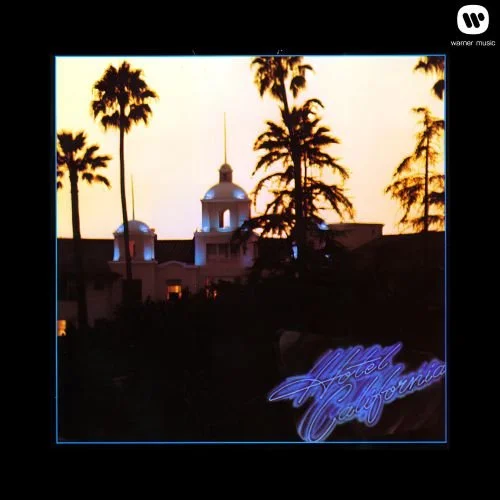
The cover artwork, designed by John Kosh (who also handled Who’s Next and The Beatles’ Abbey Road), featured a photo of the Beverly Hills Hotel at dusk, taken from a cherry picker 60 feet above Sunset Boulevard. Built in 1912 in a Mediterranean Revival style, the pink stucco hotel had hosted famous A-list guests such as Marilyn Monroe and Frank Sinatra. A month after the album came out, when the hotel learned that the Eagles had used the image without permission, they threatened a lawsuit. They dropped it when they realised that the hotel’s bookings had tripled because of the record’s success.
The Hotel California album was released on December 8, 1976, and was certified platinum in its first week. It went to No.1 on the Billboard 200, where it stayed for eight weeks. Reviews were glowing. Creem said there were “no weak tracks; the music flows majestically every step of the way”. Phonograph praised its “peerless harmonies” and said it was “pretty and punchy, as the best albums of fellow troubled hedonists Steely Dan and the Beach Boys are”. NME said: “There’s no laurels-resting, and a lot has gone into its meticulous crafting.”
While Szymczyk calls the record a “quantum leap forward”, Henley’s opinion is more modest. “I don’t know if I’d call it a ‘quantum leap’; One Of These Nights had three big hits on it,” he says. “But in terms of growth and consistency and range, I’d agree that Hotel California was an improvement.”
The 10-month, 72-date world tour that followed was gruelling. So much so that the band’s road crew nicknamed it The Prison California. Everyone travelled with their own little entourage. Walsh and Felder had their faction, briefly entertaining the idea of forming their own band. In History Of The Eagles, Henley said: “Glenn and I saw ourselves as the leaders, but other people saw us as dictators. You just cannot have five leaders in a band. It doesn’t work.”
But according to To The Limit: The Untold Story Of The Eagles, even the two leaders had stopped talking and would only communicate through others. There were also cocaine-induced physical ailments. Stomach ulcers all around. Henley suffered back pain. Frey’s nasal lining was shot (he would have two surgeries before getting his nose repaired with Teflon). By the end of the tour, Meisner had become persona non grata after drunkenly refusing to sing Take It To The Limit at one show. He left the band shortly after”.
I will end with Stereophile and their review of the 40th Anniversary release of Hotel California. There are going to be new takes and dissections of this album closer to 8th December. I wanted to bring together some features on this gigantic and juggernaut album. For anyone who has never heard the album, you really do need to listen to it. A truly masterful offering from Eagles:
“Not so long ago, you could not wander the halls of any High End Audio show and not hear The Eagles' Hotel California. To say it was an audiophile favorite is to grossly understate the obvious.
Produced by Bill Szymczyk and tracked between March and October 1976 at Criteria Studios in Miami and the California branch of the Record Plant, it was the group's fifth and ultimately one of the album-sales blockbusters of all time. Its current sales number is somewhere near 35 million copies sold. Late last year Rhino Records released a Hotel California 40th Anniversary Deluxe Edition CD boxed set edition of this rock landmark that comes complete with a hardbound book of photos, a tour posters and other assorted paper goods.
Given some of my previous utterances on The Eagles and the vociferous responses that they've elicited I need to clear the air once and for all. For the record (and hopefully the last time), even though I am a Gram Parsons fan (if not a full-fledged member of the Gram cult), the Eagles occupy a cherished place in both my teenage hood and my overall musical education. Besides the endless cruising in cars and fruitless scheming about girls that went on whilst the One of These Nights album was playing on an 8-track car stereo, I also bought all the records and saw the band a number of times, both pre and post Joe Walsh joining the band. While I prefer the self-titled debut, On The Border (their first album to be released in a quadraphonic version), and One of These Nights, I pretty much loved them all including The Long Run. With the mustachioed and rakishly handsome Glenn Frey as the front man and Don Henley, one of the few drummers outside Levon Helm who was a genuinely great lead vocalist—both of whom could also write memorable, hooky songs—they were a powerhouse. I have always marveled that Frey, a guy from Detroit, the land of the MC5, Iggy Pop and CREEM magazine, became an icon of soft, sweet SoCal country rock.
The band's supporting cast was equally strong. In fact, I like the band best when the voices of Bernie Leadon and Randy Meisner and the slide and double-necked guitar heroics of Don Felder were all still aboard. Leadon, who'd played with Gram Parsons in the Flying Burrito Brothers prior to the Eagles, wrote "My Man" for the On The Border album to pay tribute after Parsons OD'd in 1973. Losing Randy Meisner's high voice was a definite blow and noticeable sonic alteration change to the band's sound. As far as later additions are concerned, there's no doubt, however, that Joe Walsh's guitar, which upped the band's overall musicianship, and then his songwriting both became welcome infusion of new energy into the band's live shows and the last two studio albums prior to their 1980 breakup.
For me, a show during the On The Border tour (or was it during the One of the These Nights tour . . . the memory wobbles) and one show during the triumphant 1977 Hotel California tour will always rank among my favorite live music experiences of all time.
Now for the inevitable provisos. As a live act, before and after Walsh entered, they did tend to scrupulously stick to the script, essentially playing their studio albums note for note including replicating guitar solos. If you dislike bands that make changes from the studio albums when they play live, then The Eagles were your kind of act. I would have preferred a little stretching, a different vocal arrangement here and there, and a new guitar solo now and then. Seeing them live, I always wanted to see what they actually had musicianshipwise—see them kick out the jams and blow away the old saw about how they were essentially a studio-only band.
And then there's the oversaturation issue. Today, when I listen to the band's albums I tend to lift the needle over the hits and play the inner cuts—the deep tracks that the radio forgot. Because the band owed much of its massive success to 1970s commercial radio who, along with Steve Miller and Fleetwood Mac, played their singles and album cuts—OVER AND OVER AGAIN—I do not go back to Hotel California much. That and it's constant presence at High End Audio shows, where those famous opening chords to the title track that usually sent me drifting back into a hallway, have combined to give me a little ear and brain fatigue.
With that as my overlong prologue, I approached the 40th Anniversary Deluxe Edition 2-CD/1-Blu-ray reissue box ($99.98), primarily curious about three things: the original album remastered, the hi-rez and 5.1 mixes and finally the ten previously unreleased live recordings from 1976.
According to Rhino, the surround mix by Elliott Scheiner and the 24-bit/192kHz stereo mix were originally released on a DVD-A in 2001. Neither have ever really impressed me much. While the Eagles camp were early 5.1 adopters, surround was still a new toy then. These mixes could perhaps be improved upon today. While what you hear is the band all around you, at sort of the halfway point between the ceiling and the floor in whatever room you are listening in, I still prefer the standard two-channel mix—you standing in the audience and the band in front of you. Again via Rhino, this new remastering, which was done a few years back when the album was remastered for HD digital download, is here on CD for the first time. The results are not dramatic, but the overall sound is a mite clearer and like virtually all-new remasterings, a touch brighter.
As for the live tracks, they are taken from the band's three=night stand in 1976 in The Forum in LA, a gig that also supplied five tracks for the band's official live recording, Eagles Live. That album, the last Eagles album, was cobbled together to fulfill their contract with the Elektra/Asylum record label. The fact that is has an 86 on the front cover, and record labels that feature a bird's nest filled with eggs and hand grenades were seen at the time as hint that the band was over. The album was mixed and released after the famous backstage near- fisticuffs between Don Felder and Glenn Frey that occurred in Long Beach in July 1980. Frey refused to participate in postproduction. He stayed in Los Angeles while the band went to Miami to work on the album. This led to producer Szymczyk's famous quote: "We were fixing three-part harmonies courtesy of Federal Express."
All that fixing led to a live album that was overdubbed to the point of being a studio album. The sound is suspiciously clean and groomed. It's no secret that many '70s live albums were in fact sweetened in the studio before release—clams were fixed, harmonies were added, guitar solos re-recorded and dropped in. On Eagles Live and the live tracks here on the 40th Anniversary boxed set, any and all warts, both in sound and performance are scrubbed and what's left are impossibly perfect performances with vocal harmonies that are mostly dead-on. What's best about the live tracks here is the selection of tunes, which cherry picks the best tracks from On The Border, One of These Nights and Hotel California.
One mystery here is why extra material from the original sessions—alternate takes or unreleased tunes—was not included. The band's near obsession with recorded perfection, with not exposing loose ends or anything but fully assembled takes, may be the reason. While picture books are nice, more extensive notes would have been a better choice for collectors. And while there have been numerous LP reissues previously, heavy, quiet, premium-quality LPs would have been a welcome addition. Overall, though a must have for Eagles fans and the first of what I suspect will be more tributes to come to one of the most iconic albums in all of pop music recording history”.
On 8th December, it will be fifty years since Hotel California was released. Given the name, you’d think Eagles would release it in the summer, rather than the more oppressive winter! Though that may have been planned. Given the fact the title is not all about sunshine and warmth. Few classic albums were released in December, so it is a treat we get to talk about Hotel California. One of the greatest albums in music history. Some may contest this, but I would say Hotel California is…
A perfect album.