
FEATURE:
Groovelines
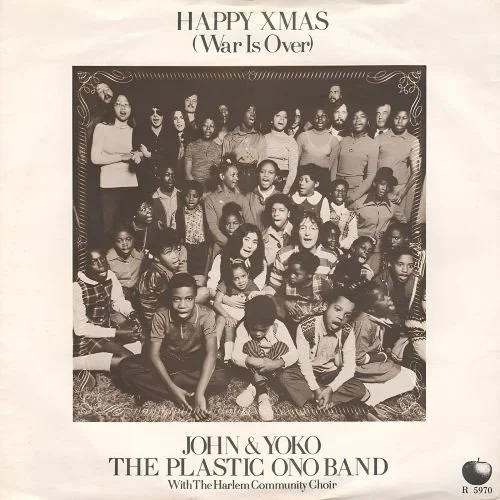
John & Yoko and The Plastic Ono Band – Happy Xmas (War Is Over)
_________
DECEMBER is a bittersweet month…
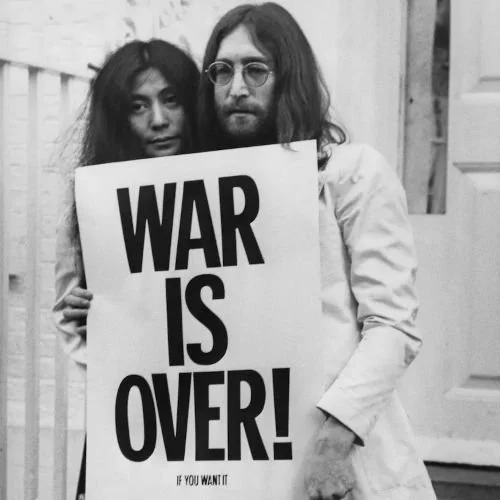
IN THIS PHOTO: Yoko Ono and John Lennon in 1971/PHOTO CREDIT: Frank Barrett/Keystone/Hulton Archive/Getty Images
when we think of John Lennon. In the context of The Beatles, 3rd December, 1965 is when Rubber Soul came out. On 1st December, it will be fifty-five years since John & Yoko and The Plastic Ono Band released Happy Xmas (War Is Over) in the U.S. It was not until 24th November, 1972 the single was released in the U.K. John Lennon and Yoko Ono were based in the U.S., so it made sense for it to be released their first. On 8th December, it will be forty-six years since Lennon was killed. Whilst I wanted to discuss a song that turns fifty-five very soon, we cannot ignore the fact that its co-writer (alongside Ono) is no longer with us. That said, it is important that we look inside this song. It is a little divisive when it comes to the greatest Christmas songs ever. Its messages and spirit perhaps as relevant now more than ever, though its imagery and lyrics are not traditional or necessarily positive. There is this plea for peace and unity, though was it quite a naïve thought to base a Christmas song around? The fact genocide and warfare rages would have repulsed Lennon were alive today. He would have been enraged by what is happening around the world. I do want to look inside its development and legacy. I guess one thing that blackens the song is the involvement of producer Phil Spector (In 2009, he was convicted of the 2003 murder of actress Lana Clarkson and sentenced to nineteen years to life in prison, where he died in 2021). However, we cannot ignore him when discussing the song. In 2011, The Guardian marked forty years of Happy Xmas (War Is Over) by publishing an account of events by Richard Williams that was first published in Uncut magazine in 1998. We are in New York 1971, just prior to this Christmas standard being recorded. It is interesting why Lennon wanted to wrote Happy Xmas (War Is Over):
“John says that he wrote it "because I was sick of White Christmas," and it could well take over as the annual Yuletide anthem. It's terrifically singable, in the tradition of All You Need Is Love or Give Peace A Chance, and it's very pretty, too. The words are simple and direct, with the chorus going "War is over/If you want it/War is over now," while John and Yoko express appropriate good wishes to all mankind”.
Unfortunately The Beatles Bible does allow you to copy any text from their site, so I will guide you to it so you can see interview archive, where John Lennon talks about Happy Xmas (War Is Over) and why he and Yoko Ono wrote it. There are articles I can source and copy, so I will bring them in. Actually, we can get some archive interview from the official John Lennon website. The addition of The Harlem Community Choir adds this extra element that is spine-tingling. It really adds weigh to the song’s messages. I do think that it sits there with the best Christmas tracks. As mentioned, its lyrics should hit especially hard today, given how divided, destructive and violent the modern world is. I don’t think it is corny or ineffectual writing a song like Happy Xmas (War Is Over). John Lennon and Yoko Ono genuinely wanted to see peace and change in the world:
“John: ‘Happy Xmas (War Is Over)’ we wrote together. Nothing more to say on that. It says it: ‘War is over if you want it.’ Because it was still that same message, the idea that somebody is either going to give us power or [has] taken our power or has made us go to war or not made you go to war or the president did this to us.
We are just as responsible as the man who presses the button. It’s that idea of God in the sky is a separate thing, you know? It’s all that separation. It’s all the same thing: nationalities, religions, authority. It’s all the same garbage. As long as we or as long as people imagine that it’s something people are doing to them, they have no control, then. They have no control.
Yoko: It was July 1971 in New York City. We were having our morning coffee in a hotel room facing the park. Then, still in the middle of our breakfast, we got this idea to write an Xmas song. We were fast workers, so the song was born by the time we fi nished our last morning coffee. That made John feel better. ‘This is going to be bigger than “White Christmas”, you’ll see.’ He wiggled his nose again, this time with satisfaction.
In November, John remembered the song and called the manager to release it as a single for Christmas. ‘John, it’s too late…printing the cover…advertising.’ ‘Well, try.’ The single was out, but the manager was right: it was too late for anything and it bombed. ‘Happy Xmas’ only became big after John’s passing in 1980.
John: What we wanted to do was have something besides ‘White Christmas’ being played every Christmas, you know, and there’s always war, right? There’s always somebody getting shot, so every year you can play it and there’s always somebody being tortured or shot somewhere, so the lyrics stand in that respect…. I’ve always wanted to write something that would be a Christmas record that would last forever, you know?
The basic idea of the poster event was Yoko’s. She used to do things like that in the avant-garde circle. Poster was a sort of media.
Jack Douglas: When we did the ‘Happy Xmas (War Is Over)’ record, Phil seemed much happier, more relaxed and more in control than he did on the Imagine sessions. Possibly because it was just a single.
It had lots of acoustic guitars in a circle around one microphone, which was one of Phil’s recipes. And lots of backing vocals and kids and sleigh bells! John & Yoko wanted to create a Christmas standard better than ‘White Christmas’ and they sure did. Every Christmas, there it is.
I was so happy to be a part of it. It was so much fun to watch John & Yoko work with the kids, who were so excited. It was funny, because they didn’t quite know who John was, which was kind of cool.
Arlene Reckson: By then, I was then the studio manager [at The Record Plant]. The night before the session, I got a request to get in a kids’ choir. Dee Lee, our African-American night-time receptionist said, ‘All those churches in Harlem have choirs.’ The very fi rst Harlem church that I called said ‘OK’. I said to Yoko and John, ‘Can I get a limousine to take me up there to talk to the vicar?’ and I went up.
The next day I hired a bus and went up to get the kids. I had to have each one of them provide a signed release form from their parents and they got on the bus with the woman who was the choir leader. I remember getting them all Happy Meals and I think that the donation John & Yoko made to the church was $500, which was a lot of money then.
Roy Cicala told John that I had organized all the kids, and he was really pleased and they got me in when they took that great group photograph. I’m standing to the right of Phil Spector”.
I will end with a feature that reviews Happy Xmas (War Is Over) and is surprised it was successful at all, given the fact it is confrontational and very much not what you’d expect from a heart-warming and inspiring Christmas song. If it were released today, how many people would actually promote it? I don’t think the holidays should be off-limits for protest and compassion, even if it is more to do with those afflicted by war and conflict, rather than people cosy in their homes around a fire. Last year, uDiscoverMusic wrote about a song whose origins can be traced back to when Lennon was with The Beatles. What was once an acoustic ditty grew and expanded into this choral thing. A song that I have always loved:
“John Lennon’s seventh single outside of The Beatles was written and demoed in October 1971 on acoustic guitar with Yoko Ono in their New York hotel. It had them entering into the spirit of Christmas in their own special way, with an anti-war sentiment and, as John was reported as saying, because he was fed up with “White Christmas.”
The song, of course, was “Happy Xmas (War Is Over)”, recorded almost immediately at the Record Plant, co-produced by John and Yoko with Phil Spector, and released as a single in America for that 1971 holiday season, on December 1 that year. But that wasn’t the case in the UK, where a dispute between John and The Beatles’ publishing company, Northern Songs, delayed the release to the extent that it had to wait until November 24 the following year to come out in his home country. The elaborate artist credit on the disc recognized both the Plastic Ono Band and the Harlem Community Choir.
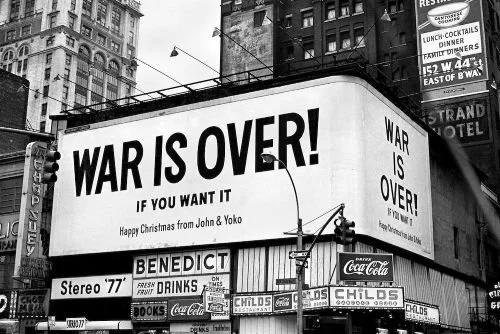
Session notables on the track included Beatles and Rolling Stones alumnus Nicky Hopkins on piano, chimes, and glockenspiel, and ever in-demand drummer Jim Keltner, who also added the atmospheric sleigh bells. The song’s title was familiar to John and Yoko devotees from the posters they had launched in 12 US cities for Christmas 1969, which proclaimed “WAR IS OVER! If You Want It – Happy Christmas from John & Yoko.”
It’s an oddity of the British charts that any number of the songs we regard as Christmas classics never reached No.1. The Pogues’ perennial “Fairytale Of New York,” featuring Kirsty MacColl, topped out at No.2 on its first release; Wizzard’s “I Wish It Could Be Christmas Every Day” peaked at No.4 peak and so, after making the UK charts on December 9, 1972, did John and Yoko’s festive message.
Even in the US, the year before, “Happy Xmas” emerged too close to the holidays to get substantial airplay, and barely made the Top 40 of the Cashbox singles chart. Billboard, for its part, listed it on its separate Christmas countdown rather than the Hot 100, limiting its profile further even though it reached No.3.
When the song finally saw UK release, its chart entry was somewhat modest, at No.23. It climbed to No.16, but sales really took off in the last chart before the holiday, and it spent the last two weeks of the year at No.4. Like so many Christmas songs, “Happy Xmas” has made many return appearances, most notably in the sad aftermath of John’s death in 1980, when it climbed to No.2.
In its many subsequent chart runs, it made the Top 40 in 2007, at No. 40, and returned to the Top 20 in both 2018 and 2020. The festive classic has inspired endless covers, including those by Neil Diamond, Diana Ross, Jimmy Buffett, the Moody Blues, and in 2018, a version by Miley Cyrus and Mark Ronson featuring John and Yoko’s son, Sean Ono Lennon”.
I do want to end with this article, as it sort of challenges the idea that Happy Xmas (War Is Over) should have got to number one and was overlooked a bit. This debate as to whether all Christmas songs need to conform to a narrative and emotional spectrum. John Lennon and Yoko Ono asking people celebrating Christmas maybe to think beyond their own lives and look around them. Perhaps it was too big a thing or too heavy to demand of those who were probably seeking escape whilst The Vietnam War raged and there was all tis horror on the news:
“The single had a lightening-fast turnaround. Within 30 days, the track went from the studio to store shelves in the United States, arriving in time for a December 1st launch. However due to a dispute over publishing rights, the single wouldn’t land in the UK until the following year.
Unfortunately, the timing of the release may not have helped the single initially. The song may have launched a bit late into the Christmas season in the US, and it struggled to get much attention in 1971. It peaked at number 36 on the Cash Box Top 100 Singles, and only number 3 on the Billboard Christmas Singles Chart, but like most Christmas songs, it’s popularity would grow over the years.
“Happy Xmas (War is Over)” really started to pick up steam in the UK, where it immediately garnered attention in 1972. The song peaked at number 4 on the UK singles charts, and it has also would continue to hit the charts nine more times, including after Lennon’s murder on December 8th, 1980, where it claimed the number two spot behind another Lennon cut, “Imagine.”
For the longest time I didn’t care for “Happy Xmas (War is Over).” It always felt a bit off-putting to me. It’s probably partially due to the cognitive dissonance that comes from someone as problematic as John Lennon writing about peace and harmony, but it also always felt like Lennon and Ono just wanted to write another protest piece but decided to disguise it as a Christmas song to garner extra attention.
As it turns out, that’s kinda exactly what they did, but looking at it now that’s actually an interesting reversal of the way lot of Christmas music was made. Take “What Child is This” for example; it’s a traditional folk tune (“Greensleeves”), reworked to celebrate Christmas.
The other important factor to consider is the actual message John and Yoko use the season to promote. As far as lyrical content goes, “Happy Xmas (War is Over)” is as true to the Christmas spirit as any of the more secular holiday songs, if not considerably more so. Christmas is supposed to be a season of hope and peace, bringing warmth and light to a dreary time of year, and these themes appear in most Christmas songs (“I Heard the Bells on Christmas Day,” “the Christmas Song,” “God Rest Ye Merry Gentlemen” to name a few). Though Lennon and Ono propose these as a commentary on global armed conflict, those themes of social unity and peace perfectly fit the season.
One other exceptional element of the song however is the way that it challenges the listener. We’ve seen this before in Lennon’s work, most notably in “Imagine.” When you listen to that song, his words command you to quite literally imagine what he’s singing. “Imagine there’s no heaven. It’s easy if you try.” “Imagine there’s no countries, it isn’t hard to do.” As a listener, you join him on that journey, and by the time the chorus hits, he directly calls you out. “You may say I’m a dreamer, but I’m not the only one.” You’ve taken part in that journey, and you’ve become a dreamer yourself, even if just for a moment.
John and Yoko take the listener for a similar ride on “Happy Xmas.” The verses don’t focus on the present season, but reflect on the previous 11 months. They ask the listener what they have done with their time, what example they have set now that we’re at the end of the year, and they challenge the listener to try harder in the new year. “And so happy Christmas (war is over), for black and for white (if you want it). For yellow and red ones (war is over). Let’s stop all the fight (now)” The song is aggressive and confrontational in a way that, to my knowledge, no other Christmas song has ever dared”.
On 1st December, it will be fifty-five years since John & Yoko and The Plastic Ono Band released Happy Xmas (War Is Over) in the U.S. Look at pretty much every article that ranks the best Christmas songs, and you will not find this one there. It seems to split people. As we remember John Lennon forty-six years after his death, surely Happy Xmas (War Is Over) has some personal, deeper meaning? Or may it is not conventional Christmas-spirited, so can we place it alongside the best Christmas singles ever?! I think it should be considered more favourably. Fifty-five years after its release, the John & Yoko and The Plastic Ono Band classic is as potent, meaningful and urgent…
AS ever.