
FEATURE:
Kate Bush: Them Heavy People: The Extraordinary Characters in Her Songs

IN THIS PHOTO: Kate Bush during the back cover shoot for 1978’s Lionheart/PHOTO CREDIT: Gered Mankowitz
The Man with the Stick (Constellation of the Heart)/Peter Pan (Oh England My Lionheart)
__________
I am going to come back to…
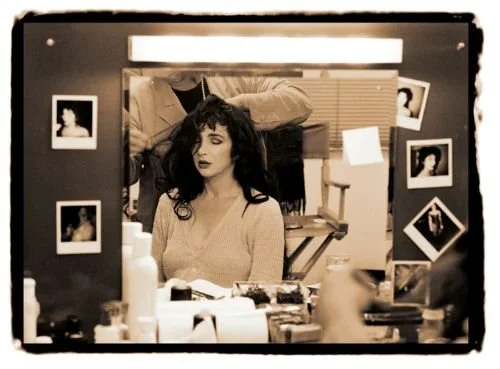
IN THIS PHOTO: Kate Bush in the make-up chair during filming of the 1993 short film, The Line, the Cross and the Curve/PHOTO CREDIT: Guido Harari (via The Guardian)
Kate Bush’s Lionheart and The Red Shoes again, as there are more characters to explore. From the latter, Moments of Pleasure has loads. There is The Song of Solomon and Rubberband Girl. In Lionheart, we have Kashka from Baghdad, Coffee Homeground and Hammer Horror. I have included at least two characters from each of Kate Bush’s studio albums (I am not including Director’s Cut), except for Hounds of Love and Never for Ever. I will team these albums next, before including characters featured outside of her albums. Maybe on B-sides or rarer songs, it is fascinating seeing the full extent of the figures that appear in her music. Not always human. There are also suggestions of people who are not named. You know who she is referring to. I am starting out with The Man with the Stick. There are not that many unnamed characters in her songs. Bush usually referring to people or characters directly I feel. I think that the influence of literature and the screen means she likes to have characters that are rounded, named or tangible. You get semi-anonymous characters, and I sense she alludes to herself without writing necessarily in the first person or revealing herself. However, there is this sense of mystery when she does drop in these unnamed characters. Appearing in Constellation of the Heart, it leads me to discuss her lyrics and their power; Bush discussing love and loss more in 1993 (or when she was writing The Red Shoes); rarer cuts that have never been performed live or been re-recorded. These songs that are terrific but have been buried somewhat. I also want to discuss the somewhat unique sound of The Red Shoes. In terms of the fact that (the album) maybe is not as warm and natural as what followed, and what would come after. I think Kate Bush’s songbook is as broad as any artist ever. I am including The Beatles in that! This is true when it comes to the compositions, the range of instruments, the way she was hugely different on each album.
I feel it is especially true of her lyrics. In sheer terms of what she writes about, there are few artists who are as eclectic and surprising. Many felt that 1993’s The Red Shoes marked a low point. Sure, Bush had to deal with personal loss and exhaustion. She was in a decade where she was no longer seen as this innovative forerunner and someone who was leading a pack. What she produced for 1989’s The Sensual World could perhaps not cut it in the 1990s. The Red Shoes is a great album but perhaps one that suffers because of the cracks, tiredness and struggles to adapt to this new decade. Bush also not having had time to breathe since the start of her career. I have seen people look at the lyrics on The Red Shoes as being cliché, boring, lacking inspiration and ordinary. Maybe that it is true of a few songs, as I do think that Why Should I Love You?, You’re the One and Big Stripey Lie are not as engaging as they could be. What I will discuss in a moment is how Bush is not only writing about the heart but to it too. I do think that The Red Shoes features some of Kate Bush’s most extraordinary lyrics. From Eat the Music and the fruit metaphors and symbolism. Mixing the edible with the sensual and profound. In Moments of Pleasure and that deep emotion and Bush remembering those dear to her that have passed. The Song of Solomon and Lily are remarkable. The title track is stunning too. I have said how one issue with The Red Shoes is the sequencing. Constellation of the Heart is the last of the great tracks. It comes right after the brilliant Top of the City – another song with remarkable lyrics -, but the final three tracks are quite weak in a sense. A slight reorder would have led to a stronger whole. Maybe people ignore Constellation of the Heart, as it appears as track nine. As of writing this piece (15th February) it is the fifth-most streamed track on The Red Shoes, so it has found an audience. It is the lyrics that are stunning. Some Kate Bush songs are economic or have fewer words. However, I feel Constellation of the Heart is one of the fullest. I wanted to highlight some examples of her genius. I’ll start with the character I am focusing on and who he may be: “Ooh and if you see the woman with the key/I hear she's opening up the doors to Heaven/Oh and here comes the man with the stick/He said he'd fish me out the moon”. There is that woman with the key and there is a man with the ladder, but they are mentioned but never materialise. I do love this man and what he might look like. That idea of fishing Bush out of the moon. The whole song is fascinating. How Bush referencing a track from Hounds of Love in one section: “We take all the telescopes/And we turn them inside out/And we point them away from the big sky”. In fact, there is another character I am not mentioning, “Well we think you'd better wake up capt'n/There's something happen'n up ahead/We've never seen anything like it/We've never seen anything like it before/I want a full report/That's it/What do you mean, "that's it?". This captain. You imagine what he looks like. In Constellation of the Heart, Bush is philosophical (an idea of turning a telescope maybe inward and seeing stars in the heart and the galaxy of emotions), funny, conversational and emotional.
Do we talk enough about songs like Constellation of the Heart?! It is a remarkable track that has one of Bush’s best vocal performances on The Red Shoes. Her backing vocals too. It is so heady and fulsome! Maybe, with Bush mentioning The Big Sky in her lyrics, she is distancing herself from a theme and sound of the past. Where she is more whimsical, childlike and fantastical. Perhaps not seeing those songs as serious or wanting to push away from that, I don’t think Bush discussed Constellation of the Heart. The power of the lyrics on Constellation of the Heart are replicated and reflected in other songs. Ones I have mentioned. The Red Shoes is an album that got a kicking and is overlooked today. It is so rich and accomplished. Even some of the ‘lesser’ tracks have interesting elements. Bush playing electric guitar (for the first time) on Big Stripey Lie. What you get from You’re the One, And So Is Love, Why Should I Love You? and Constellation of the Heart is Bush very much being more personal and looking inward. She was a bit on albums before The Red Shoes, though now in her thirties, I feel she wanted to change the narrative a bit. Maybe reacting to the breakdown of her relationship with Del Palmer and this dislocating time, Bush puts her heart out there more than she had previously. Aerial is when she went even further, though more from a maternal standpoint. That effusiveness from her new son, Bertie. I don’t consider the early-'90s as this time when artists were being especially emotive or revealing. Maybe artists like Tori Amos were. However, I associate it more with something perhaps less emotion-led. That might be wrong. Constellation of the Heart is not a typical representation of what was being released in 1993. There was observation around the slightly lyrical weakening. How (in their view) Bush was not at her peak. Many felt that The Red Shoes did not really gel and songs were half-formed. When I discuss Rubberband Girl and Moments of Pleasure, I will highlight again how strong the songs are and how different. Bush maybe not seen as out-there as she once was. She could not win. People criticised her oddness. They criticised everything she did. Maybe that sense that this evolution was a step back – and not forward. However, the fact that Bush turns the telescope inwards and looks at human emotions and her personal life – though some would say she is writing generally and not specifically about her – is a wonderful thing.
Constellation of the Heart is a rare example of a song that was not released as a single, performed live or re-recorded. Many songs from The Red Shoes were reworked for 2011’s Director’s Cut. I feel that Constellation of the Heart should have featured. Maybe take out Rubberband Girl. Whilst Top of the City featured in 2014’s Before the Dawn residency, Constellation of the Heart did not. Consider this article, and what they noted about Constellation of the Heart “is squelchy funk and the most dated production. A bit Prince and a lot Peter Gabriel, Big Time etc. Chorus sounds like lots of people although only two people are credited. I can see people might think she was running out of inspiration and following trends. Nothing wrong with this but then again nothing too exciting. Some nice audio touches. I suppose it’s a bit of an audiophile record. File alongside Dire Straits and the Blue Nile for playing through you flash hifi system”. Why did Bush not strip it back down and have this incredible version of Constellation of the Heart surface in 2011?! That idea of the dated production is one of the major issues with The Red Shoes. I do feel like Bush was always trying to push herself as producer, or at least give every album different sound. That idea of the production being dated. I am focusing on The Man with the Stick. This intriguing figure from Constellation of the Heart. You are perhaps more distracted by the production and miss that lyric. The Red Shoes a little dated in a way none of her other albums are. The drums often feeling compacted or unnatural. Compressed and lacking the warmth of The Sensual World, the power and beauty of Hounds of Love and the sense of wonder, scope and intimacy you get with Aerial, perhaps that somewhat dogs the brilliance of The Red Shoes. I do think that Constellation of the Heart is remarkable and showcases Bush’s continuing lyrical gift. How I am focusing on this unnamed character that has an important place in a song that is both personal and universal. One of her most compelling music moments. A wonderful vocal. Perhaps a little overshadowed by the production. Such a shame Bush did not include this song in Director’s Cut, as it would have shone a light on its brilliant heart, soul and bones!
This is a bit of a cheat. I am mentioning a song from Lionheart that name-checks Peter Pan but it is not In Search of Peter Pan. It is odd that Bush included him twice! Maybe this is why she wrote a song like Constellation of the Heart. Detaching from that fantasy and child-like sense of purity and curiosity. Oh England My Lionheart is a song Bush was fond of at a certain point. More and more she started to get embarrassed by it and then dismissed it altogether. She did perform it as part of 1979’s The Tour of Life, so perhaps she was tired of the song. Maybe Bush aware that this song might lead to mockery: “Oh England My Leotard’ is a song written by Peter Brewis and performed by Pamela Stephenson on Not The Nine O’Clock News, the BBC’s alternative comedy show. It was a bastardised version of Them Heavy People with alternative lyrics”. Before getting to some interviews where Bush talked about Oh England My Lionheart, I did want to mention how I will discuss Disney and Bush’s child-like side. I will also move to the melody and the way she was such an accomplished writer of these melodies and choruses that get into the heart. The imagery on Oh England My Lionheart of warfare and battle. Both of modern wars and also Richard the Lionheart. Though not a true title track, I feel Oh England My Lionheart nods to Richard the Lionheart (King Richard I of England), who died on 6th April, 1199, at the age of forty-one. He died in Châlus, France, from a gangrenous wound caused by a crossbow bolt, which he sustained while besieging the castle of Châlus-Chabrol on 26th March, 1199. Before moving along, this detail from the Kate Bush Encyclopedia: “Kate performed ‘Oh England My Lionheart’ during the Tour of Life as the first encore of the evening. Dressed in an old, oversized flying jacket and air helmet, she sung the song on a set inspired by old war films like ‘A Matter Of Life And Death’ and ‘Reach For The Sky’. Her dying comrades lay around the stage. The coat belonged to David Jackson, set designer on the Tour of Life, and according to him “she was naked underneath it. Somebody found that out and offered me £1000 for it but I turned him down. He was so besotted that he wanted to buy the coat. I was so besotted myself that I wouldn’t sell it to him!”. Maybe also worth noting that idea of Kate Bush as a sex symbol and how there was this other strand of attention. Maybe harmless fan admiration, a lot of people were obsessed with her beauty and sexuality.
I will come back to this soon. The images of war and what Bush wanted to achieve with Oh England My Lionheart. Thanks again to the Kate Bush Encyclopedia, we get this revelation from Bush as to what she had in mind. A wonderful song that she should not have come to dislike. Maybe she felt it was a bit sappy or too cloying. I would argue against that:
“It’s really very much a song about the Old England that we all think about whenever we’re away, you know, “ah, the wonderful England” and how beautiful it is amongst all the rubbish, you know. Like the old buildings we’ve got, the Old English attitudes that are always around. And this sort of very heavy emphasis on nostalgia that is very strong in England. People really do it alot, you know, like “I remember the war and…” You know it’s very much a part of our attitudes to life that we live in the past. And it’s really just a sort of poetical play on the, if you like, the romantic visuals of England, and the second World War… Amazing revolution that happened when it was over and peaceful everything seemed, like the green fields. And it’s really just a exploration of that.
Lionheart Promo Cassette, EMI Canada, 1978
A lot of people could easily say that the song is sloppy. It’s very classically done. It’s only got acoustic instruments on it and it’s done … almost madrigally, you know. I dare say a lot of people will think that it’s just a load of old slush but it’s just an area that I think it’s good to cover. Everything I do is very English and I think that’s one reason I’ve broken through to a lot of countries. The English vibe is very appealing.
Harry Doherty, Enigma Variations. Melody Maker, November 1978”.
Before ending with writing about warfare and battle imagery and also discussing the melody, I am here to focus on Peter Pan. In Search of Peter Pan sees Bush singing “He's got a photo/Of his hero/He keeps it under his pillow/But I've got a pin-up/From a newspaper/Of Peter Pan”. Maybe this romantic idea. However, on Oh England My Lionheart, there is something perhaps a little darker at play: “Oh, England, my lionheart/Peter Pan steals the kids in Kensington Park”. I am curious why Bush came to use Peter Pan twice. The Disney film, Peter Pan, was released in 1953. Although it came out five years before she was born, no doubt a film she would have seen as a child. Bush made reference to Pinocchio – a Disney film released in 1940 – for Get Out of My House (from 1982’s The Dreaming) and the cover artwork for her 1978 debut, The Kick Inside (The sky she flies in is an enormous eye; an image apparently inspired by a scene in the 1940 animated film Pinocchio of Jiminy Cricket beside waking giant whale Monstrot, as MOJO explain). I think there is a child-like quality by referencing Peter Pan. However, it is not this silly fantasy or something immature. Bush using characters from Disney in this sophisticated and challenging music. It does make me think of her childhood and when she first encountered these characters. Whether Peter Pan was someone that she was fascinated by. Peter Pan is a fictional character created by Scottish novelist and playwright J. M. Barrie. Pan is a mischievous, magical boy who can fly and refuses to grow up, spending his never-ending childhood on the island of Neverland. That idea of not growing up. Many critics sort of levied this criticism against Kate Bush. How they felt the music was immature or squeaky. Bush very much pushing against this from The Dreaming onward. It is not the only time Bush has referenced this idea of not growing up or being stuck as a boy or younger person. The Man with the Child in His Eyes, from The Kick Inside, about men who have a child in them and that quality that never leaves. Bush always fascinated by that idea an she explored the soul, the child spirit and maturity through her music.
You cannot deny that the melody and beautiful composition of Oh England My Lionheart is sublime. This article that showed love for the somewhat maligned Lionheart shines a light on the song. Especially warm words for Oh England My Lionheart: “And “England, My Lionheart”, is quite simply one of the most beautiful and unique melodies ever written. Usually in pop song craft you can hear echoes of the familiar; even if the artist is stealing from him/herself. This song exists on a different plane. That the lyrics are penned by a teenage girl is stupefying and magical. Why this song hasn’t been declared Britain’s national anthem is beyond me. It still might someday”. Think about the typical Pop song from 1978. Disco, Punk and New Wave were very much in focus. Bands like ABBA and the soundtracks for Grease and Saturday Night Fever very popular. Kate Bush was creating music and melodies unlike any other artist. Kate and Paddy Bush (her brother) harmonising. Harpsicords by Francis Monkman. The recorder is a divisive instrument, though Richard Harvey plays beautifully and it works on Oh England My Lionheart. It has this medieval or older sound. Like it would have been made in medieval times. Not only this, but Bush managed to write this gorgeous and dreamy melody and vocal sound. A talent that she always had but would develop further. Bush’s piano very much one of the driving forces of the song too. Bush’s childhood home filled with music, poetry and literature. No wonder she had this talent for lyrics, melody and the unique. This article notes how the piano spoke to her at a young age: “Her father, an amateur, Chopin-obsessed pianist, was keen to show the young Catherine how its notes could be a conduit for her inner-most feelings. Her mother was prone to spontaneously exhibiting her penchant for traditional Irish dance while Catherine’s older brothers Paddy and John were both heavily involved in the local folk music scene. The multi-instrumentalist pair would later both play crucial roles in Kate’s exploits. Being raised in such an environment, it’s not at all surprising that Catherine became fixated with the piano. Also a voracious reader, Bush spent hours pouring over the pages of poetry books and classical literature. These twin passions naturally merged. By age 11, Bush was penning her first songs, and fitting words to chords and melodies soon became a chief pastime. “Just as some people sit with a piece of paper and doodle, I guess I was doing that at the piano,” Bush said in an interview with Weekend Australian. “I used to write one song a day, sometimes two. But of course it's so much easier at that age. You have a lot less to do”.
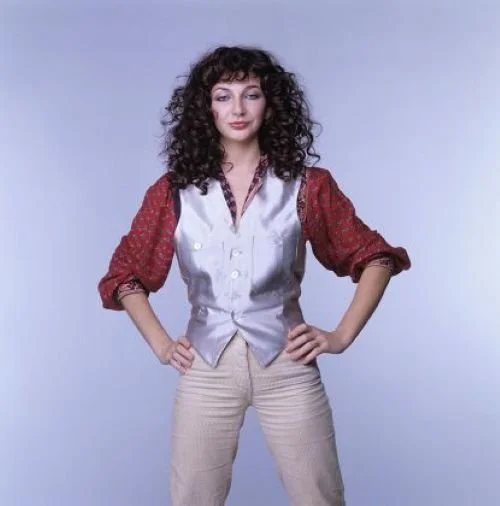
IN THIS PHOTO: Kate Bush photographed in 1978/PHOTO CREDIT: Shutterstock
Maybe one of the issues with Oh England My Lionheart today is how it might seem nationalistic. Dreams of Orgonon explored this in 2019. Kate Bush seen as quintessentially English (though she was half-Irish). Bush talked about Oh England My Lionheart as being this patriotic number. Maybe this romantic idea of an older England or the past. Consider today how people who are right-wing might attach themselves to this song and what Bush was saying. Perhaps a complex legacy, I feel Bush was instead just showing pride of the country she was born in. Not at the expense of other people and nations. Rather than it being jingoistic and a song of nationalism, a paen to a different era:
“Let’s end with the images of Oh England My Liomnheart. We saw earlier how Bush rewflected and dissected them in interviews.
“The title track “Oh England My Lionheart” engages with this British tradition. It is a classical song in a fair few regards. Unlike most of Bush’s music, the song is played features acoustic instruments exclusively, including Richard Harvey’s recorder and Francis Monkman’s harpsichord. If reading that you thought “huh, this sounds like a Renaissance song,” you would be correct. Bush described the song as being done “madrigally.” It’s not difficult to imagine “Oh England My Lionheart” being used in a classicist production of Twelfth Night. “Lionheart” sounds like a folk song, with its fixed structure of repeated chords, its descending melody, and its lengthy descriptions of scenery. This isn’t the first time Bush has interacted with folk music, of course. Bush often imbues antiquated styles with her own vision of strange things. With “Oh England My Lionheart” she takes the folk ballad and takes it on a tour through England, from the Thames to London Bridge to Kensington Park. Yet for its breadth, “Oh England My Lionheart” is dreary, positively crawling through its three minutes and twelve seconds. Bush is outright crooning in this song, doing little heavy lifting on lyrics like “give me one wish/and I’d be wassailing.” It’s an uncharacteristically mellow performance with an iffy production. Few songs could get over these hurdles, and “Oh England My Lionheart” is put to the test by them.
The production does the song a disservice, as it makes “Oh England My Lionheart” sound more conservative than it actually is. It’s easy to read the song as a nationalist ballad, but “Lionheart” is more nuanced than that. The song narrowly treads a line with its war-inflected imagery, but let’s look at exactly what Bush explores here. She’s living in a postwar England where “the air raid shelters are blooming clover.” “Dropped from my black Spitfire to my funeral barge,” Bush sings as if the country is going to land on her. Pastoral England is growing over wartime England. The country is a romantic lead here, giving solitude to those in it. “Oh England My Lionheart” is a return to Bush songs about spying on an inaccessible love. Bush cries “I don’t want to go” in the outro, desperate for her country to stay with her. Without England, there is no Kate Bush, and she knows it”.
Two very different characters from albums released fifteen years apart. Oh England My Lionheart from her second studio album, Lionheart, released in 1978. Produced by Andrew Powell, it sounds worlds away, sonically and thematically, to Constellation of the Heart from 1993’s The Red Shoes. Produced by Kate Bush, the song was Bush perhaps distancing herself from songs like Oh England My Lionheart. I love The Man with the Stick and what he might look like. How Peter Pan was mentioned briefly in this vivid scene from Oh England My Lionheart. Examples of the brilliant characters…
IN Kate Bush’s songs.