FEATURE:
Spotlight: Revisited
ARTWORK CREDIT: Carnovsky
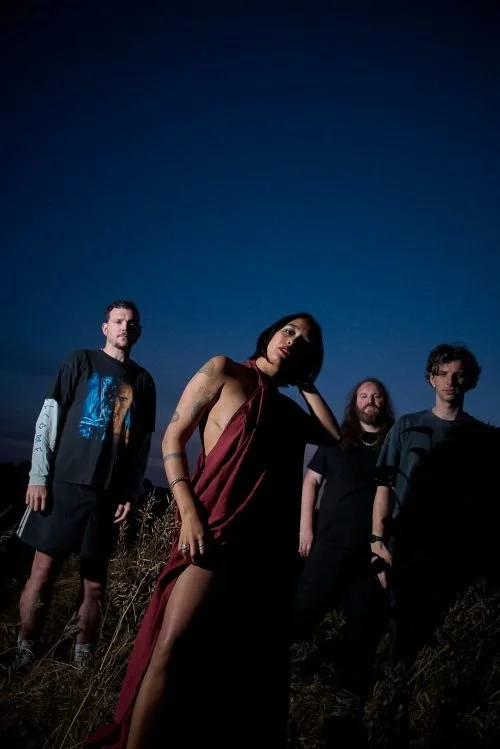
that I spotlighted back in 2023. That is when Mandy Indiana’s debut, i’ve seen a way, was released. Hugely acclaimed upon its release, I was instantly grabbed by this group. Based between Manchester and Berlin, the line-up consists of Valentine Caulfield, Scott Fair, Simon Catling, and Alex Macdougall. Their new album, URGH, came out on 6th February. I am going to end with a review of the album. Before that, it is worth drawing in some interviews with Mandy, Indiana. There are some great new interviews that bring us right up to date. I am starting with The Needle Drop and their fantastic interview with Mandy, Indiana. They talk about URGH, surgeries, movies and where they are now:
“There's an infectious disharmony within Mandy, Indiana, particularly between its two founding members, Caulfield and Fair. When films like Crimes of the Future and Titane were brought up as possible touchstones for Mandy, Indiana's creative process, Caulfield immediately vents a roguish disgust for Léa Seydoux and Kristen Stewart's performances in the former picture, while Fair leisurely confesses, "I’d probably be into that!"
Furthermore, one can sense visible ambivalence in Mandy, Indiana in allowing outside reference points to mark their art. A common narrative in bands is to always name their influences, to formulate some kind of contrived cause-and-effect narrative of why the music sounds the way it does. Caulfield's musical background doesn't abide by such narrative logic. The short story reads as someone who has studied classical music and sung opera from the age of five, only to flip on a dime and rebel into punk rock and alternative music in her late teens.
But there has to be some kind of turning point to just make music completely differently – this concrete formative moment. But Caulfield persistently opts for the "boring" answer: no, there really has not.
"And also, now having treated my voice the way I have, even if I wanted to go back to classical music, I couldn’t do it," Caulfield confesses. She says she still loves classical music and singing, even after having forfeited her ability to sing and perform it after the mileage that comes with snarling and screaming in punk bands. But Caulfield is quick to deem it less as a regression from her natural voice, and more as organic change that's in no way inferior.
Caulfield notes that with i've seen a way, the music has much more of an overarching narrative, whereas on URGH, the band was geared more to making each track is more its own insular thing. "On our first album we thought it was kind of a journey," she says. "And we feel this one is less of a journey and maybe more of an album, if that makes any sense. The storytelling is definitely different, it’s also telling stories, but on the first album there was more of this cinematic aspect than this one. Which makes it sound negative, but I think this one is so much better."
She calls the songs on URGH "more polished," adding, "but there isn’t that kind of storytelling aspect that takes you from the beginning like with [i've seen a way opening track] "Love Theme" where you go down into this underwater room and leads through the thing. This one doesn’t have so much of a narrative arc maybe."
"For me the influence of cinema is that I generally get more inspired to write a song after seeing a film more than after going to see a show or listening to an album," Fair adds. "It’s more personally that that’s where I draw inspiration from. It’s the combination of visuals and audio where I'm like 'I want to make something that feels like that.' But as Val said, the first one feels more structural and narrative-led, there’s even sort of recurring musical themes throughout the tracks. URGH is more track-based; everything’s a little more self-contained."
Each song on URGH is a crucible for deep-seated, front-line experiences. Lead single "Magazine" is a cadaverous "primal scream" revenge fantasy where Caulfield hunts down her own rapist (she courageously came forward on Instagram in 2023 about this traumatic experience), while album closer "I'll Ask Her" – one of the few songs where Caulfield trades her native French for English-spoken lyrics – acts as an austere PSA against rape culture.
Some tracks sprout into unlikely moments of beauty from their withered, miasmic roots. "Dodecahedron" stampedes with mechanized menace, but seeks illumination with a headstrong call-to-arms (Caulfield spits the rather timely line "Leurs tours d’ivoire ne les protègeront pas lorsque nous détruirons leurs sociétés immondes", which translates to 'Their ivory towers won’t protect them when we destroy their disgusting societies'), before dovetailing into a pixellated trance.
URGH goes against the grain of a traditional sophomore album, which usually revolves around refining and further cultivating the winning elements of the debut LP. If anything, all four members agree on actually making the work more obtuse and ambiguous. "When you look back at the repertoires of loads of bands, sometimes they put out a record that is headier and more considered," Fair says. "And then they want to do something different. That’s how I felt with this record. I just don’t want to make that record again. It’s not like ‘What is Mandy, Indiana, and how do we want it to be defined?’ More like ‘What feels right?’, and stumbles in the dark a bit towards whatever that is”.
Moving to CLASH, there are some great questions that are posed. In the interview, “Valentine Caulfield talks new album ‘URGH' and its connection to today’s global despair”. If you have not heard URGH yet, then make sure that you check out the album. An early contender for the best of this year:
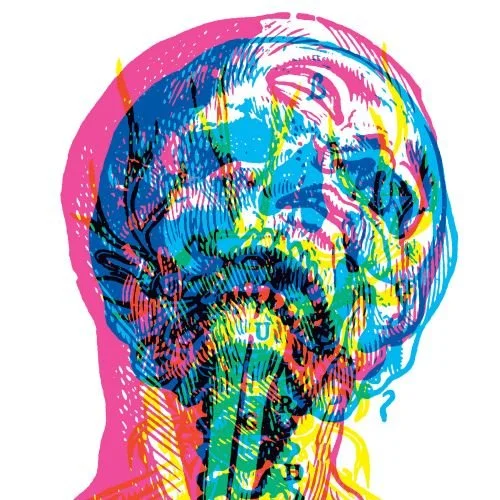
“I’ve Seen a Way’ had this really sophisticated, geometric, yet surreal cover by Jared Pike. ‘URGH’, on the other hand, has this vivid, emotional, punky visual by the Carnovsky duo. What’s the story behind this choice?
It’s actually interesting. I think it all tied together in a very beautiful way. We discovered Carnovsky when we were starting to think about album covers. Before the album was recorded. They have a lot of these RGB Images, but we were especially attracted to this one, which is like an anatomical drawing. It spoke to us in a way that we were all really quickly convinced. We’ve almost disbanded over album titles before (laughs). So, when we all find something that we all like, it’s a bit of a miracle, and we tend to stick to it. But it really spoke to us in a way, and I think it works very well with the album title, because the face on it has this expression of intense… It’s not quite pain, but it’s like, urgh – it’s really that oh my god feeling
‘I’ve Seen a Way’ was a huge breakthrough for the band and for you personally. How did it change things for you? Did that success bring new pressures?
Was there success? (laughs)
Yeah, absolutely.
I don’t know! I guess, it made us maybe… I don’t want to say a household name, because we’re really not. But I think it got a certain amount of recognition from a very specific part of music fans or people who care about music. It’s great and it definitely opened some doors.
Maybe the most exciting, or the biggest thing that we’ve ever done was that we played Coachella, we played Primavera – that’s the big two things that we’ve done, and it’s the most successful we’ve ever felt, I suppose. And I guess Coachella came about because we had really great US booking agents, and we started working with them off the back of us playing South by Southwest, which was before the album came out. I mean, I’m sure the album played a role, but arguably I don’t know how much of a role it played.
It definitely got us some things. I’m sure, and it made us maybe a bit more well-known among festival bookers and stuff like that, but honestly, I wouldn’t say there was much success from this album. We’ve only just about broken even with it, and it came out in 2023!
Your music reflects an oppressive world, but it still points to a positive future. You sing, “The future belongs to us, and our humanity” in ‘Ist Halt So’. Do you have a vision of it in your head?
It’s really hard to have a vision of a bright future right now. But, like I said, I believe in communities uplifting each other, and I believe in people working together. It’s hard to see right now because there is so much hatred, and everyone looks at their neighbor with this kind of fear and disdain.
I want to believe that we can create a world where we stop pillaging the resources of other continents and then pretending that they’re underdeveloped. I would love to see a world where not everyone turns to ChatGPT to ask what they’re gonna eat tonight, so we stop burning resources that we don’t have. I hope for a world where there are no more private jets. I hope for a world where we have all eaten billionaires. Maybe not literally eaten, but you get my point.
We have all the resources for everyone to have a decent life. We have the capacity to live together. We just need to fucking get on with it.
And I also really like the line, “They tried to bury us / They didn’t know we were seeds,” in ‘Ist Halt So’.
It’s a very famous protest line, so it’s been used in protests all over the world. Apparently, it originally was attributed to a Greek poet, and then it was basically been used by a bunch of protest movements. I’ve always really liked it. And then when we were writing that song, it became obvious that that needed to go there. Yeah, it fits really well there.
I’ve heard your collabs with The Null Club and Algernon Cornelius, which are great. Have you thought about a solo project in the future?
It’s something that I think about every once in a while, and then I never really kind of pull the trigger on it. First and foremost, because my own producing abilities are non-existent, so I would genuinely have to do it with someone else, and I think part of the reason why this band works is because this is a collaboration between myself and Scott to begin with, and we’ve really found each other in the songwriting, and we work together really well. So in order to start something else, I would have to become better at it.
But it’s definitely every once in a while that I have little song ideas, and sometimes I write them down, and there’s bits and bubs knocking about. Maybe it’ll come to fruition at some point.
Yeah, we’ll see. And the final question: can music save us?
Not on its own, but it can help”.
Before getting to Pitchfork’s review of URGH, I am getting to this interview with Post-Trash. This is a great interview that gives us more insight into the band and their second studio album. “The band’s new album, URGH, appropriately titled for the times, almost never was. Against a background of personal turmoil, surgeries, and disparate locales, Mandy, Indiana has put together the first truly great album of 2026. We sat down with Scott Fair and Alex Macdougall to discuss the making of URGH, its challenges, and how existing on the brink means always striving for the good just out of reach”:
“PT: Has the band talked about a time when it would be a political statement to just say “we can't tour the US right now,” even if it were feasible financially?
SF: To be honest, that’s the impression I’ve got from conversations we’ve had as a band. There are certainly artists who are still (touring) and using their voice to draw attention to the horrendous things that are happening. But there’s been a rebellion against doing that from our camp, to not have a physical presence until things change. The last thing we want to do is go to the U.S. and give the impression that everything is fine when it so clearly is not. I don’t want to make assumptions, but it seems the people who seek out music like ours are well-informed enough and open-minded enough to see the injustices that are happening, but we can’t know for sure.
PT: As someone who in no way supports the actions of the U.S. government, what’s happening here gives me a profound sense of shame.
AM: There’s such a diverse range of views and opinions in the U.S. and identity is such a complex thing, but when you live in a country, you’re associated with what it does almost by default. It’s like you feel complicit or responsible, as ludicrous as that may sound. It’s really hard.
PT: There's no good segue here, but let's just jump in and talk about the music. The album is fantastic. Place seems to be an important aspect to the making of your art. I've read stories that you recorded previous bits in caves and crypts and all sorts of seedy places. And for URGH it seems you've gone to a haunted house outside some chilly Northern UK city?
SF: Yeah, we went to this creepy house on the outskirts of Leeds to write. We’re all spread out across the country and Valentine lives in Berlin, so we’re rarely together as a band in the same place. The couple nights we spent at the Leeds house were the only group writing sessions we had (for the album). Then, when it came to recording, it was very disparate. Everybody recorded their parts individually in different places.
PT: Do you find that challenging?
SF: Not necessarily—and sometimes it’s just the opposite. The way we work, we don’t pay a whole lot of respect to making things sound like they’re all occurring at one place at one time. Rather, we like to embrace sounds from different spaces. In the past, we’ve recorded drums in a cave then the guitars in a bedroom somewhere. We’re almost reveling in the fact that everyone has a device in their pocket that can capture high quality enough audio from anywhere that can appear on a commercially-released album. So (on URGH) we’re continuing to embrace that dysfunctional aspect of jamming things together. We did, however, record in studios a lot more this time, but without trying to make things sound too pristine.
PT: When I listened to the new album, I definitely wondered on multiple occasions how y’all put a song together. Like, take “Magazine,” one of my favorites—how does something like that get made?
SF: That song is the oldest one on the record. It’s from a period shortly after (i’ve seen a way). I’d seen something online, a 30-sec clip of video from an event, that inspired me to want to make something that sounded like how the clip made me feel. It started with rhythmic, percussive loops, then once the outline of the track was there, Val came in and did her thing, which is always the turning point in the writing process. When her vocals are in, it becomes a lot clearer what the track is, what the structure is. Sometimes I’ll put my editor cap on and move a bit of Val’s vocal around, and sometimes Val will say, no I don’t want it there (laughs). But to go back to what Alex was saying, many of the songs start with his drumming, the performance and personality he brings, his energy. He has a bit of Zach Hill energy.
AM: Yeah, he’s one of my favorite drummers. I remember (when we were writing the album) I would ask you, Scott, who you were vibing on and I would go and listen to some of that stuff. Then I would do a solo session where I just improvised with that inspiration in mind and record it with my phone. This process becomes its own inspiration loop. Scott is inspired by something that I reinterpret, play and record, then send back to Scott. Specifically, with “Magazine,” I remember starting the first beat with that cowbell rhythm after listening to a lot of Liquid Liquid. When we came into the studio to properly record that beat, it didn’t quite do the same thing. So we replaced it with my demo recording, which has a real, like, shitty lo-fi vibe, like, you can hear the fucking pirate studio room I recorded in.
SF: The looseness Alex is mentioning happens a lot with us. So many bands that cross over to the electronic realm seem inclined to make things as tight to the grid as possible. It’s not like we don’t use click tracks, but it’s become a mantra for us to embrace the looseness as well. We like the feeling that the song sounds like it’s on the brink of falling out of time.
PT: You mentioned being in a better place as a band. And this kind of goes full circle to what we were talking about at the start. How do you balance the despair of the moment with a hope for a better tomorrow?
SF: We’re optimistic people and we try to seek out the positive in even the darkest areas of life. But we’re also realists. We don’t shy away from the horrors of the world we live in. A lot of our music is a mirror reflecting these darker areas, but at the same time, the spirit of the music is optimistic. It’s about rhythm and movement and trying to get a response from whoever is engaging with it. We’re not wallowing. This isn’t misery porn. It’s an invitation to people who are experiencing the same crazy thing to recognize the darkness together, so we can face them together and search for the positives together. This band is about not having any limitations. We want the freedom to explore any genre and any emotional content. We could go anywhere”.
Let’s end with Pitchfork and their glowing review of URGH. I think that this album will be nominated for awards. They note how it is “insidiously catchy, incomprehensibly groovy, and fueled by righteous fury”. On 25th March, the band play London’s Heaven. They then have dates in Manchester and Leeds. I am excited to see where the band head from here. After release two distinct and tremendous albums, they will acquire a whole new wave of fans:
“In Mandy, Indiana’s hands, repeated sounds and phrases become improvised weapons. “Souris souris souris souris/C’est plus joli une fille qui sourit” (“Smile, smile, smile, smile/A girl who smiles is prettier”) went the skin-crawling nursery rhyme hook of i’ve seen a way’s “Drag [Crashed].” On URGH, Caulfield flips the French playground chant “Am stram gram” into a call to the dancefloor (“Cursive”), and recreates a sample of the “Light as a feather/Stiff as a board” scene from the 1996 teen-witch cult classic The Craft (“Life Hex”). As her voice gets gobbled up by the gnashing teeth of Macdougall’s kit, the listener is, in turn, subjected to the ravages of growing up as a girl under patriarchy. But these kinds of schoolyard games are also early building blocks of female solidarity, the groundwork upon which networks of collective care—from “Are we dating the same guy?” Facebook groups to French women’s activism behind Gisèle Pelicot—are built.
“Do you want to be remembered as someone who clapped as the bombs rained down?” Caulfield demands on “Dodecahedron.” “Stand up and march.” She namechecks Gaza directly on “ist halt so,” which sounds like “Bulls on Parade” being fed through a paper shredder. Mandy, Indiana’s livewire, high-wire act—they’re somehow even more galvanizing onstage—gets juiced here by production from guitarist Scott Fair and Gilla Band’s Daniel Fox, who throw on the floodlights, catching the contours and reflections of every instrument. The rotor-blade synth that descends halfway through “try saying” seems to chop the song into ribbons. On“Sicko,” which isn’t that far afield from the most virulent El-P beats, Caulfield hands the mic to another postmodern prophet, billy woods, who rails against Big Pharma.
For the closer, “I’ll Ask Her,” Caulfield dons a British accent and sneaks behind enemy lines: “And anyway, you stand by your boys, ’cause they’re your boys and that’s just how it is, and they’re all fucking crazy, man.” A synthesizer blares like an air raid siren, one of those Pavlovian triggers that means get out, get out, get out. Insidiously catchy, incomprehensibly groovy, URGH is a razor blade hiding in a rainbow jawbreaker. Then, in its final moments, Caulfield just says the thing: Your friend’s a fucking rapist!!!
Where do you go from there? Out into the streets seems like a start. An “urgh” can be a vulgar grunt, a furious growl, a cry of physical exertion. It also sounds a lot like “urge.” On a record that transforms this band’s music into an abstracted, serrated version of its previous self, it seems pointed to close with its most startling lyric, delivered in the second person as an accusation. Here the hard work begins”.
I will end it here. I wanted to revisit Mandy, Indiana, as they have released another album since I approached their music and have grown in stature. However, there are those unfamiliar with them, so I hope that they start listening to Mandy, Indiana. In a music scene where there is a lot of homogenisation and same-sounding acts, it is clear that there is…
NOBODY like them.
__________
Follow Mandy, Indiana