FEATURE:
Groovelines
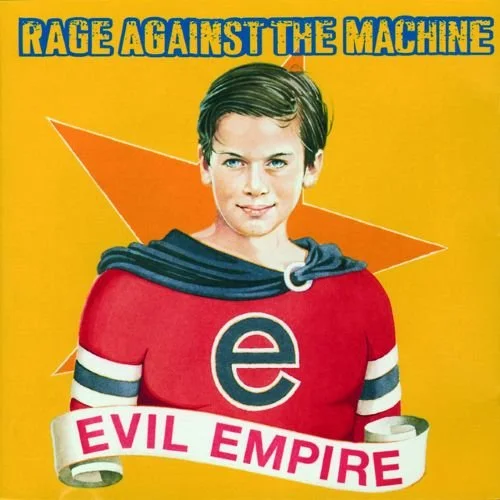
Rage Against the Machine - Bulls on Parade
__________
THIS is one of these great songs…
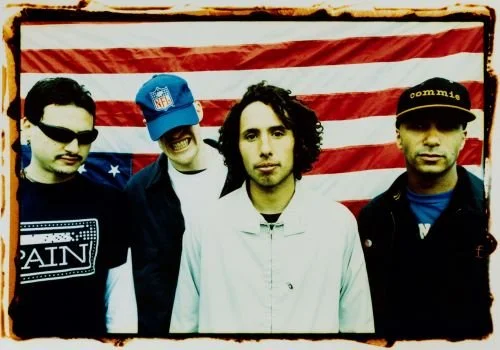
IN THIS PHOTO: Rage Against the Machine in 1996/PHOTO CREDIT: Niels van Iperen/Getty Images
whose anniversary I could not pass by. Turning thirty on 1st April, Bulls on Parade is one of the defining songs from Rage Against the Machine. From the band’s second studio album, Evil Empire, which turns thirty on 16th April, Bulls on Parade deals with U.S. military aggression. Another song as relevant now as it was when it was when it was released. Highlighted and commended for its guitar solo containing a vinyl scratch effect used by Tom Morello, which was achieved by toggling between two pickups, one on and one off, while rubbing his hands on the strings over the pickups to create an effect akin to someone scratching a vinyl record. Thanks to the Wikipedia article for that information. You can see more here. A chart success upon its release, Bulls on Parade has been used in wider media. The New York Red Bulls use it as their goal song. There are these songs that represent something at the time in terms of culture and society. Others that do that but then are relevant through the years. That is the case with Bulls on Parade. It would be great if Rage Against the Machine would get back on stage together and perform the song. I want to get to a few features about this classic anthem. Music Radar told the story behind Bulls on Parade:
“By the time Morello and the rest of Rage hunkered down at Cole Rehearsal Studios in Hollywood, California with fast-rising producer Brendan O’Brien in the autumn of 1995, Morello was already being hailed as one of the most inventive and exciting guitarists to emerge in the post-Eddie Van Halen era. And he put every facet of his renegade skills to use on Bulls On Parade.
“We didn’t know it would be the first single when we started jamming on it,” said Morello, “but we realised quickly that it was a most potent piece of music. We recorded cassette demos as we wrote and jammed, and Brendan didn’t want to lose any energy as we worked. Our method of working was pretty much ‘jam, roll the cassette tape, then cut the real track’. Not a lot of time for overthinking and overtinkering.”
Morello remembered the song as a true group effort, with bassist Tim Commerford, who was listening to a lot of jazz at the time, coming up with the syncopated riff that kicks off the song. “Then I came up with the wah-wah guitar part [played through a Dunlop Cry Baby],” recalled Morello. “I also came up with the music underneath the verses – I was listening to a lot of Geto Boys back then, so I wanted something dark and sinister.”
Zack was responsible for the rhythmic swing that drives the chorus. “He comes up with guitar parts, too,” said Morello. “And Brad [Wilk] worked up that awesome, artillery marching beat. Hands were definitely on deck.”
Surprisingly, the knockout opening riff was at first intended as the song’s coda. “When Brendan heard it, he zeroed right in on it and said, ‘Why don’t you try beginning the song that way?’,” Morello recalled. “It was exactly what the song needed. That’s why he’s Brendan O’Brien.
By the time the band had laid down the basics, the track was well rehearsed. “Zack was still writing lyrics when we cut the main track,” says Morello. “But we knew all the changes and what we were doing.” The band recorded the rhythm track live, needing only a few takes to nail it. “We were pretty much a press-and-play band,” he says. “We rarely used click tracks. The instinctive speeding up or slowing down of a take can make it much more exciting.”
Throughout his career, Morello has relied on but a handful of one-of-a-kind guitars. For Bulls On Parade, he used his ‘Arm The Homeless’ S-style guitar, built from a Custom Performance body, a 22-fret Kramer Carrera neck with a locking nut, and outfitted with an EMG 81 in the bridge and an EMG 85 in the neck position.
“I used [it] on the entire song,” he explained, “and that includes the solo, which I improvised in the tracking room with headphones on. That was another toggle-switch workout, the ‘scritchy-scratch’ DJ part that I had previously worked into the live version of Bullet In The Head. I knew I wanted to find a home for it on record, and Bulls On Parade was the perfect place”.
The lead single from Evil Empire, I will write about the album closer to its anniversary. I want to move to this feature about Bulls on Parade. They explain how this song tells unsavoury truths that are relevant today. A timelessness that relates to every Rage Against the Machine song. Thirty years after its release – appropriately on April Fools Day -, Rage Against the Machine turned the spotlight on the fools in U.S. government in 1996 who were using war for their own ends and means. Bill Clinton was President in 1996:
“Bulls On Parade" fits right into Zack de la Rocha's poetic cannon with his statements against what the United State and the First World at large have become through continued feeding of the military-industrial complex. His start to the second verse lays out the point of view behind his contempt as clearly as any throughout the band's catalog:
Weapons, not food, not homes, not shoes
Not need, just feed the war cannibal animal
The fueling of the military comes at a cost, and it's a cost borne by the citizens back home. Their suffering is clear, but working to remedy it requires monetary resources governments seem unwilling to spend, despite how much it would assist their reputation and the country at large. The growing "rotten sore on the face of Mother Earth" mentioned in the first verse is thus twofold: in one part, it's continued warfare, frequently unprovoked, waged by the world's most powerful nations for gains that amount to finance over all else; in the other part, it's the continued plight of the common people on both sides of such conflicts.
Well, isn't that a fitting narrative considering the nature of the continued Russo–Ukrainian War? (And yes, it's an invasion and a war — the few nations which are refusing to call it such are at least implicitly supporting Russia, and likely more.) The ability to plop the lyrical backdrop of so many of RATM's tracks is a testament to their sociopolitical awareness and understanding of a world fueled by big militaries and even bigger money. The same is the case for de la Rocha's chorus cry: "Rally 'round the family with a pocket full of shells." Despite continued gun violence across America, both through civilian and police action, the right to bear arms has been upheld as a core American value, in line with antiquated "family" values that cater to the traditional White ruling class.
Whenever war breaks out, or a military exercise grabs the headlines, I find that "Bulls on Parade" captures the essence of the world's disillusioned masses. As the song's title evokes, world powers proudly display and unnecessarily use their prize military bulls while ignoring bigger issues on their home front. With this aspect of modern life embedded into the machinery of major political parties and international structures, the task of making lasting action against the military-industrial complex seems so futile that it seems all one can do in response is be angry about it (though I'm intrigued to see if that mindset changes in the wake of current conflicts if/when they eventually die down). Rage Against The Machine channeled that anger and turned it into what can be considered their sonic act of protest, with Brad Wilk's simple but effective drums keeping time and rhythmically accenting de la Rocha's rhymes and the combined melody and rhythm of Tom Morello's guitar and Brad Wilk's bass. Heck, Morello's turntable scratch-like guitar solo carries as bellicose a sound as any instrument from all of the 90s — it's a musical rebellion in addition to a political one.
For a sound that is as 90s as it gets, Rage Against The Machine have maintained their cultural importance through the perpetuity of the structures against which they fought. The thunderous sound and clear message of "Bulls on Parade" is a microcosm for their discography and all it and the band represent”.
I want to end with this feature from Interview Magazine, where Tom Morello was in conversation with Sarah Nechamkin. Although Morello talks more generally about music and politics, there is a mention of Bulls on Parade. I think this is one of the most powerful political songs ever released:
“SARAH NECHAMKIN: You have been on the forefront of social justice messaging in culture and music for decades. If you could describe the state of our country right now, in three words, what would those be?
TOM MORELLO: Can I have five? You can edit them together or make compound words if you want.
NECHAMKIN: Go ahead.
MORELLO: Chickens came home to roost. It comes from the fact that over the course of the last 35, 40 years, the neoliberal policies of both Democratic and Republican administrations have fucked over the middle class, have fucked over the working class, have greatly enriched the top .001 percent, and it has made a fertile field for right-wing demagogues to use the oldest trick in the book: divide and rule racism to gain power and potentially drive our planet into the abyss.
When I say “the abyss,” I don’t say that figuratively. We’re on the brink of this potential environmental catastrophe that will mean the destabilization of civilization like we’ve known it. And the current administration has its foot all the way down on the pedal. Leaving outside all of the xenophobia and the racism and all that crap, which is horrible, the fate of the planet is at stake.
NECHAMKIN: “Killing in the Name Of” anticipated a lot of that, and that was released during the Clinton administration. A lot of people are saying, “If we just get the Republicans out of the White House and take back our democracy…” What would you say to that? How do you think that we can move forward out of this cycle that’s been continuing long before our current moment and the rise of Trump?
MORELLO: People have fought and died hard for the right to vote, and I always vote. But the system that we have is absolutely rigged so that real fundamental systemic change is almost impossible. I worked as a scheduling secretary for United States Senator Alan Cranston for two years, and part of my scheduling job was to get him on the phone with rich people to ask them for money all fucking day long. If you think the way that sausage is made is bad, it’s worse. I’ve seen it. And so, the idea that there will be sort of a savior that will rise in the ranks of one of the two parties is, I think, farfetched. But the way that the world has always changed hasn’t come from above—progressive, radical, or revolutionary change always comes from below. And the world does not change itself, it takes you. The good news is that whenever it has changed, the people who have changed it are often people whose names are not in history books, and they’re people who don’t have any more courage, money, power, and influence than anyone reading this article. They’ve stood up in their place and time for a more just and decent planet. That’s the silver lining.
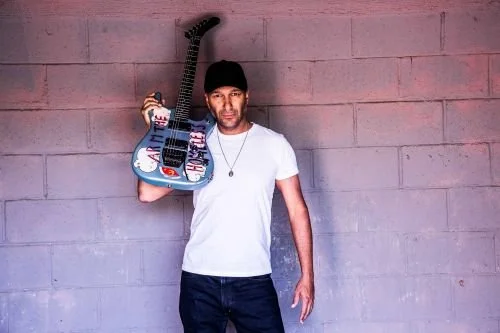
IN THIS PHOTO: Tom Morello
If the goal is to save the planet, to see that children have education, to see that countries have clean water, how do you do that? You don’t vote for the person that wants to eliminate all that, that’s one. But whoever is in office, it’s not enough to cast your ballot into the void once every four years. That’s not how change happens.
NECHAMKIN: I saw this quote in the “Bulls On Parade” video: “Free speech is like money. Some people just have a lot more of it than others.” I was watching the RNC last night …
MORELLO: To feel better about the world.
NECHAMKIN: Exactly. To ensure a nightmare-free sleep. But this emphasis on free speech and “cancel culture” seems to have really taken over the discourse in that world. How do you think that concept has been weaponized to serve certain interests?
MORELLO: Let me tell you, as a scheduler for a U.S. senator, I was in the business of buying free speech. The fact that the cornerstone of our democracy is how much money you can raise for television advertisements, that that is a major factor of who is elected and who doesn’t become elected is so ludicrous. Like, if we out-raise them by $50 billion so we can run more attack ads, that’s democracy functioning excellently right there. In my view, there’s only two positions on free speech. You’re either for it or you’re against it. I don’t want anybody censoring my speech, and so, I’m going to support anyone’s right to say whatever. Whatever the ridiculous fucked up thing they want to say, they’ve got the right to say it, because that’s how free speech works, or you don’t have it at all. Ted Nugent and I agree on free speech issues. But the biggest thing underlying that is advertising. How free speech expresses itself most is in creating false wants, via advertising, and then you fill that void by buying products. If you look at the pie chart of free speech, it’s not town hall meetings where we’re putting up a stop sign, or complaining about the dog-catcher. It’s making women feel insecure about their hair or making dudes feel insecure about their boners and then selling products to fill the void. That’s how free speech operates on a daily basis.
NECHAMKIN: So, when powerful people say they’re being censored by getting criticized on Twitter or whatever, do you think that’s really an issue of free speech?
MORELLO: I mean, if you’re being censored by people using their free speech to express an opinion, I don’t think you’ve got a leg to stand on”.
On 1st April, it will be thirty years since Rage Against the Machine released Bulls on Parade. After their eponymous 1992 album, Evil Empire was this next chapter. One of the band’s most popular songs, it holds new weight and significance in 2026. Under President Trump, there is this dictatorship of aggression and selfishness. Bulls on Parade very much tooled for today – sadly enough! Three decades after it came out, this incredibly powerful and potent song…
STINGS and cuts to the core.