
FEATURE:
I’m Waiting for the Day
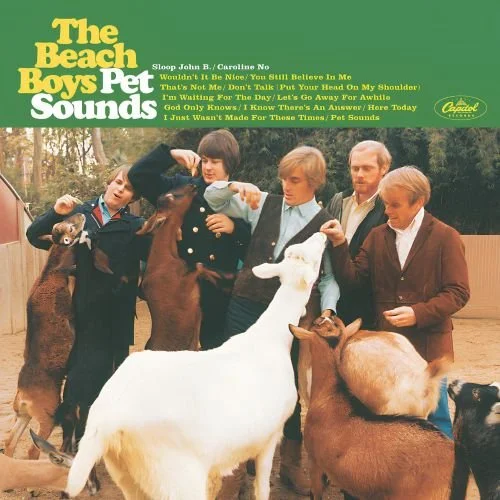
The Beach Boys’ Pet Sounds at Sixty
__________
1966 was an incredible year for music…
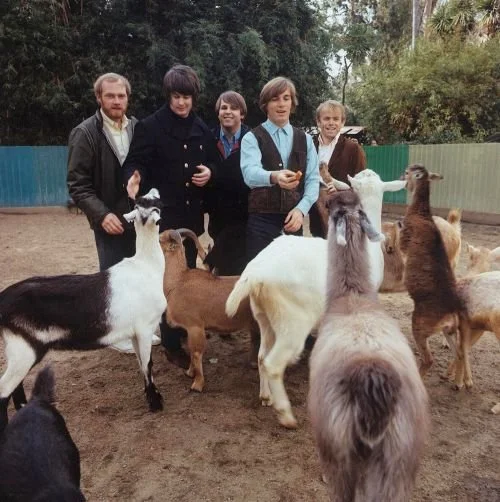
IN THIS PHOTO: The Beach Boys' Pet Sounds photoshoot by George Jerman at San Diego Zoo, California, in February 1966/PHOTO CREDIT: Capitol Photo Archives (via TIME)
where two bands in particular were dominant. Bob Dylan was one of the most successful solo artists but, when it came to groups, The Beatles in the U.K. and The Beach Boys in the U.S. were ruling. The Beatles released one of their greatest albums, Revolver, in August 1966. An album inspired by The Beatles was The Beach Boys’ Pet Sounds. That was released on 16th May, 1966. I want to mark sixty years of a masterpiece by exploring it in depth. There is something special announced for the sixtieth anniversary:
“The Beach Boys have announced a new run of “audiophile pressings” of their ‘Pet Sounds’ album, to celebrate its 60th anniversary.
The record arrived back on May 16 1966, and went on to be regarded as both a firm fan favourite, as well as one of the greatest albums of all time.
To mark its upcoming 60th anniversary, the L_ will be celebrated with a series of releases on May 15 via Capitol/UMe – including two distinct premium all-analogue audiophile pressings.
The latter includes a Vinylphyle Edition, featuring the original album in both mono and stereo, and a Definitive Sound Series Audiophile Edition. A collectible Zoetrope vinyl edition of the album will also be available”.
Wouldn’t It Be Nice, Sloop John B, and God Only Knows are perhaps the best-known and admired songs from the album. A chart success and critically acclaimed, in years since its release, Pet Sounds is seen one of the most important albums ever. The production of Brian Wilson makes Pet Sounds what it is. In terms of his ambitious and vision. Symphonic, epic, beautiful and multi-layered, it is a big reason why Pet Sounds has endured for decades. Apologies if I have included this information in previous features. However, it is worth revisiting. I want to start with this feature and their view that Pet Sounds remains a work of art. Lacking any commercial ambition, it is this experimental album that arguably changed music:
“The Beach Boys were probably the last group on earth expected to start a musical revolution. After all, they had built their renown as clean-living all-American kids delivering harmonized hymns that worshipped surfing, girls, and hot rods – the holy trinity of Californian teenagers in the early 60s – over a rocking backbeat that bore a tangible trace of rock and roller Chuck Berry‘s musical DNA. And yet, in May 1966, the Hawthorne-hailing group – consisting of the Wilson brothers Brian, Carl, and Dennis, together with their cousin Mike Love and family friend Al Jardine – unleashed an audacious sonic experiment they called Pet Sounds. It was a collection of songs that would quickly cause a paradigm shift in pop.
Few pop albums – before or since – have enjoyed the notoriety of Pet Sounds, which for decades has been showered with almost every accolade imaginable and continues to be a high achiever in magazine polls ranking the best pop and rock LPs of all time. It is pop music’s equivalent to what Citizen Kane is to the world of cinema; a universally recognized masterpiece that defined a new era while simultaneously redefining the art form it represented.
Despite its fame, Pet Sounds still remains an unexplored country for some, who may have heard of the album but are unaware of its significance. For the uninitiated, then, this article intends to answer some of the fundamental questions about what is undoubtedly the Beach Boys’ – and possibly pop’s – greatest album.
Why is Pet Sounds so important?
Quite simply, Pet Sounds ushered in a new approach to album making that revolutionized popular music. It was shaped by the musical sensibilities of songwriter/producer Brian Wilson, whose collection of carefully crafted pocket pop symphonies was unlike anything the Beach Boys – or any band for that matter – had done before. It brought about seismic changes to the landscape of pop music with its unusual sonics, novel textures, and structural innovations.
Pet Sounds didn’t follow the format of conventional pop albums of the day; It wasn’t merely a collection of disparate songs that combined a couple of hit singles with reheated covers, as was the norm in the mid-’60s; rather. It was conceived as a coherent work of art where every song – even every note – counted. Nothing was inconsequential; even the album’s two instrumental tracks, “Let’s Go Away For A While” and “Pet Sounds,” were integral to the record’s narrative arc.
How and when did the album get written?
Brian Wilson began writing the material for the album alongside a new collaborator, lyricist Tony Asher, when the rest of The Beach Boys were performing in Japan and Hawaii in January 1966. (Wilson, a nervous flyer, had quit touring with the band a year earlier). One of the tracks that ended up on the album – “Sloop John B.,” an adaptation of a traditional Bahamian folk song – was already in the can, cut in 1965, but the remaining 12 songs were recorded at three Hollywood studios (United Western Recorders, Gold Star Studios, and Sunset Sound Recorders) between January 18 and April 13, 1966, with Chuck Blitz engineering.
What influences shaped the album?
Producer Phil Spector, famed for his signature “wall of sound” approach to making records, had a profound impact on Brian Wilson’s production style and directly influenced Pet Sounds‘ multi-layered recording technique as well as its cavernous reverb effects. Another, perhaps bigger, influence on Pet Sounds was The Beatles‘ groundbreaking Rubber Soul album. Wilson heard it in late 1965, and later described it in his autobiography, I Am Brian Wilson, as “probably the greatest record ever…where everything flows together and everything works.” Ultimately, however, Pet Sounds transcended its influences”.
I am going to come to Classic Rock and their feature from last year. Also heralding how this experimental album was not aiming for the charts or to be like any other Pop album, “Brian Wilson threw away his Beach Boys’ template, assembled a battalion of top session players, and began recording an all-time classic”. Sixty years after its release, can you say that any other album sounds like it? Even if The Beatles’ Revolver and Sgt. Pepper’s Lonely Hearts Club Band (1967) revolutionised culture and defined the 1960s, I feel Pet Sounds has something special about it no other album does:
“I used to refer to him as the Stalin of the studio,” laughs Mike Love, Wilson’s cousin and who sang on many of the Beach Boys hits. “He was totally in command up to Pet Sounds and Smile [the legendarily aborted project Wilson undertook after Pet Sounds, with collaborator Van Dyke Parks]. After that, the influence of LSD made him withdrawn, a recluse almost.”
Wilson talks in terse monosyllables, at this moment eager to be anywhere else but here being interviewed about his most famous and most lauded work. At times he can seem like a fidgety, barely interested kid at school – Adult Child is the name of an unreleased album that Wilson worked on simultaneously to Smile (another unissued Wilson album, which came out in bootleg form in 1992, was titled Sweet Insanity) – but he focuses in fits and starts as he recalls the highlights of that momentous period.
Wouldn’t It Be Nice might have been the opener on Pet Sounds, but side one closer Sloop John B was the first track to completed. A cover of an old folk song, it was the anomaly on this song cycle about love and hope, regret and sorrow, and yet its lustrous orchestration was typical of the album.
The other Beach Boys – Brian’s brothers Carl (guitar) and Dennis (drums), plus Johnston, Love and Al Jardine (guitar) – may have barely contributed instrumentally to the album (That’s Not Me was one of their few showcases as musicians), but their signature vocal harmonies throughout are stunning: on the hymnal You Still Believe In Me they sound like a choir; the chord sequence for Don’t Talk (Put Your Head On My Shoulder) was so affecting it reduced Brian’s then-wife Marilyn to tears; I Know There’s An Answer was originally going to be called Hang On To Your Ego, but it was Love who apparently deemed it too weird and druggy and insisted on the change; I Just Wasn’t Made For These Times was the perfect title for this staggeringly beautiful song about alienation.
There were two instrumentals on Pet Sounds: Let’s Go Away For A While, which nodded to that other sublime 60s melodist Burt Bacharach, and the title track, briefly mooted as a James Bond theme (with the title Run James Run). Finally, there was Caroline, No, a deeply autobiographical song – the only one on the album to have lyrics written by Brian – full of yearning for a girl, and a past, that could never be recovered.
It was actually released as a Brian Wilson solo single, but, as he recalls, it barely charted. “It didn’t go over very well,” he says. “But it was a very pretty tune.”
Mike Love, who wrote the words for many of the Beach Boys’ songs before Pet Sounds, was a voracious reader himself. Although as a lyricist he’s best known for early hits such as Fun, Fun, Fun and California Girls, which crystallised the idea of the Beach Boys as frothy pleasure seekers, it was Love who, having listened to Wilson’s deeply sad music for the pre-Pet Sounds ballad The Warmth Of The Sun, wrote a poignant lyric for it about loss (it was written on the eve of the assassination of US president John F Kennedy). And it was Love who wrote the words to Pet Sounds songs Wouldn’t It Be Nice, I Know There’s An Answer and I’m Waiting For The Day, which essayed a sort of pop existentialism.
“I was reading just about every kind of philosophy there was, from Rosicrucian to Vedic, and poets such as Emerson,” Love recalls of the time. “I guess that’s what made me the songwriting partner for Brian, because I had a natural affinity for concepts and lyrics.”
Love would write the lyrics to Wilson’s next sonic departure, Good Vibrations, a boy-girl love song wrapped in LSD clothing, all psychedelic imagery and flower-power vibes. He notes the two factions in the Beach Boys: those who experimented with stimulants (the Wilson brothers), and the Love/Jardine/Johnston axis that didn’t”.
I will finish with this review from Treblezine, as it is a really interesting read. I wonder how people will write about Pet Sounds ahead of its sixtieth anniversary on 16th May. I must have heard songs from Pet Sounds when I was a child. I could sense then how significant the album was:
“For most of my adult life, I haven’t been someone who cried often. It’s not a masculinity thing—that’s never mattered much to me. I don’t feel weird about telling friends I love them, giving them a warm embrace or sharing my insecurities, and perhaps that vulnerability can still come across as guarded. But my natural demeanor is low-key and easy-going, a quality that’s been an asset as a journalist—I tend to think I put interview subjects at ease—and during some of the most trying crises of young adulthood.
It wasn’t until my thirties that I began to notice a change. On an otherwise uneventful weekday morning I found myself tearing up while listening to Angel Olsen’s “Windows,” a song that’s delicate and beautiful in its simple message to find a positive ray of light to hang onto. I can’t explain exactly why it hit me so directly in that moment and burrowed directly into a part of myself that even I never see, but I couldn’t fight it. That cool exterior was starting to fracture, and I began to notice those high-pressure emotional leaks happening more often. Like whenever I watch Anya try and frustratedly fail to understand death and grieving in the Buffy the Vampire Slayer episode, “The Body.” Or when Tina shows up to Louise’s poetry reading on Bob’s Burgers‘ “The Plight Before Christmas.” I barely held it together while recently watching Ratboys perform the title track of their last album The Window, and then on the drive home felt that same catch in my throat when I heard Waxahatchee’s “Right Back to It.” It’s a weird thing to suddenly find yourself hostage to an image or a timbre or a melody or a harmony. I should probably be used to it now, but I’m still adjusting to this relatively new norm.
When I saw Brian Wilson perform The Beach Boys‘ landmark 1966 album Pet Sounds in its entirety in San Diego in 2016, however, I knew what was coming, and yet I still wasn’t prepared for it. For the first 11 songs, the legendary Beach Boys songwriter, backed by a band that also featured his former bandmate Al Jardine, kept it light and breezy, flipping through the group’s catalog of songs both beachy (“California Girls”) and baroque (“Heroes and Villains”), even leading a sing-along of “Row Your Boat” before kicking off the main event with “Wouldn’t It Be Nice?” In fact, he even rowed that very boat again just before “God Only Knows.” But once he sang that opening line—”I may not always love you/But as long as there are stars above you…“—my defenses collapsed on that warm summer evening, the dam not so much breaking as springing a leak that I haven’t been able to successfully patch.
If the songs Wilson wrote for [Pet Sounds‘] planned follow-up, Smile, were teenage symphonies to God, as he famously said, the songs on Pet Sounds comprise an operetta of disillusionment.
A quick survey on social media of friends and colleagues who attended the show reported very much the same thing. Brian Wilson, his voice weathered from age and decades of trauma, could still evoke such powerful emotional reactions in cynical millennial and Gen-X musicians and journalists. Pet Sounds, Wilson’s greatest achievement in a career of many highs, has that power.
There are millions, billions of words written about Pet Sounds for its innovations in pop-song arrangements and lyrical introspection—all of which are true. (Except for the ones decrying it as overrated, but such is the burden of a legendary set of music.) In that sense, it’s much like The Beatles’ Revolver, released that same year, one of two 1966 albums that forever changed the landscape of pop music and whose influence remains palpable in music made more than 50 years later. In fact, the two artists played a ping-ponging game of influencing each other, Wilson first taking inspiration from The Beatles’ own Rubber Soul, and then Paul McCartney being inspired to write “Here, There and Everywhere” after hearing “God Only Knows.”
There are perhaps just as many but arguably still not enough about how this is a record about feelings more than chord charts, about being saved by love and love that can’t be saved—about the unbearable weight of the world and perhaps the even more unbearable chasm of one’s own self worth. If the songs Wilson wrote for its planned follow-up, Smile, were teenage symphonies to God, as he famously said, the songs on Pet Sounds comprise an operetta of disillusionment. But it’s one still kissed by a Pacific Ocean breeze, carrying a sweetness that prevents it from ever tumbling into full-blown bummer.
In the early 1960s, Hawthorne, California’s Beach Boys—featuring brothers Brian, Carl and Dennis Wilson, along with cousin Mike Love—became hitmakers on a string of singles that celebrated a beachy Southern California lifestyle. Their first three albums each feature “Surf” in the title, and two more include the word “Summer.” Though by only a few years in, Wilson’s aptitude for more intricate arrangements began to show through highlights like “All Summer Long,” and on standouts such as “In My Room,” he even showcased the kind of vulnerability and introspection that permeated the ballads of Pet Sounds. In hindsight, Pet Sounds seems inevitable, Wilson cultivating an open wound salted with baroque pop arrangements, but there’s something strangely intangible about its effect on a listener, something that’s better felt than analyzed.
The creative direction of Brian Wilson has led to frequent mention of Pet Sounds as being a solo album—a suggestion that’s both indisputable truth and miles from it. The album saw Wilson—increasingly dabbling in cannabis and psychedelics use—taking nearly complete creative control over the project, with songs that traveled far afield from the group’s typical fun-in-the-sun fare. Even its exotica-tinged instrumentals like “Let’s Go Away for a While” carry an undercurrent of melancholy, while the one song that very literally features the ocean as its mise-en-scène, a cover of Jamaican folk standard “Sloop John B,” is as much a litany of disappointment and dejection as anything else here. It’s single, “Caroline, No,” was even released as a Brian Wilson solo track, further reinforcing the idea of this being entirely a record of Wilson’s own vision.
And yet the album is a grand undertaking, featuring string and horn arrangements and dozens of musicians, including the famed session group The Wrecking Crew, which included bassist Carol Kaye, drummer Hal Blaine, and guitarist and country artist Glen Campbell, who took over Wilson’s vocal duties when the group’s leader ceased touring. Not to mention the countless curious details that arise throughout its 36 minutes: the harp plucks that open “Wouldn’t It Be Nice?”; the bicycle horn that honks at the close of “You Still Believe In Me”; the Theremin solo on “I Just Wasn’t Made For These Times.”
Pet Sounds is also propelled by the same driving force behind every prior Beach Boys album: the mesmerizing, intricate harmonies of the Beach Boys themselves. Despite the oft-mentioned lore of tension behind the scenes, Wilson’s change of direction on Pet Sounds took some getting used to for most members of the Beach Boys, but didn’t create major rifts, at least not initially. And Carl insisted that the group loved the album, despite suggestions to the contrary. Yet Mike Love was the most vocally averse to scrapping the easy pop hooks for something more nuanced and complex. “Mike’s a formula hound – if it doesn’t have a hook in it, if he can’t hear a hook in it, he doesn’t want to know about it,” Jardine said in an interview with Goldmine in 2000. However, Love was the only member who was consulted by Wilson and likewise heard early versions of the songs, which Wilson played for him over the phone.
Yet regardless of who we literally hear on Pet Sounds, we’re hearing Brian, whose own private world was increasingly growing unsteady as his marriage was falling apart and drug use was growing more frequent. At times it sounds hopeful, as on opener “Wouldn’t It Be Nice?”, which paints a picture of domestic bliss: “Wouldn’t it be nice to live together/In the kind of world where we belong?” But the subtext is what’s not being said, at least not so explicitly. As a friend of mine once retorted, “It would be nice—but it ain’t gonna happen.”
From there the feelings of sadness and inadequacy only intensify, highlighting things we perhaps all see in ourselves even if we’d rather not acknowledge them. “You Still Believe In Me” never fails to wreck me, underlining its confessions of low self-worth with gentle expressions of love and gratitude toward someone still providing the kind of support we all seek: “I know perfectly well I’m not where I should be/I’ve been very aware you’ve been patient with me.” By contrast, Wilson is the one providing support on the sweetly melancholy “Don’t Talk (Put Your Head on My Shoulder)”. In closing side A with “Sloop John B,” the members of the group all get a chance to shine, swapping verses and engaging in the kind of group sing-along that connects it more directly to previous Beach Boys releases. Yet for how upbeat and joyous it feels, the overall takeaway is one of frustration and futility: “I feel so broke up, I wanna go home.”
A plink of organ and burst of French horn in the intro of “God Only Knows” kicks off the album’s second side, and with it, a complete 180-degree turn from the optimistic hopelessness of “Wouldn’t It Be Nice?” That it opens with the line “I may not always love you” suggests a kind of bleak resignation, but it’s the kind of head fake we also hear in a song like George Jones’ “He Stopped Loving Her Today.” For the rest of the first verse—”...but as long as there are stars above you/You need never to doubt it/I’ll make you so sure about it“—confirms that only the death of the universe itself would derail that devotion. It’s a heartachingly sweet song that merely sounds sad, a ray of light emanating from a field of despair—if it makes McCartney choke up, what chance would I have?
Yet just as Wilson and company allow that drop of sweetness to ripple, the bitterness returns. “I Just Wasn’t Made for These Times,” my personal favorite song on the album, glides on the wheeze of a harmonium as Wilson laments a timeline connected by disappointment after disappointment: “Each time things start to happen again/I think I got something going good for myself/But what goes wrong.” Decades later that very song scored one of the greatest moments in scripted television, the backdrop of a scene on Mad Men where Roger Stirling takes LSD with his wife Jane before their own marriage comes to its inevitable end. And on closing track “Caroline, No”—originally titled “Carol, I Know,” named for collaborator and lyricist Tony Asher’s ex-girlfriend, with whom he had recently broken up—the love that buoyed a broken man is ultimately gone for good: “Where is the girl I used to know? How could you lose that happy glow?“
There’s a certain interpretation of Pet Sounds as a concept album about a relationship that eventually comes to an end, though in its meticulous encapsulation of the spectrum of human emotion, it’s not nearly that linear. The estrangement in “Caroline, No” is evident from “Wouldn’t It Be Nice?” but not necessarily in “Don’t Talk (Put Your Head On My Shoulder)” or “God Only Knows.” It’s an album about breakups in some sense, but it’s also about love, growing up and learning to understand yourself—your failures, faults and all. It’s maybe pop music’s most beautifully written document of personal frailties and insecurities, and if it makes you cry, well, you’re only human”.
A symphonic and groundbreaking album that transformed Pop music and what it could be, The Beatles would bring out Revolver three months after Pet Sounds. Sixty years after its release and Pet Sounds is still this glorious thing. If you have not played it in a while, then you really do need to immerse yourself in the album. Its genius and legacy is…
BEYOND words.