FEATURE:
The Voice of Frank Sinatra
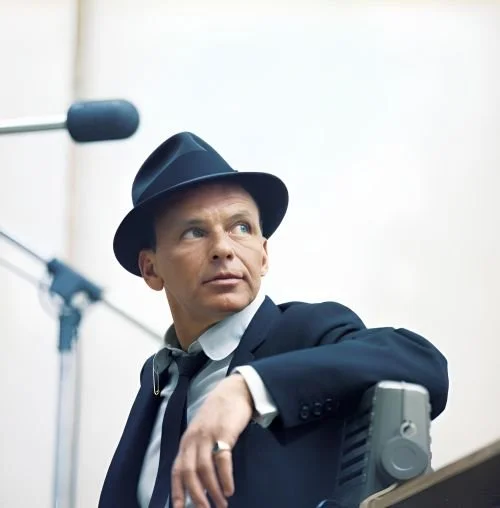
IN THIS PHOTO: Frank Sinatra
Why a Modern Interpretation of the Big Band Sound Could Work Today
__________
I missed the actual anniversary…
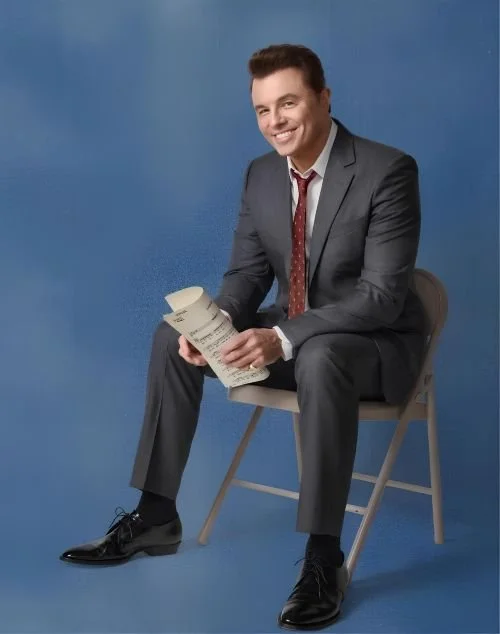
IN THIS PHOTO: Seth MacFarlane released Lush Life: The Lost Sinatra Arrangements in 2025/PHOTO CREDIT: Pamela Littky
but Frank Sinatra’s debut studio album, The Voice of Frank Sinatra, turned eighty on 4th March. Its anniversary month has made me think about that type of singer and how we do not really have a modern-day Frank Sinatra. Maybe more prevalent and relevant in the 1940s and 1950s, Pop groups like The Beatles and Rock & Roll artists like Buddy Holly revolutionised music and took it in a new direction. That might be an over-simplification, though there was a period and era where artists like Frank Sinatra, Dean Martin and Sammy Davis Jr. were at the forefront. I grew up listening to songs from these artists. Julie London too. Not a huge part of my upbringing, I do think that these artists often gets reduced to being seen as Easy Listening. When popular music changed and songs became shorter and sharper, perhaps artists like Sinatra seemed old hat. Today, Pop music is very much the dominant force. Though we have Jazz and Adult Contemporary artists who one could say channel the legends of decades past. If Easy Listening is not really a genre now, you can see a range of Adult Contemporary artists who, in some ways, provide a modern-day version of the crooners and icons of the past. One could say knowing Frank Sinatra is a generational thing. However, there is something about his voice and the gravitas that defies age and the time period. It is a shame that his music would be seen as niche or fringe now. Something that is very unlikely to be played by younger audiences. I have nothing against modern Pop. It is fantastic. However, there is this reliance on songs that are faster. If that is the right word. Listen to Frank Sinatra’s work and there are songs that unfolds. They have a particular dynamic and tempo. Not something you hear much in today’s Pop. Artists like Lady Gaga have gone in that direction. Her albums with the late Tony Bennett. Jazz standards. Modern artists like Samara Joy have that blend of nostalgic Jazz and Easy Listening with modern sensibilities.
Another reason why I was musing on this is because of someone in the contemporary climate who is very much influenced by Frank Sinatra. One might associate Seth MacFarlane with his comedy. However, he is a huge music fan with a fantastic voice. His debut album, Music Is Better Than Words, is fifteen in September. He has released nine studio albums. The most recent, 2025’s Lush Life: The Lost Sinatra Arrangements, is one I will focus on. It is a remarkable listen, and it made me wonder – having heard the richness of the performances – why the type of music Sinatra was famed for is dying. Is it seen as outdated or uncool? Music has evolved, so do audiences today have the patience or taste for Sinatra? I do love MacFarlane’s albums. There is something hopefully romantic and wonderful about the holiday albums he has released. So many major artists put out Christmas albums where they cover the standards. However, his holiday albums, especially 2023’s We Wish You the Merriest (with Elizabeth Gillies) are filled with so much warmth and joy. Hearing the two sing! I do wonder, for a possible tenth studio album (if he has one planned), whether MacFarlane will write some originals and marry his love of Big Band and Jazz. I guess that is the correct genre denomination. Rather than ‘Easy Listening’ it is ‘Big Band’. The rush and majesty; the cool of the orchestra and that rousing and spine-tingling sound they summon. You can hear Bobby Darin, Sammy Kaye, and Ella Fitzgerald in his voice too. I would love to hear him write some lyrics. I do feel there is a place for Big Band today. A modern version. So much of today’s Pop seems samey, stale or lacking in emotional richness and a certain spark. People assuming Big Band and Jazz is always slow or dull. That is not the case. Listening to Seth MacFarlane’s albums and how he interprets some of the greats. Puts his own stamp on them and really provokes a range of emotions and reactions.
Thinking of The Voice of Frank Sinatra and how it is now eighty. It made me wonder if we can revitalise or repurpose the sound of an artist who made his debut at a time when the world was still recovering from a World War. There are a couple of promotional interview with Seth MacFarlane that I want to bring in. Giving us an understanding why he embarked on the project and the meaning of these lost Frank Sinatra arrangements. Jazz Times sat down with MacFarlane around the album’s release last summer:
“Lush Life: The Lost Sinatra Arrangements (Fuzzy Door/Republic/Verve), the first fruits of his labor, started its journey when MacFarlane acquired the Sinatra music archive from the family estate of the Chairman of the Board and its fervent watchdog, Tina Sinatra, in 2018. Before taking hold on the sainted job of curating the Sinatra song legend, MacFarlane discovered that over 100 never-recorded or finished takes on arrangements from Nelson Riddle, Billy May and Don Costa were in the estate vaults, a series of “little black pencil dots on paper” that MacFarlane and his team brought to life.
As an artist working within the theatrical realm, the emotional drama and nuance of Sinatra’s finest vocal interpretive work is something that MacFarlane never takes for granted. “As a singer and an interpreter, no one can touch him,” he says.
“There’s a reason that he stands alone, still, amid a cast of characters from that era that were all truly great vocalists. There is just something in the way that Sinatra acts out a story, the way that he allows the role of the orchestrator and the band to play a part in the recording — an achievement only rivaled by Nat ‘King’ Cole — that makes his recordings a uniquely rich experience.”
Beyond Ol’ Blue Eyes
At no time during Lush Life or his other eight albums do you hear MacFarlane impersonating Ol’ Blue Eyes and his sauntering, clearly enunciated phrasing. Shared swagger aside, there is no imitating Sinatra — which is pretty great when you consider MacFarlane’s power of mimicry as an animation voiceover artist.
“I think that every vocalist post-1955 who does this music is influenced by, and indebted to, Sinatra in the same way that every animated television series post-1990 is influenced by The Simpsons,” Seth says, touching on a highlight of his day job. “We’re always going to be in the shadow of this towering figure who rewrote the vocal rulebook. I’m glad that I did this Sinatra album now because I’ve had time to settle into a style, a method of interpreting lyrics that brings my own vibe to the table.”
Besides, Sinatra is not the only object of MacFarlane’s reverence. Surprisingly, he brings up lounge singer Steve Lawrence as well as Gordon MacRae, the actor and booming baritone behind two of Rodgers & Hammerstein’s most masculine musicals, Oklahoma! and Carousel. “MacRae’s was a voice that I was in awe of because it’s always accessible even after a night of drinking — and then he’d end each song on a silky falsetto note that came from out of nowhere. He had the range of an opera singer at their peak, yet MacRae was singing pop music and showtunes. Steve Lawrence too is wildly underrated. This was a guy who sounded so relaxed and at ease, yet had a rich, natural instrument. He never phoned it in. When I record, that’s what I watch out for. They made it sound so easy, yet if you analyze the recordings, they’re never giving less than 100 percent. As Sinatra pointed out, there’s a big difference between crooning and singing. The swagger? It’s secondary. It’s garnish.”
The Inner Sanctum
Though forever bewitched by Sinatra, it was MacFarlane’s getting to know Tina and Frank Sinatra Jr. (who co-starred several times as himself on Family Guy) that brought him closer, in a literal and figurative sense.
“I had seen Frank Jr. on The Sopranos and thought if he had done that show, that maybe he would do ours,” says MacFarlane. “He did, and came in ready to go and up for anything. We wrote songs for him and he sang with Brian and Stewie, so that was a blast. He was also a walking encyclopedia of music from the big-band era and the golden age of vocal standards. The orchestras from that era that he turned me onto, that I’d never heard of, were amazing. Like the Sauter-Finegan Orchestra. Who were they? Frank Jr. knew, and he put them on my radar.” [Ed.: Eddie Sauter and Bill Finegan, both important composer-arrangers, co-led this sprawling, money-losing, quasi-Third Stream project throughout the 1950s.]
When Frank Jr. passed away, MacFarlane got closer to Tina. “She’s an amazing steward of her father’s legacy but also a great hang. She can smell bullshit and what she saw in me was a love of her father’s music. And on his 100th birthday, with an orchestra in tow, we got to sing many of Frank’s favorites — that’s a cool way to have a birthday party.”
At that very party, Tina gave MacFarlane a ring with the Sinatra family crest, of which there are fleetingly few. “Tony Bennett got one. I was immensely grateful… I wear it during every live show and recording I do.”
He was asked to acquire the Sinatra music archive from the family estate — some 1,800-plus charts and more — and MacFarlane grew interested in the songs written or arranged for Sinatra that fell by the wayside. Gathering MacFarlane’s longtime producer-arranger Joel McNeely, conductor John Wilson and engineer Rich Breen (who insisted on reel-to-reel tape), the team begin to dissect the once-lost arrangements of Nelson Riddle (nine), Billy May (two) and Don Costa (one).
“We knew that this was something we couldn’t screw up,” says MacFarlane. “It had to be done in the way Nelson Riddle would want these arrangements to be heard. And we had fun doing it.”
MacFarlane and the team were guided by Sinatra Enterprise archivist Charles Pignone when dealing with songs like Gus Kahn’s “Flying Down to Rio,” which was cut for the Come Fly with Me album but never used. There was a gorgeously odd Nelson Riddle arrangement of Johnny Mandel’s “The Shadow of Your Smile” that MacFarlane is planning for another volume. There was the melancholy “How Did She Look?” planned for the ruminating romance epic Only the Lonely but never cut. “There were 1,200 boxes of Sinatra’s that were mostly unmarked, so the only way to know what was there was to play them. So we got an orchestra to play them, and that was a real voyage of discovery.”
Riddle orchestrations such as “Shadows,” “Who’s in Your Arms Tonight” and the longing-filled “How Did She Look?” from 1958, as well as “When Joanna Loved Me” from 1977, are among the arranger’s finest moments. But it is Billy Strayhorn’s “Lush Life” that really tested Frank”.
Paste spoke with Seth MacFarlane last October about Lush Life: The Lost Sinatra Arrangements. It is not about impersonation or trying to replicate Frank Sinatra. I do feel like the authenticity and musicianship of a band or orchestra seems to be the anthesis of a lot of processed and digital music. I think this was the first MacFarlane album not recorded out of Abbey Road Studios. A cost and inaccessibility might put most artists off. Recording at a world-famous studio and hiring a lot of musicians is out of the reach of most. I have asked before why we do not have a modern equivalent of Steely Dan. The same reasons. Many days and weeks in a studio honing songs with multiple players. That said, listen to the results on Seth MacFarlane’s latest album, and it makes me yearn for more of it nearer the mainstream:
“It’s rare for anything in a contemporary space to have so many bodies—so many players—in the same room together like they are on Lush Life. How does this record compositionally compare to what you’ve done before? These songs—they’re pop standards, really—were composed by Nelson Riddle, Billy May, and Don Costa. What was the challenge for you when it came to stepping into them and embodying and honoring what they are?
It was twofold. Thank God I did this record now, instead of ten, fifteen years ago, because I really wouldn’t have known what to do with it. I hadn’t acquired the experience or the knowledge that I’ve learned from all of these musicians over the years that I’ve worked with, and certainly from Joel McNeely. But it was trying to figure out how to keep enough of myself and the tone and style that I had established over the eight or so albums that I had released over the past fifteen years present, and, at the same time, recognizing that this is music that was written for a particular instance, for a particular performer, by arrangers who had their own styles. Musically, a lot of it was looking for clues in a Billy May chart. He uses these wet-sounding sax lines; you hear it a lot on his arrangements. We would use that as an anchor, to figure out how fast or slow he might have wanted this chart to have been played. Sometimes, the dynamics on these score sheets literally say “uptempo,” which could mean 80 million different things, right? It’s up to you to figure it out.
And, with all these guys having passed away, it’s a lot of guesswork. You have to piece together what you know of their individual styles and cross-index it with what’s on these scores, that no one has ever played, and try to read their minds, basically. The same was true with Sinatra. Vocally, I was really trying to honor what it was that he would have wanted to hear, because he was so particular about his orchestrations. At the same time, I was making sure that it didn’t feel like a Vegas cover show, or that I was just doing an impression. It was this Goldilocks zone that I had to exist in, musically. Hopefully we pulled it off.
When it comes to craft, be it the craft of the charts or the craft of your interpretations of them, what do these songs best exhibit about that, by your approximation?
It’s really the art of the arrangement. It’s the art of orchestration, which, in many ways, is kind of lost for a number of reasons—one being for the same reason that melodic writing is lost: It just is of another time and of another world. It’s also just not necessary, in many ways, for the kind of music that we produce today. What always astounds me is that, if you pull Sinatra’s vocal out of the recording and you listen to just what’s going on with the orchestra, it’s amazingly intricate and amazingly detailed. And, in some cases, it sounds like you’re listening to a fucking symphony. On some of these ballads, it’s just amazing.
Probably the simplest litmus test that you can do is, if you go to a karaoke bar and listen to the “orchestration” or arrangement from your pick of pop songs today—to take nothing away from that music, it’s a different style—it’s comparatively simple. There’s a simplicity to it and a steadiness to it that doesn’t really deviate from itself a whole lot. Listening to something like “Spring is Here,” there’s an insane amount going on in that orchestra, even without Sinatra.
Craft-wise, it’s about 75-percent of the reason that I do this. I love orchestras. My favorite part of working on a film or working on a TV show is going to that soundstage and hearing the orchestra play, because it’s the one part of the process that I really have nothing to do with. A lot of times, I just get to go and listen. It’s the part that still has some mystique for me. Every other part of the filmmaking process, I now know the ingredients of the soup. I know how they’re doing it—and it’s helpful, because I have to, oftentimes, do it myself—but it takes away some of the excitement that I used to feel, going to the movies and having no idea how they’re doing these things. The one thing that still has that feeling of mystery is the musical process. When I give my composer a finished episode of a show or a finished film, and they come back, if it’s a film, eight weeks later with a full score that is just so astonishing and so intricate, and I hear the orchestra play it, I don’t really know how they’re doing it. And I certainly don’t know how they’re doing it that quickly. That part of the craft is still the most affecting for me. Again, some of this is because of ignorance—I’m able to preserve some of what I loved about making music and TV shows that’s now gone, because I do know how it all works.
I remember being thirteen years old and seeing the cover of Music Is Better Than Words for the first time. It was huge for me. I bought Chet Baker Sings on vinyl because it reminded me of that. When I was in high school, you were showing people my age how cool it was to sing standards by Rodgers and Hammerstein, or Lerner and Loewe. I don’t think I understood why that meant something back then, not until I went to and graduated from college. We had no idea back then. But so much of that style that you’d cultivated for yourself, and have been tending to since, was so often in response to Sinatra’s inventions and what groundwork he laid for vocalists seventy years ago. Between that first record of yours and Lush Life now, what’s your favorite thing that’s changed about your musicality?
I had the same experience when I was a kid too, because my parents introduced me to all of these old films and musicals—things that I was receptive to but didn’t really appreciate until I was in college and started to understand what it was that I had been hearing. More than anything, it’s an understanding of casting musicians, which is something I had really no clue about. Today, I at least have this skill of, like, “Okay, if we need a guitarist for this type of recording, is it Larry Koonse? Is it Graham Dechter? We need a drummer. We have Peter Erskine, we have Ryan Shaw. We need a woodwind player. Is it Dan Higgins? Is it Brian Scanlon?” These are names that I wasn’t really aware of fifteen years ago. I mean, I was aware of them, but I hadn’t dug in deep and hadn’t really gotten the education of each individual player and what their skill set is. It really is like casting an actor. It’s right down to the song. If you’re doing this kind of song, you probably want this trombonist.
It’s the art of orchestration. I was able to really learn about what it is that comprises the gears of this machinery, and why an orchestra sounds the way it does playing a particular piece of music, and why it is that old recordings sound the way they do, and why they have that warmth that’s so often hard to duplicate. If you hear somebody making a big band recording today, there’s a weird antiseptic quality to it. You can tell, instantly, that it was made today. There are a lot of little elements that we learned over the years that, by the time we got to Lush Life, we were able to use to make sure that this sounded as authentic as it could.
And that’s down to how you record it. Rather than recording digitally, we used reel-to-reel tape. They would haul these old reel-to-reel recorders out of the basement of Capitol Records or Abbey Road, wipe off the dust, and record it. That little hiss that you hear is actually part of it. It’s how you mic the band; how much vibrato the string players and woodwind players use when they’re recording; and, above all, it’s making the time to rehearse with the band. Even on film scores back in the forties, fifties, and sixties, you had all these contract orchestras that were just there every day. If you were a part of the Warner Brothers or MGM orchestras, you were sitting next to the same person every single day for years. So, what you had was an ensemble that could sometimes be ninety players that would have the tightness of nine, like a small jazz combo. Achieving that kind of sound is something that, in tiny increments, I learned over the course of the past fifteen years. And that’s why I’m very happy that this opportunity didn’t come about when Music Is Better Than Words came out, because I don’t think it would have been anywhere near as good”.
Eighty years after Frank Sinatra’s debut album, and you can feel his influence running through certain corners of music today. Whilst we do not have a modern Rat Pack (a 1960s group of entertainers led by Frank Sinatra, featuring Dean Martin, Sammy Davis Jr., Peter Lawford, and Joey Bishop), you can detect the legacy and impact of Frank Sinatra on modern artists. Though perhaps not as prolifically and prevalently as when he was in his pomp. Seth MacFarlane’s music keeps alive the Big Band sound and that cool. Rather than mimic and replicate Ol’ Blue Eyes, MacFarlane keeps his spirit and genius alive, though he does it…
HIS way.