
FEATURE:
Spotlight
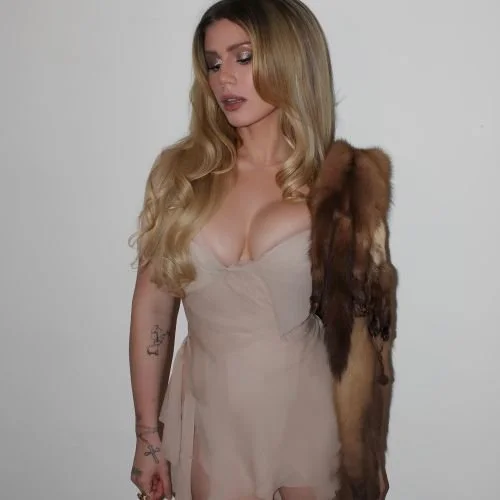
Slayyyter
__________
I was pretty sure that…
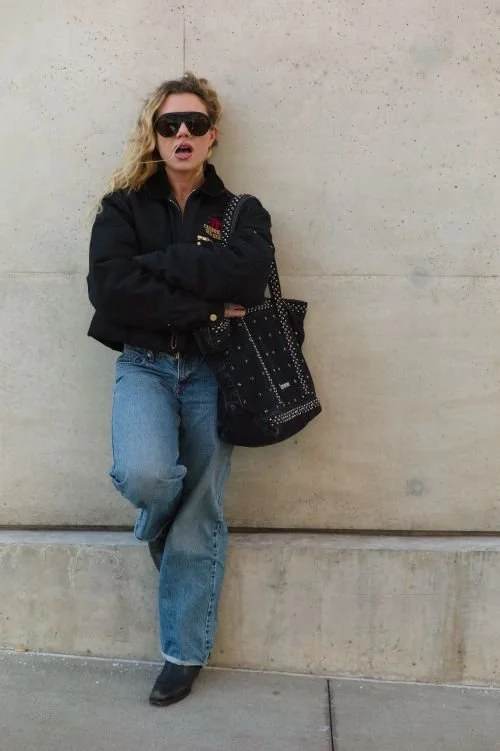
PHOTO CREDIT: Ethan Holland for FADER
I had spotlighted Slayyyter recently, but I can find no record of it. So I am sort of doing this to make amends. I shall end with a review of her new album, WOR$T GIRL IN AMERICA. I am starting out with some recent interviews. Slayyyter is the alias of Catherine Grace Garner. This is not the first album from the Missouri-born artist. Her debut, Troubled Paradise, was released in 2021. A lot of new artists have been proclaimed the future of Pop or the sounds of today. I do think that Slayyyter is not only one of the most important and astonishing artists we have today. I feel that she will inspire so many other artists coming through. WOR$T GIRL IN AMERICA is an example of her peerless talent. I want to come to interviews now. There are a lot of new interviews with Slayyyter. I am starting out with Cosmopolitan and their chat. Declaring that this artist has released a new album that is” gory, glittery, and introspective just in time for festival season”, Slayyyter has a busy diary ahead. She is playing Reading and Leeds in the summer. I feel that she could have headlined the festival. Maybe she will do soon enough. She plays London’s Roundhouse in November, but that is already sold out:
“Congrats on Worst Girl in America. How are you feeling about it now that everything’s out?
I get really nutty on release day. I kind of like it. I feel very anxious and fearful, but there’s really nothing to be afraid of. People already like the singles, but it’s hard to describe. It’s just a weird feeling of doom.
Even the title is quite polarizing. How did you decide this was the name of the record? Was it something you had in mind before hitting the studio, or did it come to you as you started working on the music?
I was inspired by my skater friends in St. Louis. There’s this terminology or nickname if someone’s drunk too much, like “He’s the worst dude.” “Worst girl” feels like it could be a term of endearment, but it could also be something I feel insecure about, like people thinking I’m not a good artist or person, feeling annoying, or like I don’t really fit in with any of my peers. As soon as that title popped into my head, it clicked.
Well, you’ve been an “artist to watch” since those days, and they say it takes 10 years to become an overnight success. Does this era feel like you stepping into your next form? How do you feel you’ve grown up within pop?
The reason we keep seeing artists with long-winded careers recently having big breakout moments is that it takes time to develop yourself. Back in the 90s, you would be swallowed into the system at a very young age, but you would be developed for years before your first song ever hit the market. Now, you have something hit on the internet, and then you’re thrown into the deep end and told to swim.
This project is not something I could have made at any other point in my life because it required years of experience and exploring different sides of me. I finally hit the mark on who I am as an artist, where I haven’t really been able to do that in the past. This album is a sweet spot of what my true sound is and what my visual output looks like, and it’s an evolution of what I'm capable of creatively. That can only come from years of trying and failing.
This era has such a gritty glam-meets-Americana aesthetic. What was on your moodboard, and how are you bringing that visual world to the stage at festivals this summer?
I’m going to be performing with a band for the first time, which I’ve never done. The music really called for that, and I didn’t want it to be me and a DJ performing to a track. I was really inspired by the Soul Wax tour documentary and how no two shows were ever the same—they would switch it up every single night. Worst Girl in America lends itself to a live setting so well, and I’m excited for festivals to give it a different energy. My biggest goal for the tour is to make it feel like people are stepping into a music video with the set design and the band”.
Even though I am spotlighting Slayyyter, I am not referring to her as emerging or up and coming. She has been in the industry for a long time and put out quite a bit of work. Established and with huge gigs booked, this is someone perhaps who is becoming a modern idol. EUPHORIA. spoke with Slayyyter to discuss the sensational WOR$T GIRL IN AMERICA:
“Since 2018, Slayyyter has maintained an impressively steady output, releasing a string of singles, three studio albums, a mixtape, and a remix EP. Alongside headlining her own tours, she has also supported Tove Lo and Kesha, ensuring her profile continues to rise. What began as a small online cult following has steadily expanded, with Slayyyter’s fanbase growing louder and more visible as her influence widens.
“Everything’s been a slow build over the past couple of years,” she says. “Instead of chasing a viral moment, I’ve focused on building my fan base organically. You can’t really predict those big moments anyway. It’s been gradual — everyone is kind of coming together over time. I feel a bit like a cult favorite, which feels real. I never tried to occupy that position, but over the years, it’s slowly become this little inside club.”
During the creative process, Slayyyter knew things felt different this time around. “This was the first album where I really felt my age while making it. I’m almost 30. I don’t want to still be called ‘up and coming’ at 33,” she reveals. Her previous frustrations even almost caused her to quit altogether. “I started asking myself if I wanted to do this forever. Should I move back to Missouri? Do something else? I love music and visuals more than anything — it’s my heart and soul. But you reach a point where you ask what you’re fighting for. So I decided to make the sickest record I could, give it everything, and if nothing happens, at least I made something I’m proud of,” Slayyyter continues.
However, she recognizes that this album wouldn’t exist without that constraint. “I couldn’t have made this album at 21,” Slayyyter declares. “It came from being older and feeling that pressure. For the first time, I didn’t care about writing a hit. I didn’t care about radio or TikTok song lengths. If I wanted to make a six-minute song, I did. A very cool project came out of that freedom.”
I saw online there had been speculation about the album title. Can you reveal why you chose WOR$T GIRL IN AMERICA?
This was always the main title. I had another one floating around that I’m saving for the next project, but this just made the most sense. It’s how I feel a lot of the time. It’s tongue-in-cheek — it can be sarcastic or real. It started as a term of endearment from my skater friends. If I was hungover or threw up at a party, they’d joke and say “worst girl.” But a lot of the songs are about my angst and anger — where I sit in music, in social settings, feeling like a loser sometimes. There are moments where I feel like the worst person in the world. I don’t really have artist peers I’m close with. I don’t feel like people have taken my music seriously. It’s been years of being called “up and coming,” and when you’re almost 30, that starts to feel insulting. I channeled all of that into this album and the title. Sometimes I feel like I’m too drunk at a party, not doing what I’m supposed to be doing, not making people enough money. It felt like the perfect title to capture where I’m at in my career and life.
“GAS STATION” is also another standout. Production wise, it feels as if you took notes from early Crystal Castles.
I grew up listening to Crystal Castles and that Tumblr-era music. “GAS STATION” was one of the first songs for this project. My friend Marvy and I started it, and I kept saying I wanted to make “iPod music” — music that reminds me of being a teenager, downloading songs intentionally, curating what lived on your iPod. It was before Spotify really took over. “iPod music” almost feels like a genre to me — indie electronic from 2010–2011. Nostalgic but still forward-thinking. “GAS STATION” was the first one that really defined that sound for this project. It feels like something I would’ve loved in high school, but it also feels timeless. Crystal Castles is definitely an influence, even if the album wasn’t directly inspired.
Gosh, I feel like everyone wanted their own song to feature on an iPod commercial.
Back then, getting an iPod commercial sync could make an artist’s career. I remember discovering so much through iTunes’ Free Single of the Week and Free Video of the Week. It was such a big editorial moment. A lot of indie electronic or alt songs would get that placement — the kind of thing you’d hear on Gossip Girl. That’s the spirit of this album. Creative music videos that didn’t need huge budgets, just strong ideas. I’ve tried to approach the visuals the same way. The visuals are just as important as the music, and they’re very
You finish the album with “BRITTANY MURPHY.” Why did you want to end the album on that note?
That song is a very personal diary entry. I was feeling stuck in my career and having dark thoughts. I kept thinking, if this were the last album I ever made, what would I want it to be? Would I leave behind party songs, or something more personal? “BRITTANY MURPHY” isn’t really about her specifically — it’s about my own suicidal thoughts and feelings. But she inspires me. Uptown Girls meant so much to me growing up. The themes of girlhood and not feeling like a grown woman even when you are — that resonated deeply. The title is more about honoring her, but the song is about me. Ending the album there felt complete. You go through all the angst, insecurity, bravado, and then it lands in something sad and honest. It felt like tying a bow on the whole emotional journey”.
Adrian Horton, writing for The Guardian, spoke with an artist who was hitting a peak. She writes how “the self-described ‘worst girl in America’ is having a breakthrough”. It must be a bit frustrating for Slayyyter to be seen as a new artist or someone still coming through. I think WOR$T GIRL IN AMERICA will change that. Horton also notes: “Slayyyter’s new album Worst Girl in America scratches a similar anarchic itch. Immediate, vertiginous and diabolically cheeky, the after-hours record finds her channelling a ferality that feels rare in our slop-ified pop culture (cue the rock-tinged Cannibalism), and has garnered breathless hype among those in the know”:
“Out of her midwest trash drag, Slayyyter is also midwest nice – chatty, digressive, eager to discuss any of the many naff noughties cultural references that inform Worst Girl in America’s haute-trash style, from paparazzi shots of Lindsay and Paris to Kate Moss’s rain-soaked boots at Glastonbury (as an homage, the album’s vinyl appears stained by dirt), and Perez Hilton to The Hills. We’re breezily FaceTiming from what appears to be her bed in Los Angeles, recalling mutual teenage obsessions from a time when celebrities “seemed both glamorous and totally out of control”, partying and battling TMZ in a way “that felt like a completely foreign world to my suburban midwest upbringing”. Like much of her fanbase, Slayyyter is highly pop-culture literate, shaped by years on Twitter (irony) and Tumblr (evocative pastiche). Growing up in suburban St Louis, she was “a bit of a loner kid” who found her tribe online, and whose interests in celebrity culture and music were “one and the same”.
Her early music, posted to Soundcloud in between shifts as a receptionist at a hair salon – “they wouldn’t let me touch the hair, only the phone” – turned popculturediedin2009 fixations into vibrantly tacky, bombastic, deep-fried pop. “It was very much a parody on that kind of paparazzi, McBling, tabloid, trashy girl,” she recalls – webcam photos with Paris’s mugshot in the background, knowingly ridiculous yet catchy songs about Juicy Couture and rhinestone jeans. After her first major breakup with a boyfriend in Missouri, the artist then known as Slater coped by trying to get all her social media handles in order – hence the three Ys, under which she released her first track with a beat bought from the underground electronic producer and fellow very online teen Ayesha Erotica. The Bacardi-soaked BFF went moderately viral in the right circles for 2017 – stan Twitter, largely – while Slayyyter was on shift at the salon. “I remember sitting at my desk at my job and a magazine put it on their songs of the moment list, and I was like: what is going on? It was so fast.”
At the time, “hyperpop” was not an overused genre term for any self-referential, boundary-pushing electronic music outside the mainstream, and Y2K was not yet an all-encompassing aesthetic. “I feel annoying saying this, but at the time when Ayesha and I were making music, no one was doing that yet, it wasn’t a trend yet,” she says. “Now you type Y2K into your search bar and it’s like every fast-fashion brand has a section on their site.” McBling had legs, and the stan internet-to-experimental-pop-darling pipeline flowed.
Still living with her mom in St Louis, Slayyyter cobbled together attention-grabbing tracks into a mixtape and indie record deal, then a spot on Charli xcx’s self-titled tour in 2019. There was a move to LA to make full albums: her gussied-up 2021 debut Troubled Paradise and the cocaine chic of 2023’s Starfucker, an intoxicating and deeply underrated exploration of Hollywood’s destructive and defiantly plastic allures. There were tours with Tove Lo and, more recently, Kesha. There were unexpected wins: Daddy AF, a dementedly horny and catchy riff on the slut persona, which in 2024 became one of the least likely songs to be included in an Oscar-winning movie when it soundtracked strip club scenes in Sean Baker’s film Anora.
But approaching 30, navigating pop’s hollowed-out middle class started to feel bleak. She had big co-signs but seemed to have hit the ceiling of being “famous but not quite”, as Charli xcx put it on her career-realigning 2024 album Brat.
“It feels so depressing to say, but I was like, ‘Oh, I guess it’s over for me,’” Slayyyter says candidly. “[I] started from a place of me wanting to do this for fun with the hopes that maybe I’ll be a star. And then when it kind of happens but not all the way, the goalposts shift. You’re like, ‘Well, my numbers aren’t good enough. Everyone’s getting TikTok hits, and I don’t have that.’
The urgency of Worst Girl In America can be traced to 80s gutterpunk and noughties electro sleaze as well as the whiplash pace of her internet-addled brain. “I have ADHD in a way that is so severe,” she laughs in one of many unfinished digressions. When I note that Crank does in fact hit like Adderall, she laughs – “How do you think that got written?” And, of course, there’s Kesha, the party-girl trailblazer Slayyyter recently supported on her Tits Out Tour. (Like Kesha before her, Worst Girl in America is stylized with a $.) Her tourmate has been a necessarily vocal critic of the music industry’s most predatory practices; Slayyyter has luckily avoided the worst – “I can’t even imagine,” she says – and Kesha has helped her learn through osmosis. “She was unapologetically herself always,” Slayyyter says. “That inspires me to do the same and to not feel the need to be so buttoned-up all the time.”
It is admittedly difficult to imagine the self-proclaimed Worst Girl in America buttoned-up, especially on an album this riotous, which rips through dive bars, motels and emotionally desolate gas stations with preposterously heavy beats and bared teeth. It’s certainly magnetic, and that rare thing for the very online these days: fresh. It feels like a breakthrough moment, but Slayyter has seen enough of the fickle music industry to not allow herself to believe that yet. “My biggest thing right now is just continuing to work on music and expand on the sound,” she says. “I’m not, like, looking for a mainstream moment. But if one happens, that’s great”.
I am ending with a review for Slayyyter. NME provided their take. WOR$T GIRL IN AMERICA has received so much praise and affection. NME highlight how this year-defining album “finds salvation in the underbelly of American cinema”:
“Our first brush with the third studio album by the eternally up-and-coming pop genius Slayyyter is a blistering checklist of hedonistic excesses: “Money, drugs, chains on my chest, that vintage Celine / Diamond grills, champagne bottles, swagger I bleed,” she sings on lead single ‘Beat Up Chanel$’. It’s a state of mind for the fast-living, blunt-carrying, self-destructive narrator. “I want a cigarette,” she squeals at last, before the track lurches into a splendorous clash of thumping electro house, peppered with screwed synthesisers and all. This is the ‘Wor$t Girl In America’, take her or leave her.
Charting a chameleonic shift from the noisy proto-popstar of her self-titled debut, to the sultry, ’80s-noir of ‘Starfucker’, Slayyyter returns to the saddle on album three with her take on the lurid world of late-noughties indie sleaze (which she affectionately terms “iPod music”). Here, she indulges in clichés of American life as depicted on screen by her favourite auteurs, from drugged-up trailer trash (Spun) to deprived misfits (Gummo) and even homicidal showgirls (Faster Pussy Cat, Kill Kill!). Inspiration from the latter manifests in the spooky sonics of ‘Cannibalism’, a new-wave bop led by a lusty, cooing chorus that undulates between screamo-pop and the bravado of a tragic, on-screen heroine.
At the beating heart of the project’s explosive and utterly delirious sound lies ‘Crank’, a salacious, screaming techno track with shudders of industrial rip-roars that features some of this year’s best lyrical offerings. Lines like “She pick up then we fuck, I get so gay off that Tequila” and “He wanna fuck Slayyyter, Richard, we should link later” (the latter followed by a gallant Matthew McConnaughey impression) play to the singer’s historically cheeky pen, toeing the line between the project’s playful, rage-fuelled spirit.
These sonic experiments continue in flirtations with dark wave (‘Gas Station’), twinkling synthpop (‘Unknown Loverz’) and even religious sermon (‘Prayer’). But paramount to all of this is a note of club-led salvation, nowhere more so than on album opener ‘Dance…’, which charts a slinky new territory for the artist as she edges on the precipice of come-up with doses of acidic Korg basslines and slow-burning electro clash. Slayyyter fashions a similar patchwork of influences in the album’s self-directed music videos too, visually feasting on fireworks, rodeos, flickering cityscapes, derelict backyards and a trip to Prada Marfa, as if she was surfing through her own Tumblr feed.
The album concludes with an ode to the incomparable Brittany Murphy, the star of Jonas Akurland’s aforementioned Spun, which the singer has cited as a significant reference for the project. Synonymous with girlhood at its most challenging and delirious, Murphy couldn’t be a more fitting subject as archetype for the album’s final girl. Giggling through the chaos of the past 13 tracks as psychedelic dream-pop fills in the gaps, we can’t help but give in to the cinematic peak of ‘Wor$t Girl In America’, touching us the way all good movies do”.
If you have not heard Slayyyter or followed her music, then now is a perfect time to show support for an artist who is going to become one of the biggest on the planet. WOR$T GIRL IN AMERICA is one of my favourite albums of the year and I really love Slayyyter. She is a modern genius whose music is impossible to ignore. Let’s all salute and show respect for…
THIS music goddess.
____________
Follow Slayyyter

PHOTO CREDIT: Kait Muro
Official:
Instagram:
https://www.instagram.com/slayyyter/
TikTok:
https://www.tiktok.com/@slayyyter
Twitter:
Facebook:
https://www.facebook.com/slayyyter/
YouTube:
https://www.youtube.com/channel/UCjbIFp5s_kUgrH1S8-bG0vw
Spotify:
https://open.spotify.com/artist/4QM5QCHicznALtX885CnZC?si=TEywy4NlRUyxAfGu158Rhw