
FEATURE:
The Girl Who Wanted to Be God
Manic Street Preachers’ Everything Must Go at Thirty
__________
I previously wrote…

IN THIS PHOTO: Manic Street Preachers’ lead, James Dean Bradfield
about the lead single from Manic Street Preachers’ Everything Must Go, A Design for Life, as it turns thirty on 15th April. I am writing this feature in March but sharing it in April, as the band’s fourth studio album turns thirty on 20th May. I am going to get to features and reviews of this amazing album. It was the first record released as a trio, following the disappearance of lyricist and rhythm guitarist Richey Edwards. Reaching number two upon its release, Everything Must Go is often cited among the greatest albums ever released. There are a few features I want to come to first. They give us some background behind Everything Must Go. It must have been one of the most challenging of the band’s career. Considering Richey Edwards’s disappearance and uncertainty around him, it would have been almost impossible to focus. However, what Manic Street Preachers released on 20th May, 1996 is one of the most powerful and enduring albums ever. In 2016, twenty years after Everything Must Go was released, The Line of Best Fit reflect on this masterpiece. Even though Richey Edwards went missing in 1995, it was still very much raw in the mind of the trio of James Dean Bradfield, Nicky Wire and Sean Moore. The article charts the build-up to Everything Must Go and the gruelling tour in support of 1994’s The Holy Bible. I pick the story up here:
“What would, fifteen months later, be released as Everything Must Go was fairly improbable prior to that day in February, but seemed utterly impossible thereafter. Left with so many questions, Bradfield, Moore and Wire found a shared focus in crafting a remarkably accomplished record. The Manics were not known for conjuring meticulously sculpted music. They’d blustered onto the scene at the start of the decade making forever-quoted claims about selling sixteen million copies of their debut and then splitting up, unfortunately forgetting to then actually record an album worthy of such grand figures. The shambling Guns N’ Roses-light reverb-laced polish that was applied to the majority of the sixteen songs neutered much of their early punk energy, only for the follow up, Gold Against The Soul, to head even further down the hard rock route. By the time The Holy Bible arrived, with its raw inertia and uncompromising intensity, people were losing interest and failed to notice the change.
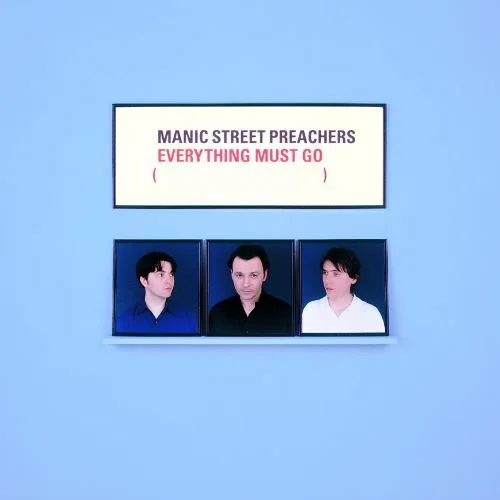
The space is what stands out the most. It’s there on the album cover, with the band’s portraits neatly arranged in the middle of so much unassuming pastel blue. It’s there in the parentheses below the album’s title, hinting at what is missing. It’s there in James Dean Bradfield’s audible breath at the start of Interiors (Song For Willem De Kooning) which offers a very literal manifestation of the fact he “wanted [the music] to breathe a bit.”
Such a pause was rare in the band’s catalogue to date, lyrics normally dominating their songs to such an extent that they necessitated a machine-gun fire delivery from their beleaguered frontman. And yet, Everything Must Go is an album that is delicately arranged. Revered British poet Simon Armitage recently observed rather beautifully that “prose fills a space, like a liquid poured from the top, but poetry occupies it, arrays itself in formation, sets up camp and refuses to budge.” This description perfectly captures the transition that occurs between the songs of The Holy Bible and its successor.
The record’s first single, the song with which the band chose to step out into the public gaze once again, "A Design For Life", is built around only ten lines. That’s ‘only’ in the sense of size alone, for their impact is not to be underestimated. The boozy culture of Britpop had birthed an asinine notion that the working classes were stupid and driven by simple desires. The reclaiming of their status as those capable of intellectual insurgency resulted in the subsequently slightly misappropriated rallying cry of “we only want to get drunk.” Originally intended to highlight the media’s characterising of that section of society, even the band themselves later admitted that the quest for oblivion when eloquence alludes was a feeling with which they were all too familiar of late. It remains the final song in the band’s live sets, twenty years later.
Even if most of their new audience missed the irony of bawling their way through what they perceived to be a paean to alcoholic obliteration, it provided a fortuitous foothold in the world of laddish indie that was dominating the UK music scene at the time. Bradfield remains defiant that “we were not Britpop”, but this rare period, during which the acts who adorned the pages of the weekly music press were somehow also dominating the charts, provided the perfect platform for this oft-overlooked Welsh band to gain purchase in the nation’s affections.
Such elevation was soon to be formally confirmed. Taking to the stage in a t-shirt stenciled with the phrase ‘I Love Hoovering’ to collect two BRIT Awards in February 1997, Nicky Wire, with Bradfield and Moore alongside him, looked in his element. Everything Must Go had just been named album of the year and the Manic Street Preachers had gone from being perilously close to having no record deal to occupying the position of Best British Band.
After Bradfield had delivered conventional awards show thank yous, Wire grabbed hold of the microphone and proclaimed “this is also for every comprehensive school in Britain which the government is trying to eradicate. They produce the best bands, the best art and the best everything. The best boxers too.” It was delightfully incoherent and typically out of step with everything else that happened that evening, but the warmth with which it was greeted neatly highlighted the scale of their acceptance in the mainstream. Ten months on from their return, they were heralded by the public and their peers alike, revered in a way to which they were entirely unaccustomed.
The evolution was complete but at what price? Manics diehards were not used to sharing standing room with the beer-swilling Oasis fans, the meticulous anti-image had produced the strange sight of Bradfield on Saturday night television in double denim and even he still wasn’t happy, recalling “there was never a moment where it felt like we won.” Greater triumphs lay ahead, but those twelve songs taken together formed a truly classic album. In an age where endless promotional schedules necessitate insincere hyperbolic proclamations about each new release, it’s heartening to hear Wire stating emphatically that he’s “not afraid to say that I think it’s our best record.” He’s right”.
There is not as much written about Everything Must Go as you’d hope. However, I do want to source from Riffology and their feature from last year. They looked at the making of the 1996 album. From the genesis through to the recording process and the commercial success of it. I recall when it came out. I was aware of Manic Street Preachers, but this album was a revelation. It awoke me to their brilliance:
“From the start, the creative direction was clear: this would not be a repeat of The Holy Bible. As James Dean Bradfield later told NME, “We didn’t want to make another album about darkness. We wanted to make something more open, more anthemic, something that felt like a release.” The band kept five sets of lyrics Richey had left behind, weaving them into new songs, while Nicky Wire took on a larger role as lyricist. Musically, the band moved toward bigger, more symphonic arrangements, embracing strings, synths, and expansive choruses.
Here’s a look at the band members and their roles on the album:
Recording costs for Everything Must Go were financed by the band’s label, Epic Records. The sessions were not extravagant by major label standards, but the band invested heavily in time and effort, determined to get every detail right. There is no evidence of major financial challenges, but the emotional stakes were high. The working title, Sounds in the Grass, drew inspiration from Jackson Pollock’s paintings, hinting at the abstract, searching quality of the music. The final title, Everything Must Go, came from a play by Nicky Wire’s brother, Patrick Jones. It captured the sense of change, loss, and the need to move forward.
The album’s artwork, designed by Mark Farrow, featured minimalist blue and white imagery, with a Jackson Pollock quote inside: “The pictures I contemplate painting would constitute a halfway state and attempt to point out the direction of the future – without arriving there completely.” The cover’s clean lines and cool colours reflected the album’s themes of clarity, renewal, and looking ahead.
Recording Process
Entering the studio, the band knew they had something to prove. Recording began in late 1995 and continued into 1996, taking place across three main studios: Chateau de la Rouge Motte in France, Big Noise in Cardiff, and Real World Studios in Box, England. Chateau de la Rouge Motte, owned by producer Mike Hedges, was particularly important. The studio boasted a mixing desk originally from Abbey Road, adding a touch of history and prestige. According to Bradfield, the choice of Hedges as producer was influenced by his work with Siouxsie and the Banshees, especially the song “Swimming Horses”.
Mike Hedges brought decades of experience to the sessions. Known for his work with The Cure, The Associates, and Siouxsie and the Banshees, Hedges was skilled at blending lush arrangements with sharp rock dynamics. He worked closely with engineer Ian Grimble, and the band themselves took a hands-on approach. Dave Eringa, a longtime collaborator, produced and mixed the track “No Surface All Feeling” and mixed “Australia”. Stephen Hague, another respected producer, handled the original production for “The Girl Who Wanted to Be God”. The team used a blend of analogue and digital equipment, with an emphasis on warmth and clarity.
The studio setup at Chateau de la Rouge Motte included classic microphones, vintage compressors, and a legendary Abbey Road desk. While the exact gear list is not fully documented, we can make educated assumptions based on the studios’ capabilities and the era’s technology. Here’s a likely list of hardware and instruments used during the recording:
Throughout the sessions, the band faced moments of doubt and exhaustion. Yet, the process was also marked by bursts of inspiration. “A Design for Life” came together in less than ten minutes, with Nicky Wire describing it as “a bolt of light from a dark place.” The band aimed for a sound influenced by Phil Spector’s Wall of Sound, The Cure, Joy Division, and Magazine. The drum sound, in particular, was crucial—James Dean Bradfield said, “The drum sound had to set the tone for the whole record.”
Producer Mike Hedges has an extensive discography. Here is a table of notable albums he produced (excluding Everything Must Go):
Commercial Performance and Reception
When Everything Must Go was released on 20 May 1996, it was an immediate commercial triumph. The album debuted at number two on the UK Albums Chart, selling 60,000 copies in its first week. It remained in the Top 5 for a year and spent 104 weeks in the UK Top 100. According to the Official Charts Company, it has sold 1,097,865 copies in the UK, earning triple platinum status. Worldwide sales exceed two million copies, making it one of the band’s biggest successes.
Internationally, the album charted across Europe, Asia, and Australia. It peaked at number 12 in Ireland, 21 in Sweden, 29 in Finland and New Zealand, 40 in Denmark, 50 in Austria, 55 in Australia, and 63 in the Netherlands. The singles “A Design for Life,” “Everything Must Go,” “Kevin Carter,” and “Australia” all reached the UK Top 10, with “A Design for Life” peaking at number two and going silver (over 200,000 copies sold)”.
I am going to end with a review for Everything Must Go. Maybe there are better or more appropriate reviews for Everything Must Go, though I want to quote NME and their take. Reflecting a lot of reaction to Manic Street Preachers and the disappearance of Richey Edwards, there was a lot of focus on the album in relation to that event and how it affected the band and their music:
“Will they use any of the large pile of lyrics he left behind, or will they choose to press forward with a new ideal? Will they persist with the powerful, mangled claustrophobia of 'The Holy Bible', or will they broaden their sound to incorporate a lusher vision? Will there be songs about Richey or will the issue be skirted? For those who never fell prey to the Manics' charms, the idea that Richey's input wouldn't even be missed is understandable. He was derided as the guitarist who didn't play on the records and who used his instrument onstage merely as a visual prop. But fans know that his ideology, sleeve design and lyrics were the driving force behind the band. How can they carry on without him?
Well, whatever powers them forward now - and it can't be born of the same grim intensity as before - tragedy has not dimmed the Manics' creative glow. 'Everything Must Go' does not collapse under its own sheer significance in the way that New Order's first album did after Ian Curtis' suicide and Joy Division's subsequent split. It's a record that races with heavenly string arrangements and huge sweeps of emotive rock orchestration, one that bristles with a brittle urgency. It is not a wake, but the sound of a band in bloom.
The crucial pointer to this can be found in the realistic optimism of Nicky Wire's lyrics on the title track (the compulsion to pore over the words on the whole album is necessarily huge). "I just hope that you can forgive us," bellows James Dean Bradfield during the chorus, as strings and guitars clash tunefully around him, "but everything must go." How long must they have agonised over these sentiments among themselves, let alone publicly, before committing them to tape? Yet the result is gloriously cathartic.
Richey's lyrics account for five of the 12 songs - three written on his own, two finished in his absence by Nicky - but there are no motivational clues here, as he wrote them while working with the band. Still, the bleak intelligence of the man
8/10”.
There will be a lot of new things written about Everything Must Go ahead of its thirtieth anniversary on 20th May. I wanted to come in early and discuss one of the finest and most important albums ever. 1996 was a year when Britpop was still here and Spice Girls came through. British music was changing and shifting. It was a strange time for Manic Street Preachers. Losing a band member and having to recalibrate, Everything Must Go could have been a mess or something very dark and forgettable. As it is, the Welsh band’s fourth studio album stands up today and is this work of brilliance. Ahead of its thirtieth anniversary, do go and check it out. A twentieth anniversary edition was released in 2016, so I wonder if there are plans for anything on its thirtieth. Cathartic and more polished than what came before, Everything Must Go was a breakthrough, in the sense that Manic Street Preachers reached a whole new audience. All these years later and Everything Must Go is…
THEIR most enduring work.