FEATURE:
Talkin’ Bout Hey Love
De La Soul’s De La Soul Is Dead at Thirty-Five
__________
THE Daisy Age…
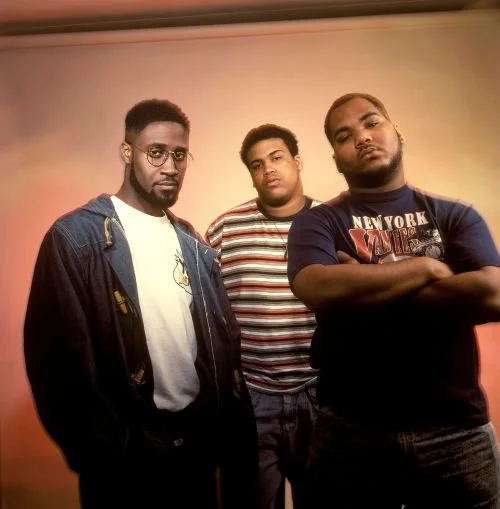
IN THIS PHOTO: De La Soul in January 1991/PHOTO CREDIT: Ebet Roberts/Redferns/Getty
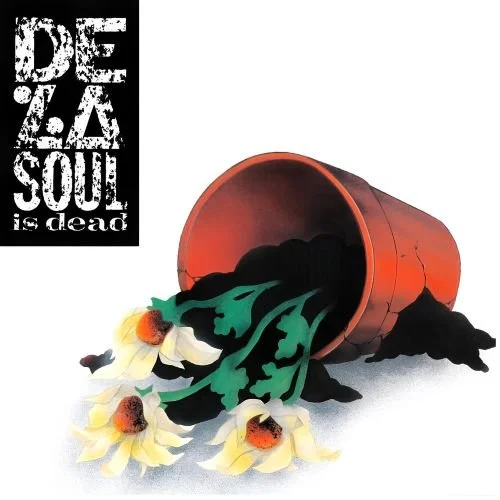
did not last long. Maybe overwatered or kept in harsh conditions, De La Soul pretty much declared it dead on their second studio album. Released in 1989, 3 Feet High and Rising was this Daisy Age classic. Against a Hip-Hop scene that was political and aggressive, they put out something that was harmonious, funny, loving and gentle. Not that De La Soul Is Dead reversed and undid all of that. It seemed to be the tag that was applied to them was shaken off. The cover of their second studio album shows a pot with daisies tipped over and broken. I do wonder if a certain reaction from their peers or a feeling within the group led them to distance themselves from The Daisy Age. Like their classic intro, De La Soul Is Dead contains skits, humour and truly incredible samples. I want to go inside it now, as the album turns thirty-five on 13th May (it was released a day later in the U.S.). Whilst not as acclaimed and heralded as the 1989-released debut, its 1991 follow-up is still a work of genius. Technically The D.A.I.S.Y. (Da Inner Sound, Y'all) Age, Posdnuos, Maseo and the late Trugoy the Dove managed to evolve and retain their core fanbase. The first single from De La Soul Is Dead was Ring Ring Ring (Ha Ha Hey). Considered one of their signature songs. De La Soul is a classic case of critics being divided at the time but retrospection being a lot kinder. Many expecting a same-sounding album to 3 Feet High and Rising. I am starting out with Albumism and their retrospective. Marking thirty years of De La Soul Is Dead back in 2021, it is worth shining new light on it. Often overlooked by those who could not accept De La Soul changing or not wanting to repeat themselves. Or feeling that same quality was not there:
“This is a journey back in time. A trip down musical memory lane, back to a bygone era nostalgically regarded by many as nothing short of golden. An age when hip-hop music was fundamentally defined by a vivacity and adventurism that has evolved, expanded, and mostly faded over the past few decades.
This is also the story of three gifted gentlemen who proved instrumental in defining hip-hop during this most fertile of periods in the genre and culture’s storied history. Formed in 1987 on Long Island, NY by Kelvin Mercer (“Posdnuos”), David Jude Jolicoeur (“Dave,” formerly “Trugoy the Dove”), and Vincent Lamont Mason Jr. (“Maseo”), the imitable De La Soul have always been and continue to be the embodiment of all that is pure and unfettered about hip-hop. True masters of the art form. Trusted ambassadors of the culture. Treasures of American music.
In the late 1980s through the mid 1990s, De La Soul—together with their kindred musical spirits the Jungle Brothers and A Tribe Called Quest—evolved the Native Tongues’ unique aesthetic and philosophy, defined in equal measures by whimsy and wit, unparalleled bohemian cool, Afrocentric sophistication, and admirable humility. Musically, the collective placed a heavy premium on appropriating and reimagining a widely varied array of samples, across rock, folk, pop, soul, funk, jazz and beyond, in the interest of crafting fresh and vibrant compositions that reinforced the power of music to move minds, bodies, and souls.
When it comes to the quality and consistency of musical output, even among the many incredibly skilled and prolific artists that emerged during hip-hop’s seminal golden era, only a select few can rightfully claim masterpiece status for each of their first four albums of their careers. De La Soul most certainly fulfill this rarefied criteria, and I’d argue that their legendary colleagues Eric B. & Rakim, Public Enemy, and the aforementioned Tribe qualify as well.
While most fans and critics alike cite De La’s watershed 1989 debut LP 3 Feet High and Rising as the strongest album of their esteemed catalog, I’ve always considered their sophomore album De La Soul Is Dead to be their greatest achievement to date. In fact, I’d say it qualifies as one of my five favorite albums of all time across all genres, perhaps even cracking my top three. OK, definitely cracking my top three”.
I want to draw in this review from last year. There are generations growing up who do not know De Soul and an album like De La Soul Is Dead. Modern Hip-Hop is really different to what it was in 1991, so perhaps it does not instantly resonate. However, released during a classic period of the genre, this album still holds up and sounds fantastic:
“The opening “Intro” is a stage setting. A thread is introduced, a storyline of characters discovering a discarded copy of De La Soul Is Dead. This device allows the group to comment on their own public perception, the shifting currents of Hip Hop, and the very act of listening. It’s a playful, almost self-aware approach, as though anticipating the questions and criticisms that would inevitably arise. This sets up a framework that, while conceptually interesting, occasionally disrupts the album’s pacing.
Then comes “Oodles of O’s.” No grand entrance here, but a simple, almost hypnotic bassline emerges. It’s a groove that settles deep, allowing the rhymes to take center stage. Posdnuos, Trugoy, and Maseo deliver their verses with a precise, conversational flow. The words address the growing commercialization of Hip Hop, a shadow that hangs over the entire album. It’s not a furious condemnation, but a wry observation, a commentary on the pressures and allure of the industry.
“Talkin’ Bout Hey Love” brings a change in atmosphere. A sample of Stevie Wonder’s classic provides the bedrock, but it’s not a simple copy. The instrumental arrangement is intricate, with layers of sound that weave in and out. The track becomes a dialogue, a verbal exchange between Posdnuos and a female voice, exploring the complexities of relationships. There’s a touch of melancholy, a sense of searching for connection in a world that often feels disconnected.
“Johnny’s Dead AKA Vincent Mason (Live From the BK Lounge)” takes a sharp turn into the unexpected. The recording quality is deliberately rough, like a worn-out cassette tape. The track presents itself as a live performance, complete with background chatter and stage ambiance. The song itself is a dark tale, dealing with violence and its aftermath. It’s delivered with a darkly comedic tone, but the underlying message is unsettling.
Then, a jolt of pure energy: “A Roller Skating Jam Named ‘Saturdays’.” This track provides a necessary dose of levity. The instrumental is pure funk, with a driving rhythm and an irresistible groove. It’s a celebration of weekend release, a reminder of simpler pleasures. The energy is contagious, making it one of the album’s most immediately appealing moments.
The album continues with “Kicked Out the House,” incorporating elements of house music. “Pass the Plugs” offers a moment of reflection, with a melancholic instrumental. “Ring Ring Ring (Ha Ha Hey)” addresses the frustrations of dealing with unsolicited demos, with a catchy and upbeat instrumental. “Shwingalokate” explores more experimental territory, with unusual sound effects and a disjointed structure. “Fanatic of the B Word” features guest appearances, adding another layer to the sound. “Keepin’ the Faith” takes a more traditional Hip Hop approach.
The album concludes with a final skit, closing the storyline. The characters discard the album, deeming it lacking in the elements they associate with Hip Hop. This ending serves as a final commentary on the album’s themes, questioning the very definition of the genre.
De La Soul Is Dead is a complex and ambitious work. It retains De La Soul’s signature creativity and wordplay while venturing into darker territory and a more challenging musical landscape. The album’s structure, with its recurring skits and diverse musical styles, creates a rich and engaging experience, but the sheer number of interludes and the album’s length can hinder a smooth and continuous listen. While conceptually strong, the constant interruptions can disrupt the flow of the music.
Following the passing of Trugoy the Dove in February 2023, the album takes on a new layer of poignancy. With its complex themes and innovative approach, De La Soul Is Dead remains a significant part of his legacy, a reminder of his artistry and his impact on music. It is a work that continues to resonate, not only as a snapshot of a particular moment in Hip Hop history, but as an exploration of artistic growth, the pressures of expectation, and the ever-shifting landscape of music itself. It is a complex, layered, and ultimately rewarding experience”.
Before finishing off with another review, I will bring in a 1991 interview from Rolling Stone. A trio that was concerned less with neon, flowers, jokes and everything associated with their 1989 debut, they were now concerned with growing up. De La Soul Is Dead was a symbolic killing of the old selves and this introduction to the new De La Soul:
“With its Day-Glo cover, peace signs and flowers and its rhymes about the coming of the “D.A.I.S.Y. Age” (which stands not for a new form of flower power but for “Da Inner Sound, Y’all”), 3 Feet High and Rising earned the members of De La Soul an image as the hippies of hip-hop, a description the group has never accepted. Dove thinks that “100 percent of the people listening to De La Soul were really attached to the image and not to what we were trying to say.” Pos says that when he and his partners returned to the studio for the new album, they were determined to shake the familiar De La image. “We didn’t want to be pinned down to a visual look,” he says, “and so we thought, ‘This whole daisy thing has to just die.”’
Indeed, the stylish black-and-white video for “Ring Ring Ring” includes a slow-motion shot of a pot of daisies falling off a table and shattering to bits. It’s a neat summary of De La Soul Is Dead‘s achievement; from the unblinking anticrack narrative “My Brother’s a Basehead” to the elaborate tale of sexual abuse and revenge in “Millie Pulled a Pistol on Santa,” this is the work of an older, wiser De La Soul. Not that the group’s lighter touch is gone – its repartee with a Burger King waitress in “Bitties in the BK Lounge,” for instance, is at least as silly as anything on the first album.
“I feel like we’re showing something else to the people we introduced to a whole new sound on the first album,” says Pos. “Like a lot of the white kids – we’re bringing them to more of a street level this time.” Mase says: “We wanted to show the one side that, yo, it ain’t gotta be a rough beat all the time. And let the other side know there is a rough side.”
This expanded scope makes for a demanding, often bewildering brew. The beats are slow for a hip-hop album, and the grooves are often interrupted by spoken-word segments or careening tempo changes. The three rappers are sometimes too clever for their own good. But they’ve anticipated some of the criticism they’ll undoubtedly provoke: The game-show theme that ran through 3 Feet High has been replaced by a “read-along” story of three knucklehead hoods who bully a schoolmate into giving them a De La Soul tape he’s found in the garbage. They’re not impressed. “These rhymes are so corny,” our narrators complain. “Sounds like Vanilla Ice wrote ’em.”
The hip-hop world has been waiting so long for this album that it’s easy to forget just how young the members of De La Soul are. At twenty-two, Trugoy is the oldest, but the trio has been together for almost six years. Kelvin Mercer (Posdnuos, 21), David Jolicoeur (Trugoy) and Vincent Mason Jr. (Maseo, 21, formerly Pase Master Mase) first met in high school in Amityville, a quiet suburb about an hour’s drive from Manhattan but one that has not been untouched by the city’s problems. After kicking around in assorted local groups, the three recorded a home demo of their own “Plug Tunin’,” which sampled Liberace and utilized large doses of their private, whacked-out slang.
Mase played the song for his neighbor, Prince Paul (Paul Houston) of Stetsasonic, who started circulating the tape among local DJs. Soon, De La Soul was the talk of the New York rap world and the subject of a bidding war. The trio signed with the rap-specialty label Tommy Boy Records in 1988. Mase was still in high school.
Prince Paul, who Pos calls “the fourth member of De La Soul,” produced 3 Feet High, an astonishing contrast to rap’s tired bass pumping and chest thumping. Soon, the press was running lengthy explanations of the group’s in jokes, expressions and names (Trugoy is yogurt, Jolicoeur’s favorite food, spelled backward; Posdnuos is an inversion of Sop Sound, Mercer’s old DJ tag). De La’s impact was even more visible on the street. Even as the three admonished listeners to stop wearing trendy clothing on “Take It Off” and preached nonconformity on the album’s first track (“Casually see but don’t do like the Soul/’Cause seeing and doing are actions for monkeys”), their bright, baggy shirts and short dreadlocks became the year’s most copied styles.
But late in 1989, De La Soul’s creative process came under fire; the group became the subject of the biggest antisampling lawsuit ever. “Transmitting Live From Mars” is a minute-long gag made up of a French-language instruction record played over an eerie organ loop. Flo and Eddie of the Turtles (and now New York radio DJs) recognized the snatch of keyboards from one of their old records and, alleging that they had never been approached for permission to use it, filed a $1.7 million suit. (The parties settled out of court last August for an undisclosed amount.)
The implications of the lawsuit, more than anything else, slowed the release of De La Soul Is Dead. The album was essentially completed last fall, but it has taken almost four months to process the paperwork necessary to clear all of the samples. “Now everybody is looking for De La Soul to sample them,” says Mase. And indeed, just before the album was mastered, Herb Alpert refused permission to use the Dating Game theme on a new comic bit, which had to be pulled.
This time, though, there are virtually no samples as instantly recognizable as the Hall and Oates or Parliament-Funkadelic riffs on the debut. “Before, I just sampled things that I grew up on and loved, the music our parents listened to,” says Mase. “I still do that, but now I’ll sample anything – I’ll sample knocking on the wall, I’ll sample Tony! Toni! Tone! – anything that sounds good.”
Such wildly imaginative sampling, a refreshing departure from the usual, overfamiliar James Brown breaks, has extended De La Soul’s appeal far beyond traditional hip-hop fans, most notably to white college kids. But will that crowd be able to follow the twists and turns of De La Soul Is Dead? Dove says: “It’s not the same feeling as 3 Feet, where as soon as you put the needle on the record, you jumped to it. But I think people will have faith in us and say, ‘Let’s listen to it for a little while, let’s see what’s really happening.”’ Mase says: “We see this album as directed more to our peers, but it also gives our alternative audience a chance to hear what our peers listen to. Really, instead of being a step ahead, it’s a step back to where our roots are.”
Some of the subject matter, though, is a decisive step forward. “My Brother’s a Basehead,” a bonus cut on the CD, is the most hard-hitting rap the group has recorded yet. Posdnuos says the song’s powerful story is no accident and no joke; he wrote it from personal experience. “One of my older brothers was fucked up on crack,” he says. “I wrote that song basically straight from the anger that I had inside.” Happily, one detail is changed from real life: Unlike the song’s subject, Pos’s brother is currently in rehab.
Similarly, “Millie Pulled a Pistol on Santa,” an almost surreal and technically breathtaking rap about a friendly social worker who sexually abuses his daughter, is based on a story related to Posdnuos by a friend. “Whatever we see,” says Pos, “whether it’s from within us or what we learn or see in the streets, that’s what we write about.” Mase says that the new album is “more self-explanatory” than 3 Feet High: “It’s like looking into a mirror. We even wanted to have a mirror as the inner sleeve. Because looking to the album, you see yourself.”
The members of De La Soul are trying to do something no rap group has ever really done: They’re trying to grow up. It would have been easy to return to the D.A.I.S.Y. path; 3 Feet High, Part 2 probably would have flown off the shelves. “The record company was very into the ingredients that went into the first album,” says Posdnuos, “but we told them we were gonna try something new, and it could either fail or work. If it fails, we don’t feel like it’s gonna kill our careers.” Dove says: “The whole D.A.I.S.Y. Age thing worked, so we went along with it. We wanted to take that ladder, and then when we got to the top, we could do our own thing from that point on.”
De La Soul cultivated one of the strongest, freshest and most identifiable images in hip-hop, but having to stay in character outside the studio very quickly proved too limiting for these bright, shy rappers. “Every minute you’re on guard,” Pos says. “I can’t put the Posdnuos thing down for a second.” He cites an unlikely star as inspiration: “If you look at David Bowie and compare how he changed all through the years, that’s how De La Soul would like to come across.”
Some things, of course, don’t change overnight. The members of De La Soul are still three Long Island kids, the kind who drink Hawaiian Punch and who still joke that their real ambition is to open a doughnut shop. But Posdnuos says: “People ask, ‘Has success changed you?’ Obviously, it has – it changes everything from eating habits to thinking habits. It’s hectic, I’m losing hair, but it’s cool.” And do people still ask if the guys in De La Soul are hippies? “When we go to photo shoots, everyone wants to mess with flowers,” says Posdnuos, “but all that is starting to be cleared up. Now everyone wants us to be with caskets”.
I will end up with a review from Treble published in 2008. Anyone who has not heard De La Soul Is Dead needs to give it a shot. Even if it is quite a long listen, I do think that it is one of the most important Hip-Hop albums ever. De La Soul would follow it with 1993’s Buhloone Mindstate:
“One can imagine the burden on De La Soul following the critical and commercial success of Three Feet High and Rising. So much praise, so much pay, and already pigeonholed as hippies of hip hop. Where to go next? De La Soul went dark and disjointed. The result is an album that addresses their success, their own image, and the trends they saw in the hip hop community (i.e., the growth of gangsta rap). Prince Paul’s mixing mastery is still on display (his quirkiest work is the old-timey, bone-tapping “Pease Porridge”), and Posdnuos, Trugoy, and Mase can still flow like champs. There is even some humor (albeit brief, and sometimes dark) on the album, like the mumbled Slick Rick lyrics, or the kazoos and snappy snaps on “Bitties in the BK Lounge.” Yet overall, De La Soul is Dead is edgier, darker, older, and more cynical than its predecessor. Sure, that’s an easy feat given the Technicolor vibe of their debut, but what astounds is how dark they get. It’s not like it’s all gloomy or anything, but compared to Three Feet High and Rising, it’s none more black.
The three singles off the album are all strong spots. “A Roller Skating Jam Named ‘Saturdays'” is the funkiest of the funky bunch, capturing the excitement of the one day to play after five days of work (which means De La Soul rolls on Shabbos, but doesn’t roll on the Sabbath). “Ring Ring Ring (Ha Ha Hey)” relates the group’s frustrations dealing with overzealous aspiring artists who want to use De La Soul to get into the music business. It features a great refrain that could double as a voicemail message. “Keepin’ the Faith” deals with gold diggers and actually features a sample that is reminiscent of the backing tracks on Three Feet High and Rising.
But “Oodles of Os,” the album’s lead off track, presents the marked shift in De La Soul’s tone. Rather than the big synth blasts of “Me, Myself, and I” or a whistling Otis Redding on “Eye Know,” the backing track on “Oodles of Os” is mostly just a jazzy, descending bassline over drums. The sample on the following song, “Talkin’ Bout Hey, Love,” is a little off-kilter and out of tune. By the time you hit “Millie Pulled a Pistol on Santa” in the middle of the album, you are completely immersed in some dark territory. After you listen to the tale of a girl sexually molested by her own dad, you’re then bombarded by “Who Do You Worship,” in which the narrator–a misanthropic dickhead–thinks about how good he feels about being bad.
After all of that, you almost feel the need to step a way and take a break, and those breaks come in the form of one of the album’s skits. The framing narrative of De La Soul is Dead is a bit of pomo self-reflection that would make Charlie Kaufman smile: People who don’t like De La Soul is Dead listening to a stolen copy of De La Soul is Dead. It’s clever and it’s as if De La Soul anticipated that their album would be a commercial failure, especially when compared to their debut.
Since its release, however, De La Soul is Dead has developed a greater following. It’s an album that grows on you with each listen, and what was jarring at first seems less so each go round. At the end of the album, the guys in the framing narrative throw away a copy of De La Soul is Dead. They lament that it lacks pimps, lacks guns, and lacks curse words. Of course, the soul being invisible and intangible, it’s obvious they didn’t sense the album’s soul when they trashed it. They proclaim in unison, “De La Soul is dead”.
On 13th May, it will be thirty-five years since De La Soul Is Dead was released in the U.K. Splitting critics, it was still a commercial success. In years following its release, the album has rightly been labelled as one of the best Hip-Hop releases ever. Thirty-five years after its release and this important and sensational album…
STILL hits the spot.