
FEATURE:
Sign in Stranger
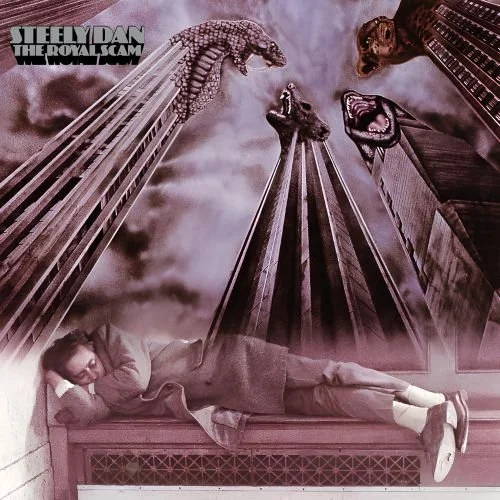
Steely Dan's The Royal Scam at Fifty
__________
WHEN we rank…
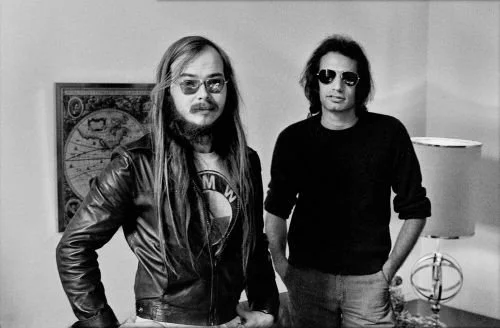
IN THIS PHOTO: Steely Dan (Walter Becker and Donald Fagen) in London in May 1976/PHOTO CREDIT: Alan Messer
the albums of Steely Dan, where does The Royal Scam come? Many would probably have it in their top five, though I don’t think it gets as much love and attention as Aja (1977) or Pretzel Logic (1974). This was the album released a year before their masterpiece, Aja. Katy Lied of 1975 was a great album, though there are some sound issues stemming from a faulty DBX noise reduction system used during mixing. That had been rectified for The Royal Scam. Perhaps the best-known song from The Royal Scam is its opening track, Kid Charlemagne. Released on 31st May, 1976, I want to mark fifty years of this classic. There is not a tonne written about it, though it is still worth exploring and spotlighting. I do want to get to some reviews of The Royal Scam. However, I will start with this interview that was published in Melody Maker in June 1976. Steely Dan were in London at the time. Donald Fagen and Walter Becker discuss their careers in general, but also they were asked specifically about the newly-released The Royal Scam:
“Donald Fagen and Walter Becker are living proof that intelligence is still regarded with suspicion in rock and roll. I confess it annoys me that they are more persistently categorized as “oddballs” and “smart asses” rather than considerable songwriters, which is what they are, because rock music and literary qualities are still held to be incompatible even by those who write about rock. Or so it seems.
Yet I suppose that, ultimately, Fagen and Becker, progenitors of Steely Dan, have only themselves to blame for insisting upon erudition and references drawn from jazz, Latin and classical music, as well as pop, whilst concealing it all beneath shiny music that can demand very little beyond an acquiescent toe unless one wishes it; for the supreme irony of Steely Dan, with whom irony as a device is second-nature, is the apparent equanimity with which they go about being most things to all men and everything to a few.
Probably, as they are children of the Sixties (Fagen is 28, Becker 26), it was inevitable that they chose rock as their creative field, but just as predictable, given their tastes and ambitions, that they would thereby appear conspicuous to those who did want more than to tap a toe. As Becker says himself, “if we were novelists dealing with the subject matters of our songs… our thematic concerns would not stick out as much.”
Those concerns are the most wide-ranging within rock writing, and have become the subjects for more interpretations than songs by any other artist since the Dylan of the period leading up to John Wesley Harding. Not usually very specific — the most recent album, The Royal Scam, is the least difficult of the five — they range from the typically black little tale of a compulsive loser (“Do It Again,” the hit single from the first album, Can’t Buy A Thrill) to the grandly worked title track of Royal Scam, which in three verses encapsulates an epic story of Puerto Rican settlement in New York.
The extent of their ambitions for these songs is illustrated by Becker’s statement that on “The Royal Scam” they were trying to catch the inflection of the King James Bible (in fact, there’s perhaps an echo of the 107th Psalm, “they wandered in the wilderness in a solitary way,” in the song’s chorus line “And they wandered in from the city”).
Nothing if not carefully constructed, their writing does not flow along with Dylan’s stream-of-images; it relies upon nuance, upon literary style and the suggestion of atmosphere in a novelistic manner far removed from the traditional workings of the pop song.
In lyric terms, very few writers in rock — perhaps Randy Newman, Robbie Robertson, Joni Mitchell — are working as consciously towards the aesthetic experience; for a start, there is nothing in the whole of Becker-Fagen’s output that is overtly autobiographical, which, because there’s nothing except for the songs themselves to which the audience can relate, helps explain why Steely Dan seems so faceless.
During the following interview with them in London recently, where they were on a working holiday looking at studios, Fagen suddenly broke off at one point to make the observation that reggae music, he had just realised, was very much like German band music.
This precipitated a rapid exchange of views between himself and Becker, who then went on to develop a theory of his own that the sound quality of English rock music was dictated by the humidity.
The last two albums have taken two years to appear, partly because of specific technical problems that tax the perfectionists in them, and there has been no touring in that period.
Nor will there be — in Britain, at least — until next year, since there are contractual problems with ABC that necessitate the delivery of two albums by January 1977.
“Caesar wants a record every three months, it turns out, so we have to render unto him before we can render unto the concertgoer,” describes Becker.
However, they have never been very happy performing, anyway.
They claim that in the early days of Steely Dan they were “coerced” into extensive performances with ill-prepared bands, although they were satisfied with the line-up that played here in 1974.
Even that trip, though, was marred by Fagen’s problem with his throat, for which he says he was wrongly treated by a Harley Street doctor and had to seek medical help in California.
Fagen still lives in California — precisely, in Malibu, and within hailing distance of Becker; but it does look as if the next album will be cut somewhere in Europe.
This interview was recorded one recent afternoon in London at the Montcalm Hotel, where both they and the Rolling Stones were staying.
I was amused that they had conveyed the message, through ABC, that the conversation had to be conducted “on a certain intellectual level,” for Fagen was once to exclaim, “this is really serious! Jesus! It’s only rock and roll.” Perhaps the Stones next door were at the back of his mind.
Gary Katz, a drawn, bony man, sat mostly in silence throughout, while Fagen slumped down in an armchair behind his shades and delivered his replies unsmilingly in an adenoidal New Jersey accent.
Becker perched himself on the edge of his chair, from which he could better twinkle in his inimitably sardonic fashion.
I had been informed by the press office that they had been woken up one morning at 4 a.m. by Keith Richard playing Katy Lied.
“Apocryphal,” Fagen replied shortly. Their answers generally, I found, were just as succinct and scholastically phrased…
Do you see a specific mood for each album?
Fagen: You know, I don’t listen to them after we’ve made them. In a restaurant the other night some guys from the record company played it while we were eating, some old record of ours, and it sounds like some other group to me, really, in a lotta ways.
Becker: We do try to put together a programme of songs that somehow hangs together.
Fagen: But mostly that’s things like tempo.
Becker: Yeah, not in terms of themes, really.
Fagen: In other words, we don’t wanna have too many songs with a very moderate tempo on one album; we like to break up the musical flow. But lyrically we feel we write the songs and the album will take care of itself.
We sequence for sound rather than for narrative potential; we sequence for how it affects the ear, rather than cerebrally.
Katz (entering the conversation): There’s no concept. Never.
Fagen: Chance is very important to an artist, you know. Dostoievski wrote in installments for magazines, and I’m sure he wasn’t aware of the entire flow until it was all together.
You know, if there is a lyrical unity to each album it’s simply because most of the songs on each album are written in a certain time period, and naturally a certain phase of our personalities would be prominent while the songs were written, and that would give it a lyrical unity, certainly.
There’s not usually more than two or three songs that were written long before we start recording them.
Let me ask you about individual songs, beginning with those on The Royal Scam.
Fagen: We don’t have to answer anything, but take a stab at it.
‘Kid Charlemagne,’ for instance — could that be about a Leary or a Manson? Am I in the right direction?
Fagen: You’re on the right track. I think it would probably be about a person who’s less of a celebrity than those people.
Did you have a definite person in mind?
Becker: Well, there is a particular individual, whom we naturally can’t name…
Fagen (straight-faced): For legal purposes.
Becker: …who hovered over the creation of the song like a sword of Damocles, like Hamlet’s father. Basically, it’s a chef.
A chef?
Becker: Cooks.
Katz: Master cooks.
Becker: Chemists.
‘Sign In Stranger’ — that’s almost like a school for gangsters?
Fagen: That’s true. Of course, it does take place on another planet. We sort of borrowed the Sin City/Pleasure Planet idea that’s in a lotta science fiction novels, and made a song out of it. But, indeed, you’re right.
Turning to the last album, Katy Lied — is that a praying mantis on the cover?
Becker: It’s a katydid. They may not have them here, or they may not call them that, but it’s a little bug that looks like a grasshopper, except that it has larger translucent wings. It makes a sound that is onomatopaeically rendered as “katydid.”
How about the phrase “Lady Bayside”?
Becker: Aah! In Queens, New York, there is a community called Bayside, where I culled numerous members for my first rock and roll band, and Bayside had a particular character to the community, which ranged from politically, rabidly conservative to absolute congenital mind-damage among its younger citizens. So the young women growing up in this community had a particular kind of character.
Fagen: It would be kind of like saying Lady Knightsbridge.
Becker: It may not mean anything to anyone but me, but lit sounded good.
Is ‘The Royal Scam‘ about Puerto Ricans trying to settle in New York?
Fagan: Because the interpretation is so accurate I wouldn’t even want to comment any further.
Becker: In other words, you already know more than is good for you.
Fagen: To tell you the truth, we tend to refrain from discussing specifics as far as lyrics go, because it is a matter of subjective interpretation, and there are some things that are better that man does not know. You are on the right track, and whatever you make of it will suffice. Really.
Why do you find you need so many guitarists. There are five on Royal Scam.
Becker: Just to keep it interesting. We’re constantly trying to expand the number of musicians that we think will fit into what we’re doing. It’s more fun for us to have different musicians.
How does Denny Dias like that?
Fagen: Denny is an extremely tractable human being.
I presume Jeff Baxter was not.
Becker: He was less tractable by a good margin, although he was an exceptionally good sport about what we were doing, always, and extremely co-operative with us.
I also presume his problem was you weren’t touring.
Becker: That was one problem. Another problem had to do with money, in that being a member of Steely Dan was tantamount to a kind of enforced poverty at that time. And there were musical things.
Fagen: It was always a compromise.
Do you tend to be martinets, then?
Becker: I wouldn’t put it that way. Good grief! Perhaps you would care to re-phrase the question. I know you can do better.
Katz: It’s their show.
Becker: What we try to do is nudge very, very competent musicians into doing something extraordinary, even for them.
Fagen: A musician will come in and see some of the changes we got, and he’ll go, “Mmm. This is some sort of music here!”
Are you thinking of recording here?
Fagen: We’re looking at some recording studios here. We may.
Is it just because you want a change of scenery?
Fagen: That’s just about it, yeah, really.
Becker: Well, actually, our main motivation in coming was that we might pick up some inspiration, or stimulate some provocative vision or experiences or feelings”.
Let’s get to a couple of critical reviews for The Royal Scam prior to rounding up. I am going to lead with Sputnikmusic and their 2021 review of the incredible The Royal Scam. I had never really thought of this album as an especially ‘fun’ one, but it is an interesting point to make. It has a different energy to Aja, that is for sure:
“The Royal Scam is affectionately referred to by fans as the duo’s “guitar album”, and for damn good reason. As with previous Steely Dan releases, this one shows yet another facet of their core jazz-rock sound: guitar-driven funk. Prior records had their funky moments as well, but they were never featured quite as prominently as they were here. More importantly, as is the case with funk rock in general, the chemistry between the guitar and the rhythm section is crucial to the quality of these songs. Luckily, the lineup of guitarists featured on The Royal Scam is absolutely fantastic. There’s Larry Carlton as I previously stated, but there’s also the return of legendary Steely Dan alumni Denny Dias, Elliott Randall (remember that amazing guitar work on “Reelin’ in the Years”?), and Dean Parks. Add Walter Becker himself to the mix and you’ve got an amazing all-star cast.
But of course, they’re all used in the service of these amazing tunes. “Kid Charlemagne” might be an incredible opener, but what it really does is give us a taste of just how eclectic and crazy this record really is. Despite being more funky in nature, this might also be one of the most diverse tracklists the group ever put out; jazz, pop, funk, hard rock, progressive rock, and a hint of blues can all be found on the album. In fact, just after the opener, we get a complete change of pace with the horn-driven number “The Caves of Altamira”; the song marries a story about the genesis of creativity and expression with an arrangement that only gets more complex as it goes on. Lots of jazz, of course, but also a hint of R&B in the verses and some prog in each post-chorus. Meanwhile, “Don’t Take Me Alive” might just be one of the most hard-rockin’ Steely Dan numbers; Larry Carlton’s lead guitar work absolutely tears it up on this fast-paced number, perfectly complimenting the dark lyrics about a criminal who’s killed his own father and wants the cops to shoot him. How pleasant!
And the stylistic contrasts continue. But it’s not like any of this detracts from the cohesion and focus of the record. If anything, each song is like its own unique extension of the Steely Dan style while still very much being in the Steely Dan style. This is perhaps best represented in some of the album’s deeper cuts, most notably “Haitian Divorce” and “The Fez”. The former is a song that I never would have expected to enjoy; I’m not much of a reggae fan as it is, so I wasn’t really excited about the prospect of a Steely Dan song using rhythms and guitar leads reminiscent of the genre. And yet, it somehow works! I think the band’s infusion of jazz into the mix, as well as the haunting and melancholic chorus, are really what pull it through in the end. Those backing vocals in the chorus are just lovely, and they only make the song even darker and more atmospheric than it already was. “The Fez”, however, is an interesting experiment for the duo as well. The music covers pretty familiar funk rock rock territory, but the lyrics are quite minimalistic. “No I'm never gonna do it without the fez on; oh no!” is repeated as if it were a mantra, while the strings in the background make you feel as though you’re in a 70s cop show. Honestly, it’s fun as hell. And it culminates in the beautiful jazzy harmonies that make up the chorus.
If I had to give a label to The Royal Scam, I'd say it’s probably Steely Dan’s most “fun” album. The energetic funk-inspired sound is just a blast, and the incredible roster of amazing guitarists just makes it even more exciting. Additionally, with the lens of hindsight, you can definitely tell that it was the immediate precursor to Aja. While it’s a lot funkier and more fast-paced than its successor, The Royal Scam was even more drenched in jazz influence than its predecessors and paved the way for songs like “Black Cow” and “I Got the News”. Simply put, this album absolutely rocks and I can’t give it a higher recommendation. But if you put it on, just make sure to turn down The Eagles; the neighbors are listening”.
Let’s round off with Pitchfork and their 2019 review. It has been great learning more about The Royal Scam. A Steely Dan album I have not investigated as much and deep as many of their others, I am now compelled to correct that. As it turns fifty on 31st May, it is a good time to reacquaint myself with The Royal Scam:
“Although Scam was Steely Dan’s slickest album to date, it was also, in some ways, their ugliest. Its arrangements are a jungle of Rhodes stabs and the most aggressive—and finest—guitar work on a Steely Dan album since 1973’s Countdown to Ecstasy. On “Don’t Take Me Alive,” Larry Carlton seems to take up most of the space, snarling, feeding back, advancing the simmering tension at the song’s stakeout (in a 1979 radio interview, Gary Katz said they’d directed the guitarist to play as “nasty and loud as possible.”) In “Sign in Stranger,” Elliott Randall’s erratic guitar breaks jostle for space with Paul Griffin’s bluesy piano—hard-bop comping in double-time. Together, they seem to mimic the crooked vendors vying for customers in the song’s marketplace, which Fagen claimed to have modeled on the “Sin City/Pleasure Planet” trope from some of his favorite sci-fi stories.
Techniques like these illustrate how Fagen and Becker pushed the music on Scam to feel as grotesque as their words—to be vignettes musically as well as lyrically. This tendency toward the theatrical is most apparent in the album’s queasy emulations of reggae and Carribean music. “I think Duke Ellington’s whole exotic jungle trip contributed a lot to our tropicality numbers,” Fagen told Melody Maker in 1976. “It’s an idealized, exotic atmosphere...Showtime, Ricky Riccardo stuff. More I Love Lucy than Bob Marley.” There is the rock-steady backbeat of “Sign in Stranger,” with a closing horn line that sounds like Cuban jazz pouring in from somewhere outside of the song.
On the more extreme side is the white elephant in the room: “Haitian Divorce,” complete with an intermittent Jamaican accent and a talkbox-treated guitar that sounds like Charlie Brown’s teacher. Allegedly inspired by tracking engineer Elliot Scheiner’s attempt to finalize a divorce in a matter of a couple of months through a Central American loophole, it was a cinematic bit of storytelling, and Fagen and Becker framed it explicitly as such: “Now we dolly back/Now we fade to black.” It would be easy to write off as a misguided aberration if it didn’t rank among the record’s musically inspired moments: The song’s central modulation when the backing vocalists enter makes for one of the most satisfying chorus drops they ever recorded. It was also the band’s highest-charting single in the UK to date.
The song is a microcosm of what makes The Royal Scam both singular and frustrating: a combination of sharp songwriting, a resourceful approach to narrative, piss-take musical references, and willfully poor taste. More than on any album they ever released, Fagen and Becker foregrounded their jarring stylistic pivots, tying them directly to their lyrical scenarios; Aja and Gaucho, on the other hand, would create a sleek musical surface that functioned just as well apart from the sordid narratives. The Royal Scam is the Dan album where the music doesn’t allow the listener to escape the mindset of its characters and their stories’ grim implications: real progress is rarely possible, and we are doomed to repeat our worst behaviors over and over again.
Nowhere on The Royal Scam does this feel more apparent than on the title track and closer, a plodding epic about Puerto Rican immigrants in New York City. With little in the way of vocal melody, verbose phrasing inspired by the King James Bible, and a beat that never really seems to kick in, it sounds like a smooth-rock version of what it might have felt like to row a Viking warship. It is based around harsh melodic cells traded back and forth between Fagen’s Rhodes and Carlton’s guitar, with a few solo horn interjections. The motifs feel oddly mechanistic—a process that never gets anywhere. The corruption and abuse that crop up throughout the rest of the album descend on the undeserving populace. “The Caves of Altamira” may be about a loss of idealism, but we never see the fallout; here, Fagen and Becker shove our faces in the characters’ dashed dreams. In the album’s final moment, they perpetuate the scam they fell victim to like a game of telephone, crafting fabricated success stories for their relatives at home: “The old man back home/He reads the letter/How they are paid in gold/Just to babble in the back room/All night and waste their time.” By all indications, the cycle of hope, subjugation, and destruction will begin again”.
A typically distinct Steely Dan masterpiece, go and listen to The Royal Scam. Although the cover is awful – they had a habit of putting our particularly dreadful covers! -, don’t let that put you off! The music contained within is up there with the best released in the 1970s. The Royal Scam continues to reveal treasures…
AFTER fifty years.