
FEATURE:
Independent Women Pt. II
Destiny's Child's Survivor at Twenty-Five
__________
ALTHOUGH not my personal…
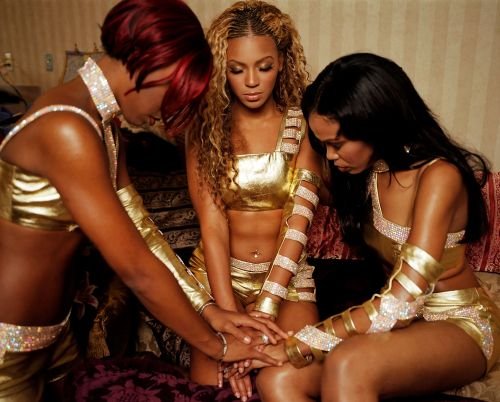
IN THIS PHOTO: Kelly Rowland, Beyoncé and Michelle Williams sayiong a prayer backstage before a gig/PHOTO CREDIT: Gillian Laub via Vanity Fair
favourite Destiny’s Child album (that would be 1999’s The Writing’s on the Wall), I think that their very best is 2001’s Survivor. This was with the classic and definitive line-up of Beyoncé, Kelly Rowland and Michelle Williams. It was released on 1st May, 2001, so I wanted to mark twenty-five years of this classic. I do think that this is one of the most underrated albums ever. I guess there is a lot of controversy around the album. The departure of Destiny’s Child members, LeToya Luckett and LaTavia Roberson, who exited the group in February 2000. A lawsuit that was filed. How was contention around some of the lyrics and song conceptions. Some critics liking the thematic impact but dismissing the lyrics. Some saying how it was a calculated record and Survivor lacks the joy of some of the very best Pop and R&B albums. I would disagree with that. I feel Survivor is an empowering work. Vincent Anthony from The 97 said Survivor was responsible for "unbiasedly [melding] R&B inspirations and hip-hop nuances into an [sic] unique brand of pop that defined the early 2000s”. I am going to come to some features around Survivor. In 2021, Stereogum marked twenty years of Survivor. They talked about the personnel shifts in Destiny’s Child and some of the controversial and, let’s say, classless moments on the album. However, there are huge strengths and this legacy that has remained. It is arguable that, without Survivor, Beyoncé would not have become the huge name and icon that she is now:
“First to be eliminated were original members LeToya Luckett and LaTavia Roberson. With lead darling Beyoncé being nudged closer into the spotlight, Luckett and Roberson questioned the disproportionate monetary ethics of Destiny's Child manager and Beyoncé's father Mathew Knowles. Rumors also flew that So So Def Recordings R&B group Jagged Edge were causing a rift between the girls, courting Luckett and Roberson while on tour with Destiny’s Child. After loyally following Mathew's acumen as teenagers, the two were blindsided when they learned they had been replaced upon seeing new members Michelle Williams and Farrah Franklin in the technicolor music video for 2000 hit "Say My Name" -- no matter that Luckett and Roberson’s backing vocals on the song remained unchanged and the two dismissed members were still pictured alongside Beyoncé and Kelly Rowland on The Writing’s On The Wall’s futuristic album artwork.
In a 2001 New York Times article, journalist Diane Card Well scathingly dismissed the banished duo: "But the reality of Destiny's Child is that Beyoncé is the magnet. The band originally had four members, Beyoncé and Kelly and two other girls, but it was always a Knowles-family operation, with the family's fair-haired daughter in the spotlight." Replicating the 1960s-era Motown girl group formula of centering one woman à la the Supremes, Mathew Knowles' strategic ambition made Beyoncé the focal darling of Destiny’s Child.
Having experienced brief success as a medical equipment salesman from shortly before marrying fashion guru and soon-to-be Headliners salon owner Tina Beyoncé, Knowles quit his day job once discovering his first daughter's superstar determination. Upon starting Music World Entertainment in 1992, Knowles primed the teenyboppers, then known as Girls Tyme, with harsh critiques and drill instructor tactics. His wife -- once part of high school harmony group the Veltones -- dutifully assisted in fulfilling his family’s vision as wardrobe designer, styling the group’s hair and allowing them to practice at the Headliners shop. With brewing nepotism, the Knowles family operation seemed to have been planned before Beyoncé and younger sister/polyhistor Solange were even born.
Rowland became an unofficial adopted sister, living with the Knowleses for 11 years when her mother was unable to drive her to frequent rehearsals. After a brief stint studying criminal justice and accounting in college, Williams was working as a backing vocalist for R&B singer Monica when she met Beyoncé and Kelly in an Atlanta hotel in 1999, not long before Destiny’s Child began secretly vetting new candidates for the group. "As the new member, I was being protective over the girls because I was just starting to know them," she told Entertainment Weekly in 2016 while also shrugging off any perceived drama or injustice regarding the lineup switch. "There are member changes in groups all the time," Williams continued. "Things happen. I believe in the journey Destiny’s Child had to take to fulfill the group’s mission: to continue to empower everybody."
The sisterly image of Destiny’s Child was wholesome, but keeping up with Mathew’s regimen was tough. As he authoritatively drove Beyoncé into becoming pop royalty, the remaining members also caught the heat; Franklin abandoned the group just five months after being initiated, citing "dehydration." Knowles, Rowland, and Williams were once again without a fourth member, but the trio decided not to seek wannabe prospects that couldn’t keep up. With Williams' gospel-oriented rasp, Rowland's mezzo-soprano stamina, and Knowles' epic octave range and unparalleled showmanship, Destiny's Child met their full potential.
On their third album Survivor, which turns 20 this Saturday, Destiny's Child had another chance to prove their staying power. The Writing’s On The Wall was largely a flippant kiss-off to male suitors on tracks "Bug A Boo," "Bills, Bills, Bills," and "Jumpin', Jumpin'." Survivor encompassed the maturation of Destiny’s Child through girl power anthems, humbling ex-group members, and pompous body-positive messages, all while trading the '90s hip-hop and R&B tendencies of their first two records for a more tech-y sound in keeping with Fanmail, Aaliyah, and The Heat. It was like Destiny's Child were finally making a statement.
While Destiny’s Child was arguably the most important girl group of the 21st century, they were still victims of racist microaggressions in pop music. Prior to The Writing's On The Wall, in a 1999 issue of Maxim, the group’s forenames were blasted for not being ‘sensible’. Being Black women in a pop lane forced them to take a backseat to white bubblegum acts like *NSYNC, Britney Spears, and Christina Aguilera. During press runs, Destiny’s Child were burdened with discriminatory questions, which Beyoncé rehashed during a 2001 interview with pop culture magazine Interview: “We did an interview yesterday, and a woman asked us, "Where did you meet? In the ‘hood?"
Destiny’s Child made ‘the hood’ their playground on salacious track "Bootylicious," where the group teasingly cooed at suitors who weren’t ready for their "jelly." The track confidently rode a slowed-down guitar riff from Stevie Nicks’ 1981 hit “Edge of Seventeen,” and the former Fleetwood Mac member-turned-rock goddess even made an appearance in the song’s tantalizing visuals. An ode to their voluptuous, Southern-bred curves, “Bootylicious” solidified Destiny’s Child as bolder, more salacious pop artists.
However, Survivor wasn’t without its poor moments. The tone-deaf, Salt-N-Pepa-interpolating “Nasty Girl,” which was released as the album’s fifth single but failed to chart in the US, arrogantly slut shames “classless” women with “booty all out, tongue out her mouth/ Cleavage from here to Mexico.” The hypocritical track arrived over a decade before Yoncé sang about getting “Monica Lewinski'd all on my gown,” but in 2001, Destiny’s Child was a ripe act who weren’t even of the legal drinking age. With appearances at the Nickelodeon Kids Choice Awards and 12-inch Hasbro Barbie Dolls that immortalized their likeness, to maintain their pop star status, Destiny’s Child had to fulfill PG-rated expectations instead of being deemed as raunchy Black women. That strategy also apparently involved appealing to millennial teenagers’ baby boomer parents; during a moment of softness on Survivor, the group covered Samantha Sang's 1978 disco hit "Emotion," penned by the Bee Gees' Barry and Robin Gibb.
Destiny’s Child also took catty jabs at Luckett, Roberson, and Franklin throughout Survivor, including on the snide “Fancy” and the album’s war-ready title track. When a radio DJ jokingly compared membership in Destiny’s Child to the CBS TV series Survivor, the hot new reality show of the moment, the group reframed the comparison as a positive, delivering a battle cry in which they gloated about their ascension despite tension from ex-members. The song also served as a showcase for newcomer Williams, who had an earnest vocal standout over a riveting string section. Although Luckett and Roberson later filed a lawsuit against Beyoncé, Kelly, and Mathew, in the public eye “Survivor” worked as graceful public closure amid the girl group hostility, winning Best R&B Performance by a Duo or Group with Vocals during the 2002 Grammy Awards”.
I acknowledge that there are some problems with Survivor and some weaker tracks. Dogged by some controversy and rifts between the departed members and the remaining trio. It does not take away from the brilliance of the overall album I feel. I will come to Vibe now and their 2011 feature on Survivor. Marking fifteen years of this incredible album:
“While the May 1, 2001 release wasn’t DC’s best album in terms of lyrical content, it was a seminal force in the female empowerment trend of the 21st century, serving as a love letter to body-positive, independent and fierce women all over the globe. Additionally, Survivor serves as the pièce de résistance in the group’s opulent-yet-turbulent few years in the limelight. While the group seemed to finally be set in stone, a brief hiatus soon after the album’s release signaled some major changes to come.
The album’s title track serves as a kiss-off to the group’s former members, La’Tavia Roberson, LeToya Luckett and Farrah Franklin. To critics and fans alike, it seemed as though DC’s ship was sunk after yet another line-up change in 2000. However, the song “Survivor” proved that negative notions and odds stacked against the girls only made the newly-solidified group more secure in their bold sound and look. As sung in the song, the three ladies planned on working harder and making music that could survive the industry and the test of time.
The album’s overall purpose, however, was to do what most girl groups aim for- to empower other women to be confident in their personal independence, individuality and femininity. “Independent Women Part I” celebrates the women who can buy their own diamonds and can pay their own bills sans man. It was so powerful, in fact, that it served as the theme song to the film centered around strong and confident women, Charlie’s Angels. “Fancy” discusses how certain women (who “know who they are”) need to stop swagger jackin’ in order to find their own sense of identity. “Bootylicious” turns the distinct rock riff from Stevie Nicks’ “Edge Of Seventeen” into a call-to-action for women to own their sexuality, curves and jelly.
Aside from the lusty serenades about irresistible men you’ll likely hear from an all-female act, the album also highlights DC3’s flexibility in experimenting with R&B, pop and gospel infused-sounds. The ladies put their spin on the timeless Bee Gees track “Emotion,” while “Gospel Medley,” acts as a modern take on the hymn “Jesus Loves Me.” “Independent Women Part II” is (lyrically) almost the same song as the album opener, however, different background music gives the song a whole new flavor, showing the group’s versatility within the genre.
Although the album was commercially successful (it was certified 5x platinum in the U.S.), there were rumors that things were still not copacetic behind-the-scenes. Beyonce had song-writing credits on almost all of the songs and had many of the lead singing parts, which allegedly led to jealousy among Kelly and Michelle. There was no denying that Bey was the star of the album, so it’s understandable why the group focused on individual music careers before re-uniting for 2004’s Destiny Fulfilled. Although the latter attempted to give each member their shine and was more advanced in terms of production and content, it was inevitable that the trio had to go their own ways in order to truly have their own musical and personal freedom.
Survivor is the kind of album Destiny’s Child needed to produce to catapult them to girl group superstardom. It was the kind of album they needed to produce to change the conversation about feminism in the music industry. It was the kind of album they needed to produce in order to showcase that they were “independent women” capable of being on their own as musicians. All three had different styles as singers and performers, so they needed to capitalize on their strengths in their own ways. It was bittersweet to see Destiny’s Child disband, but we got several solid albums amidst the closeted chaos. If they could survive the tumultuous early years of being in a girl group, they could surely survive the industry, and as time has shown, these ladies are surviving in their own right”.
There are reviews and features that counter Survivor is a messy album. A Pop album. And not a very good one. However, I am going to end with a positive review that states, whilst 1999’s The Writing’s on the Wall was shady and male-bashing (I feel it took scrubs and no-good men to task and was about empowerment), Survivor takes a different – and more positive – direction:
“Long before Kelly aired her “Dirty Laundry,” before Michelle had a Journey to Freedom, and before Beyoncé turned her lemons into Lemonade, Destiny’s Child at just 19 and 20 years old stepped out as voices of empowerment for our generation.
It’s hard to believe two decades have passed since Destiny’s Child released their iconic Survivor album. It is amazing to think back to that time, and that album, as a fan and reflect upon how much has changed since.
When the group released Survivor, they were hot off the success of their biggest hit to date, “Independent Women Part 1” (the soundtrack to the hit movie Charlie’s Angels), the massively successful The Writing’s on the Wall era, and had cemented their second and final lineup: a trio, consisting of Beyoncé, Kelly, and Michelle, rebranded as DC3.
The drama surrounding the group only added to public interest in them, and the Survivor era had a phenomenal start. Prefaced by an 11 week long #1 in “Independent women,” the set was lead off by its title track which hit #1 on Airlay chart and #2 on the Hot 100, fended off by Janet Jackson’s “All For You.” However, redemption came quickly and in competition with yet another diva who inspired the trio: Mariah Carey. The Stevie Nicks sampling “Bootylicious” hit the pole position, edging out Mariah’s “Loverboy” (we won’t go into the nasty details on how Mariah’s ex made this event swing in DC3’s favor). Subsequently, Survivor debuted at number one with over 663,000 copies sold. For its final single in the US, the trio chose a cover of The Bee Gees-penned “Emotion,” which peaked at a modest #10.
While it was a bit of a short-lived era in its present, Survivor has endured as a defining moment in the ladies’ careers. The Writing’s on the Wall opened the door to their “male bashing” songs, Survivor took a turn in a different direction instead. The album was empowering rather than shady like its predecessor. It marked the beginning of a career of empowerment for the ladies of Destiny’s Child.
While the album itself was by no means an innovative artistic masterpiece, it is still a pristine example of pop perfection. It unbiasedly melds R&B inspirations and hip-hop nuances into an unique brand of pop that defined the early 2000s. There was something that set DC3 and Survivor apart from its competition, though: its content and message.
The album deals with a variety of topics: obviously empowerment (specifically female), independence, body image (“Bootylicious”), self esteem (“Happy Face”), hate (“Fancy”), over-sexualization and perception (“Nasty Girl”), sexual abuse (“The Story of Beauty” – written by Beyoncé based on fan mail DC3 received), friendship (“Thank You”) and of course, love – and surviving heartbreak.
It is because of this that Survivor resonated with millions of fans that have stuck by Destiny’s Child ever since – like me. Of all the late 90s, early 2000s Pop groups Destiny’s Child’s legacy is by the far the most long lasting and beloved. If the ladies announced a proper reunion today, undoubtedly it would yield tremendous success. Why? Because fans have such a strong connection to this group. They may have retired, but the love between them has survived. There is no pretense, there is no need for a reunion for the sake of their careers. Of all their Pop group peers, only Destiny’s Child’s members have found notable success with their solo ventures. When they reunite it is out of pure love; and love conquers all.
Their iconic status was cemented with their 2004 comeback, Destiny Fulfilled, but Survivor was really their defining moment. It was the springboard to the success that came for all three of them. The sisterhood that was established with Survivor is perhaps the best aspect of it all. For millions of young girls, Destiny’s Child was the example of a strong sisterhood. For millions of people, period – Destiny’s child is a symbol that no matter what life throws at you, you can survive it: “After all of the darkness and sadness, still comes happiness. If I surround myself with positive things, I’ll gain prosperity.” Indeed, they did, and by doing so, showed millions of people that they can too. This message has endured two decades, and will for sure last for many, many more. So, put your fist up and celebrate that you, too, are a “Survivor” today.
I am going to leave it there. I wonder if Beyoncé, Kelly Rowland and Michelle Williams will say anything about Survivor on 1st May on its twenty-fifth anniversary of whether they do not have particularly fond or lasting memories of that album. There is always this curiosity as to whether they will perform together again or record another album. It would be incredible if they toured or did another show, as they have this incredible bond. That is evident through Survivor. Though not a perfect album or one without flaws or controversy, I think that it is…
WORTHY of more respect than it has received.