
FEATURE:
Tonight’s the Night of the Flight
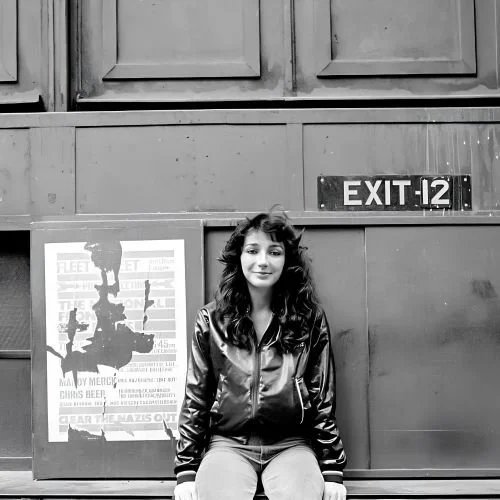
IN THIS PHOTO: Kate Bush in 1981/PHOTO CREDIT: Janette Beckman
Kate Bush and a Turbulent British Summer in 1981
__________
I have looked inside…

IN THIS PHOTO: Kate Bush in 1981/PHOTO CREDIT: Clive Arrowsmith
Kate Bush’s 1981. Rather than discuss the entire year, I do want to focus on the summer of 1981 and events later in the year. In the spring, in May 1981 in fact, Kate Bush was fully immersed in recording The Dreaming. As we can see from this timeline, May was quite an important month: “Kate goes into Townhouse Studio with Hugh Padgham as engineer to begin the recording work of The Dreaming album. The backing tracks for three songs are put down before Nick Launay takes over as engineer. In a session that lasts until the end of June more backing tracks are laid. Kate is tempted by the offer for her to play the Wicked Witch in the Children's TV series Worzel Gummidge, but she is already too far involved in the album and has to turn down the offer”. I have brought in this snippet in for a recent feature, but I did want to stay in 1981. It is nearly forty-five years since race riots took place in Toxteth. Rather than look at the whole year, I will focus on the summer and where she was when recording The Dreaming. I am going to end on an interview that is worth re-exploring. In July 1981, there was civil disturbance in Toxteth, inner-city Liverpool, which arose in part from long-standing tensions between the local police and the Black community. I think that the summer of 1981 was a very rocky and turbulent one in the U.K. Social unrest and with riots happening and there being this sense of disruption and disorder in the air, it must have been a horrible time. Some artists reacted to the riots and what the realities were. The Specials’ Ghost Town was released in June 1981. Exploring themes of urban decay, deindustrialisation, unemployment and violence in inner cities, Ghost Town was a hit around the time riots were incurring in the U.K.
Thinking about Kate Bush, the summer of 1981 was one where she was tucked away in the studio. By May 1981, sessions for The Dreaming decamped to Townhouse Studios. I am looking inside Graeme Thomson’s Under the Ivy: The Life and Music of Kate Bush. Most of The Dreaming's backing tracks were recorded here over a period of three months. Bush played Fairlight CMI and piano on almost every song. David Gilmour added backing vocals. Del Palmer or Jimmy Bain on bass. Preston Heyman and Stuart Elliott on drums. It was, as Thomson notes, “an album defined by painterly overdubs”. As there was this turmoil and crisis happening in Britain, one of the country’s greatest artists was constructing an album. I had never considered whether the darkness and division that was seeping Britain in 1981 affected the tone and direction of The Dreaming. Bush saying that she was not a political artist and was holed up recording. She would have seen the news and heard about the riots. However, little of that is specifically channelled into songs. Even so, there is a thickness and smog. A haunting and heavy aspect to The Dreaming which may have come from the atmosphere around her. There was violence in London so, even if she was in studios out of the way, she was not too far from a lot of this violence. Sat in Your Lap was released on 21st June, 1981. Nick Launay came in as engineer after Hugh Padgham departed. The two had different ideas and directions. Padgham didn’t have a great experience. He tried to explain to Bush that if you have loads of layers of vocals and sounds then it hard to hear things. Perhaps feeling she was not that experienced or knew what she was doing, he was glad to hand over the reins. Launay was twenty and Bush twenty-two. They both clicked and it was a much smoother working relationship. What is evident about the summer of 1981 in terms of Kate Bush’s career was that she was still growing as a producer. There were a lot of takes and musicians doing the same parts over and over.
It may have seemed like one big noise. More refined or at least a little more stripped for Hounds of Love in 1985, The Dreaming was an album where Kate Bush put so many ideas into the pot. Musicians like Ian Bairnson (who played on Sat on Your Lap and Leave It Open) recalled how Bush was thinking more as a producer and using all these unusual sounds. July 1981 was an especially important month. Bush goes into Abbey Road Studios with Haydn Bendall as engineer to complete the backing tracks. Bush travels to Dublin to record Night of the Swallow with members of Planxty and The Chieftains. I did cover this in the other feature. Again, with unrest happening in the U.K., Bush was working on one of her greatest tracks. Night of the Swallow is perhaps the most extraordinary and accomplished song on The Dreaming. At one point recording the songs, musicians utilised all three of Abbey Road’s studios. It was a hectic and productive time. I think about the sense of this division and violence. Margaret Thatcher had only been Prime Minister for a couple of years. Kate Bush not really a political writer, she channelled her emotions and energies into songs that did have some bite and violence within. Maybe Pull Out the Pin is the closest example we get to a song that absorbs some of the U.K. riots. Though this song was set during the Vietnam War rather than the U.K. in 1981. You can see that a negativity or blackness lingering like storm clouds did impact The Dreaming. Even so, in the summer of 1981, she did record songs with so much beauty in them. Night of the Swallow is a classic example. At times, Bush struggled to keep track of what was being recorded. Becoming “lost in the in the woods of her own imagination” as Graeme Thomson writes, she was very stoic and took control. Leading up to Christmas 1981, Bush worked at home and changed lyrics; adding this and that, working on backing vocals and getting things into shape.
That summer must have been quite intense for everyone. Riots in July in Toxteth (Liverpool), Handsworth (Birmingham), Moss Side (Manchester), and Chapeltown (Leeds). Kate Bush, at the time, might have seemed a little blasé or rose above it. You know that it was affecting her or subconsciously influencing the direction of some of the tracks through The Dreaming. Night of the Swallow stands as this moment of beauty and wonder on The Dreaming. Not the only example, though it is one of Kate Bush’s greatest examples of her brilliance as a songwriter and producer. This is what she said to Melody Maker in October 1982 about Night of the Swallow:
“Unfortunately a lot of men do begin to feel very trapped in their relationships and I think, in some situations, it is because the female is so scared, perhaps of her insecurity, that she needs to hang onto him completely. In this song she wants to control him and because he wants to do something that she doesn’t want him to she feels that he is going away. It’s almost on a parallel with the mother and son relationship where there is the same female feeling of not wanting the young child to move away from the nest. Of course, from the guys point of view, because she doesn’t want him to go, the urge to go is even stronger. For him, it’s not so much a job as a challenge; a chance to do something risky and exciting. But although that woman’s very much a stereotype I think she still exists today”.
I am going to end with an interview that she gave to Record Mirror in 1981. Following my feature on 1981 and why it was this important period between Never for Ever (her third studio album was released in September 1980) and The Dreaming, it occurred that the summer of 1981 was a hostile and unsettled one in the U.K. Bush did say this in her piece for the KBC Issue 10 (Summer 1981): “I've been lucky enough to be tucked away in the studio through all the riots, and only catching the muggy weather in between sounds. I hope everything has been good for you during this summerless time. We all know that "things they are a-changing”.
Late in 1981, Bush did get a chance to relax a bit. Or at least find some sense of order and perspective. The summer of 1981 was especially busy and important. In terms of some of the songs she recorded and the stage she was at with The Dreaming. John Shearlaw spoke to Kate Bush for Record Mirror. The interview was published in September 1981. After a period of depression and drain following The Tour of Life in 1979 and recording Never for Ever, she was feeling more positive. Quite refreshing considering everything happening around her. Not only the riots that happened through the summer. Bush was also throwing herself into the album, and it must have been exhausting at times:
“My life has never been into money, more into emotional desires; like being an incredible singer or an incredible dancer; and if I can buy something that can help me, I will now. But I wouldn't buy something that I couldn't live with, like a country house which I don't need. [Actually, about two years after giving this interview, Kate bought--a country house.] I'd rather buy a huge synthesiser that I could live with all day."
She emphasises and explains, thinks out the question, returns to her theme. The easy answers have gone over the years. Take her career...
Kate maintains that there hasn't really been a gap, even though she admits that Sat In Your Lap only surfaced after her longest break to date.
"My slowness at doing things surprises me," she says, "but i have been doing things continuously. It's a battle to keep up with all the things I want to do, and obviously things like dancing are going to suffer. I couldn't spend twelve hours a day in a studio like I'm doing at the moment, and dance, as well."
Again the emphasis on her way of working--the only way. The ups and downs are of her own making, they don't follow rules. And Kate only bows to her own pressures.
"The last album was the first one that I would actually hand over to people with a smile," she says, almost seeming to imply that it was the first one she was actually pleased with, "and that was followed by a greater period of non-creativity, when I just couldn't write properly at all.
"It happened before, when the tour was over, and then I felt I'd just given so much out that I was like a drained battery, very physically and tired and also a bit depressed.
"This time it was worse; a sort of terrible introverted depression. The anti-climax after all the work really set in in a bad way, and that can be very damaging to an artist. I could sit down at the piano and want to write, and nothing would happen. It was like complete introspection time.
"I suppose I had about two months out earlier this year...and that was a break I really needed. It gave me time to see friends, do things I hadn't been able to do for three years.
"It wasn't really as if I was missing out on normality," she laughs. "I'd rather hang on to madness than normality anyway, so it was more like recharging."
But something more came out of it than just a rest?
"Oh yes!" The smile returns. "I felt as if my writing needed some kind of shock, and I think I've found one for myself. The single is the start, and I'm trying to be brave about the rest of it. It's almost as if I'm going for commercial-type "hits" for the whole album.
[I have always been struck by this statement. It seems to me to indicate that Kate really doesn't have a very sound notion of what is "commercial"--which is all to the good, of course. For if she felt that The Dreaming had a commercial sound, then some listeners's criticism that she seemed to have developed a calculatedly commercial sound for the next album, Hounds of Love, loses credence, since her mental image of "commercial" sound is so different from the sound of Hounds of Love.]
"I want it to be experimental and quite cinematic, if that doesn't sound too arrogant. Never For Ever was slightly cinematic, so I'll just have to go all the way."
The shock that Kate refers to, eyes almost ablaze as she uses the word, came months ago...after she started to work with a rhythm machine while she was writing.
"I'm sure lots of things that I'm trying to do won't work," she says, "but I found that the main problem was the rhythm section. The piano, which is what I was used to writing with, is so far removed from the drums. So I tried writing with the rhythm rather than the tune."
Sat In Your Lap, naturally, is the first fruit of the new approach--original (in that it could only be Kate Bush) marriage of pounding drum sounds and two layers of voice. There is a theme, but it's the rhythm that hits you first, blasting right through to the synthesised end--a step that she knows is likely to continue the critical division.
"I was really frightened about the single for a while," she admits. "I mixed the song and played it to people, and there was complete silence afterwards, or else people would say they liked it to me and perhaps go away and say what they really thought.
"Of course it's really worrying, because there's an assumption that if you're one of us, an artist, you don't need feedback at all, when in fact you need it as much as ever, if not more. I really appreciate feedback, and I'm lucky that the people closest to me, my friends and family, are used to me and realise that I've got my own 'bowl of feedback' to rely on."
And that's more important than the public reaction, or do you worry?
"There will always be some who are irritated by me. I seem to irritate a lot of people," she smiles, "and in a way that's quite a good thing."
Nor will the change stop there. Drums, Kate enthuses, are as wide a concept as music itself, and she's determined to go further than "a lazy acceptance of a drum kit." Add that to the news that she'll be working with other musicians on the new album--"the best around"--and it seems likely that "Kate Bush 4" will be one of the big surprises of the year.
As a preview she plays me one track that's currently being worked on: a wild soaring collusion with Irish group Planxty entitled Night of the Swallow, which also features one of the Chieftains. Again the sound is unmistakable, but this time it's Kate Bush married to the heartbeat of traditional Irish folk.
Discussing the project brings Kate Bush into larger-than-life focus once more. The burning enthusiasm returns, along with the string of "amazings", "incredibles" and "fantastics". She'd been up all night in the studio the previous night in Dublin, and her reactions are genuine, real and hard to resist.
"I'm still really up from the experience," she says. "In fact, I'm still reeling from it. I asked them if they'd be interested, and the whole thing was so relaxed, it was wonderful. I badly want to work with them again. I'm so excited about the fusion.
"And I think that there's so much of the Irish in my mother that it all suddenly came back to me--it was fate rearing its head at just the right time!"
So that's two surprises already, and although Kate has been making demo tracks since March, and Abbey Road is now her second home, the rest will have to wait until summer completion...if all goes according to plan.
What about the book you're planning to write, though? Again, she sighs (a marginal sigh) and repeats her line: "There's so many things I want to do, and it's so hard to fit them all in..."
But yes, a book is on the cards, hopefully before the end of the year, and she says: "I'd like to write it myself. Without saying anything about the other books, which I don't want to, I feel almost pressured to speak, otherwise there's this huge misrepresented area.
"In one way it's ridiculous--I feel it's much too early to write a book, I've hardly done anything yet. But I really want people to be aware of reality--subjective reality, obviously.
"It'd be about what it's like being me, my feelings, my friends, the people that I rely on. I need to be represented in a positive way, and I'll have to do it myself."
[This book, tentatively titled Leaving My Tracks, was shelved in 1984.]
Slowly Abbey Road is beginning to wake up for another Kate Bush day that is likely to last until the early hours of the next morning, and she announces candidly: "I'm beginning to feel like shit. Ireland's catching up on me. And all the things that have to be done. It's impossible to do it all in the time...perhaps if I could stop sleeping it would help."
But she doesn't really believe it, even if she does wonder if transcendental meditation does help you to relax enough to cut down on those "very wonderful" hours of sleep. No, she decides, it's work as usual.
Twenty-two years old, a Tour of Life and three albums behind her...and the rest can wait. Treading devastatingly and surely between the doubters and the devotees, Kate Bush may well continue to "amaze" us all”.
Forty-five years since riots broke out across the U.K., I did want to see where Kate Bush in terms of her career. She did feel unsettled by what she saw, though she was focusing on recording and making her fourth album. People have not commented before. I do feel that some of the mood and turmoil that was on the news and on the streets did find their way into The Dreaming. The claustrophobia and tension. If Night of the Swallow suggests otherwise, listening to tracks like Get Out of My House and a sense of regret in All the Love. I will write about her 1981 at some point in the future, though I wanted to add to my previous feature. Look back forty-five years. 1982’s The Dreaming remains this…
EXTRAORDINARY creation.