FEATURE:
Kate Bush: The Whole Story
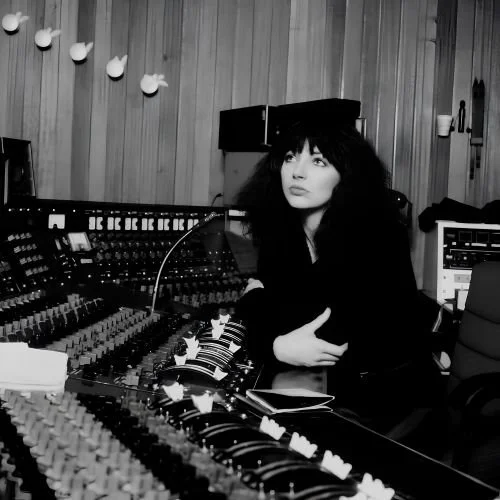
IN THIS PHOTO: Kate Bush in Studio Two’s control room at Abbey Road Studios, 1980
Never for Ever at Forty-Six
__________
I am going to be combining…
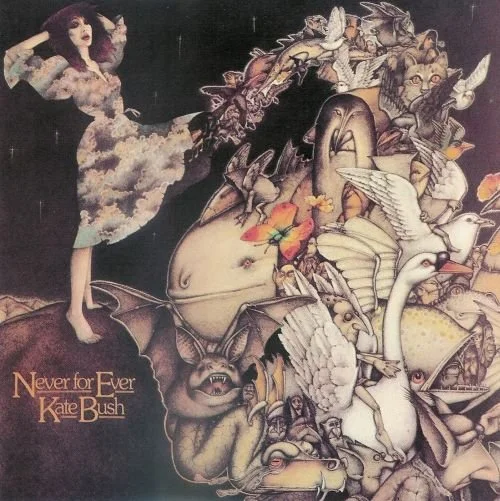
a few things together in this anniversary feature. Kate Bush’s third studio album, Never for Ever, turns forty-six on 8th September. I do want to come to an article from the Kate Bush Club where Bush discussed Never for Ever. Rather than this being the entirety of the feature, I want to also draw in reviews of the album and some words around it. It went to number one in the U.K. It was the first album by a British female solo artist to top the U.K. album chart, and the first album by any female solo artist to debut straight at number one. I think what makes the album stand out is the production. Kate Bush co-producing with Jon Kelly. Melody Maker commended the production: “Any doubts that this is the best Bush album yet are finally obliterated by the inspired unorthodoxy of the production. I had to look to see if Steve Lillywhite wasn’t at the controls – it’s that clean and fresh”. I shall come to words from Kate Bush when she wrote for the Kate Bush Club. First, below is some interview archive with her. After releasing two albums in 1978 – her debut, The Kick Inside, and Lionheart – and the second album being rushed and pressured, she did not release an album in 1979. She went on tour and started work on Never for Ever. This album was one where she was able to gain more control and have the songs sound more like what was in her head:
“It’s difficult to talk about the album without you actually hearing it, I suppose it’s more like the first album, The Kick Inside, though, than the second, Lionheart, in that the songs are telling stories. I like to see things with a positive direction, because it makes it so much easier to communicate with the audience of listener. When you see people actually listening to the songs and getting into them, it makes you realise how important it is that they should actually be saying something. (…)
There are a lot of different songs. There’s no specific theme, but they’re saying a lot about freedom, which is very important to me.
In terms of progress from Lionheart, Never for Ever was a broader album. The themes addressed was more varied. There were a couple of songs that could be considered political. Bolder and bigger than anything she had released to this point, you can tell that technology such as the Fairlight CMI were starting to influence her and add something special to the music. PROG wrote a feature about Never for Ever in 2022. They discussed the themes addressed through the albums. I want to highlight the three singles that were released:
“BABOOSHKA
A more bitter than sweet love story, coming from somewhere between Edmond Rostand’s Cyrano de Bergerac and Rupert Holmes’ Escape (The Pina Colada Song). Bush told Australian TV that the wife of the tale tests her husband’s loyalty by sending him “scented letters” from a young temptress, but he becomes so besotted with the fictitious creature she’s dreamed up that their relationship is ruined. (Nowadays they’d just Snapchat each other.)
The traditional English folk song Sovay, involving a woman in disguise, was another inspiration, having fascinated Kate since childhood. In the video, she played the wife, while the double bass symbolised the man (John Giblin’s fretless bass was a key element of the track). The sound of glass breaking at the end (she smashed up crockery at Abbey Road, later apologising with chocolates to the studio’s kitchen staff) was an early use of a sample made on the spanking new Fairlight CMI synth to which Peter Gabriel had introduced her. (There were only three in the UK at the time.)
The song became a UK Top Five hit, and thus her biggest since Wuthering Heights. Kate’s admitted that she didn’t realise that ‘babushka’ is the Russian word for grandmother, and many shared her misapprehension that the word signified a series of dolls of decreasing size placed one inside another. ‘Matryoshka’, the technically correct phrase for that, wouldn’t have scanned or been half as catchy.
ARMY DREAMERS
This insistent waltz decries the effects of war, centring on a mother, rattled
by guilt as she grieves for the loss of her son who was killed on military duty. She wonders if he could’ve been a rock star or a politician, if she’d been able to afford him a guitar or ‘a proper education’. Weirdly, the single was longer than the album track (which fades). Insanely, it was banned by the BBC during the 1991 Gulf War. Bush rocked camouflage gear in the video. The song’s been covered in numerous languages, from Hebrew to Finnish.
“I wanted the mother to be a very simple woman who’s obviously got a lot of work to do,” she told Flexipop! at the time. “She’s full of remorse but has to carry on, living in a dream. Most of us live in a dream.” She also told interviewers that it wasn’t “specifically” about Ireland. “I’m not slagging off the Army,” she said to ZigZag’s Kris Needs. “It’s just so sad that there are kids who have no O-levels and nothing to do but become soldiers, and it’s not really what they want. That’s what frightens me.”
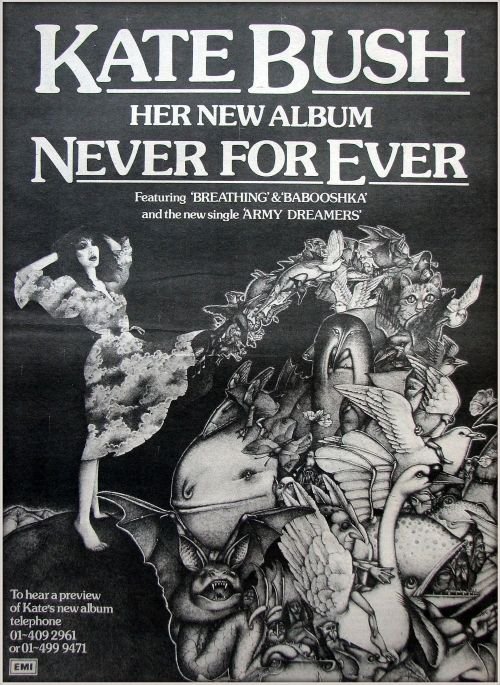
BREATHING
An eerie, thoroughly prog trip back to the womb was a curious choice as the first single and teaser for a new project (it stalled at No.16), but uncompromisingly confirmed that Bush was now taking a firmer hand in decision making. Again her telly watching played a part as she cited a documentary she’d seen on the perils of nuclear fallout (fragments of spoken word describing the flash from a nuclear bomb can be heard). It’s interwoven with fears that the mother’s smoking may also damage the foetus (as if the kid didn’t have enough to worry about, with the apocalypse and all). No wonder Kate, in the video, wants to get out of that rather low-budget plastic bubble. ‘We’re all going to die!’ cries a background voice.
Upon release, in the fan club letter, she called it “a warning and plea from a future spirit to try and save mankind and his planet from irretrievable destruction”. She told ZigZag it was “the best thing I’ve ever written, the best thing I’ve ever produced – my little symphony”, while Smash Hits elicited the quote, “We’re all innocent. None of us deserve to be blown up.”
Roy Harper had a backing vocals credit. Talking to Melody Maker’s Colin Irwin, Bush said, “When I heard Pink Floyd’s The Wall I thought there’s no point in writing songs any more because they had said it all. When something really gets you, hits your creative centre, it stops you creating… After a couple of weeks I realised that [they] hadn’t done everything […] Breathing was definitely inspired by the whole vibe I got from hearing that album, especially the third side. There’s something about Floyd that’s pretty atomic anyway”.
Prior to getting to Kate Bush and her writing for the Kate Bush Club, I want to source an article from The Quietus that I have featured before. The write how Never for Ever, whilst not Kate Bush’s most celebrated album, might be her most pivotal. It was a turning point and important step for her:
“Never For Ever is a starting point, not a zenith, and those miraculous opening six minutes aren’t as groundbreaking as her later innovations. But it is, I’d argue, the first of her LPs that’s genuinely experimental. Paddy’s greater involvement brought weird new instruments – zithers, kotos, musical saws – although Peter Gabriel introduced Bush to the Fairlight, the sonic equivalent of a Jedi being handed their first lightsaber; there were only three in the UK, and while she wouldn’t master it until later, her instant obsession speaks to how determined she was to bend her ornate style into bizarre new shapes. ‘All We Ever Look For’, her happy-go-lucky reflection on knotty parent-child relationships, mutates into several different forms by itself: it jumps between lurching, whistling synths, the koto’s fluttering strings, and a mishmash of Foley-style noises including chirping birds and hurried footsteps. “The whims that we’re weeping for/ Our parents would be beaten for,” sings Bush over its jaunty, oddball din, like the ringmaster at a baroque big top.
Although Never For Ever was largely well-received, a few reviews were grossly sexist, and less egregious offenders nonetheless harped on tired, gendered criticisms. Speaking to ZigZag, Bush blamed the reservations of NME’s reviewer on old hangups regarding her supposed naivety. “He saw me as this chocolate-box-sweetie little thing who had no reality in there, no meaning of life,” she said. It was a common misconception. Naysayers called her twee, but she boldly centred female desire; they dismissed her as cloying, yet The Kick Inside’s title cut wrestled with incest and suicide; they insisted she was whimsical, as if her biggest hit wasn’t about horny teenagers as much as gothic ghosts. Yes, Bush was imaginative, inventive, fantastical. But she didn’t lack substance.
That messy, human drama provides the heart and guts of Never For Ever’s stories, too, however fanciful they get. Often they’re about women deciding their own destinies in fraught, far-fetched situations, old-fashioned expectations of meekness be damned. Some are schlocky: Bush has a murderous ball on ‘The Wedding List’, inspired by 1968 French film The Bride Wore Black, as a gun-toting bride hellbent on avenging the husband killed on their wedding day. “I’ll fill your head with lead!” she crows, vamping and winking with as much gusto as a gangster’s moll. Every so often, however, the slick, romping keys and tough-talking threats die away and are replaced by wheezing, mournful harmonica, and the rampage ends with the broken, pregnant widow turning the gun on herself. Some are shocking: ‘The Infant Kiss’, based on 1961’s Henry James-indebted horror flick The Innocents, finds a governess convinced a child is possessed by her dead lover’s spirit. Bush brings out its lush creepiness with ghostly, trembling strings, more frightened of her own desires than any spectre: “I must stay and find a way/ To stop before it gets too much.”
In that sense, the LP’s final two tracks, despite being the most explicitly political Bush had ever written, aren’t quite the radical outliers they seemed back in 1980. For all their polemical grist, she saw them as personal, poignant stories just like all her others, and although most critics lauded them for reckoning with ‘real life’ in a way her older efforts didn’t, their power transcends such bogus rules of authenticity. They’re spectacular not because their subject matter is inherently weightier than yarns about paranoid Russian wives or grumpy syphilitic composers, but because Bush brings it to life with exactly the same kind of exquisite, singular imagination; they’re political songs that have been twisted and transmogrified so they can exist in her strange universe, not the other way round. If Never For Ever made her a bolder, sharper songwriter, it was still absolutely on her own terms.
And so on ‘Army Dreamers’, a misty waltz about a mother racked with grief and guilt when her son is killed on military manoeuvres, Bush resembles an otherworldly prophet rather than a common-or-garden tub-thumper. “Wave a bunch of purple flowers/ To decorate a mammy’s hero,” she sings softly, sadly, bitterly, her gentle Irish lilt mingling with its sweet, woozy mandolin and the Fairlight’s unnerving samples of cocking rifles (Bush thought the accent, combined with the thwack of bodhrán, had a poetic vulnerability her regular voice lacked – not the last time she’d invoke her Celtic roots for emotional heft). Its gauzy prettiness gives it the air of a nightmare taking place inside a snow globe, twice as crushing for her delicate touch.
Nothing, though, is as devastating as the closing ‘Breathing’, a vision of nuclear doomsday with a horrifying wrinkle, like Threads turned into a poisonous lullaby (Bush, ever prescient, actually beat the film by three years). She sings as a terrified foetus breathing in toxic fumes inside the womb, slowly being killed by the blast’s fallout because mother doesn’t stand for comfort at all in this grim new world. Every element is beautifully brutal: the brooding electronics that fill the air like dangerous smog; the chilling, fairytale-gone-wrong image of plutonium chips “twinkling in every lung”, made extra-disturbing by gorgeous, glimmering chimes; the ominous scientific lecture that builds to a billowing, mushroom-cloud explosion of ungodly noise, followed by the background singers’ dread chant of “We are all going to die!” Most harrowing of all is the strangled, throat-tearing terror in Bush’s voice. In the past she’d shrieked, yelled, whooped and wailed, but she’d never all-out screamed like she screams here, a guttural cry for help that freezes the blood: “Leave me something to breathe!” Bush was as proud of its apocalyptic nightmare as she’d been unmoved by Lionheart. “It’s my little symphony,” she boasted to ZigZag.
Whenever people told Bush they didn’t understand Never For Ever’s title, she patiently explained it encapsulated her belief that all things, good and bad, eventually passed. “We are all transient,” she declared in her fan newsletter, and it’s hard to think of a finer choice for an album that, even now, exists in a glorious state of flux. Never For Ever proved how great Bush could be when given the control and freedom she craved. More tantalisingly still, it promised the best was yet to come”.
Prior to getting to the article from Kate Bush, it is worth discussing the photo at the top of this feature. Rather than out Never for Ever’s cover there, I wanted to include one of Bush at Abbey Road Studios. The studio became very important to her. A big moment for her. A space that definitely meant a great deal to her. In terms of some story behind the photo: “Kate Bush at Abbey Road Studios, in Studio Two’s control room at the famous EMI TG12345 Mark IV recording console. Kate worked at Abbey Road Studios on the albums Never For Ever, The Dreaming, and Hounds Of Love in Studio Two, and recorded the orchestral parts for the albums The Sensual World and The Red Shoes. The console seen in the photo is legendary and is often referred to as the greatest console ever constructed. A collaboration between Abbey Road and EMI engineers, the production of every component was built to military precision. In addition to being used by Kate Bush, it was used to record several influential albums including The Beatles' Abbey Road and Pink Floyd's The Dark Side of the Moon. Kate on her experience at Abbey Road: [“Being on your own in Studio Two is a fascinating experience. I felt like there were at least ten other people there with me... I think it's a combination of all the people who have performed there over the years and their combined creativity.”]. Issue 7 of the Kate Bush Club was published in September 1980.
I do want to end with Kate Bush’s writing for Issue 8 of the Kate Bush Club. Published in December 1980, she reflects on the release of Never for Ever and promotion. It is quite a long piece, but I think it is important to pop in. We get a real insight into how busy she was after the release of the album. The fact that she was looking forward to Christmas and getting to have a break:
“For the album to have been so warmly embraced has made me very happy. It's hard for me to explain how easy it is to get anxious with your own songs once they're on disc. They can easily be up to a year old already, and so the unveiling of the album felt very like the prodigal son coming home to me. I was willing to leap into anything that would help move it along. As you all know, most artists will do promotional work--which we will call "the rounds"--to accompany their product. It was my turn for "the rounds". What makes that fun are the people that you meet and you are with--the travelling, the talking are tiring and monotous. Among the major promotional events was a radio p.a. [personal appearance] tour, which you'll hear more of in A. B.'s [Andrew Bryant?] article. This means travelling from city to city, visiting radio stations and record shops to meet people and give autographs, and to do the odd press interview. The tour was to start in Edinburgh. Hil [Hilary Walker, Kate's manager] had booked a motorail ticket for us to travel by train to Carlisle, taking the car to drive us from there onwards. The train left at five minutes to midnight, and things were packed: a flask of tea, a couple of sandwiches, some books, etc. And as the car had been put on the train an hour or so before our departure, I decided I'd visit a friend in between that time and get a taxi to the station. I was having a great chat in a nice, warm, cause environment with homemade fruit buns and a steaming cup of tea, when I realised the taxi that I had ordered had not arrived yet and it was getting late. I rang again--they said it was on its way, but we know they always say that, don't they?
Eventually, with an excited driver speeding to the station at the thought of the mentioned "big tip" if he got me there on time, I arrived at midnight: no train and lots of weridos. Another train was quickly sorted out which left an hour later, and so I bedded up in a little cabin set for Scotland. The first thing that really hit me when I got in the cabin was it was so quiet. I couldn't remember the last time I'd been anywhere so silent, and it scared me. Its silence made me feel uneasy because of me being so unused to it.
The scenery was beautiful, waking up as the sun peeped over the transient countryside and factory chimneys. We arrived in Edinburgh and the first radio station. The schedule had begun. Meeting the people in the shops is a very strange experience--whilst I sit at the back of the shop and watch them all come in, as anxious as me, some of them. All these faces feeding me, one by one; they think I'm feeding them, but they're giving me so much it's like they've all come to my party and the more the merrier. That's something that struck me, how most of the people are remarkably warm and kind and unbothered, and they're not trying to prove anything. I get a certain kind of "pride", if that's not too arrogant, thinking how lucky I am to have these people receptive to my music. It means a lot in terms of artistic reward.
A TV show in Germany meant a dance routine, choice of dancers and a trip to Munich. Babooshka and Army Dreamers had been asked to be performed. The Babooshka video, if you remember, had double bass sections, and this is what I "bassed" my routine on, using the instrument all the way through the song. The evening I was working on the choreography, Paddy, Andrew [Bryant] and Del [Palmer] were in the room. We decided to try it, as I had some ideas, and we worked the night through very enthusiastically, eventually coming up with a very dramatic and very pleasing routine. "Army Dreamers" is one of those songs that could take many different concepts as a visual choreographic piece. For Germany we decided a cleaning-woman of abstract barracks would be fine, joined by three army dreamers, one of whom is a mad sergeant-major who shouts commands at invisible troops, one who carries a gun and mandolin, and one who blinks blankly and carries a small brown teddy bear. The routine was rehearsed, army uniforms bought, Mrs. Mopp's costume improvised with an old jumble-sale dress, a pair of pink rubber gloves, a head scarf, Ma's kitchen apron, her wooden broom and a small brown teddy-bear for one of our "dreamers".
Arriving in Germany, we were met and taken straight to the TV centre, where we were to spend the day. The rehearsal went well--borrowing some toy guns from the TV people, and a broom which I'd forgotten to bring as hadn't looked like a prop standing in my hall as I left for the airport. It was time for the performance. I was Mrs. Mopp, and the three army dreamers were somewhere in the building, waiting, too, for the call. As I came down the stairs, receiving many funny looks at my dress, I saw three men in uniform standing in the doorway with black, made-up faces looking very heavy and official, and it was not until I got very close and noticed the grinning, familiar faces that I realised who they were. Everything went very well; and, joined by two MM [Melody Maker] scouts, we had a great time. The show was done, and out to dinner, incorporating an MM interview. The Germans looked after us very well, and at one point in rehearsals we had been hesitant that people around us were offended or worried by three Englishmen dressed in Army uniforms strolling around the studio with little guns, but no problem--it shows how little these people hold grudges that we were still suspicious of.
"Babooshka", again, was to be performed abroad, this time in Venice. Venice is an extremely beautiful place, and if you ever get the chance to see it, please do, it really is magical. Water is the way of everything there--even lampposts are on water. I took lots of photos, and we've included one of a canal. The hotel that we were staying at was beautiful, with an incredible view of the ocean out of my window. For this TV show Gary [Hurst] and I had rehearsed a duet which we had made up the night before. Often this has strangely good results; maybe it is due to adrenalin. Gary had hired a suit from Moss Bros. the day before, and I'd pulled out an old dress which I used to wear when I was in the KT Bush Band and we performed in pubs. This TV show was live, and as the studio was only across the road (the other side of the hotel backed onto one of the few pieces of dry land in Venice), every performer dressed and made up at the hotel and walked to the TV studio fully equipped .
Our turn came, and as we hit the street we saw silver-suited spacemen; red-, blue-, green-haired people; electric guitars; pantomime horses; one yellow submarine and two dancing bears spilling in and out of the TV centre. We squeezed past the various brightly coloured suits and smiles, did our bit and squeezed past them again on the way back to the hotel. In many ways it reminded me of Noah's Ark: two of every kind in a place on the water.
Just as we entered the hotel we met Peter Gabriel, plus band, who were also on the same show and were on their way out. We exchanged very English greetings on foreign land: "Break a leg, old chap!"; and Peter headed on his way to the bizarre circus. Meanwhile, we had heard that there was a TV room upstairs, so we rushed up to a mini-circus where all the artists that had already performed were sprayed around the floor, glued to the television, expressing kind words of comradeship in the relevant language to whomever was on the screen at that point in time; an unusual live, friendly feeling. Peter's performance was powerful and stood out amongst all the others, and the viewing-room certainly seemed to agree.
The next version of "Army Dreamers" was to be the promotional video. For a long time my vision of "Army Dreamers" on screen had been in green woods, heavy and sad, and the extent of the visual production I wanted on this occasion would only be possible where we had the time, opportunities and budget: not unlike an unknown TV studio, where you have no control over the set or lighting--you go for the simplest, easiest concept possible without spoiling the image. I drew a storyboard from which we worked. I have never had a talent for drawing [I don't agree at all. A very clever and sensitive landscape drawing by Kate, dated 5th November 1978, appeared in issue number 14 of the Newsletter. It shows great style and natural ability which Kate, unfortunately, has never developed.] and so I got a lot of laughs, as well as being able to communicate the ideas in a more concrete way. The cast had to be big--we were to represent an army unit, therefore needing a Sergeant-Major. I gathered all the people that I knew would not only look good but act the part; the choice was obvious--the band, Andrew [again last name not given] as our Sergeant-Major. Phone calls were made, and I couldn't have asked for a more positive reaction from everyone concerned, to the point of someone putting off a [recording] session. A second phone call was made immediately afterwards to find the size boot required for the uniforms. This became very Pythonesque, especially when people replied "Size 9." Everyone involved was a natural actor and performer, and a rehearsal was called. The cast were to turn up at 4 o'clock in the afternoon, Keef at 2 and Rocket and Barry (who were the two cameramen) at 3. From 2 until 3 Keef and I excitedly worked out the details, using my storyboard (which certainly got a giggle out of him) and bouncing ideas that we would get in turn. Most of my inspiration came from every war movie I have ever seen, from the original All Quiet on the Western Front to Apocalypse Now, and this was then applied to the subject matter and concept of the song. When Barry and Rocket turned up, Keef and I were bursting with anticipation of letting them in on the epic. They'd hardly got in the door before I thrust my storyboard under their noses and Keef was talking special lenses. Rocket and Barry are the two best cameramen I have worked with on a frequent basis. They soon joined in the "Ooh!"s and "Hey, what if we...?"s and "Well, we could try..."s, and we were away on a very challenging prospect, having to wait just for the confirmation of safety before we could definitely write the jerk-jacket into the script (we will talk more about this fabulous device later). 4 o'clock arrived, the band arrived, and the good weather had arrived; so we were set for an outdoors rehearsal. It went so smoothly, and all the cast were so professional, that Barry and Rocket could not hide their respect, and neither did we for them (you can see Barry being charged and Rocket being jumped over in the photos). The rehearsal broke, we sabotaged the crew as they left, and we all went our ways to prepare for the big day tomorrow.
It was a very early start, having to reach Pinewood by 8 a.m., and everyone's prayer for mild weather had been answered uncannily. The sun lit up the fern-swamped woods in a way I could never have hoped for; it was a good omen for a good day. Philip and Graham are two child actors; they both have pure white hair that, in that day's sunshine, shone and glittered, and they behaved very professionally and looked stunning on the screen. The day was long and full, and so much was achieved that apparently in film terms the amount we covered would have taken a week, which was encouraging to hear. Everything had gone as planned, all the action shots covered, and everyone looked superb. There were some magical moments created both on and off screen by the talent and humour of those people who I'd be lost without. Jay took some incredible shots during the day, which perfectly catch the moods and the lighting of those people and woods. Lisa [Bradley] took some fabulous movie-film which expressed not only the effort that was taken, but also, again, the comedy of the personalities involved. Al was blown up as beautifully as could be [this is a repetition of an aesthetic attitude which Kate expressed in an NME interview by Danny Baker in the fall of 1979: "Well, whenever I see the news, it's always the same depressing things. Wars' hostages, and people's arms hanging off with all the tendons hanging out, you know. So I tend not to watch it much. I prefer to go and see a movie or something, where it's all put much more poetically: people getting their heads blown off in slow motion, very beautifully."] of course only in terms of video fantasy land; Paddy somersaulted and fired, Stewart tripped and danced, Andrew roared and soared, Brian was flying, Preston kept his vest on, Kevin was in heaven, we all tumbled and ached and played soldiers until all was finished, bar the jerk-jacket.
We had lost our daylight by now, and as the trees echoed the screams and yells of musicians and dancers in soldier's clothing, I turned to see them leaping over the camera in the most dramatic light I have witnessed outside a studio. Two huge spotlights leaking smoky light across the clearing in the wood. It's these little moments I lock away as thrills of the theatre manmade. It was time to get into the jerk-jacket. The idea was to finish the video with myself symbolically representing my son, as well as being his mother. We wanted a very violent movement of my body, ideally being thrown off the ground. The effect we used was the jerk-jacket, which we would film and then put into slow motion at the editing stage. The jacket consists of a harness and a wire, with a man manually pulling the wire via a pulley system. The wire is connected to the back of the harness, with a hole through various layers of clothing to allow the wire to be straight when taut. As the man pulls the wire, the person wearing the harness is pulled off their feet backwards, landing on an appropriately camouflaged, padded area to soften the landing.
I was very excited at the prospect of experiencing the feeling, and with the professional help of stunt-men it was an unforgettable event--very exciting--and we got the footage we'd hoped for.
Everything over, wires being wrapped up, vans driving off, cameras tucked in for the night and us off to do the edit of that day's filming. The edit was in my opinion the most complete so far: it was like a well-made wooden jigsaw, with all the edges smoothly planed, and by two in the morning, with the excellent help of our visual engineer, Brian, we had made and edited the movie, and it was now complete and very satisfying.
It was a busy week. The next day, an Austrian interview and mixing Warm and Soothing were on the schedule, and off to Holland the next day to do Babooshka and yet another slightly different version of Army Dreamers in Holland. [See Paddy's description of the Holland performances in his Newsletter article, Memoirs of an Army Dreamer, in the same issue.] I was feeling tired when we started rehearsing the routines that evening for the next day, and by the time I had packed and finished rehearsing, it was about five in the morning; and so, as I was being picked up for the airport at 6:15, I ended up without that night's sleep.
At one point I looked at Pyewacket, my cat, and said, "Help me, Pye, I'm so tired." And she looked at me and said, "Me'ow?" It became one very long day, and my energies were going, but they survived with much help from those around me.
The show went very well, including the floor-manager being searched as part of our routine. It went out very late at night and, as it was the first one in the series and was live, everyone was very relieved when it was over. At last, a few hours' sleep before leaving early next morning for Munich and then Hamburg on a two-day radio/press tour; which was fun, meeting up with Werner from EMI-Munich. He was very good to me: earlier, he had given me the copy of Bowie's album before it was released here, and on this trip he did exactly the same with Stevie Wonder's new record. It is an incredible album [The Secret Life of Plants], and I was lucky enough to see him tour when he was here. The whole of the arena was dancing and laughing--I've never seen anything like it. And by coincidence Paddy bumped into none other than Werner while leaving. It certainly was a happy concert, and was marked with many ticks by me, alongside The Wall [Pink Floyd's concert] and others. [Kate says nothing here about the direct result of her excitement over the energy of the Stevie Wonder concert: that very night she went home and wrote/demoed the first version of Sat In Your Lap, which is arguably the most important recording she has made to date, in terms of stylistic development.]
Since my promotion has eased off, the nights are drawing in. It is colder, and I must soon draw to a close. I have spent as much time as possible on writing--and I think that shows by the length of this introduction! I'm more than happy to be concentrating on my songs at the moment.
I hope all of you are feeling happy and looking forward to Christmas as much as I am.
It's wonderful to know that December will be let out of the chimney this year--I was worried that it might get sooty. Have a very happy Christmas, and as children have the best time, why don't we be children at Christmas, too?
Love,
Kate”.
I will leave things here. Turning forty-six on 8th September, Never for Ever made history. It was the first where Kate Bush had a significant production role and could influence her music more directly. I feel that it is pretty underrated. Based largely on the success of Never for Ever, Bush was voted as the best female artist of 1980 in polls taken in Melody Maker, Sounds, The Sunday Telegraph, and Capital Radio. Her next album was 1982’s The Dreaming. Producing solo, the Fairlight CMI features more prominently. It was another big leap for her. If you have not heard Never for Ever, then you really need to check out…
THIS brilliant album.