
FEATURE:
Turn Off Your Mind, Relax and Float Down Stream…
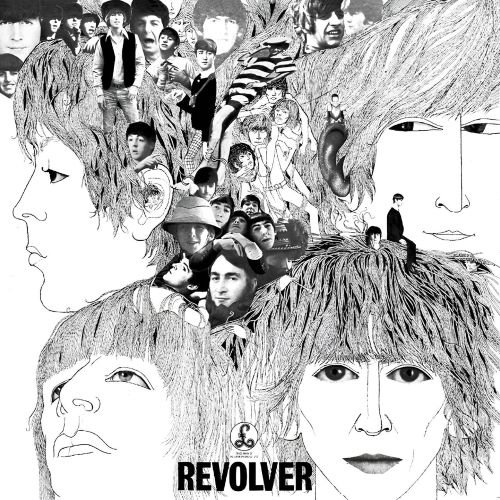
The Beatles’ Revolver at Sixty
__________
THERE is always that debate…
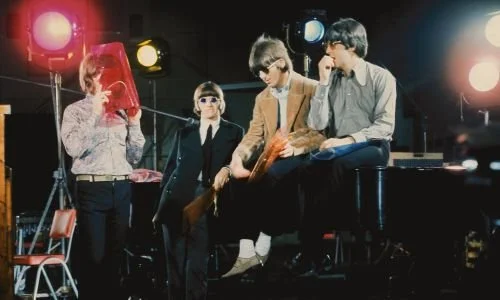
IN THIS PHOTO: The Beatles in Abbey Road Studios during filming of the Paperback Writer and Rain promotional films in 1966/PHOTO CREDIT: Apple Corps
as to which album by The Beatles is the best. People switching between Abbey Road (1969), Sgt. Pepper’s Lonely Hearts Club Band (1967) and Revolver (1966). The latter was released on 5th August, 1966. I am casting ahead to its sixtieth anniversary. It was certainly an important album from The Beatles. By 1966, they were touring less (this fascinating article from June of this year explores their final gigs in 1966) and pushing the limits of the studio. On 30th May, over two months before releasing Revolver, The Beatles released Paperback Writer. It contained one of the all-time best B-sides, Rain. I think Revolver was their biggest leap in terms of sonics and songwriting. If you consider tracks like Tomorrow Never Knows, this was bigger and bolder than anything they had recorded before. Sgt. Pepper’s Lonely Hearts Club Band found them expanding their horizons and redefining Pop music once more. Though Revolver is one of their most consistent albums. Everything on it is amazing. Opening with the brilliant Taxman, there are so many Beatles classics on Revolver. Eleanor Rigby, Here, There and Everywhere, And Your Bird Can Sing, and I’m Only Sleeping. I wonder whether Paul McCartney and Ringo Starr will share memories of Revolver as it turns sixty. Revolver was accompanied by the double A-side of Eleanor Rigby and Yellow Submarine. Reaching number one in the U.K. and U.S., The Beatles’ seventh studio album has regularly been voted one of the greatest albums ever released. I am going to bring in some features about Revolver. There are a lot of features around Revolver, so I am selecting carefully in terms of what to include. Cambridge Audio marked fifty years of Revolver in 2016. Before discussing it, they laid out some facts. Three-hundred hours of studio time were devoted to this album. It was recorded in Abbey Road’s Studio 3. Spending seven weeks at the top of the U.K. album charts, early title options for Revolver were Abracadabra, After Geography, Four Sides of the Eternal Triangle and Beatles on Safari:
“Following the release of the rushed yet still fantastic Rubber Soul the year before, The Beatles were due to make their third film but shelved it as they couldn’t agree on a script. The three months down time however wasn’t wasted as it allowed the band to develop their song writing ability and try out some very different ideas for their next studio album Revolver. The term ‘studio album’ in particular holds weight, as the band were looking to put the touring part of their career on hold, giving them the chance to try out ideas where they didn’t need to worry too much about recreating the tracks in a live setting. John Lennon himself noted: “One thing’s for sure, the next LP is going to be very different…Paul and I are very keen on this electronic music.”
And he was right. Revolver was the start of a turning point of sorts for the Fab Four. Many music enthusiasts have noted that their seventh studio album is a sort of marker, separating two sides to The Beatles. The earlier half consisting of pure pop classics that kicked off Beatlemania worldwide and the second demonstrating the evolution and maturity of their song writing craft, where their psychedelic experimentation lies. It’s Revolver and onwards that has helped us perceive what we see as the 60s to this day.
Changing a Winning Formula
What’s noticeable is that the regular guitar, bass and drums Beatles line up known the world over was being invaded by a range of new instruments and influences. In fact, Eleanor Rigby was the first track none of The Beatles actually played instruments on. It used four violins, two violas, and two cellos composed by the late George Martin. It was also the lyrical content that took a huge departure from conventional upbeat love songs, as the track told the story of a lonely woman and her eventual death. Something the screaming fans weren’t used to! Love You To and Tomorrow Never Knows take an even further stride from the norm with their clear psychedelic and multi-cultural influences. In particular the closing track Tomorrow Never Knows was John Lennon’s way of transferring a three minute LSD trip into song form. Although drug experimentation had started to become a catalyst for inspiration (Doctor Robert was about a New York physician that helped rock stars obtain ‘exotic’ drugs…), the band agreed that the recording studio wasn’t the place to be under the influence.
Backmasking Pioneers
A particular encounter with marijuana led to a recording technique called Backmasking being included on the album. Backmasking is when sound or a message is recorded backwards onto a track that is intended to be played forward. Lennon under the influence accidentally played the tapes to the earlier released single Rain backwards and liked what he heard. You can hear the technique used in particular in the guitar solo of Tomorrow Never Knows. This wouldn’t be the last time backmasking would be linked to The Beatles, as during the time of the 1968s White Album there were rumours that Paul McCartney had died, with evidence hidden using backmasking in tracks on the album. The technique has gone on to be quite controversial over the years fueling plenty of musical urban myths, especially in the realm of rock music.
Even More Sonic Experiments
It wasn’t just John, but the entire band that began to take home tapes and recorders to experiment with. Playing tracks backwards, sped up, slowed down, loops and the invention of ADT (Artificial Double Tracking). This was where The Beatles really began to exploit the ever evolving recording technology. Going back to Tomorrow Never Knows, Lennon wanted a vocal effect that gave the ‘sound of a guru on a mountaintop’. George Martin ran the vocal track through a rotating speaker called a Leslie Spinning Speaker. As it span, it produced a strange sound similar to the Doppler effect (the effect on frequency and wavelength in motion, think of a passing ambulance as an example) Combine this with the ADT, tape loops and reversed instruments and a truly unique song was born. Many of these techniques can be heard across the entire album if you listen closely enough.
For its wild creativity, daring studio experimentation and use of eclectic influences, Revolver wasn’t only a career defining moment for The Beatles, but an album that helped change the industry both musically and in recording technology for good”.
Of course, there was a lot of retrospection around Revolver in 2016. There will not be as much written for its sixtieth anniversary. There is always going to be that debate whether Revolver is their peak. The BBC published an article in 2016 where Greg Kot explained why Revolver is the crowning achievement from The Beatles. It is an album that still blows the mind. It doesn’t matter how many times you have heard it. The sheer eclectic nature. The fact that Yellow Submarine and Eleanor Rigby sit alongside Tomorrow Never Knows. And yet it all slots together perfectly. The genius of The Beatles:
“All The Beatles’ previous albums had been rush jobs – their debut was recorded in four hours. But in 1966, the quartet pulled off the road for good to devote themselves to songwriting and record-making. Lennon and McCartney were still closely collaborating and pushing each other to new levels of innovation, and Harrison was emerging as a formidable third songwriter and voice in the band. Now, with the luxury of time to tinker, edit, re-edit and experiment, The Beatles were poised to record a masterpiece.
Tomorrow Never Knows set a high standard for an album that moves from one peak to the next: Harrison’s corrosive guitar lick and McCartney’s commanding counterpoint bassline in Taxman made for one of The Beatles’ toughest-sounding tracks, the brisk strings on Eleanor Rigby presaged the chamber-pop feel and emotional tenor of She’s Leaving Home on Sgt Pepper, and Harrison’s plunge into Eastern mysticism and modalities on Love You To set the stage for the similarly inclined Within You Without You on the later album.
The melancholy beauty of Here, There and Everywhere answered the challenge of Brian Wilson’s Beach Boys masterpiece Pet Sounds, Doctor Robert and And Your Bird Can Sing achieved jingle-jangle guitar-pop perfection, and the horn-fueled Got to Get You Into My Life channeled Motown and Stax soul. Even a relatively lightweight track such as Yellow Submarine presaged the sometimes fanciful, almost child-like wonder of Sgt Pepper tracks such as Lovely Rita.
Sgt Pepper proved to be a prettier package, with its elaborate Peter Blake cover art of the satin-suited, newly bearded Beatles among images of cultural icons ranging from Karl Marx to Mae West. The Beatles spent 700 hours in the studio crafting it, but despite its unassailable high points – the staggering A Day in the Life, the acid-rock fantasia Lucy in the Sky with Diamonds – it’s also riddled with the cute and lightweight (When I’m 64, Lovely Rita) and the drab (Within You Without You).
Revolver was preceded by Rubber Soul, recorded in 1965, in which the band had achieved a new level of sophistication in its songwriting. The evocative wordplay in Norwegian Wood and In My Life aspired to the pop poetry of Dylan and Smokey Robinson. Song for song, it matches up well with Revolver, but it’s not nearly as sonically ambitious.
By the time of the 1968 White album, The Beatles were splintering and essentially turned the sessions into a series of solo recordings with the rest of the band members acting as session musicians. It contains some brilliant music – including Lennon’s caustic Happiness is a Warm Gun and McCartney’s civil-rights hymn Blackbird – and at least a side’s worth of filler (sonic collage Revolution 9; juvenile Why Don’t We Do it in the Road?; blues parody Yer Blues; and the music hall pastiche of Honey Pie).
Abbey Road marks The Beatles’ final recording session, and it planted the seeds for progressive rock by stitching together 11 half-finished songs into a sublimely sequenced suite. Its closing line – “And in the end, the love you take is equal to the love you make" – is a career capstone worthy of The Beatles’ legacy. The first side of the album contains Harrison’s finest Beatles moment, Something, and Lennon’s metal precursor She’s So Heavy. It’s the album in The Beatles discography that comes closest to the majesty of Revolver.
Revolver wasn't always so highly regarded. A few months after it was released, The Beatles began recording Sgt Pepper, an event that was chronicled with great fanfare as the band sequestered themselves in Abbey Road studios. Its magnificence seemed a fait accompli. In contrast, the release of Revolver was overshadowed by Lennon’s infamous and widely misinterpreted ‘more popular than Jesus’ comments. But time has affirmed the enduring worth of Revolver. It now stands as The Beatles’ greatest album”.
I am going to end with a couple of reviews for Revolver. In 2022, when discussing the Super Deluxe edition of Revolver (which was hugely adored), Giles Martin discussed the wonders of Revolver. In this article, the son of The Beatles’ producer George Martin gave some insight into an album of insights and discoveries. Perhaps one of the most extraordinary and inspired albums there has ever been. It is clear that more time in the studio was the right call. If the band continued to tour endlessly, would we ever have Revolver? It is interesting to consider:
“Martin started listening to the sonic potential to bring the original Revolver to a new audience, with the addition of extensive previously unreleased material. That augments a listening experience as arresting in 2022 as it was 56 years ago. “I found the outtakes really entertaining, especially as I’d been working on Get Back,” he notes. “The analogy is, I’m listening to a band unwrapping their presents, as opposed to a band that have all their presents around the floor, and they’re just basically ignoring them.
“Revolver is an album of inspiration and discovery, [whereas] Let It Be was a period of time where they were being retrospective and wanted to back to how they were before they had all these gifts they got given.”
Even committed Beatles devotees have been surprised at the depth of unissued recordings served up in the new editions, which run to 28 early takes from the sessions and three home demos. But Martin says he only ever finds out what is available to each project from the expert archivists on the reissue team. “I didn’t know anything honestly, not until I start[ed] doing it,” he confides.
“People ask me about outtakes on Rubber Soul. I don’t really know until we start looking into it. I’m not the curator of The Beatles. I’m the person that, I suppose, makes decisions and does these things. But there’s really clever people that know everything, and I have to tap into them, Mike Heatley and Kevin Howlett, and there’s Matthew Cocker at Abbey Road, who’s the archivist. They’re brilliant.
“A package like this has to work on many different levels,” he goes on. “You have the fans that obviously want everything. There’s the people that love Revolver, they want a deeper dig, and then there’s people who’ve never heard Revolver before, like my kids, for instance, that will listen to on a streaming service. It’s multi-layered.
“As far as outtakes go, and that world, it’s a bit like going to a gallery and looking at paintings and discovering the pencil drawings and sketches they did in the early versions of the works they did, before the masterpiece comes. That sounds pretentious, but that’s the ethos of it. So I try and tell a story with the outtakes that shows the roots behind the album, and more so, the humanity behind the record.
“People look for the secret of The Beatles, how did they do this? Was it my Dad? Was there a magic button that was pressed at Abbey Road? It was the combination of humans together, and that’s what you begin to hear. You can’t replicate it, because it’s like replicating a relationship. It’s different between the different people involved. Everything is unique, and the relationship of the four of them, and the relationship they had with my Dad, was completely unique.”
Often, the fascination in the new extras comes in the ingredients yet to be added: the early takes of “Got To Get You Into My Life” before the augmentation of the magnificent horns that transformed the track, for instance, and, in one version, with guitars where those horns would be. There’s George Harrison’s “Love You To” pre-sitar, and the elegantly forlorn “For No One” without French horn.
“It shows you how they made the right decisions,” agrees Martin. “You hear these developments of songs, and you go, ‘OK, I can see where you’re going with this.’ We kind of know that there’s going to be horns ending up on it, but it’s interesting hearing the pathway to that decision.”
As always, Martin was acutely aware of the younger audiences who will consume the new Revolver from a very contemporary perspective. “For me, it’s like time travel. The band are 25, and they will always be 25 on this. It shouldn’t be an album from 1966, because kids don’t listen to music like that any more. We did, because we were sifting through records in our parents’ or our friends’ record collection or our own record collection, which had time and date and images attached. Kids don’t. They just listen to songs now.
“Like my kids will say, ‘Listen to this, it’s great. This should be used for a TV theme.’ And it’s ‘The Chain’ by Fleetwood Mac. [I’ll say] ‘Well, it was used for the Grand Prix.’ ‘Oh, right, OK, that’s a good idea.’ It’s that sort of conversation. I remember I was with one of my 15-year-old’s friends in the car and I said ‘What are your favorite bands?’ and she goes ‘Fleetwood Mac and Bob Marley and the Wailers.’ Fair enough. If I asked her when did they happen, she would have no idea. It would be like a ridiculous question. It’s just a song. So to turn Revolver into ‘Songs that I like for kids,’ great.”
Working versions of later household sounds from Revolver reveal new layers, as on an initial take of “Tomorrow Never Knows” which comes across like prototype grunge, decades ahead of its time; or the version of “Rain” with John Lennon’s vocal at the correct speed – not slowed down as it was on the B-side of “Paperback Writer” – that has shades of the Byrds. “Yeah, obviously, the Byrds had suddenly become an influence like lots of other things,” says Giles. “George was really into other guitar players, as you know, as all of them were.”
An often under-discussed element of The Beatles’ genius, which is very much to the fore on Revolver, was their harmonies. “When they could do, they were singing together. On “Taxman,” for instance, that is George lead vocal, and Paul and John singing at the same time as George. One take.”
Of his own favorite moments and discoveries from the album, Martin particularly enjoys “some of the quieter songs, like ‘For No One’ and ‘Here, There And Everywhere.’ I didn’t realise Ringo was playing drums on ‘For No One,’ but you can suddenly hear a kick and snare drum, to tie it down, if you like. It’s mainly being able to move the drums into the center, that made a big difference to the whole mix. What’s enjoyable is the ability to do things that they couldn’t do, and hopefully doing things that they would have done if they’d had the technology.”
Martin also eulogizes about the extraordinary track that closed the album while opening doors of musical experimentation previously unknown. “‘Tomorrow Never Knows’ was the first track recorded for Revolver,” he says. “They’d all been on holiday, they’d also discovered pot, they came back in and John had this song which was just a single chord of C. He played it to my Dad and was like, ‘I want to sound like I’m singing from a Himalayan mountaintop.’ This is someone from Liverpool.
“To the band and my Dad’s credit, they were like, ‘OK.’ And the early versions you hear on the outtakes are very loopy, trancy. The whole idea was very progressive. There’s very few songs on albums like ‘Tomorrow Never Knows,’ still. Someone said to me ‘It must be fun to mix, there’s so much going on.’ There isn’t. There’s bass and drums, there’s a bit of tambora which is an Indian drone instrument, and there’s tape loops. But it creates this world, and they did create this spiritual mantra from a mountaintop. At Abbey Road.”
Among the greatest revelations in the package, especially as few fans even knew of their existence, are the “songwriting work tapes” of “Yellow Submarine,” in which the sing-song jollity of Ringo’s familiar lead is replaced by John’s maudlin, acoustic introspection.
“I always thought it was a Paul song,” says Martin, “and we found this demo. I think Sean Lennon sent us this demo of John singing it at home. It’s ‘In the town where I was born, no one cared, no one cared…’ John’s version is like a Woody Guthrie version of the song. It’s that classic Lennon and McCartney thing where they they come from two different worlds, and those two worlds are colliding to almost to produce the perfect planet”.
In 2009, Pitchfork reviewed Revolver. As they spent more time in the studio and experimented, we did get this 1966 album where The Beatles’ “individual voices and confidence continued to grow, resulting in the sonic landmark Revolver”. I wonder how people will look back on the album for new features. Sixty years later, have we seen anything like it at all? It is a monumental statement from the greatest band of all time:
“Like any band, the Beatles' recording career was often altered, even pushed forward, as much by external factors as their own creative impulses. The group's competitive drive had them, at times, working to match or best Bob Dylan or Brian Wilson; their drug use greatly colored the musical outlook of John Lennon and George Harrison in particular; and the death of former manager Brian Epstein ushered in a period of distracting and poor business choices and opened the door for individuals such as the celebrity guru Maharishi Mahesh Yogi, Yoko Ono, and businessman Allen Klein to penetrate, alter, and, some would say, disintegrate their inner circle.
The most important of these external shifts in the Beatles narrative, however, was a series of changes that allowed them to morph into a studio band. The chain of events that ushered in the band's changing approach to studio music began before Rubber Soul, but the results didn't come into full fruition until Revolver, a 35-minute LP that took 300 hours of studio time to create-- roughly three times the amount allotted to Rubber Soul, and an astronomical amount for a record in 1966.
Bottom of Form
Longtime Beatles producer George Martin, justifiably upset that EMI refused to give him a raise on the back of his extraordinarily profitable work with the Beatles, quit his post with the label in August 1965. Martin used his clout to create his own company, and the group and producer used theirs to effectively camp out at Abbey Road Studios for whatever length of time suited them rather than being forced to comply to the rigid and economically sound schedules demanded by labels at the time. The Beatles could now work both in and out of the studio, taking full advantage of new advancements in sound recording that allowed them to reflect upon and tinker with their work, explore new instruments and studio trickery, and refine their music by solving problems when they arose.
This new approach not only greatly altered their work environment, but drove the Beatles to value the flexibility of emerging technology. They also cashed in some of their commercial capital to abandon the mentally and physically sapping practice of touring-- and the glad-handing and public relations requirements that went with it. Exceptionalism became the watchword for the band, and it responded by using its freedom to push forward its art and, by extension, the whole of pop music. Musically, then, the Beatles began to craft dense, experimental works; lyrically, they matched that ambition, maturing pop from the stuff of teen dreams to a more serious pursuit that actively reflected and shaped the times in which its creators lived.
Revolver was also the first record in which the impression of the Beatles as a holistic gang was disrupted. The group had taken three months off prior to Revolver-- easily its longest break since the start of its recording career-- and each band member went his own separate way after years of moving around the world as a unit. Even without the break, it's possible that the group would continue to explore individual concerns: After starting to do just that on Rubber Soul, it was only natural that the Beatles wished to continue to highlight their individual strengths on its follow-up, and they did by listing each song's lead singer on the record sleeve.
The first, surprisingly, was George Harrison, who kicks off the record with another stab at politics on "Taxman", and then later offers philosophical musings on "I Want to Tell You" and the Indian-flavored "Love You To". Over the next year or two, Harrison's guitar played a more background role in the group's recordings-- fortuitously, then, that time also corresponded with the years in which the Beatles were pleased to bunker down in the studio and most explore the dynamic tension between their individual interests and their final stretch of camaraderie and mutual respect.
Lennon's primary interest throughout much of this time was himself, something that continued throughout his career-- he was always suspicious, even dismissive, of Paul McCartney's character songs, but once he and Yoko Ono joined forces, her Fluxus-rooted belief in art-as-subjectivity became orthodoxy in his mind. Lennon's early explorations of self and mind that began on Rubber Soul continued on Revolver, as the suburbanite spent much of his time at home indulging his zest for the exploratory powers of LSD. He contributes five songs to Revolver, and, indeed, each is concerned with drugs, the creative mind, a suspicion of the outside world, or all three.
Each is also uniformly wonderful, and together they provide a tapestry of Lennon's burgeoning art-pop, which, along with Martin's inventive arrangements and playful effects, would peak the next year with the triumphs of "I Am the Walrus", "Strawberry Fields Forever", and "A Day in the Life". The gauzy "I'm Only Sleeping" and rollicking 1-2 of "She Said She Said" and "And Your Bird Can Sing" aren't nearly as demonstrative as the songs he'd write in their wake-- as a result each remains oddly underrated-- but they function as some of Lennon's most purely satisfying pop songs.
"Tomorrow Never Knows" is another thing entirely. While "Doctor Robert" or "She Said She Said" touched on drug culture playfully or privately, "Tomorrow Never Knows" was a full-on attempt to recreate the immersive experience of LSD-- complete with lyrics borrowed from Timothy Leary's *Tibetan Book of the Dead-*inspired writings. Remarkably, though, much of it due to Martin's experimental production, tape loops, and musique concrète-inspired backdrop, the song is lively and giddy instead of self-serious or preachy. Even Martin's primitive psychedelia could have been thudding and ponderous, and yet more than four decades later the entire thing seems less a clear product of its time than not only most art or experimental rock, but most Beatles records as well.
Despite that triumph, however, Revolver was McCartney's maturation record as much as Rubber Soul was for Lennon. While Harrison was learning at the feet of sitar master Ravi Shankar and Lennon was navigating heavy use of psychotropic drugs, McCartney was refining his compositional chops by exploring classical music, training an eye for detail and subtlety in his lyrics, and embracing the orchestral work of Brian Wilson.
McCartney's optimism and populism resulted in the most demonstrative songs he created for Revolver-- the brassy "Good Day Sunshine" (which delightfully toes the line between schmaltz and heartwarming) and "Got to Get You Into My Life", and the children's music staple "Yellow Submarine", an inventive and charming track too often derided as camp. (It's also an early indication that it would be McCartney who would hold tightest to the impression of the group as a unit-- the image of the band all living together here was, for the first time in years, untrue.)
The understated qualities of McCartney's lyrics began to be misconstrued as simplistic in his ballads, but he provides three of his best here: "For No One", all the more affecting because it's slight and difficult to grasp, "Here, There and Everywhere", a model of sepia-toned sentimentality, and "Eleanor Rigby", which in its own way was as groundbreaking and revolutionary as "Tomorrow Never Knows". Virtually a short story set to music, "Rigby" and its interwoven descriptions of lonely people was and is a desolate and altogether mature setting for a pop song.
Revolver in the end is the sound of a band growing into supreme confidence. The Beatles had been transformed into a group not beholden to the expectations of their label or bosses, but fully calling the shots-- recording at their own pace, releasing records at a less-demanding clip, abandoning the showmanship of live performance. Lesser talents or a less-motivated group of people may have shrunk from the challenge, but here the Beatles took upon the task of redefining what was expected from popular music. Lest we forget it, the original flashpoint of Beatlemania remains the most influential and revolutionary period in the Beatles career, but the creative high points of 1966-67 aren't far behind. It's worth remembering as well that what had been demanded or expected from them as entertainers and popular musicians was something they'd challenged from their first cheeky, flippant interview, but just a few years later they were no longer mere anomalies within the world of pop, no longer potential fads; they were avatars for a transformative cultural movement”.
I will end by going back to 1966. On 15th August, Edward Greenfield reviewed The Beatles’ Revolver. The Guardian published the original review in 2016. It must have been mad getting an album like Revolver in 1966. It was a real explosion in terms of what a Pop band could achieve. Those who felt The Beatles were a simple band who wrote love songs and had this particular style were in for a shock in 1966. There were still elements of their earlier work, though Revolver was this new exploration and peak. Things had distinctly changed:
“Turn off your mind; relax and float downstream; it is not dying. Lay down all thought; surrender to the voice: it is shining. That you may see the meaning of within: it is being.”
A curious sort of poetry, and the Beatles devotee might detect the hand of John Lennon. These are the words of the most remarkable item on a compulsive new record, the Beatles’ latest LP (Parlophone stereo PCS 7009; mono PMC 7009), called in typical punning way “Revolver.” The song quote, “Tomorrow never knows,” is musically most original, starting with jungle noises and Eastern-inspired music which merge by montage effect into the sort of electronic noises we associate with beat music. Then Lennon moaning out the words above, which in their sinister way define the real point of the song: pop-music as a substitute both for jungle emotions and for the consolations of religion. After all, teenagers are not the only ones who through the ages have “turned off their minds” and “surrendered to the voice,” whether to the tribal leader, the priest, or now the pop-singer. Thank goodness Lennon is being satirical: at least one hopes so.
In studying Beatles philosophy one does of course have to distinguish between the natural acquisitiveness of George Harrison in “Taxman” and Lennon and McCartney and their rather lefter-wing views. But all three creative Beatles habitually (as serious artists always must) in specific feelings and specific experiences. “Dr Robert,” for example, is a brilliant send-up of an expensive doctor-psychiatrist (which Beatle went to him one wonders?). “Well, well, well, you’re feeling fine,” the doctor is made to say, and the link with what the Beatles think of as prepackaged religion is underlined by the Victorian hymn-tune accompaniment below.
Even the already ubiquitous “Yellow submarine” is specific in its simplicity, and a number like “I’m only sleeping” brings a vivid picture of the pop-world: the late-sleeping Beatle being jolted into consciousness – nicely illustrated in the repeated jolting back to life of the music. “Eleanor Rigby” (with “square” string octet accompaniment) is a ballad about a lonely spinster who “wears the face that she keeps in a jar by the door” and about Father McKenzie “writing the words of sermon that no one will hear,” the verses punctuated by wailing cries of “Look at all the lonely people: where do they all come from?”
There you have a quality rare in pop music, compassion, born of an artist’s ability to project himself into other situations. Specific understanding of emotion comes out even in the love songs – at least the two new ones with the best tunes, both incidentally sung by Paul McCartney, the Beatle with the strongest musical staying power. “For no one” uses Purcellian tricks to hold the attention, gently-moving, seamless melody with characteristic descending bass motif, over which half way through there emerges a haunting descant, beautiful by any standards, Alan Civil, no less, playing the French horn.
It is not just a question of the Beatles and Paul McCartney in particular paying lip service to classical values. “Here, there and everywhere” brings yet another Beatles tune that like “Yesterday” or the best of Ellington, Cole Porter or Sandy Wilson (taking highly contrasted examples) can be demonstrated by the most hide-bound analysis to be a good melody. After the unexpected success of “Yesterday,” I shall be interested to see whether this new “sweet” number with its rising fifths and sevenths (forbidden interval in “pop”) again vindicate the perception of popular taste. The Beatles’ whole success, based demonstrably on musical talent, is fair vindication in itself”.
On 5th August, Revolver turns sixty. I really love the album. Whilst Rubber Soul (1965) is my favourite from the band, I cannot deny the genius of Revolver. You can see the legacy of Revolver here. There was this time when Sgt. Pepper’s Lonely Hearts Club Band was seen as the defining Beatles album. The conversation changed. In terms of books about Revolver, I would recommend this one from Robert Rodriguez. I shall leave things there. Revolver brought the underground to the mainstream. It changed popular music and culture and, with it, confirmed The Beatles’ God-like status. Sixty years later, and Revolver…
CONTINUES to stun.