
FEATURE:
Best Foot Forward
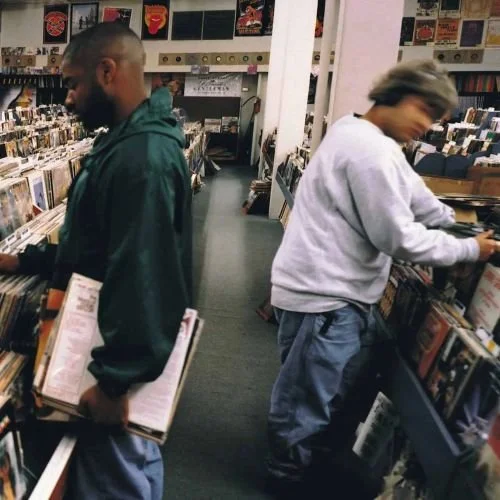
DJ Shadow's Endtroducing..… at Thirty
__________
THERE is…
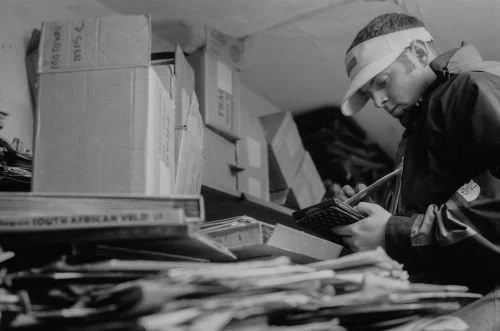
IN THIS PHOTO: DJ Shadow (Joshua Davis) in 1995/PHOTO CREDIT: B+ via WaxPoetic
quite a lot to discuss when it comes to DJ Shadow’s Endtroducing..... One of the finest debut albums in music history, it turns thirty on 16th September. A Hip-Hop masterpiece, its use of samples is extraordinary. Hughley critically acclaimed – I shall bring in some reviews -, DJ Shadow produced the album over two years, using an Akai MPC60 MKII sampler and little other equipment. That layering and editing of samples to create these new and unique pieces. Maybe not as easy today due to copyright and possible legal issues and expense, Endtroducing..... is an album I don’t think we would see today. Too many barriers for artists to hurdle. I am going to go inside this classic ahead of its thirtieth anniversary. I guess the album could be coined Trip-Hop, though DJ Shadow has refuted this and hates being put into categories and labelled. It is almost hard to categorise an album as wide-ranging as Endtroducing..... This feature from last year goes inside a masterpiece:
“To listen to DJ Shadow’s Endtroducing is to hear sampling approached as a spiritual practice, an aural document of one man’s lifelong reverence for hip-hop and his communion with the history of recorded music. After years of bending over record crates and inhaling dust from decades-old vinyl in the basement of the Sacramento record store, Joshua Davis pulled hundreds of samples together to create a record that reimagined and expanded the possibilities of the art form. Producers had sampled for years, and perhaps the Beastie Boys’ Paul’s Boutique rivals the number of sources on Endtroducing, but nothing before Endtroducing had its sonic scope. The fact that Shadow was able to keep every musical fragment in his brain almost makes him seem more like a conduit than a composer.
In the expansive, ethereal, and meditative world that is Endtroducing, The Meters coexist with Tangerine Dream (“Changeling”), Pink Floyd plays on the same bill with Jimmy Smith (“The Number Song”). Hip-hop, electronic, ambient, jazz, rock, classical, and more coalesce. Endtroducing was a hip-hop record that irrevocably blurred the lines between genres, exposing the reality that genre never really existed. It was a construct that DJ Shadow helped deconstruct one sample at a time.
Endtroducing legitimized sampling as an art form unlike few albums before it. If ever anyone says sampling takes no skill, that’s it’s lazy theft, you can point to Endtroducing. The seamlessness and shape-shifting of Shadow’s sonic collages aren’t impossible to recreate, but they would take years of study and innate musical skill to get right.
“By ’95, when I was really working on Endtroducing heavily, I was very much trying to make a statement about, ‘Why are we all abandoning this artform? What everybody else is doing is great, but I feel like there’s a lot of work left to be done in this discipline.’ And I wanted to create a record that pushed that conversation forward,” Shadow told Westword.
The album gave rise to the notion that hip-hop producers could create a full instrumental album, that they were more than composers for rappers. Without Endtroducing, the world might not have been ready to accept J Dilla’s Donuts, another brilliant work of sampling bricolage. Somewhere between Shadow’s Endtroducing and Dilla’s Donuts, you have the roots of the Los Angeles Beat Scene, the hip-hop and electronic music community that spawned Grammy-winning producers like Flying Lotus. There are decades of music that might not have happened if not for Endtroducing.
How was the album received upon its release?
In the UK and Europe, Endtroducing was a critical and commercial success. The album spent ten weeks on the UK album charts and was certified gold within two years. Apart from a negative review in The Wire, foreign press was extremely positive. Tom Wilkes, who reviewed Endtroducing for British music magazine Melody Maker, couldn’t have been more adulatory. “I hear a lot of good records, but very few impossible ones…” Wilkes wrote. “You need this record. You are incomplete without it.” NME called Shadow the “Jimi Hendrix or Jimmy Page of the sampler.”
However, after a whirlwind of press and successful gigs abroad, DJ Shadow returned to Davis still virtually unknown. Fans recognized him on UK streets, but sales and critical acclaim were slow to arrive stateside. “The album wasn’t getting radio play anywhere, as far as I could tell. Even my own college radio station didn’t seem to know who I was, or have any interest in playing my stuff. So, I thought that was it,” Shadow told Eliot Wilder for his 33 ⅓ book on Endtroducing. “At that time, Davis was the world to me. [laughs] Even though I had been a lot of places, it’s the only thing that seemed real. And then, all of a sudden, the weekly Sacramento arts and entertainment paper did a cover story on Endtroducing, and I didn’t even know about it. That’s when it hit home.”
DJ Shadow seems to discuss Endtroducing in every interview. This isn’t his fault. Even if the focus of the interview is Shadow’s latest album, the interviewer eventually circles back to his debut. In 2016, 20 years after Mo’ Wax released Endtroducing, Shadow reflected on the album’s legacy in an interview with Rolling Stone Australia.
After expressing his gratitude for the album’s continued resonance, Shadow said he hopes Endtroducing was “bought by 100,000 artists.” In other words, he wants musicians to return to Endtroducing for inspiration, to use the album to push their art forward. He also realizes the rarity of creating a piece of music of this magnitude.
“Being a student of music and reading about other artists and their aspirations, I know how difficult it is to connect in a meaningful way and have a record that endures for 20 years the way this one has, so I know how lucky I am. I know how grateful I am every day that I managed to achieve that at least once in my lifetime”.
Back in 2022, Joshua Davis (DJ Shadow) and Mo’Wax label founder James Lavelle discussed the making of Endtroducing..... with The Guardian. This ideas of instrumental Trip/Hip-Hop soundscapes. That fear people would not buy it. Perhaps unusual in 1996, now we can see the influence of Endtroducing..... I have loved this album ever since its release. This is what DJ Shadow says about his debut album:
“By 1991, sampling had entered a golden era with De La Soul’s 3 Feet High and Rising, NWA’s Straight Outta Compton and the Beastie Boys’ Paul’s Boutique. I was a senior in high school, frustrated that I couldn’t afford turntables, let alone a sampler. I was doing poor man’s sampling by cueing records directly into my four-track cassette recorder, trying to fool the industry that I was more equipped.
I pooled all my money, went down to the Guitar Center in San Francisco and bought the Akai MPC60. When anybody buys an instrument, they always say that they go home and stay awake for two and a half days, just playing. That’s exactly what I did. You could only sample 2.5 seconds of stereo and store 13 seconds, so I would do the beat, melody, percussion, and go to the studio of Dan the Automator, a producer who had an early form of multi-tracking using VHS tapes. For the seven-inch mix of Stem, I wanted to sample Heat, the 1995 movie, so I said: “Make sure you’ve got a VCR. I’m gonna go rent the movie.”
I wanted people to understand that sampling has a long lineage, so the credits are right there in the liner notes. James Lavelle from Mo’Wax said: “Give us a list of the big eight.” So I identified the samples most likely to cause issues, such as Metallica, Björk and the piano on Midnight in a Perfect World that comes from 1969 song The Human Abstract by David Axelrod. A few weeks later I said, “Do you want some more?” and he said, “We still have our hands full, thanks.”
Just push your sound, I said, don’t worry about choruses and verses
I spent the summer of 1996 in the UK promoting the album. As a 23-year-old, there seemed such an optimistic aura. The album didn’t take off in the US until a year later. I’d hop on the phone to do an interview and would be met with a confused silence: people assumed I was British.
I know some fans think I don’t like talking about Endtroducing, as if it’s some sort of albatross, but that’s not true. There’s also been a narrative that James and I don’t get along. There has been some truth to that, but I’d do anything for James, and I’m sure he feels the same”.
In December, DJ Shadow joins with The BBC Symphony Orchestra to celebrate thirty years of Endtroducing..... This masterful, towering, mightily influential, enduring and ingenious album is going to performed in full and reimagined for an orchestra. I will end with The Line of Best Fit and their review of Endtroducing.....They were reviewing the special deluxe reissue that featured demos, alternate takes and live versions (alongside the original album):
“Obviously, major labels aren’t reissuing classic LPs solely to preserve their legacy and introduce the music to new generation of fans. All this repackaging – double packed with a photograph and an extra track (and a tacky badge?) – simply serves as a way of cashing in on someone else’s genius. While a lot of the records that tend get this treatment do feel like unnecessary label cash-ins (no one really needs a reminder that Oasis’ Be Here Now still exists, for example), some really do just deserve the occasional glamourous gesture of appreciation and re-recognition. Works as groundbreaking as Endtroducing... are just too important to fade into obscurity.
The only problem with a reissuing an LP as extravagant and excessive as Endtrospective Edition is that, at an overall combined time of 2 hours and 42 minutes, it can sure get isolating for the casual listener. The full package here – including the live tracks, demos and remixes – is exclusively designed for purists, which seems paradoxical. Wouldn’t any diehard already own a copy, meaning that they really wouldn’t need to invest in another?
Having said that, if you’ve got the time (and the money), then the Endtrospective Edition is most definitely worth a listen at very least. It’s an interesting insight into the creation and subsequent influence of one of the best albums of the last two decades. Of course, the expanded edition does feel over-the-top - as expanded editions usually do - but, hey, what better way is there to celebrate a 20th birthday than by having it a little too large?
Ultimately, the substantial collection of ephemeral presented here only really highlights one thing: just how good the original album is. It’s an album similar to J Dilla’s Donuts in the sense that it’s a classic hip-hop record that doesn’t have any rappers on it. Dilla’s early production work for Slum Village seems to be unfairly underrated because listeners are too invested in the raps rather than focusing on the beats, and this is what puts the likes of Donuts and Endtroducing... into a league of their own - their sample-led beats are so intelligent and insanely listenable that they themselves become the main attraction. There's absolutely no need for a mid-level rapper to spit obscenities on top of them.
Endtroducing... is a part of a unique breed of albums that don’t need any additional work, and this is why the demos and remixes – while enjoyable as a whole – are largely redundant. This leaves Endtrospective Edition feeling more like a corporate con and an unessential expansion of an already essential album rather than the celebration of a landmark moment. Still, if nothing else, this expanded edition perfectly encapsulates how, even after 20 years, Endtroducing... still speaks for itself”.
It will be great to mark thirty years of Endtroducing..... on 16th September. An album that refined Hip-Hop and remains one of the most important albums ever released, it still sounds utterly awe-inspiring. You listen to it and are sucked into this world! DJ Shadow created something truly epic on his debut. He has released seven studio albums (his most recent is 2023’s Action Adventure), but nothing can compare to his debut (which is an impossible task!). A hard act to follow, his second studio album, 2002’s The Private Press, is pretty remarkable. You can buy Endtroducing..... on vinyl here. Go and own a copy of…
THIS seminal masterpiece.