
FEATURE:
Feverpitch

IN THIS PHOTO: Kylie Minogue shot for British Vogue in June 2001/PHOTO CREDIT: Vincent Peters
The Regency of Kylie Minogue in 2001
__________
THERE have been…
career peaks and regencies of Kylie Minogue through her career. I first heard her music in the 1980s when I was a small child. She released her debut single, The Loco-Motion, in July 1987. Almost forty years of her music. Maybe now is where she is at her peak, though some would argue that was earlier in her career. With Kylie Minogue, there are these purple patches and golden runs. After Light Years was released in 2000, there was this wave of new interest. People thinking it was some sort of comeback. Minogue had not gone anywhere! What people were suggesting was this was a great album, following one that was not so good. I think 1997’s Impossible Princess is a remarkable album, though Minogue did faced sexism and critical negativity. Fever a more mainstream or accessible album. Helped by the success of the single, Spinning Around, and its video where Minogue donned those iconic gold hotpants. 2001 was a year when that momentum continued. I sort of have to frame music of that year around the terrorist attacks on 11th September. The fact is that Fever and its lead single, Can’t Get You Out of My Head, could have failed. They were released right around that time, when the world was in complete shock. Artists afraid to fly and promote music. Maybe audiences did want escapism and to carry on, though it must have been strange for artists releasing and promoting music after the horrific attacks in the U.S. How New York was rocked. Fever came out on 1st October, 2001. I want to look to its twenty-fifth anniversary, but more generally look at Minogue’s 2001. On 8th September, 2001, the first single from that album was released. Can’t Get You Out of My Head ranks alongside her very best. I covered this song in more detail for another feature. It also hit a billion streams on Spotify. Kylie Minogue shared the news.
What is amazing is how this single, released three days before one of the worst events in modern history, captivated and was successful. It reached seven in the U.S. Billboard Hot 100 and got to number one in the U.K. Number one in Kylie Minogue's native Australia. I am going to bring in some reviews for Fever, as this might be her greatest ever album. Stiff competition! I feel it was a response to the critical lukewarmness around Impossible Princess. More ‘Indie Minogue’, Fever sort of continued and built from Light Years. Disco and Dance-Pop combined. It was a massive international success and silenced anyone who felt Minogue was not a serious artist or was past her best. Fever was certified platinum by the Recording Industry Association of America (RIAA). The album was also certified septuple platinum by the Australian Recording Industry Association (ARIA), and quintuple platinum by the British Phonographic Industry (BPI). At the 2002 BRIT Awards, it won International Album. The Perfect Magazine chatted with Kylie Minogue last month to mark and celebrate twenty-five years of Fever. Her recalling this imperial phase. This astonishing year. An album that reaffirmed her position as a global megastar and one of the most inventive and brilliant artists of any generation:
“So this year is the 25th anniversary of Fever.
It is.
When we were talking about it in the office, the thing that surprised us all was this ritual that Sid, our digital director, and his mates have, of watching your Brits performance of ‘Can’t Get Blue Monday Out of My Head’.
Oh, but I love Sid. We all need a Sid on our teams. He’s genuinely special.
What does their ritual tell you about the longevity and resilience of Fever?
You know what? It’s just so beautiful it’s mind-blowing. You can do so much – due diligence, best efforts to try and make something a thing, not something that’s just self-propelling in the moment. When it gets these fresh injections of love and life, coming from a completely different mindset… I mean, what do that generation think? What do they make of it? They are just so cool about it. Honestly, it fills me with so much joy. We were there, we know what it was like. But Sid and his mates ritually go to it? That is so… I just want to hug them all. Maybe I want to go out for a night out with them all and go into their world for a minute. But not too late (laughing). All I need to know here is: is the ‘Can’t Get Blue Monday Out of My Head’ moment 11.30pm or is it 3am? That’s all I need to know.

PHOTO CREDIT: Willy Vanderperre
Where did the ‘Blue Monday’ idea come from?
Very possibly from Miles Leonard [her then label boss] or Jamie Nelson [her A&R]. It’s such a clever idea you just wouldn’t change one thing about it. Believe me, I look back on the majority of things and think, yep, maybe something different here? But that moment just thrills me – especially now that I know that story. Not only of Sid himself, but the culture around it. When he told me, I was like, ‘What are you talking about?’ I’m just going to roll with it.
Was ‘Can’t Get You Out of My Head’ the first great global pop hit of the 21st century?
I’d have to look at what else came out then. Maybe something slipped out of 2000? I couldn’t definitively say that. But I do believe that it has its place in that realm. I’d have to sit with you and look at the charts and jog my memory, but it definitely… sonically and visually and at that point in my life, I think, what was I? What, 32? I was settling into myself, I guess. I’d been through the whole PWL era, the Deconstruction years. ‘Spinning Around’ got us back on. Then it was like riding a spaceship, this juggernaut.
Were you at your most confident during ‘Fever’?
A lot was simplified. It’s quite streamlined and then, in time, it got really busy again and by the time you’ve got to [her 2011 album] Aphrodite, it’s full-on over the top again. I think that when you can get to achieve so much with fewer elements, that’s when pop music is at its most incredible.
Tell me about the importance of the female gaze to the project. Dawn Shadforth directing the video for ‘Can’t Get You Out of My Head’ lent it this very specific angle. We knew you had that in you, but it took that direction…
Sorry to interrupt you, but I hadn’t actually thought of this before – that thing that ‘we knew you had it in you but we hadn’t seen it before’. You need your collaborators, you need a team, those people to help you get there. Or I do, at least. So she was instrumental. It could’ve been a very different video, a very different treatment. The female gaze of the director is it. And also, Dawn is just… She is cool. So she is only going to do cool stuff.
What’s your favourite song on the record that isn’t ‘Can’t Get You Out of My Head’?
It would have to be ‘Love at First Sight’. The ad libs at the end are inspired by Donna Summer and that inspiration started from when I was nine years old. I would listen to her all the time. I love ‘Love at First Sight’. I love hearing other people’s versions. It’s done a lot of weddings, that song. It was the first song that I’d written alongside Biffco and Richard [Stannard] where the puzzle started to make sense for me. We went back and forth on the chorus and it landed where it landed. We sent four songs to Parlophone and they didn’t respond to it. We were so baffled. Then they came around and it’s become the song it’s become”.
Let’s get to some retrospective examinations and features around Fever. 2001, this massive year for Kylie Minogue. Firmly thrust back into the spotlight. This iconic artist was in her third decade. Many might say that the 2020s have been her best decade when it comes to the brilliance of her albums. I do feel like 2001 was one of her most important years. I think that Fever is almost a perfect album. I have seen some mixed reviews. Those who feel it had a couple of great singles and some filler. I would strongly disagree. There are going to be twenty-fifth anniversary features around Fever. Close to its anniversary on 1st October. I want to head back to 2021 and some features published then. Albumism looked at her career evolution, and they wrote why Fever is so enduring and impactful:
“Mind you, while Minogue continued to experience success worldwide throughout the ‘90s, her career trajectory took a completely different turn stateside during this period. In 1990, Geffen Records released Minogue’s sophomore album Enjoy Yourself in the US, but the album’s poor commercial performance subsequently led to the label parting ways with her. Rather astonishingly, for the next eleven years, none of Minogue’s five albums would see the light of day in the US, as the few singles she released here—including 1990’s “Better the Devil You Know” and 1994’s “Confide in Me”—failed to produce meaningful sales and labels remained wary of supporting full album releases.
So although Minogue’s popularity had not just remained intact, but had actually proliferated across Australia, Europe and beyond, she had faded to relative obscurity in the states, arguably relegated—at least among her more fair-weather followers—to the undesirable one-hit wonder association thanks to the “The Loco-Motion.” Thankfully, the glaring dichotomy between her stature overseas and her marginalization here in the US would come to an end in September 2001, with the arrival of the dazzling dance-pop brilliance of “Can’t Get You Out of My Head.”
Co-written and produced by Rob Davis and Cathy Dennis, who you’ll recall from her early ‘90s hit singles “Touch Me (All Night Long),” C’mon and Get My Love, and “Just Another Dream,” Minogue’s midtempo ode to obsession, replete with the unforgettable “La La La / La La La La La” chorus that lodged itself firmly in millions of minds upon first listen, proved instantly memorable. And the song ultimately became her most successful single of her career, placing her squarely back on US fans’ collective radar after her extended 11-year “hiatus.” “Can’t Get You Out of My Head” topped the charts in more than 40 countries, peaking at number 7 on the Billboard Hot 100 in the US. “It kick-started a whole different phase in my career,” Minogue explained to The Quietus in 2012.
While its ubiquitous lead single is what most people still remember from Fever, her eighth studio album and third released in the US, the rest of the album showcases more than its fair share of standout songs. Most of the songs stick to the same house music meets euro-pop sonic template complemented by Minogue’s yearning, seductive vocals. And the songs seldom stray too far from the thematic script of the pursuit and realization of love, accentuated by a more overtly sexual energy than can be heard on Minogue’s previous albums. So while variety is in short supply here, anyone expecting anything else from Minogue obviously isn’t familiar with her musical modus operandi, which she and her production team execute to flawless effect across Fever’s twelve tracks.
Finest among these, according to my ears, is the hypnotic “Come Into My World,” the other of the two Davis & Dennis penned/produced compositions and the final single released from the album. Sounding like the sonic and vocal extension of “Can’t Get You Out of My Head,” albeit with a faster tempo, the song finds Minogue extending a straightforward invitation to her lover, encouraging him in the second verse to “Take these lips that were made for kissing / And this heart that will see you through / And these hands that were made to touch and / Feel you.” “Come Into My World” rightfully won the 2004 GRAMMY Award for Best Dance Recording, triumphing over competition that included Madonna’s “Die Another Day” and further solidifying Minogue’s career resurrection in North America.
The other two officially released singles are sublime slices of dancefloor-designed effervescence as well. Featuring a nod to her aforementioned 2000 single (“Ohh, is the world still spinning around?”), the infectious “In Your Eyes” highlights Minogue at her most seductive. On the jubilant, melodic ballad “Love at First Sight,” Minogue floats on cloud nine after falling in love upon first blush, conjuring “Love to Love You Baby” era Donna Summer in the song’s outro with the repeated refrain of “it was love / it was love / it was love.”
Among the non-singles, a handful of highlights emerge, including the house-imbued groove of album opener “More More More,” the irresistibly catchy exploration of vulnerability “Fragile” (which could very well have been the fifth single), and “Dancefloor,” an ode to the escapism one invariably finds blanketed by the comforting shimmer of disco lights. While not filler fare by any stretch of the imagination, the trio of songs that close out the album—“Love Affair,” “Your Love,” and “Burning Up”—may not quite measure up to the bona fide stunners that precede them, but they nevertheless reinforce that Fever is an exquisitely executed dance-pop affair from beginning to end.
A surprise to no one, Fever took the global charts by storm, including a peak position of number 3 in the Billboard 200. And while the album was critically applauded, the media’s preoccupation with her undeniable status as an international sex symbol, as well as her personal life, often diverted focus away from her music. In fact, in my research for this tribute, I was hard-pressed to find many interviews that contained more than a passing remark or two about her music, with most interviewers more than content to discuss her public persona and a whole host of topics unrelated to her songs.
Oh well. Sex sells, as we all know. Minogue has sold it well and confidently, albeit with a sophistication and grace that remains largely unrivaled by her pop peers. But ultimately, it’s the songs that endure long after the veneer of the superficial wears thin. In the two decades since Fever first blessed our eardrums, she has continued to craft electro-dance-pop tunes of the highest caliber, as most luminously evidenced on 2003’s Body Language, 2010’s Aphrodite and last years’ triumphant DISCO (2020).
With all of the throwaway pop songs and vapid pop stars (who shall remain nameless here) still pervading the musical landscape, we are the ones that should be so lucky that Kylie Minogue is still going strong three-and-a-half decades into her storied career. And twenty years later, we still can’t get Fever out of our heads”.
A few more features to get to before wrapping up. Stereogum recognised Fever at twenty back in 2021. Everyone has a slightly different take on the album. Although some, including them, feel there is a little repetitiveness creeping in, you cannot argue how addictive and memorable the songs are. This album that endures this day. The singles so fresh, as many artists are influenced by Fever and you can hear it in their work. Arguably, Kylie Minogue albums like Tension (2023) are influenced by Fever. Or Minogue going back to that album and adding in other styles and sounds:
“Though repetitive at times in production and lyrical content, Fever was an ultra-sleek turn into the wonders of millennial pop futurism. The aesthetic was best reflected by Fever’s rhapsodic lead single "Can’t Get You Out of My Head," the song that sent the dance-pop world into Minogue mania. Co-produced and co-written by former Mud glam-rock guitarist Rob Davis and British pop singer-songwriter Cathy Dennis, "Can't Get You Out of My Head" began in Davis' garage-turned-makeshift studio in South East England. They initially offered it to former British pop group S Club 7 and indie pop singer Sophie Ellis-Bextor, both of whom passed on the demo. It thus serendipitously landed on Minogue, who wanted the song within 20 seconds of hearing it.
Balancing in-your-face ubiquity with a more elusive seduction as it built to an infectious "la la la" refrain, "Can't Get You Out of My Head" launched Minogue into icon status. The song became her biggest hit in the US since "The Loco-Motion," peaking at #7, and her bestselling single overall, with worldwide sales of over five million copies. The visual for "Can’t Get You Out of My Head" looked just as glossy as the song sounded -- Minogue's razor-sharp jawline stole the show alongside robotic choreography by an army of clones with cutout tops that would give Mean Girls' Regina George a run for her money.
There was more where that came from. Veering towards discotheque futurism, Fever arguably made Minogue the global queen of nightclubbing. Opening track "More More More" throbbed with a rapturous, tech-y hotline tone and a deep house bassline courtesy of British producer Tommy D. Second track (and third single) "Love At First Sight" pulsated with an adrenaline rush of optimism as Minogue cooed about passionate reverie. The title track was an alluring, flirtatious escapade that brought the steamy album cover full circle.
Breathy vocals ran rampant throughout Fever, notably on the lush, nearly-inebriated sounding "In Your Eyes" and "Come Into My World," which won Best Dance Recording at the Grammys three years later. (It was released as a single in November 2002, placing it within the eligibility window for the February 2004 ceremony.) "Come Into My World" was a follow-up collaboration between Davis and Dennis, who spun it out into a hallucinogenic disco utopia, paving the way for releases decades in the future like Dua Lipa's Future Nostalgia.
Later tracks like "Love Affair," "Your Love," and “Burning Up" opted for more analog instrumentation, but the legacy of Fever lies within its synth-powered Europop menagerie. Those electronic dance hits were the songs that pushed Fever to a #3 debut on the Billboard 200 and helped it sell 6 million copies worldwide. It remains Minogue’s highest-selling album and a testament to her eternal nu-disco appeal. All these years later, I still can't get it out of my head”.
Last year, Classic Pop Mag showed their love for Kylie Minogue’s Fever. I was a teenager when it came out, and 2001 was when I started at university. The month before Fever arrived, I was embarking on this big move. Songs from that album definitely kept me positive and helped me through some bad moments:
“The genesis of the Fever album came towards the end of 2000 while Kylie and her label Parlophone were at loggerheads deciding what to release as a fifth single from Light Years (it had boundless possibilities).
The Goddess of Pop wanted to release Your Disco Needs You, a rallying call to arms inspired by the Village People’s Go West as a thank you to her gay audience for supporting her during her career lull, the label felt that the campy disco track would push Kylie further into niche act territory rather than broaden her audience.
To indicate the kind of direction they envisaged for her, they played her a demo of Can’t Get You Out Of My Head. “From the very first time it was played to me I absolutely loved it,” Kylie said. “It was exactly what I was looking for – cool, edgy, simple.
“Then I started panicking: ‘Are you sure we’ve got it? No-one else is going to record it?’ I just wanted to get in the studio and record it as soon as possible, I was so excited.”
Written by Cathy Dennis and Rob Davis, the song had already been rejected by S Club 7 and Sophie Ellis- Bextor before Kylie’s A&R man Jamie Nelson heard it and said it was the perfect song for the progression Minogue was looking to make musically.
“Even though Kylie wasn’t the first artist to be offered the song, I don’t believe it was meant to go to anyone other than her, and I don’t believe anyone else would have done the incredible job she did with it,” Cathy Dennis told M Magazine. “It was a very natural and fluid process, the whole thing was written in about three-and-a-half hours.
“We had the ‘can’t get you out of my head’ bit and we had the bridge, but it needed another hook. We knew it didn’t need another lyric, so I just went ‘la, la, la…’”
The song informed the direction of Kylie’s next album and, feeling inspired, she headed into the studio to begin work on the album, collating writers, producers and ideas before she went on tour.
As well as asking Cathy and Rob to submit more songs, she teamed up with writers that she’d worked with on Light Years, Steve Anderson and Biffco [Richard Stannard], Ash Howes and Julian Gallagher as well as several new writers/producers who had submitted tracks.
Work on the album resumed after Kylie completed her On A Night Like This Tour in May in Australia. She flew straight to the US to work with Mark Picchiotti in Chicago before returning to the UK to finish the album at London’s Olympic Studios and Biffco’s studios in Dublin.
Throughout the summer, she recorded around 25 tracks, including a pair of Greg Fitzgerald/Tom Nichols cuts (one of which became the title track) and two more tracks from Cathy Dennis and Rob Davis.
After repeated playbacks to what she had recorded, Kylie and her label began formulating a cohesive direction for the album.
What we set out to do with Fever was to make it a culmination of everything I’ve learned an everything I’ve done,” said Kylie. “Everything I’ve done well, and also everything that I’ve done terribly in the past!
“I just feel like the album has the best of both worlds – Light Years and Impossible Princess, it’s a summation of the two. I feel like I’m starting to develop a style that’s my own and though it’s very challenging, I’m enjoying it immensely.”
Having decided on a more stripped-back version of dance-pop than the OTT opulence of Light Years, Fever’s foundation was in electro rather than disco and that also informed the aesthetic of the album.
While Light Years had conjured up images of Studio 54 and poolside parties, Fever’s points of reference were sci-fi and minimalist modernity.
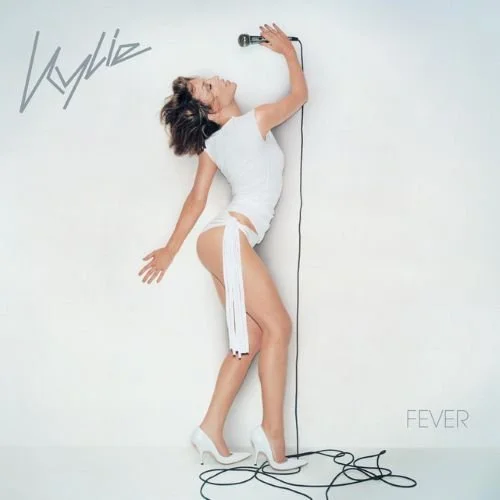
Fashion photographer Vincent Peters, who had shot Kylie for her Light Years cover as well as an editorial in Vogue magazine, shot the singer against a plain white background wearing a white t-shirt, knickers and heels holding a microphone for the album cover – it is a new take on Jean-Paul Goude’s iconic photograph of Grace Jones from the Island Life cover.
When it came to shooting the video for Can’t Get You Out Of My Head, Jones’ influence remained prevalent.
Fashion designer and DJ Fee Doran, a friend of Kylie’s stylist William Baker, was asked if she had ideas, as she had similar points of reference to what William and Kylie were looking for. When the singer visited Fee’s studio, she spotted a hooded jumpsuit and asked to try it on.
“Kylie’s half my size, a fragile little bird and I’m this big clumsy oaf,” says the six-feet-tall Fee. “It was laughable because it drowned her but she knew what she wanted. We pinned it up and even then, we could see it was going to look amazing. Her grandmother was a seamstress so we discussed how we were going to tweak it”
With the video wrapped, album finished and artwork completed, Fever was set for release on 1 October 2001, with Can’t Get You Out Of My Head proceeding on 8 September.
As the record company began arranging Kylie’s promo schedule, they were dealt a blow when it was revealed that the release of Can’t Get You Out Of My Head embroiled her in a chart battle with Victoria Beckham’s debut solo single Not Such An Innocent Girl.
“I did ring my manager as soon as I heard and asked whether we should change it,” Kylie said. “In the end, the cards had been dealt and I just had to play the game. If it hadn’t been Victoria I would have just been in competition with someone else.”
The extra publicity generated from the ‘chart battle’ helped both records and, when it was revealed in the midweek charts that Minogue’s single had sold 125,000 copies in its first three days, the face-off was already won.
Nevertheless, Kylie was overwhelmed when she found out the final chart position. “It was one of those movie moments,” she said.
“My record company has a number that you call that gives the week’s chart result. The voice on the phone said: ‘Kylie is No.1 with sales of 306,000 copies’. I was absolutely flabbergasted. I just thought, ‘that can’t be right’.”
The single spent four weeks at No.1 and she did the double when Fever entered the album chart at No.1. Internationally, both the single and the album fared just as well. Can’t Get You Out Of My Head topped the charts in 40 countries while Fever went on to sell six million, the most successful album of Kylie’s career.
The critics universally praised Kylie’s mature take on dance-infused pop and an arena tour was announced, beginning the following April. Underestimating the demand, KylieFever2002 sold out within minutes and the initial number of dates doubled.
The success continued into the new year. Plans for In Your Eyes, Fever’s second single, had to be postponed by a month due to the enduring success of Can’t Get You Out Of My Head (the label were at one point considering deleting the single in order to continue Fever’s release strategy).
When Kylie performed it as a mash-up with New Order’s Blue Monday at The BRITs the following February, it was still in the charts. As well as delivering an iconic performance, she picked up awards for International Female Solo Artist and International Album.
Living up to those international plaudits, Kylie was forced to sacrifice 10 days of her tour rehearsals to fly to the US where Can’t Get You Out Of My Head topped the dance chart and landed the singer with her first Top 10 hit since The Loco-Motion.
With Fever following it into the US Top 10, she had conquered the final market where success had so far eluded her. Kylie-mania had reached its zenith”.
I will wrap up. I wonder what Kylie Minogue has planned for Fever’s twenty-fifth anniversary. When she spoke with DAZED in May, she was asked about the album and what she had planned. Keeping her cards close to her chest, we might see an album reissue or some big celebration, perhaps:
“This year marks the 25th anniversary of Fever! How will you be celebrating?
Kylie Minogue: This depends. Can you keep a secret? Hmmmmm. What I can say is that I will definitely be celebrating. It’s an album that still stands up, marks a real point in time not only for me but for some others and it’s such a weird and wonderful mix of emotions looking back.
Do you have a favourite look from the Fever era?
Kylie Minogue: Omg, so many. Grace Jones’ white catsuit and Manolo Blahnik white pumps from the “Can’t Get You Out Of My Head” video for starters. I also love the Dolce & Gabbana looks from the tour, the Clockwork Orange section, and the ballad section.
What’s something you’re looking forward to this year?
Kylie Minogue: There’s a lot happening. My Netflix documentary is coming very soon, we'll be celebrating the 25th anniversary of Fever later this year, and a few other little surprises...”.
I wonder how Kylie Minogue reflects on 2001. It was a scary year in many ways. The terrorist attacks happening so close to the release of Can’t Get You Out of My Head. The reverberations still being felt in October when Fever came out. We do mark twenty-five years of this wonderful album on 1st October. Fans around the world will share their memories and favourite songs. Aside from the big hits, the deeper cuts are also fantastic and prove what it is such a strong album. Twenty-five years after its release, and Fever still…
BURNS so bright.