FEATURE:
Modern-Day Queens
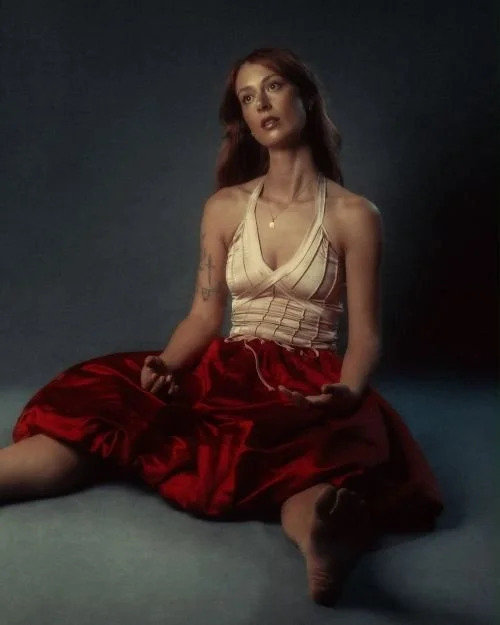
Grace Cummings
__________
THERE have been a fair few…
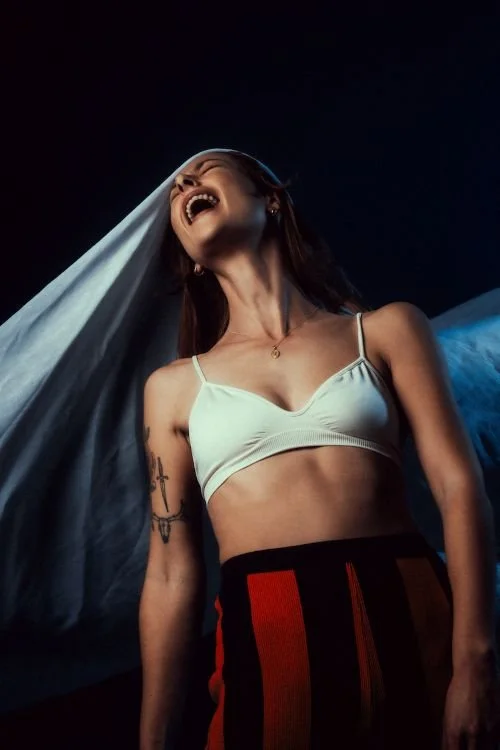
PHOTO CREDIT: Jeff Andersen Jnr
new interviews published recently, as Grace Cummings released her album, Bloodhorse!, last month. The Melbourne-born artist is coming to the U.K. in November. You can find details here. I did want to include a few interviews with Cummings. I am starting with CLASH and their conversation with Grace Cummings. They write how her new album has “classical flair and a passion for surprise”:
“Could you go back to the process and explain how you began sketching the album out, or how that works for you?
Grace Cummings: Well, I think that writing any album sort of starts from the moment you stopped recording the last one. For instance, I’ve had songs on previous albums where I wrote it on the day of the last recording, but we didn’t have time to record it, so it was on the next one. This time I went in with over fifty songs that I could choose from, but I didn’t really have any kind of preconceived concept or story or whatever. But the one thing that I did want was to be as much of myself as possible. It was important to me to be extremely honest and true and not to worry about how that came out.
Did you feel different expectations of yourself either internally or externally when going on to album number four or did it just feel like a natural continuation of the process that you’d built up through the previous ones?
GC: A little bit of both, but I did have the expectation of myself to just not to care about outside judgment or opinion. I think that I’ve gone through a particular kind of change in my life where I’ve realised, not that previous albums have been untrue, but that some of my opinions and what I think I like or dislike, have kind of been adopted by others, and I’ve realised that that’s not actually who I am. This time around, I just thought, ‘fuck that’. And I’ll get back to being who I am, really.
In some ways, the album sounds like it could have been made at any time in the last forty or fifty years. It seems to have been crafted as an album and not a collection of individual tracks. Is that deliberate?
GC: I certainly think of things as a whole, and I know that’s sometimes not the way that you should think about it. But I can’t help it, and it’s not going to change because I love that, and I think that it’s really important. I kind of think about it as being like in acts almost.
And the reason it sounds like that is because Jonathan’s an analogue guy. That’s how everything’s recorded and listened to, you know, like everything, even the synth stuff, we’re manually getting that in the right tempo while it’s going into the tape. But though he’s analogue, but he’s also hi-fi. I love that too because everything is something real, even though it doesn’t sound like it, except for one thing on the album, and yeah, I want to listen to something like it’s an album. I don’t really want to listen to things like they’re supposed to be on a computer.
You are four acclaimed, and increasingly popular, albums in, how close do you feel to that?
GC: Very far. My ambition is to be truthful and that includes this. I don’t want to say something that isn’t true. I’m very far from it. It’s hard.
Also, being an Australian, being so far away from everything, it’s extremely hard. You kind of haemorrhage money all over the world. It takes a lot.
Sinead O’Connor said that the reason you make an album is you’ll go fucking mad if you don’t. That’s true. But I’m very far from being able to sustain myself. It’s incredibly stressful. You know, not to be like woe is me, but I’m also extremely, extremely grateful and extremely lucky to be where I am. But it’s a testament to the care and the need that I have to do it. Because I think a lot of people would fucking give up. It’s not for the faint of heart.
So now that the album is out, what’s the plan for the next, and where do you hope to be at the end of it?
GC: Well, for the rest of the year, I am doing tours in Australia and the UK and Europe with my band, and in the US just alone or with one other person. I’m really looking forward to that. In an ideal world, in an ideal world, I just hope that this finds the right people that connect with it, and that I will keep being pushing myself to just have a little bit more courage every time, you know”.
There are a few more interviews that I want to explore God Is in the TV spoke about Bloodhorse! It is an album where she got the opportunity to turn painful things into things that give her great joy and relief. I have been following Grace Cummings for a little while now. An extraordinary artist that everyone needs to know about and listen to:
“Recorded in Topanga Canyon, California, with GRAMMY-nominated producer Jonathan Wilson (Father John Misty, Angel Olsen, Margo Price) like her last album, it was another fulfilling artistic experience for her. “I love that guy, and I’ve worked with him every day for the rest of my life because he’s amazing,” Cummings enthuses of working with him. “Recording Ramona, we became really good friends because of, you know, similarities in the way that we approach music, but just similarities in the way that we are and the playfulness that we have together is something that I find really, really important.”
“I’m up for anything, and he’s up for anything. I think that different musical shades, a lot of it I wanted to do; I knew that I wanted to go in there and do that and kind of delete some other kind of musical shades, if you will, from previous records,” she explains of the albums shifting sonics.
“I just don’t want to do the same thing over and over again, like that would be boring for me, at least, and he’s got no problem with that, which is awesome. It’s just anything goes...”
“I love that guy; he’s a freak, and he kind of understands me being that way as well. We just kind of go in, and there’s not too much planning at all, at least not this time. I think that works really well because a lot of it is just spontaneity, and it feels present and good at the time. I think that’s kind of the best thing that you can hope to capture, really. If I plan something out too much, I don’t think it’s going to be very good.”
‘My God’ comes replete with a homespun video by director Ben Portnoy. The song itself is an emotive, haunting piano track with striking percussion that simmers wonderfully around Cummings’ deep, breathy vocals, recorded while she was suffering from pneumonia. Her voice and lyrics house a deep disquiet at the world “Lyrically, this song is about hatred, jealousy, rage. The God here is the dark forces that are wrapping around us, that we scroll through, the toxic energy that binds us together in this modern world, and the fear we feed it every day”, Cummings confides.
“When I speak about God, I don’t speak about it with religion in mind. ” She continues, “I speak about it because it’s a gateway into talking about the fallibility of people and questioning your own morals and humanity and pain, and I think God is the biggest word for that.”
“I think that we’re constantly asking for help or in desperation or something like that. This song, though, is, I suppose, pretending to have a God that I certainly don’t believe in. But the force of it is enough to be a God, like a Greek God. It’s dark, and it’s vengeful, and hateful. I think that it is represented in a lot of our world and a lot of our communities, and it makes me very sad. Sometimes I find myself subscribing to it myself, on your phone or whatever, see how much people go on and just tear each other apart and build armies, founded on hate for no reason. It’s just like you’re worshipping something here. It’s not good.”
“We can talk about the Greek gods; they certainly weren’t all happy and merry. Not at all, they’re killing each other left, right and centre and putting in little curveballs for us down here out of spite and vengeance and hate.” She continues, “There’s a God for this, a God for that, a God of the sky, a God of the sea, and they are fallible just like us. It’s just the bigness of them, or of the mythology or of stories about God or different kinds of theology, different beliefs that I’m interested. And it’s just a word to trigger something huge that none of us really know much about.”
Cummings says of the album’s title, “A bloodhorse is a horse expected to be a winner. But they can often also be temperamental, fearful, fragile and easily broken. Sometimes I feel like I’m a trapped animal. When I go to sleep, sometimes it’s like I’m in the gate, twitching. And as soon as I open my eyes, I’m fucking running.”
“Someone brought up that I talk about animals a lot, which I guess I do. I didn’t really realise. But it’s the symbol, I suppose, that I’ve chosen: temperamental, flighty, fight, flight and hide and trapped and all that kind of thing. All related to fear, really, anxiety. But that’s the human condition, isn’t it? ” Cummings asks.
“I think we’re all very much the same, really. I don’t think anyone’s that terminally unique. I just think that some people look into it a little bit more and some people don’t. I envy people that don’t feel the need to look into it that much, but I can’t get it out of my head. I guess that’s why I do things to occupy myself, and make music to feel better”.
Rolling Stone Australia spoke with one of their greatest modern artists. Grace Cummings is a hugely consistency and hard-working artist. “vulnerability, the realities of Australia’s music industry, and learning to lean into who she really is”. I have not seen Grace Cummings live, though I will try and catch her at some point. Her music has garnered praise from around the world:
“What do you hope fans get out of your new album?
What I hoped for myself was to lean in to who I am, try and keep trying to move away from judgement; of myself and from the outside. It’s funny… because “leaning in to who I am” really has meant connecting with who I was when I was a child, before outside noise made me feel like I had to be a certain way to please certain people. I don’t wanna be like that anymore. If I’ve got the privilege of having a platform where I can make something that people may find to connect with, I want it to be real. To be true. I hope somebody might have their hand held by this music, I hope that somebody might feel more understood. If I shot for the moon, I’d hope that people might want to lean into who *they* are — in a way that might have made them be burnt at the stake a few hundred years ago.
When publications like Pitchfork, us, and NPR praise your music, how does it make you feel? Do you pay much attention to it?
I’m really grateful that my music can reach people and does reach those platforms. It doesn’t feel very real to me sometimes, and I guess I have a gap in the connection of understanding that it is “real”. What I really feel is the connection between us and the the people in the room when I/we play live.
If you had to choose the most notable musical influence on your sound, who would it be and why?
I find that changes often, and I’m in all honesty not very sure. Anybody who I can hear truth in, vulnerability, risk, raw and unsettling exposure of themselves… Some things touch you in a way that you can’t explain. But I really look up to people who take the risk to be themselves.
It’s such a tricky time for working musicians like yourself. How have you noticed Australia’s music industry changing over your career? Has it gotten better or worse, in your opinion?
It’s pretty hard. I think sometimes from the outside it might look like things are easy and you’re ticking boxes and living the life… but the changes in the industry make Australian musicians and teams some of the hardest working and self sacrificing people I have ever met. It lets me know that anybody making music and trying to get it out there is doing it because their passion for it is fucking huge and real”.
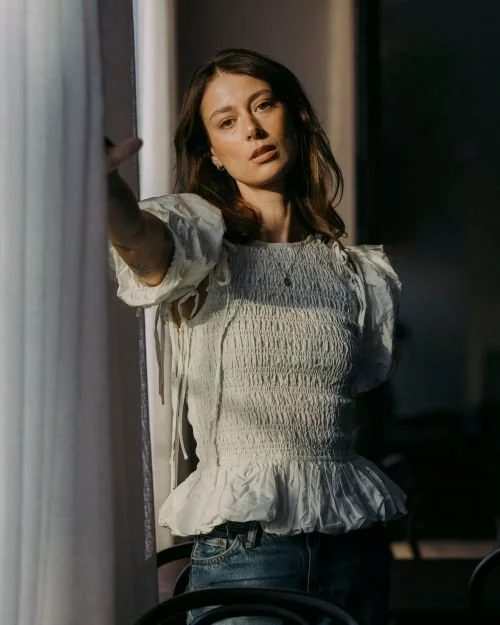
PHOTO CREDIT: Charlie Kinross/The Guardian
Grace Cummings has been compared to artists like Nina Simone, Nico, and John Cale. Even though Bloodhorse! Deals with “themes of identity, gaslighting, manipulation and betrayal, with a depth that only someone well-versed in otherworldly angst could reach”, Cummings has found peace and a life-saving quality in music. The final interview I want to bring in is from The Guardian:
“Since releasing her debut album, Refuge Cove, in 2019, Cummings has had success both in Australia and overseas, playing international festivals including Great Escape in the UK. Though she is a sure-footed songwriter whose last album, Ramona, was shortlisted for the 2024 Australian Music prize, Cummings has spent a lifetime trying to better fit people’s expectations – ever since that formative night-terrors incident.
In her track The Magnum Opus of The North is a Cowboy Boot, she describes the kind of man “who cosplays as tortured poets or cowboys, pretending to be disaffected”. Recently she’s come to the realisation that she has been a bowerbird in her relationships, borrowing opinions, taste and values and assuming them to be her own.
“I’ve been mirroring people’s behaviour in order to please them,” she says. “I’m autistic and I didn’t really realise what that meant. Now I want to live my life the way that I am – in a way that I would probably be burned at the stake for a couple of hundred years ago. I only want to do things that teach me something, or help somebody. The fucking coolest thing is to care. And I do care, so much.”
The aforementioned cowboy theme pops up a few times, including in an abbreviated, highly sexual AI country banger with a male vocal (it’s as surreal as it sounds), and in the video for My God, shot at The Lawrence Rodeo in Maclean, New South Wales. The rodeo becomes a physical manifestation of the hatred she describes in the song, the kind of hatred that people direct at strangers online. “The rodeo is this fucking strange environment where people have a bloodlust,” Cummings says. “A real depiction of us just sitting and watching something that’s quite awful.”
My God, the first single from the album, has a percussive urgency with its uh-huh-huh refrain. When recording it, Cummings had pneumonia, which forced her to experiment with her breath – picture the sound you might make when jumping into freezing water. “I’m leaning more into vocalisation without words, and this was primal sounding,” she says. “It’s the way that some people soothe themselves and their nervous system.”
With her track FAKE, she wants the listener to feel as though they are being dragged under water. The line “if you would just be a good girl” is so offensive to her that she has omitted it from the official lyrics and uses a glottal stop to make it almost unintelligible. In the video, she chokes on viscous black blood when singing it.
Seeing Cummings live, there’s a similar feeling of purging, as if watching a seance or someone speaking in tongues. “There’s definitely a milking of catharsis going on, but there’s no acting in it,” she says. “Sometimes I have no idea what’s going to happen and my band are like, fuck. But then you’re like, ‘Oh well, I guess that was there and needed to come out at some point’”.
CLASH provided their review of Bloodhorse! They wrote some interesting insights into one of the albums of the year. I know there is going to be a lot of love waiting when Cummings plays the U.K. in November. I think that she is a truly unique artist. I wonder where she goes from here:
“‘My God’ is a juddery, twitchy and almost equally dramatic piece, packed with off-beat vocal fills and “uh huh”s which continue the eye-opening feel of the album as a whole. But by now we’re at least partly acclimatised: perhaps getting used to expecting the unexpected. The song explores the “jealous creep” and “wounded animal” which lives in our ubiquitous handheld devices: the god – or idol – of our modern age. It ends with a soothing resolution in a quick piano chord which foreshadows the lead instrument of the third track, ‘Paradise’. This is a slower number, but still steeped in Cummings’ unusual sonic choices (the insistent open hi-hats and possible harpsichord). ‘FAKE’ takes the sound palette even further and elevates it thanks to an inarguably beautiful chord sequence, the kind that rends the heart no matter your constitution. Swelling strings and a head-turningly menacing tone from Cummings anchors this as a visceral piece of songwriting. Just as enjoyment has really set in, though, the track abruptly dissolves into a monotone drone – an undercurrent of electronic hum which may have been there all along and, for all we know, might continue forever.
It doesn’t though, instead melding after two long minutes into the bed of title track ‘Bloodhorse!’ That transition is a truly inspired move, evoking intense emotion which Cummings has explained seeks to evoke the feeling of gasping for air or “Alice falling down the rabbit hole.” The song which emerges is set on a racy, pattering rhythm section, and there’s plenty of entertainment to be had even while Cummings continues to push every boundary she can find. Like the rest of the album, this is an accessible form of the avant garde: challenging in part and extremely innovative but allowing space for essential music ingredients to flourish also.
A quick aside to note that the subsequent “take two” of this track has to be heard to be believed – putting it mildly, it bears no resemblance to its namesake but seems to take the form of an adult-rated, AI-delivered country and western mashup. Cummings’ thought processes are sometimes impenetrable and inexplicable but that, after all, is what sets humans apart from the apes (and the machines).
‘I’m Not Crazy’ is set on more “typical” ground: a woozy, acoustic guitar-prominent confession exploring misdirected love. Coupled with ‘John Lennon’, Cummings now seems to have entered a retro lounge pop era (and seems to have an impressive budget for string sections) too. Then, another startling contrast and an exploration of the misty mysteries of childhood night terrors: ‘WITCH! WITCH! WITCH!’ evokes primal fears from a knowing standpoint, using slow-paced and eminently enjoyable melody to paint dark pictures.
That’s already a lot to take in. What’s left are three reflective songs, leading us with Cummings ultimately to a place of farewell and acceptance through a process of fierce self-help (‘My Island and Me’) and seeking of peace (‘The Magnum Opus of The North is a Cowboy Boot’), both songs built on gorgeous piano riffs.
As the final track, ‘See you in Fifty Years’, presents unanswered and perhaps rhetorical questions of what our futures may hold, it’s impossible not to share at least some of Cummings’ desire to seek – if not find – answers. For us mere mortals to understand every nuance of what Cummings is aiming to say in ‘Bloodhorse!’ may not be a realistic goal, though. This is a unique and intensely unsettled album, swerving from anxiety to hope; dream-like with some of those visions clearly amounting to nightmares, and others much less clear-cut. There are countless moments of brilliance, with only an occasional drop of energy, but perhaps it’s entirely unreasonable to expect Cummings to operate constantly at fever-pitch. Go back, listen again and you will likely find more secrets which have been tantalisingly hidden by this singular artist.
8/10”.
Go and connect with the remarkable Grace Cummings. If you are new to her work then go and listen to Bloodhorse! I do hope that there are more tour dates next year, as I will try and get along to see her play. For now, I am enjoying one of the standout albums from this year. The brilliant Grace Cummings is one of…
OUR best artists.
__________
Follow Grace Cummings
Instagram:
https://www.instagram.com/gracecummingsmusic
TikTok:
https://www.tiktok.com/@grace.cummingsmusic
Facebook:
https://www.facebook.com/gracecummingsmusic
YouTube:
https://www.youtube.com/channel/UC6ANsvg8EAfIP8TLs0VnlOA
Spotify:
https://open.spotify.com/artist/3uAWPonHw80gRQRUjhdW5a?si=pomM5ek4QCuB3peoKFfIPg