
FEATURE:
Kate Bush: The Whole Story
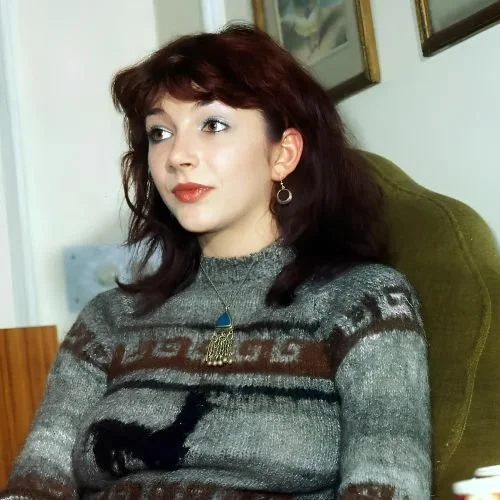
IN THIS PHOTO: Kate Bush photographed in December 1979/PHOTO CREDIT: Alamy
A KBC Short Story, Issue 4 (Christmas 1979)
__________
IT made me think about…
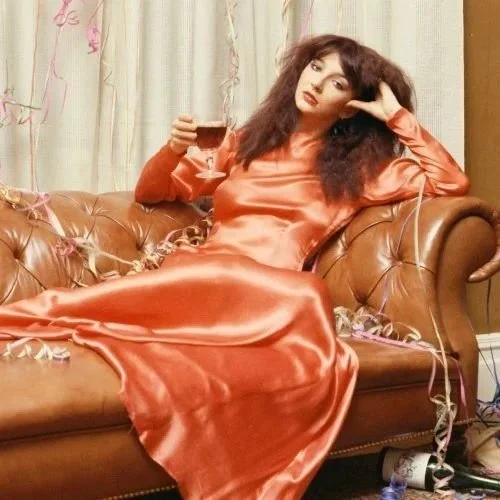
IN THIS PHOTO: Kate Bush in 1979 for her BBC Christmas television special, Kate/PHOTO CREDIT: TV Times/Future Publishing/Getty Images
The Beatles and how they would treat their fans to updates at Christmas. Even though we are not anywhere near Christmas, for this Kate Bush: The Whole Story, I did want to drop in a short story that Kate Bush submitted for the Kate Bush Club Issue 4. In 1979, Bush had released two studio albums – her 1978 debut, The Kick Inside, and the follow-up, Lionheart (also 1978) – and she had completed The Tour of Life. It was an exhausting couple of years! Looking ahead to the end of 1979, Bush was working on her third studio album, Never for Ever, and a chance perhaps of some rest. This might be the final visit to the published writings of Kate Bush, or I might dip in one more time. I like this particular one, as we get a short story from Kate Bush. Rather than a standard interview or memories from Bush and what she has been up to, it allowed her to be a bit more creative and write something non-musical. It must have been great for fans to read this in 1979. I wanted to comment on the story, as it is wonderful. It is titled A Could Be Story. You do not get much revelation from the title, and I wonder what inspired Bush to write it. What could have influenced the story is that Bush was working on her Christmas single, December Will Be Magic Again, and she recorded out of Abbey Road Studios. That sense of history and importance would definitely have influenced her. The fact that this fictional band Bush talks about were going into a big studio to record their third studio album makes me think of her going into Abbey Road Studios for Never for Ever:
“When the Shades went into Priory Street Studios to make their third album they were working on a very tight schedule. Their first album had made the top sixty but their second had hardly done anything at all, and now their third one had to be good or they would have difficulty in getting another recording contract. They felt they needed to find a Christmas single that would help them out of their troubles, but they only had until the end of November to get this together. Any later than that and the record company would be unable to bring a single out--even November was cutting it pretty fine! They had decided to try something different on the new album and had become interested again in the music that was around in the middle 50s.
They had come across a song that none of them had ever heard of before, and it could be the one they were looking for. The song was called I'm Riding With Santa Tonight, by someone called Billy Smith. They decided they would give it a very genuine Bill Haley treatment, with saxophones and lots of shoo-bops-doo-wah-woo-bops-di-wops.
They worked on the rhythm track the first day, putting onto tape the drums, bass guitar and some funky rock-and-roll piano, with a rough voice-track to keep it all together. Late that night they played the various takes they'd done, to choose the one they would keep. Half way through listening to the first take the recording engineer started to look worried and began pressing buttons and pulling down slide controls on his mixing desk where all the sounds were controlled. When he was asked what was the matter, he said he was starting to pick up interference on the track that certainly hadn't been put on there by any of the band during the day. This was the first time he had worked in Priory Street Studios, and he was not used to the equipment. He played back the bit that he thought was wrong, and there was quite clearly a whining sound breaking in on the track. It could have been a loose connection, or even one of the band's stomachs rumbling.
Right at the start when she reveals The Shades’ first album was fairly successful then the follow-up did nothing. Comparisons to The Kick Inside and Lionheart?! Of course, The Kick Inside was very successful and sold over a million copies, but Lionheart was rushed and was not as big-selling. Some of her regret over that. Not that she was to blame. EMI rushing Bush to follow up an acclaimed album without giving her time to write many new songs and develop as an artist. I am not sure whether Bush felt she was at risk of being dropped if her third studio album did nothing. December Will Be Magic Again was released in 1980. She may have felt obliged to enter the Christmas market. If The Shades took influenced from the music of the mid-‘50s for their third album, what can we say of Never for Ever? In terms of decades, I don’t feel we could say it sounds like music from the 1960s or earlier. It feels of its time. That 1979/1980 sound. I would love to have seen this short story brought to life in an animation. I do like how The Shades, at the wonderfully-named Priory Street Studios (there is a Priory Street in London that is located in Tower Hamlets), are a little panicked. Technical issues in the studio or something supernatural. Because The Shades are not a real band and have no music, I am popping in Kate Bush songs from The Kick Inside and Lionheart (and a bit of The Beatles) to fill the gaps!
They listened to all the takes, but the interference was there on each one, and the engineer couldn't find a way of shifting it. This meant a whole day of studio time had been wasted, and feeling pretty disappointed with their first attempt at a comeback, the Shades slid back home in the early hours to get some sleep before starting again the following day.
At two o'clock the next afternoon they turned up at the studio and did the rhythm track once again. But on listening to it that evening, instead of the interference having been cleaned off, it was now even more noticeable, and the engineer could not understand what was happening. It put him in a difficult situation because the band were now talking about using other studios; but he'd been booked for the next two months to do the album, and he was determined that was what he was going to do. After a lot of arguing and shouting the Shades were sitting on one side of the studio and the recording engineer and his assistant on the other and they weren't talking.
At that point the roadie who looked after the Shades' equipment came bouncing into the studio hoping to get an earful of what had been going on for the last couple of days. When he saw the glum faces he knew something was up, and had great difficulty in persuading the engineer to let him hear the tape. Eventually he was persuaded, and the roadie sat back and listened with a critical ear. The Shades knew that he never missed spotting a potential hit single and they often used him as a test of their music.
I guess some of this trouble and waste in the studio was relevant to Kate Bush. Though The Kick Inside was recorded quite quickly and Lionheart was not too stressful, by the time of Never for Ever, there were longer sessions and more experimentation. Things took a bit longer and there would have been days when very little was produced. I think too of The Beatles and their frustration that we can see in the Get Back documentary. Trying to work on new songs in 1969. The band eventually playing their famous rooftop concert. Days when they were perhaps tense and they could not get things together. This idea of The Shades having a nightmare in the studio. You could read that some of this relates to Kate Bush not having control of her albums. More a cog in the machine rather than the architect. That would change for Never for Ever. I wonder if the roadie in this story is David Gilmour. In terms of him being Kate Bush’s mentor and him being able to spot a hit. Or producer Andrew Powell (who produced The Kick Inside and Lionheart). Things do take a lighter turn…
When the track came to the bit with the heavy interference the roadie began to brighten up, much to the surprise of everyone else in the room. When the track had finished, he said it was one of the best things he'd ever heard, and how on earth did they get the amazing effects? The engineer had to say that it was a mistake, and they'd been trying to get rid of it. The roadie said that that was ridiculous, and he managed to persuade everybody that if they pretended it wasn't interference but a very interesting form of synthesiser, it could be the hook needed on the record to make it sell. So it was agreed that the Shades would come back in the next day and put down some guitar work and talk about the vocals.
On the third day, at the end of the evening, they played back an almost completed track, apart from the lead vocals. Once again, the interference was there, and once again, if anything, it seemed to be a lot more dominant. But they had to agree with the roadie that it certainly did give the song a lot of crackle and bite. When the lead vocal was put on and the track finished and ready to go off to the record company for their approval--and hopefully then for release as a single--they all gathered for one final listen.
The odd thing was that the interference now seemed to have mellowed out, and was almost adding a very strange sort of harmony to the lead singer's voice. But everyone agreed that the track was good, and that it could work.
When I'm Riding With Santa Tonight eventually reached number ten on the hit parade, the Shades arrived at the Top of the Pops studio to appear for a Christmas edition and sing their hit single. While they were waiting in the canteen to be called up to perform, they talked with a producer friend and mentioned that they had recorded the single at Priory Street Studios. He nodded his head to show that he knew the studios, and then asked them if they'd had any trouble with the ghost.
That first paragraph. How a seeming accident or interference is actually a good effect and gives the music a unique flair. Perhaps Bush thinking about her experiences. When she was recording later albums like The Dreaming (1982), she was immersed more in technology of the day and there would be these happy accidents. How mistakes could lead to brilliant music. That interesting synthetiser that is talked about, I always feel is Bush nodding to the Fairlight CMI. She would use that for Never for Ever, but it was much more present on The Dreaming. Introduced to her by Peter Gabriel, the Fairlight CMI could produce sound effects and added new layers to Kate Bush’s work. This interference seems to be ghostly. Kate Bush believes in the supernatural and has this openness, so maybe a gremlin in the works. Did she encounter this when at Abbey Road Studios?! No doubt there would have been some adaptation to the technology and grandeur of the space. Different to what she was used to at AIR Studios (The Kick Inside) and Super Bear Studios in France for Lionheart. If The Shades’ Christmas track was a chart success, December Will Be Magic Again reached twenty-nine in the U.K. It was not a major success and got some mixed reviews. That ghost at Priory Street Studios. It is interesting that Abbey Road Studios was haunted, and has its own ghost story:
“The first and perhaps most famous studio to have a ghost is Abbey Road. Built as a desirable, private residence in 1831, the property was converted into studios by The Gramophone Company 100 years later but in the 1920s it was home to the notorious John Maundy Gregory. Gregory was in the business of selling 'honours' for sizable sums, that he allegedly split with Lloyd George's government. A knighthood or even a baronetcy could be purchased in this way. The well-known phrase, ‘Lloyd George knew my father', was the stock reply used by sons and daughters when asked about their father's newly acquired title.
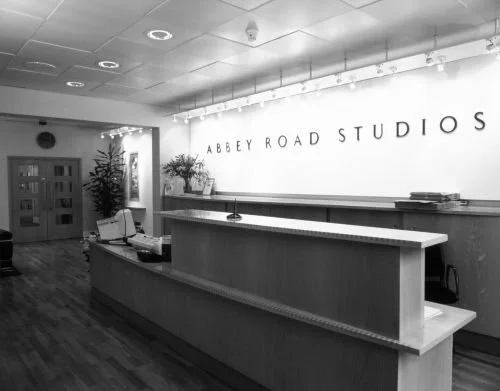
IN THIS PHOTO: The deserted reception of Abbey Road Studios. It was in the early hours during one of his rounds that commissionaire, Smythe, got the fright of his life
Gregory shared the house with Edith Rosse, a former music hall star, and together they masqueraded as husband and wife, until her suspicious death in the mid '20s. Under Gregory's orders, the body was buried at a Thames side graveyard that was particularly prone to flooding - a strange choice unless, of course, it was intended that the body should decompose quickly.
Foul play was eventually suspected and the body was exhumed to undergo one of the longest post mortems in police history. No firm evidence was found connecting Gregory with her death but, nevertheless, he left the country in great haste never to return again - fuelling the widespread belief that he had poisoned her.
The White Lady and Edith Rosse are thought to be one and the same. The story that is most often told of the ghost dates back to the early '60s, just pre-dating the first Beatles recordings. In those days the studio didn't work late and at night the building would be deserted apart from the commissionaire, whose duty it was to make periodical security checks. It was in the early hours during one of these rounds that the man, an ex-Hong Kong policeman called Smythe, got the fright of his life. The building has a number of long corridors intersected by the glass panelled swing doors; the commissionaire was on the ground floor when he noticed the door in front of him shudder - a sign that the door further down the corridor had opened and closed causing a vacuum. The same thing happened again. Peering through the glass into the dimly lit passageway, he could just make out the next set of doors opening; through it came a figure dressed entirely in white.
Transfixed, he stood back as the doors in from of him swung open, letting through a woman in a long flowing white dress; as she silently drifted past him, the temperature suddenly dropped, and as quickly as she'd appeared, the apparition vanished into the gloom. In the morning a very pale and shaky commisionaire handed in his resignation.
Although this is perhaps the best sighting of the White Lady, it is not the only one; other strange things have happened: doors opening and closing by themselves, rooms suddenly filling with a strong smell of perfume, and there is an alleged bloodstain that changes colour in one of the attic rooms.
Another unexplained event occurred a few years ago when technical engineer Brian Gibson was taking some night photographs of the front of the building. He noticed that a light had been left on in one of the upstairs offices and told the security man about it. The man immediately went up to investigate but when he unlocked the room the light was off. No one apart from the security man had access to keys, no one had been seen either going up or coming down, and the lights in the room were checked to be working perfectly normally. Gibson's photographs showed the light to be on”.
In the final stages of the short story, The Shades seeming lucky break and happy accident takes a more ghoulish and spectral twist. It is fascinating how Bush writes! I would love it if we got some more unearthed short stories. If they were collected into a volume…
The Shades looked at each other, and went whiter than the white make-up they wore on stage. The producer explained to them that Priory Street Studios had a reputation for its ghost, and that at one time the owners had thought of closing down the studio because of the electrical interference they kept getting on takes. They had gone as far as taking out all the equipment, having it thoroughly looked at and put back in again, but this had made no difference. In the early 70s the Studios had been completely re-modernised, and he'd assumed that the troubles were over, but he had heard that occasionally they still had problems.
The Shades didn't say anything, but after doing a strong appearance--though it was a rather shaky one--on the television, they went for a celebration party at a friend's house. They now had a good talk about the ghost story they'd heard, and they were all wondering whether it was the ghost that had made the single a success.
The following day they sent their roadie off to the publishing company where they'd found the song, with the job of looking through the catalogues and finding anything he could about the song and the songwriter. That evening he met them at the studio with some very interesting news. It seemed that Billy Smith, who had written I'm Riding With Santa Tonight, recorded his first and only album at Priory Street Studios. All the songs on the album were his own compositions--this was quite unusual in those days, as most of the early rock-and-roll singers in England sang other people's songs.
Unfortunately, just after the album had been completed he'd been electrocuted in the Studios when something had gone wrong with his electric guitar. The record company hadn't thought much of his album anyway, so it was shelved and eventually completely forgotten.
The Shades thought this was a pretty good reason for a ghost to hang about the studios and, wondering how they could best express their thanks to the dead rock singer, they decided to put a credit on the album--"Ghost Synthesiser by Billy Smith".
Apparently there has been no more trouble with interference at Priory Street Studios, which probably goes to show that a ghost is quite content when his music has eventually reached his public”.
Abbey Road Studios itself did not undergo renovations in the 1970s. Instead, it was defined by technical experimentation and analogue gear modification using existing spaces, alongside an official name change from EMI Studios to Abbey Road Studios (in 1970). You can read their story here (the studios turns ninety-five in November). That “shaky one”, in reference to the T.V. performance. Kate Bush performing Wuthering Heights for the first time on Top of the Pops in 1978?! She hated it because she could not play with her band. The Billy Smith character makes me think of perhaps Billy Preston. He played with The Beatles. Though how obviously did not get electrocuted and haunt The Beatles! It is very Kate Bush to have this musical ghost story. What could have been dark and demonic has a sweetness to it. Even if it is quite haunting and unusual. You know she had Abbey Road Studios in her mind. That unusual interference and electricity. Perhaps thinking of darker energies and forces around her. Some of her own fears and experiences in this story. A great Christmas story for fans in 1979, we see that she had a real flair for storytelling! Painting vivid pictures. It would be wonderful to see The Shades, Priority Street Studios, the roadie and Billy Smith animated and brought to life. Or a filmed version. Such a wonderful and engrossing short story from…
A true genius.