FEATURE:
Spotlight

PHOTO CREDIT: First Last
Tiffany Day
__________
AN immense talent…
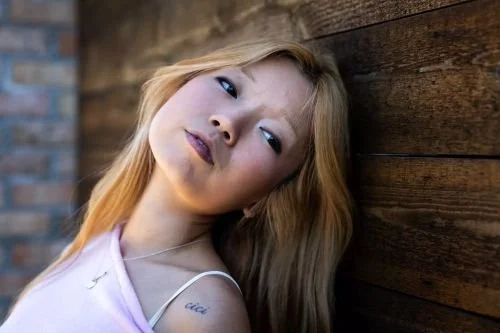
PHOTO CREDIT: Brian Feinzimer for Los Angeles Times
with a massive international following, the incredible Tiffany Day comes to the U.K. in December. The Los Angeles-born artist released her album, HALO, in April. This is someone that you need to hear, as he music is phenomenal. I will come to some interviews with her. I do want to start out with Los Angeles Times and their interview from April. I have included quite a bit of the chat in here, as I think that it gives us some context and background to this stunning artist. Although she is perhaps more popular in the U.S. than other nations, she has a huge fanbase around the world:
“For the majority of Day’s career, which began in her late teens, she drifted between the bedroom pop and R&B genres, occasionally grabbing at a more electronic sound — including through a DJ alter ego — but shying away from it on account of a deep-seated insecurity that followed her from Kansas to L.A.
As a “nerdy” Asian girl coming up in a majority-white school system, Day had the persistent thought: “I’ll never be a cool kid.”
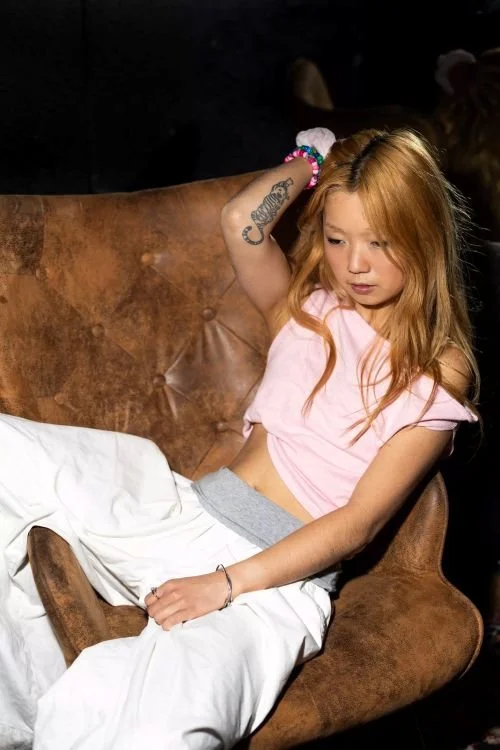
“It weirdly translated into the artist world,” the singer-producer said in a recent interview at the Observatory in Santa Ana, where she would open Aries’ show a few hours later. While she spoke animatedly from a green room couch, Day’s bubblegum pink off-shoulder tee and baggy white pants repeatedly flounced out and then resettled in new shapes
“I fell in love with electronic music when I was, like, 10, but as I got older, I started making indie pop and then slowly moving into an electronic space,” says Tiffany Day.
In place of the populars, Day said she began measuring herself against her favorite electronic artists, whose style of performance she idolized but felt she could never approximate. That feeling peaked at a 2024 electroclash concert, which showcased a sound that fuses ‘80s synth pop, ‘90s techno and the brashness of punk. Day attended the show shortly after the release of her debut album “Lover Tofu Fruit.”
“It was this weird shattering of inspiration, but I also felt sick to my stomach, because, how could I ever be as cool as these people?” Day said. By the time she set off to tour her album, the artist said, “I was already so checked out.”
Day packed all of the angst of that period into “American Girl,” the second single off of “Halo.”
“All up in my head/ I’m an American girl/ I know I don’t look like you yet/ Wanna be part of your world,” she sings in the glitch pop confessional, which has become one of her favorite songs to play live.
With “American Girl” and her previous single, “Pretty4U,” Day started to hone her signature sound. But she also lost some engagement from her more indie-leaning listeners.
“They weren’t being well-received because it wasn’t necessarily made for her previous fan base,” said Day’s manager, Sammy Seaver. Even before a less-than-successful promotional push for “American Girl” led Day to make a distress call to her manager, “we both knew the conversation was coming,” he said.
Seaver likes to tell people that when he first met Day, she was doing pop sessions, but all she listened to was the dubstep music she’d fallen in love with as a kid.
While she hesitates to call it a rebrand, Day said her hard pivot in the hyperpop direction was nerve-racking at first. She feared being called a clone, or a try-hard who’d hopped on a trend.
“But I got over it pretty quick, because I’m in love with the songs I’ve been making,” she said, and that love “triumphs [over] all of my fears.”
For many of the tracks on “Halo,” Day would start off with a producing collaborator and finish on her own: “They’ll usually send me home with the Ableton file, then I get to freak it.”
Such was the case for “Start Over,” a dizzying homage to the rave music Day considers its own art form. The track starts relatively tame with a melodic synth sequence, and then sounds crash in one after another until it’s full electromania. Fittingly, Day made it in the witching hours after last year’s Niteharts Festival. She’d chugged a Red Bull, which she never did, and couldn’t fall asleep.
“So I sat up in the hotel bed with these s— $2 Target headphones and produced out the whole song,” Day said. “It was like that feeling of being a kid and staying up until 7 a.m. playing a video game.”
That night she spent producing “Start Over” was immensely cathartic, just like writing it had been. Composed as Day’s star rose in real time, the song was a receptacle for all of her conflicting feelings about her newfound attention.
“So I did it/ now I’m starting again/ at first no one gave a f—/ but now you’re hitting me up/ I guess I’m doing something right,” Day sings over a thrumming backing track early in the song. A few bars later, she professes, “Could give a f— ‘bout what the number says/ at least that’s what I tell my[self].”
The week “Start Over” was scheduled to drop, Day posted a quick pair of TikTok edits teasing the release.
Before she knew it, the first edit had blown up and people were begging for the song. When it came out, “Start Over” broke Day’s personal record for release day streams with 100,000 across Spotify, Apple and YouTube. It’s impossible to predict which songs will gain traction, Day said, but she was very proud that one did.
That pride radiated off of her in late March as she bounced around the Observatory stage like a lottery ball in an air blower. Her energy was contagious, seizing entire parties across the venue.
At times, Day said the inherent impermanence of the spotlight gets to her.
“I feel like I’m on shrooms when I think about this,” she said, “the whole idea of hype and how much time is left in this.”
But after feeling forgotten for most of her career, and forging ahead in spite of it, the idea of going back doesn’t scare her so much.
“Or maybe that’s what I tell myself,” she grinned”.
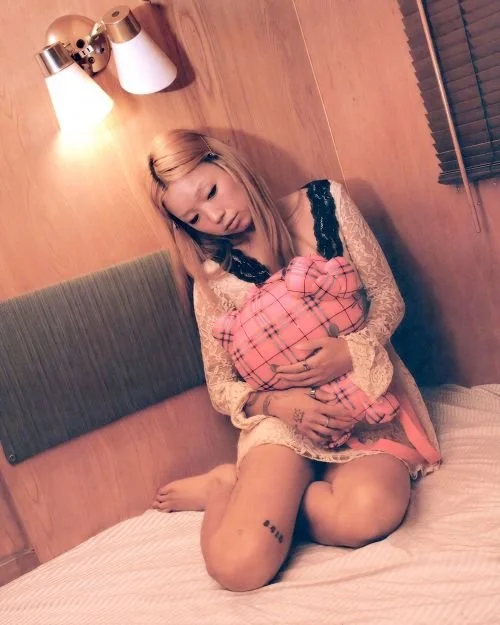
PHOTO CREDIT: Natalie Somekh
I move on to FADER and their recent conversation. They spotlighted a tremendous underground Pop artist who “combines a singer-songwriter’s angst with strobe-light euphoria”. I am really interested to see where Tiffany Day heads. There are so many artists int eh industry, so it can be hard to get a footing. Tiffany Day is definitely offering something different and distinct:
“In the past six months, Day has quickly transformed into underground pop’s ubiquitous new star. Clips of her performing have become embedded into the algorithm and view counts are rising — as is the discourse. Online, some commentators compare her to another Gen Z pop star: 2hollis, who also writes heartfelt pop songs in a language of 808s, side-chained synths, and vocal distortion.
“I love Hollis’s music,” she says. “[But] for people to call me a ‘trend hopper’ is pretty unfair. I grew up listening to EDM and attending raves. I was yearning for a way to bring that world to the pop realm of Tiffany Day. Hollis is definitely someone who helped me realize it’s all possible, but I’d like to think I’m making a lane for myself.”
Besides the tinge of misogyny in that comparison, it also minimizes the extent to which Day’s music is finding an audience because of her own skill. She is uniquely able to articulate the ache and euphoria of coming into adulthood, and she’s remarkably adept at crafting brain tingling melodies. All of that is on display in her new album HALO (released April 3 via Broke Records), the beginning of what is clearly a mainstream breakthrough
Day is not new to online attention. She first went viral in 2017 when she was still in high school, after a video of her singing “Hallelujah” into a reverb-ey well in Spoleto, Italy, while on a school trip with her choir took off on YouTube. “The freaking Ellen show was hitting me up,” she recalls. In the next half-decade, she forged a music career that inadvertently hit upon just about all of Gen Z’s cultural touchpoints: She began posting acoustic guitar covers on YouTube, then moved to Los Angeles as a college student/part-time pop star, and self-released four EPs, many of which featured a very late-2010s, bedroom R&B soundscape.
In 2024, after graduating college, she self-released an album, LOVER TOFU FRUIT, that combined her heartfelt singer-songwriter lyrics with dreamy digital production. She had a devoted fan base and toured, but the daily grind and fallow economics of independent artistry was a lot for a young girl who had aspirations of studying biomedical engineering before a music career fell on her lap. “Every day I thought about if I had chosen a different life, if I had worked a 9-to-5 with a steady routine and paycheck,” she remembers.
Her “last straw” happened on a beach in San Francisco in 2025, when she admitted to a friend that music no longer brought her joy. She struck up a deal with her managers: her next album would be her last, and she’d do the most for her final send-off.
Briefly giving up ended up marking a new beginning for Tiffany Day. She decided to try on the electronic dance music of her youth and the post-Crystal Castles pop that was finding a footing among Gen Z. “I was journaling about it for months,” she says. “I always wanted to belong to a niche and [electronic music] felt like it was calling to me, but it terrified me what [fans and musicians in this genre] would think of me and my music.”
Anxiety morphed into drive as she decided to take the reins on her production. She worked alongside her producers — Jeff Melvin, Niles Forester, and Jack Hallenbeck — but didn’t hesitate to “do rather than explain” her ideas. “It was a continuous journey of feeling like I didn't have the skills to [produce],” she says. “One day, I was just like, ‘I don’t need to keep telling myself that narrative.’ I just sent it.”
Whereas her music prior to HALO had a trying-this-out quality, the songs of her current era boast clear pop logic. Tracks like “SAME LA” and “START OVER” combine the adolescent angst of an Olivia Rodrigo ballad with the big-feeling sonics of EDM. Alongside the new sound, she adopted a more clearly defined look, part-skater, part-princess, and very online: slouching low-rise pants, an askew cap, over-ear headphones, and layers of colors and prints. She sparked some online attention via a viral On The Radar interview, where she performed with a big pink plushie backpack. “I just didn't want to lose myself when I moved into this [darker electronic] niche,” Day says. “I'm naturally a happy, fun person. Performing with my plushie backpack felt so real and so genuinely me. Your artist project should be who you are, times 30”.
I did want to include this interview from EDM.com, as they ask some interesting questions, and we get to learn more about the superb Tiffany Day. In their header they note how, “She has a dubstep alias, an inner compass pointing to the nearest rave, and a policy against writing indirect similes, which together paint a portrait of an artist profoundly uninterested in doing things the expected way”:
“EDM.com: Walk us through your introduction to electronic dance music. Which artists or tracks made you realize you were meant to go down this path?
One of the first tracks I ever heard that really hooked me into EDM was a flip that Whethan did back in 2015 called ‘Mssingno – XE3 (Whethan Turn).’ I remember sitting in my room with my headphones, trying to dissect what exactly I was hearing and why it made me feel so emotional and how the hell he made those noises. I was maybe his biggest fan back then, I convinced my parents and drove over 2 hours on a school night to go see him. That song pulled me into a lot of other artists in that similar world of future bass, like Flume, Lucian, and Vanic.
When I started making original music, I was really just writing pop because I had learned how to write music on a guitar and naturally, that was the evolution. In 2019, I met Jef, and I think he was the first producer who made a song with me that was a little more electronically influenced. It makes sense, because Jef also has an artist project called MELVV, and back then, he was doing all those same tours and festivals as Whethan and everyone else I looked up to.
EDM.com: The frenzied production of HALO soundtracked your anxieties about fame and self-worth. Before that, LOVER TOFU FRUIT was deeply informed by your struggles with nihilism and mortality after your grandfather’s passing. As your sound seems to more heavily embrace EDM, how are you translating these heavy existential themes into a genre inextricably linked with the concept of euphoria?
As much as EDM is linked to euphoria, I also think it can be linked to just feeling anything intensely. Certain songs can make you reminisce on a moment, or maybe realize something about yourself that you haven’t before. As an EDM enjoyer and rave-goer, in live settings, I want to feel euphoria. But when I’m all alone and high, I like to lay in my bed in the dark with my monitors at full blast and feel whatever the song is telling me about.
Sometimes it’s intense sadness, sometimes it’s like confetti cannons are shooting out of my ears and my smile is so wide that it feels like it’s ripping my face. I think a lot of these heavier concepts I write about pair well with whatever the production makes me feel.
I think personally for me, there’s also a simplicity to my lyrics. When you’re feeling a song, both production wise and lyric wise, I think you kinda just wanna feel it directly in the moment. I don’t wanna think about what a line means. If I’m heartbroken because someone left me, I’m going to say that, not write some indirect simile or abstract concept about it.
EDM.com: Mainstream dance music has always been about pure escapism, losing yourself in the drop to forget your reality, while hyperpop is more about confronting the anxieties behind that racing heart. In the next five years, do you think the broader EDM community will fully adopt hyperpop, or do you think it will remain a unique island of anxiety on the dancefloor?
Honestly, I’m just not sure. As someone who does go to raves and partakes in losing myself in a drop, it’s hard to say if hyperpop could really be adopted by rave culture. I mean, don’t get me wrong, there is a huge overlap between the two. It’s just hard to see PLUR culture blending with hyperpop. I think there are a lot of mainstream EDM fans who like hyperpop, but I don’t know if I could say the same thing the other way around.
But a lot of hyperpop fans are also fans of other genres that just feel so wildly different from mainstream dance music. In my perfect world, I think integrating the two would be super cool if done properly, because I am a lover of both worlds, but honestly, I just can’t see it happening anytime soon”.
Let’s end with Pitchfork and their review of HALO. One of the standout albums of this year, if you are new to Tiffany Day, then I would urge you to listen to her music and follow her on social media. It will be great when she heads to the U.K. at the end of this year:
“For all we wax poetic about youth, would any of us be brave enough to actually go back and relive it? Scroll through Snapchat memories or re-read teenage diaries and see if you could survive it again: breaking up with boyfriends because you thought you weren’t good enough for them; coughing up blunt smoke to impress older kids; awkwardly lingering at parties and watching everyone else to try to figure out who you were.
Such is the anti-nostalgia of Tiffany Day. In interviews, the 26-year-old electro-pop artist and producer has referenced growing up as one of few Asian teenagers in Wichita, Kansas, and feeling perpetually nerdy and uncool. As HALO, her second album, attests, maybe we never really leave high school; here, Day takes these growing pains and supercharges them with the sugary sounds of electroclash. “AMERICAN GIRL” lurches with quavering synths, shy as wallflowers, as Day confesses: “Now I’m so anxious at the function, getting fucked up on some shit/I never planned on even trying, I just wanted to fit in.” And while “DOIT4ME”, on first listen, sounds like a deep-fried ode to getting slizzard—all pulsating four-on-the-floor, obliterating walls of scuzzy supersaw synths, and tweaked-out cooing—it’s really meant for the girls hiding behind their phones at the party, nervously fiddling between the Find My and Settings apps (“It’s so funny I won’t look at my name/Lit up on my phone screen”).
In Day’s hands, electroclash hallmarks—crunchy McDonald’s Sprite electronica, chopped vocals, brain-tingling overstimulation—are beamed like a laser onto teen angst, frying up hormones into sizzling overdrive. The troubles she tackles on HALO are often small, but she cranks up the volume to magnify them—mirroring the emotional overload of growing up, where what matters is not the existential weight of these experiences but how overwhelming and real they feel. On “PRETTY4U,” Day’s voice is drenched in Auto-Tune fuzz as she promises she can be pretty too; it’s the sonic equivalent of aggressively FaceTuning your selfies while wondering if second puberty is actually a thing. “COPYCAT” finds Day idolizing the cool older girl—the one with the pretty braids, knocking back shots on a Sunday like it’s nothing—and contemplating what it’d be like to copy her. Yet right when Day is on the cusp of saying so—“I just wanna be your…”—her voice blitzes out into a cyclone of chiptune glitches. When you’re young, you can’t always express exactly what it is you want; all you know is that you want something.
Day first got her start as a bedroom-pop artist, and HALO marks a pivot into electronic music. The move has prompted a flurry of skepticism and controversy—including an accusation of plagiarism—in a scene wary of trend-hopping, post-Brat opportunists. Yet HALO feels both like a new exploration and an extension of Day’s perennial bedroom-pop sensibilities, and you can hear the DNA of earlier projects coursing through her new album’s coming-of-age confessionals. Day approaches medication, her struggles with OCD, messy breakups, and new therapists with a diaristic immediacy: This is Olivia Rodrigo for the kids vaping in the bathroom and crashing out on Instagram Reels comments sections. At times, the songwriting can veer into sounding juvenile, like the glacial trap-inflected “TELL ME WHAT I DID”, whose lyrics—“What a fucking switch/Kiss me on my lips/Then you fuck a bitch/I was on a trip, you were in her hips”—come off like the edgy finsta poetry of someone who’s just learned to curse.
Still, at its best, HALO wields electroclash’s chaos to capture the blown-out excesses of youth, where every emotion feels like you’re experiencing it for the first time. Album standout “SAME LA” opens with a cutesy ahem—functionally a teen pop-rock record-scratch of “You're probably wondering how I got here”—before Day eventually chants: “I’m scared to talk talk talk to you/’Cause my brain thinks everyone hates me.” Swirls of synths follow like a churning whirlpool of insecurity. Yet by the end, the song explodes into a crushing wall of sound, Day’s voice spawning in triples above a screeching electronica bed. You can’t talk through this; you can barely think. All you can do is feel everything while you slowly become who you’re meant to be”.
Such a remarkable and inspiring artist who is creating music that is pulsating, personal and yet resonates with a lot of people. Incredible music videos and great interviews, there is no denying Tiffany Day has a very long future ahead. This Los Angeles treasure should be on your radar, so make sure that you…
FOLLOW her now.
__________
Follow Tiffany Day