
FEATURE:
Groovelines
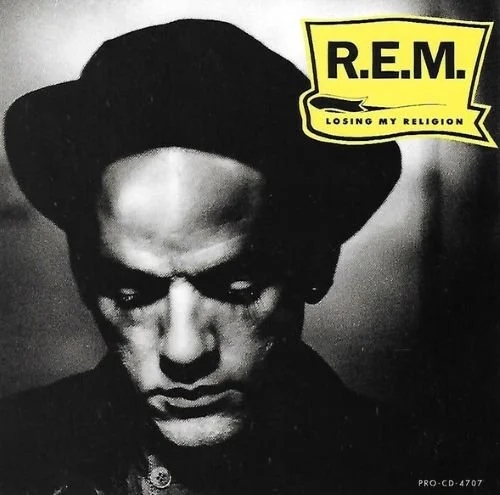
R.E.M. – Losing My Religion
__________
THERE is…
an anniversary-related reason why I am including R.E.M.’s Losing My Religion in this Groovelines. One of the legendary band’s best-loved and most popular songs, it was released on 25th February, 1991. I am looking ahead to its thirty-fifth anniversary. Losing My Religion was the first single from R.E.M.’s seventh studio album, Out of Time. This was an incredible period for the group. A year after Out of Time was released, in 1992, they released perhaps their most important album, Automatic for the People. Their music in 1991 and 1992 up there with any other artist. Automatic for People is my favourite R.E.M. album, though I really love Out of Time. It remains underrated. Losing My Religion is a masterpiece song with a wonderful video. I am curious if there will be any recognition of its thirty-fifth anniversary. Losing My Religion reached four on the U.S. Billboard Hot 100. It got to nineteen in the U.K. Everything came together perfectly on the lead single from Out of Time. Get Up was the final single from the previous album, 1988’s Green. I think Losing My Religion was this shift that was unexpected. I was six when Losing My Religion came out, and I can faintly remember the song being played. It is a remarkably entrancing thing. Michael Stipe’s vocal. Confessional, emotional, strong and timeless! I hear the song now and, hundred of listen later, Losing My Religion still holds this power and sounds amazing and fresh. There are some features I want to get to, including some around its truly iconic video. I am starting out with Give to Rock and their article regarding the story behind one of the most astonishing tracks R.E.M. ever produced. It is a song that I have loved since I was a child and can listen to endlessly:
“Contrary to popular belief, Losing My Religion is not about losing faith or becoming an atheist. In fact, the phrase "losing my religion" is an old Southern expression that means "losing one's temper" or "being at the end of one's rope". As lead singer Michael Stipe explained in an interview: "It's just a classic obsession pop song. I've always felt the best kinds of songs are ones where anybody can listen to it, put themselves in it and say, 'Yeah, that's me.'" The song is about unrequited love and the frustration and desperation that comes with it. The narrator is obsessed with someone who doesn't reciprocate his feelings, and he feels like he has said too much or not enough to win them over. He imagines hearing them laugh or sing or try to reach out to him, but he knows it's all in his head. He is losing his grip on reality and his sense of self.
The Music of Losing My Religion
One of the most distinctive features of Losing My Religion is its mandolin riff, played by guitarist Peter Buck. Buck had bought a mandolin at a local music store and taught himself how to play it by listening to records. He came up with the riff while watching TV one day and recorded it on a cassette tape. He brought it to the band's rehearsal studio and played it for Stipe, who immediately liked it. The rest of the song was built around Buck's mandolin part, with bassist Mike Mills adding piano chords and drummer Bill Berry playing tambourine instead of drums. The band wanted to create a folk-rock sound that was different from their previous work. The result was a unique blend of acoustic instruments and electric guitars that created a rich and atmospheric sound”.
I am going to move to a fascinating article (one that is paywalled/subscription-blocked) about a brilliant and alternative (perhaps with a capital A too) number one. Stereogum provided their take on a song that has been discussed and dissected for thirty-five years now. Even though R.E.M. are no longer together, Losing My Religion has taken on a life of its own. It has affected so many people in different ways:
“For six weeks in spring 1990, Sinéad O'Connor's I Do Not Want What I Haven't Got was the #1 album in America. After that, the country went through more than a year without a rock LP on top. Instead, newer forms of popular music held the album charts in thrall, as MC Hammer, New Kids On The Block, Vanilla Ice, and Mariah Carey traded off the top spot. Finally, in May of 1991 -- the last week before Billboard started using SoundScan to keep track of album sales -- something funny happened. R.E.M., longtime heroes of the American college-rock quasi-underground, found themselves on top of the Billboard 200 for the first time ever.
The first week that Billboard started using SoundScan, Michael Bolton booted R.E.M. out of the #1 spot. A week later, however, Out Of Time was back on top again -- proof, if you needed it, that lots and lots of people were buying R.E.M. records. "Losing My Religion," the chiming and elliptical lead single from Out Of Time, became the sort of thing that I heard whenever my parents drove me to little league practice. This was the moment just before the fabled grunge takeover started, a time when self-serious folk-rock couldn't have been further from the American mainstream. Again, I must ask: How?
The answer is the same as always: "Losing My Religion" was the right song at the right time. R.E.M. started off pretty hot a decade earlier, and they grew steadily in the years that followed. They'd made two top-10 pop hits already, and they'd graduated to arenas when they toured behind their first major-label album, 1988's Green. R.E.M. built an audience on the road, and the music press in both America and the UK sold their legend to the world.
R.E.M. played the game while giving the impression that they were not playing the game. The band embraced some parts of the music business enthusiastically, doing tons of interviews and dropping by radio stations whenever they had product to push. But they avoided other parts -- opting not to print Michael Stipe's hard-to-discern lyrics in their liner notes, refusing to lip-sync in videos. They carved out a niche as a mainstream version of an underground band, and for a little while, they were one of the few bands that fit that definition.
And then there was "Losing My Religion." In some ways, the song was perfectly in keeping with the style that R.E.M. had already developed over six albums. In others, the track was a weirder, quieter move for a band that was already plenty weird and quiet. R.E.M. wrote "Losing My Religion" on largely-unfamiliar instruments, and Michel Stipe sang lyrics that hinted broadly at big subjects without ever lapsing into literalism. For the first time in their careers, the group made a big-budget music video for the clip, and Stipe even consented to lip-sync. The song itself was good, too. That helped.
In the world of modern rock radio stations, the one that I write about in this column, the release of Out Of Time was always going to be an event. R.E.M. were the saints of college radio. Green came out shortly after Billboard started running the Modern Rock chart, and two of its singles, "Orange Crush" and "Stand," have already been in this column. Modern rock programmers were so in love with R.E.M. that even the band's wackiest side projects got some radio play.
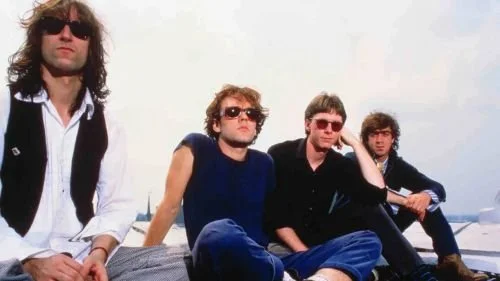
IN THIS PHOTO: R.E.M. in 1987: (from left) Peter Buck, Michael Stipe, Mike Mills, Bill Berry/PHOTO CREDIT: Chris Carroll/Corbis via Getty Images
In 1987, for instance, all four R.E.M. members worked on Warren Zevon's Sentimental Hygiene album. During those sessions, Zevon and R.E.M. resurrected the Hindu Love Gods, a just-for-laughs group that played a few live shows in Athens. During those sessions, Zevon and the R.E.M. guys got drunk one night and recorded a bunch of covers, mostly of blues standards. In 1990, Warner Bros. released that session as the Hindu Love Gods' self-titled album, and it was mostly ignored -- except on the Modern Rock chart, where the band's cover of Prince's "Raspberry Beret" made it to #23. It wasn't a hit by any stretch, but you have to be at a certain level when even your drunken larks make the charts.
After touring behind Green, R.E.M. took a little time off. Michael Stipe toured Europe with his friends Billy Bragg and Natalie Merchant, while the other guys played on other people's records. R.E.M. kept releasing one-off singles, usually covers, for members of their fan club. That's the kind of break that most big-deal bands need to recuperate when they're finishing up their exhausting cycles. But R.E.M. reassembled relatively quickly, and the non-Stipe band members started putting together instrumental backing tracks, keeping their core chemistry intact even as they messed around with instrumentation.
During those Out Of Time sessions, drummer Billy Berry played a lot of bass, bassist Mike Mills mostly stuck to keyboard, and guitarist Peter Buck got excited about mandolin. Buck had been trying to teach himself mandolin for a while; he brought an acoustic one with him when R.E.M. toured behind Green. Buck didn't want to make a loud rock record. Instead, he got into the idea of chamber music and lush instrumentation. The band also had another musician along for those sessions: Peter Holsapple, formerly of the dB's, a cult-favorite New York power-pop group that broke up in 1987. Holsapple was a touring member of R.E.M. for years, and he played on a bunch of Out Of Time tracks, but he eventually split with the group when he got upset over how much he was being paid.
After his bandmates worked on backing tracks for a while, Michael Stipe came in and figured out lyrics, and then the four of them figured out how they wanted the album to come together. The four of them collectively decided beforehand that they wouldn't tour behind Out Of Time, which opened up the sense of what they could do in the studio. They brought in the B-52's' Kate Pierson to sing on a couple of songs and Stipe's friend KRS-One to rap on the weird album opener "Radio Song." (Apparently Stipe and KRS used to get together and talk about the environment? I have a very difficult time picturing this.) They added in strings and horns and other instruments, and they took their time recording everything with longtime producer Scott Litt before mixing the tracks at Prince's Paisley Park studios.
Peter Buck came up with the "Losing My Religion" riff one night while he was watching TV and noodling with his mandolin. He kept his tape recorder running, and when he listened back, he heard something that he could use. Mike Mills landed on a bassline that, at least to him, sounded like something from a Fleetwood Mac record. (He had to go back to those records to make sure he didn't unintentionally steal something.) Peter Holsapple played acoustic guitar. Buck later claimed that the music took maybe five minutes to write and that Michael Stipe took less than an hour with his lyrics. The band was just in that kind of flow-state, operating on momentum and expertise.
Michael Stipe has given a few different explanations for his cryptic "Losing My Religion" lyrics, but he's always been clear to point out that the song isn't about religion as such. On the song, the band certainly plays around with churchy iconography. The music has a strange and ritualistic grace, and Stipe does have that line about choosing his confessions. But Stipe has always pointed out the Southern expression "losing my religion" -- meaning blowing your top, losing touch with your politeness -- when describing the song. (I live in the South, and I've never heard anyone use the expression that way. But maybe it's a regionally specific thing, or maybe that's just a symptom of living in the South after "Losing My Religion.")
Early on, Michael Stipe said that "Losing My Religion" was about unrequited love and obsession. In 1991, he told Rolling Stone that he wished he'd sung "that's me in the kitchen" instead of "the spotlight," and he later claimed that the kitchen line was the original lyric. From that standpoint, "Losing My Religion" is about being attracted to someone but being too nervous and unsure of yourself to say anything. You're at a party by yourself, trying to fade into the background. You're just watching someone, analyzing them, overthinking every laugh and whisper, worrying that you've said too much. Been there, brother.
"Losing My Religion" shot straight to the top of the Modern Rock chart and stayed there for eight weeks, tying a record that R.E.M. set with "Orange Crush" two and a half years earlier. "Losing My Religion" also crossed over to the Hot 100, peaking at #4 in June. (It's still R.E.M.'s highest-charting single on the big chart.) Soon, Out Of Time became R.E.M.'s first #1 album in the UK and then in the US. The album and single were huge all over the world, and the "Losing My Religion" video stayed in heavy MTV rotation for months. That September, "Losing My Religion" swept the VMAs, winning six trophies, including Video Of The Year. R.E.M. did not perform at the ceremony. Tarsem Singh became pretty famous on the strength of that clip, and he went on to a career directing big-budget commercials and visual-feast movies like The Cell and the now-lost film The Fall”.
I will come to the video for Losing My Religion soon. However, I want to get to a 2022articles from Loudwire, where we get revelation from Michael Stipe that the song is not about him. I am not sure whether I totally buy that! However, it is interesting what Stipe says about the song, over thirty years since it was released. If you are not familiar with R.E.M. or missed them first time around then I would say that Losing My Religion is a great starting point:
“I changed one lyric, I remember... [Instead of] 'that's me in a corner, that's me in the spotlight,' [it previously was] 'that's me in the corner, that's me in the kitchen,'" stated Stipe.
He continued, "So, what I was pulling from was being the shy wallflower who hangs back at the party, or at the dance, and doesn't go up to the person that you're madly in love with and say, 'I've kind of got a crush on you. How do you feel about me?' So there's this whole relationship that's happening only in the person's mind. And he doesn't know whether he's said too much or hasn't said enough. So he's like, in the corner of the dance floor, watching everyone dancing, watching the love of his life, on the dance floor dancing with everyone, 'cause that's the most exciting person. Or he's in the kitchen, behind the refrigerator."
It appears as though Stipe was more basing the wording around a character idea, but as he reveals, "I changed the 'kitchen' to 'spotlight' and instantly, of course, the song became about me, which it never was, I don't think. I mean, I'm pretty self-aware. But the video with Tarsem [Singh] is what really pushed it over the edge. And that was probably the queerest video of all time. And that was kind of nice."
Though R.E.M. had toiled as college radio favorites for years in the '80s and were starting to see some mainstream attention over their two previous albums, it was "Losing My Religion" from Out of Time that catapulted them to the biggest success of their career.
"When 'Losing My Religion' hit - you know, I'm not a person who has ambitions; if they're there, they are unconscious or subconscious, but I did always want to be really famous," said Stipe. "And I didn't realize what that really entailed. Looking at it from the other side, it's nice to be anonymous again - I'm on the subway and nobody knows who I am. They don't look at me, anyone under the age of 30 does not even look at me because they just register old. And I'm fine with that. It's totally amazing."
"But 'Losing My Religion' was when I went from being someone that was recognized by people in my age group who love a certain type of music to being universally, wildly, insanely famous. And on the street, I couldn't go anywhere. And I was okay. It was kind of charming... But 'Losing My Religion' really changed it for me. And the one thing - if I ever had an ambition, it might be to have a song of the summer, and 'Losing My Religion' became R.E.M.'s song of the summer. And that was thrilling”.
A few features about the video. This Rolling Stone spoke with the video’s director Tarsem Singh in 2016. In terms of the concept and feel of the video, it must have been quite daunting for a director to get it right. However, what we get from Losing My Religion is perfect. The imagery of the video has created conversation and debate for years. It is so fascinating to watch! Michael Stipe so hypnotic throughout:
“Twenty-five years ago, R.E.M. released Out of Time, which eventually sold over four million copies in the United States and transformed longtime college radio darlings into a mainstream concern. It was the album’s first single “Losing My Religion” that definitively turned the group to artistic and commercial leaders of the burgeoning alternative rock movement. Up until this point, the group’s singer Michael Stipe had directed their music videos, or had entrusted them to people rooted in the art world like Robert Longo, James Herbert and Jem Cohen. Stipe had also stated publicly that he would never lip sync in a video — a claim he backed up in every video during the band’s first ten years.
Though the band and their label sensed that this was their potential crossover moment, they selected Tarsem Singh to direct “Losing my Religion.” Singh (credited as just Tarsem) was finishing up film school at the Art Center College of Design in Pasadena while nearing the age of 30 and selling cars in the summer to afford tuition. He had previously directed only two videos for record labels — for Suzanne Vega and En Vogue — but the young director managed an artistic triumph. “Losing My Religion” would go on to win six MTV Video Music Awards, including Best Video and Best Direction as well as the Grammy for Best Short Form Video.
After “Losing My Religion” Singh would quickly depart from videos to produce commercials and visually stunning films including The Cell and Mirror Mirror. Here Singh tells the story of how the captivating and confounding video for “Losing My Religion” came to be.
Tarsem Singh: I had done a Suzanne Vega video [for “Tired of Sleeping”], I really liked the song and I wanted to do something in the style of the photographer [Josef] Koudelka. The Czech Republic was just opening up. My college professor at the time was from the Czech Republic and I told him, “You want to go there for a week? We can shoot this thing in the countryside. They don’t seem to have a working currency. We can sleep in a bus and do it.” He said, “OK.” That landed with the R.E.M. guys and Stipe was a fan of Koudelka. They approached me to see if I was interested in doing a music video.
The reason I only did [a small number of music videos] was I never really was a very good music video person. I’m quite the opposite from people like Mark Romanek and David Fincher. They always had a team of people and did it correctly. I never wrote [a treatment] for a song, ever. I would just have this idea and I would assume that when the right song comes along, I’ll do the music video. Later it kind of created not-so-friendly situations where bands that I love and adore would know that I liked their music and would send me a song. I would hear it and go, “That’s great.” Then I would spend some time and go, “Oh, it doesn’t fit into any of my ideas.” And everybody would say, “It’s supposed to be the other way around”.
Before ending with a brilliant feature about the video and some of the iconography, American Songwriter covered a music video that actually caused quite a bit of consternation and controversy. As it was seemingly alluding to faith and the video featured references to homosexuality, of course it was seen as outrageous and blasphemous from select idiots. What should have been a celebration was marred by the prejudicial and pious ignorance of certain groups and nations. Maybe confirming its brilliance and importance in the meantime! Giving Losing My Religion and its video more attention:
“R.E.M. is one of the most iconic bands of the 80s and 90s, given that they did not fall into the boy band and pop music fads of the decade. They were unique, subversive, indie, and appealed to music fans who disliked groups such as Duran Duran and The Cure. The songs that helped R.E.M. score such individualistic success include “Everybody Hurts”, “The One I Love”, “Shiny Happy People”, and the controversial Top 5 hit single, “Losing My Religion”.
Needless to say, the single garnered a lot of attention, and so did the music video for it. However, the attention brought on by the music video wasn’t necessarily positive. Certain Christian religions detested the video for its sacrilegious imagery. As a matter of fact, the Irish government actually banned the video from the entry country for this reason.
Why the Irish Government Banned R.E.M.’s Disruptive Video
R.E.M.’s music video is clearly controversial, but that was seemingly their intention. While the lyrics of the song do not articulate a loss of faith, the music video arguably does. This is primarily due to the fact that R.E.M. depicts several contrasting religions simultaneously. They feature religious figures such a Saint Sebastian, Thomas’s Incredulity, and several Hindu deities. Furthermore, one of the more controversial aspects is the featuring of homosexual angles, and this is where the Irish government (possibly) took the most offense.
While the depiction of homosexual angels has never been confirmed, the masses interpreted the scene as such. Aside from that interpretation, the Irish government viewed the entire video as sacrilegious. Consequently, the Irish government and its strong Catholic values banned the video from Irish television.
The song itself was not banned from the Irish airwaves, and despite this ban, the single still became a monster hit worldwide. Following the song’s 1991 release, the single peaked at no. 4 on the Billboard Hot 100 and reached the Top 20 in the UK, Canada, and Australia”.
Last year, Songs that Saved Your Life provided some fascinating details and interpretations. Reasons both personal and widespread why the song is so meaningful. They asked: “Is “Losing My Religion” a song about reconciling religious beliefs alongside unrequited queer love? Well, no. But also, of course it is”. R.E.M. created this masterpiece. The first single from Out of a Time, an album that never got all the respect it deserved, it was a seismic moment in their already successful and notable career:
“For queer fans who interpreted “Losing My Religion” to be about the turmoil of coming out, these lines are frequently cited as evidence. “Losing religion” feels familiar to any queer person who’s been forsaken by the church. And in the early ‘90s, that was all of us. Stipe had refused to address his sexuality, so when “Losing My Religion” came out, people assumed that Stipe had as well. Stipe has never acknowledged this interpretation. In fact, he’s said he doesn't write narrowly biographical songs.
When Stipe came out three years later, the queerness and religious context of the music video that accompanied “Losing My Religion” affirmed people’s suspicions.
Up until this point, Stipe had directed most of the band's music videos or had entrusted them to visionaries rooted in the art world like Robert Longo and James Herbert. For “Losing My Religion,” Warner Brothers hired Tarsem Singh to direct. Singh said he was inspired by religious imagery, Caravaggio, and queer photography.
“I told him (Stipe) there’s a story by Gabriel García Márquez called A Very Old Man With Wings in which this freak angel arrives and nobody knows quite what to do with it,” Singh told Rolling Stone. “So it’s that story, told abstractly through the style of these guys called Pierre et Gilles, who are these iconic gay photographers that take how Indians do their gods and goddesses, then they do that to the Western gods.”
All of Singh’s references to Christian iconography are obvious. Caravaggio’s portrait of St. Thomas doubting the validity of Jesus’ resurrection is blatantly depicted throughout the video. Except in Singh’s version, Jesus is replaced with the angel from A Very Old Man With Wings who fell to Earth and is mocked by humans. The video’s mocking might’ve struck a nerve with bullied or ostracized queer teens, even if this version of the art wasn’t supposed to be about them either.
Singh speaks to them again, though, by mixing queer and religious iconography in the style of photographers Pierre et Gilles, as he depicts androgynous angels and a very feminized version of Saint Sebastian.
The story of Saint Sebastian is itself decidedly queer. As a Christian, Sebastian was sentenced to death by a Roman archer firing squad. The image of him tied to a tree, his body pierced by arrows, has become iconic in art history — but also in queer history. Queer people have long interpreted Sebastian's persecution as a coming-out narrative, in which the martyr reveals his truth and is punished by mainstream society. In 1976, queer artist Derek Jarman interpreted the story of Saint Sebastian through a homoerotic lens in his film Sebastiane. British painter Keith Vaughan similarly depicted Sebastian.
One of the most famous paintings of St. Sebastian was by Guido Reni in the 17th century. In 1877, Oscar Wilde visited the Palazzo Rosso to see the painting.
Wilde later wrote in “The Grave of Keats,” “The youngest of the martyrs here is in lain / Fair as Sebastian, and as early slain.” Wilde would liken himself to Sebastian as a countercultural figure, even changing his own name to Sebastian Melmoth when he was imprisoned and then exiled for being queer.
Then there’s the fact that Sebastian is also known as the protector against plague, which felt in the ‘90s like another of the music video’s nods to the queer community fighting the AIDS pandemic.
Whether the music video’s interpretation for “Losing My Religion” had Michael Stipe’s papal blessing for being about religion, queerness and the reconciliation between the two, is irrelevant. Art is always subject to interpretation. Closeted people might think the song is about coming out. People having a crisis of faith might think the lyrics sing their pain. When realizing the context of the song being written by a closeted queer man, the interpretations aren’t so far-fetched”.
Losing My Religion turns thirty-five on 25th February, which seems staggering! 1991 is undoubtably one of the greatest years for music ever, and R.E.M. were a big part of that. So many people discovered the band after hearing this song and watching the stunning video. In 2011, Rolling Stone ranked it as their best song: “Whenever the mandolin was brought onstage by a roadie at R.E.M. concerts, the place would explode because everybody knew they were about to play this song. This is the one on karaoke machines. This is the one that your mom knows. The huge success of this unlikely hit catapulted the band to the next level and led to the most successful period of their career. Some longtime fans were turned off when "Losing My Religion" hit big, but the band didn't care. "The people that changed their minds because of `Losing My Religion' can just kiss my ass," Peter Buck told Rolling Stone in 1991”. In 2023, The A.V. Club placed it in second.
If confirmation were needed of Losing My Religion’s superiority, in a feature from Uncut from last November, they revisit a 2003 edition where Peter Buck, Mike Mills and Michael Stipe chose their favourite major label R.E.M. songs. Over twenty years since the band discussed the song, I know they will still see it as a favourite. It is clear their careers changed significantly in 1991 when the single came out:
“1 LOSING MY RELIGION
From the 1991 album Out Of Time.
Released: February 1991. Chart positions: UK No 19, US No 4
REM’s music has always been marinated in irony and here was the supreme example. Following Green’s several attempts at ostensibly big, dumb, self-consciously pop songs, the single that finally pushed them way over the top commercially wasn’t a ‘please-buy-me’ capitulation to mass sensibilities but one of their most ‘natural’ and personal testimonies, the mandolin and melody running as clear and as beautiful as spring water. There’s none of the forced extroversion that occasionally characterised REM at this time – rather, it sees Stipe agonising over the pressures and compromises of fame, the potential loss of integrity and privacy. “I don’t know if I can do it,” he declares, tottering along the fine line that has always defined REM: “I’ve said too much/I haven’t said enough.” Yet rather than REM putting on make-up and seeking out the commercial spotlight, for “Losing My Religion” it was the spotlight that sought out REM in their own dark, quiet corner, doing their own thing. And the world fell in love with them for it. That, and Stipe’s silly dance. Perfection.
PETER BUCK: I bought the mandolin at the end of 1989 and I wrote the song, the music, in about 1990, so I hadn’t been playing it that long and didn’t play very well – I still can’t really. I only pick it up to play “Losing My Religion”.
MIKE MILLS: The record company were using it as a warm-up to “Shiny Happy People”. They didn’t expect it to be a hit.
MICHAEL STIPE: “The One I Love” was the song that had established us on radio. So, after that, we consciously put out singles prior to the album that would totally challenge radio. The idea was, let’s blow the gates wide open, knowing that radio would play whatever we did and whatever the record company threw at them, because they had six weeks before the album. So we had this clout to release these incredibly strange songs that they’d then play on the radio, which in our minds would open up radio, open up formatting, would make it available to the Grant Lee Buffalos of the world. We were being altruistic but a little cocky as well. I mean, “Losing My Religion”? There’s no chorus, there’s no guitar, it’s five minutes long, it’s a fucking mandolin song. What kind of pop song is that?
MIKE MILLS: Musically, it’s very straightforward, but there’s something satisfying about that song, in the sense of the way the sound of the mandolin combines with the chords, the appealing, evocative nature of the lyrics – and a fabulous video. I have to admit, I’m not really a great fan of videos, but there’s something about the video for that song which made its success. And you put that together and it’s kind of a fluke, but thank goodness. I’m not even sure if that song could be a single now, if it would even be selected. But it came out at the right time, the right place…
MICHAEL STIPE: They said I stole the dance for the video to “Losing My Religion” from David Byrne in “Once In A Lifetime”. But that’s not true. I actually stole it from Sinéad O’Connor. The director of that video had a very clear idea of what it was going to be. My performance took a lot from Bollywood, Russian constructivist posters and so forth – he wore his references very clearly and openly. He wanted my performance to be complete Bollywood, where I’m sitting facing the camera like Cleopatra on the fainting couch, with my legs wrapped around each other and flowers all around me and then turning in this contorted way and delivering my line. And he worked about half a day with me doing all these poses. Then after half a day he came up to me and said, “I feel really uncomfortable.” And he went to the bathroom and vomited his guts out. Then he came back and said, “I don’t know what to do.” He had this budget, all these actors, this very expensive set and it wasn’t working. I was giving everything that I had but it wasn’t working. So I said, “Turn on the camera and let me do what I do, let me sing my lines the way I would sing them.” And I didn’t have a mic stand – so I had to do something with my hands. And I thought of “The Last Day Of Our Acquaintance” by Sinéad O’Connor – and her performance in that video was fucking beautiful. So I did my version of Sinéad. And it worked.
PETER BUCK: For Out Of Time, we’d decided to turn our back on touring, even though we assumed it was going to kill our career stone dead. We had a big meeting, in which we considered if we were going to have to cut our salaries, collect on insurance for not touring. And following the success of “Losing My Religion”, the album sold 10 million copies. So we were like, “Whatever.” But I was quite prepared for it to go the other way. My feeling was that if we can’t be successful being who we are then I just don’t want to be successful. There’s nothing worse as a fan than when you see a band with a unique identity who will then give it up just to have a hit. Because what are you giving it up for? Money? Well, hey, I have a middle-class attitude towards money, I assume I can always work or something. But to sell your soul – or sell your soul and then not sell records – think about how bad that would be. And I know people that’s happened to and now, they’re like, “What was I thinking?”.
I shall leave if there. I needed to take this time to truly get to the bottom of not only one of the best songs of the 1990s and R.E.M.’s career. Losing My Religion is one of the greatest songs ever. Almost hymnal and gospel in its power and soulfulness, whether you see it as a song about alienation or loss of faith or struggle with revealing feelings for someone and having that desire that is not required, the sense of mystery and open-to-interpretation-intrigue that makes it such a classic. Ahead of its thirty-fifth anniversary, I wanted to show my praise for a song that is almost like a religious experience. Spiritual and divine, it is a track that will be…
DEAR in the hearts for so many people.