FEATURE:
Leaves That Are Green
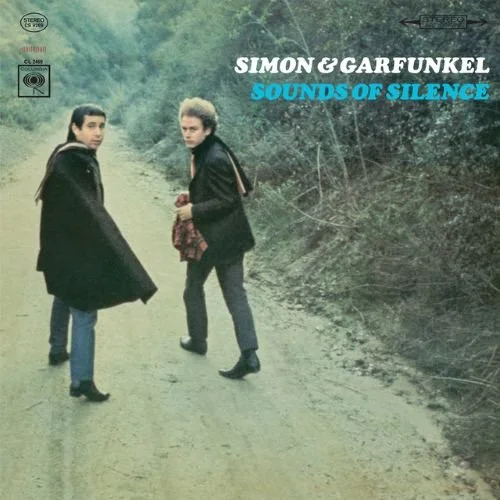
Simon & Garfunkel's Sounds of Silence at Sixty
__________
EVEN though…
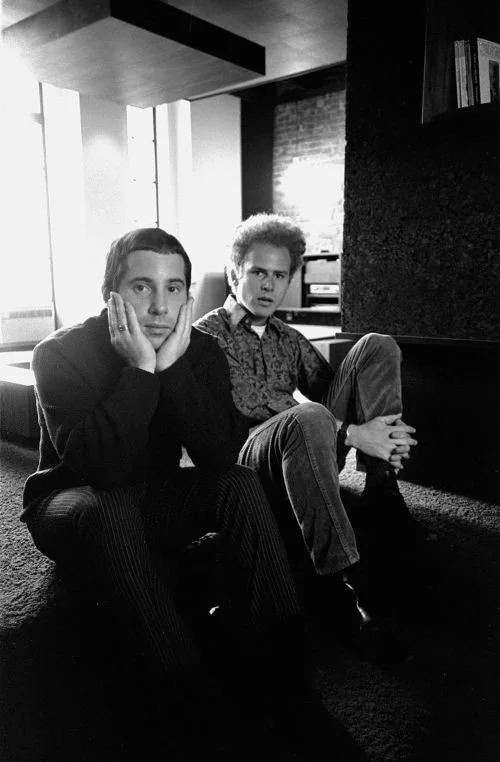
IN THIS PHOTO: Paul Simon and Art Garfunkel in 1966/PHOTO CREDIT: Douglas Gilbert
the gap between their first and final album together was six years, Simon & Garfunkel released some of the best music of the 1960s. I guess The Beatles were active for a similar period of time. In the case of Simon & Garfunkel, every one of their six studio albums was superb. Such a consistent and rich body of work from Paul Simon and Art Garfunkel. They released two albums in 1966. I am going to talk about the first one, released on 17th January. As Sounds of Silence turns sixty very soon, it is worth reflecting on this album. The U.S. version is terrific, however, the U.K. version features the sublime Homeward Bound, which is one of the very best Simon & Garfunkel tracks. The song had earlier been released in an acoustic version on the album Wednesday Morning, 3 A.M. And it later featured on the soundtrack to the movie, The Graduate. Unfortunately, without the knowledge of Paul Simon or Art Garfunkel, electric guitars, bass and drums were overdubbed under the direction of Columbia Records staff producer, Tom Wilson. I Am a Rock is the final track on the U.S. release, and it is another masterpiece. The songwriting of Paul Simon at its peak. However, he would continue to write brilliant music for the duo until 1970’s Bridge Over Troubled Water. Simon, of course, has this incredible and decades-long solo career. Garfunkel has a solo career too, and his most recent album, Father and Son, was released in 2024. It was made with his son, Art Garfunkel Jr.
Perhaps not seen as the best album from the duo, they did distance themselves from it. Paul Simon released acoustic versions of the songs in 1974. However, Sounds of Silence is a landmark album, and one that contains these incredible compositions by this exciting new duo that helped transform the Folk scene in the 1960s. If we associate the glory days of Folk music (largely coming out of New York) with people like Joni Mitchell and Bob Dylan, I think Simon & Garfunkel are not talked about quite as much. I am going to start out with a feature from Consequence of Sound from 2016. They celebrated fifty years of Sounds of Silence. They spoke with the writing duo of Goble and Bray to get these thoughts about the album:
“Sounds of Silence rode the folk-rock wave to exciting highs, with commercial slickness unrealized in the duo’s previous efforts, and it’s lasted in a curious way for its pop cultural second life in comedy.
For this latest anniversary edition of Dusting ‘Em Off, Consequence of Sound has assembled a fresh-faced new duo by the name of Goble and Bray. They haven’t expressed frustrations over differences in their art, so their partnership is a rock, not an island.
Blake Goble: Yes, yes, this is a little memetic at this point, but let’s really take a moment to listen. The simple back-and-forth of a guitar. And then the whispery calm voices open up in unison.
Fascinating, huh? How a single tune, no, the beginning of one, can conjure up a million different connotations, feelings, and vivid images. Whether it’s the soft-spoken stylings of folk-rock’s most finely harmonized duo, the jaded angst of a whole decade, or the existential dread of the oldest Bluth brother, that song is still talked about and fascinating to this day. That’s probably 83% of why we still reference the Sounds of Silence and the sounds of Simon and Garfunkel.
And yet Sounds of Silence remains fascinating for its popularity, its genesis, and its differences from Wednesday Morning, 3 A.M. This album was secretly mainstreamed by Columbia Records with electric guitars and studio sounds, unbeknownst to the pair. It featured re-hashed material, and spoke awkwardly to the creative differences of the duo (especially when considering how Simon wrote much of it while living in London). And yet, the album plays on, having just been added to the Library of Congress in 2013, while the catchy title track remains a popular hit.
Ryan Bray: I wish I could sit here and come up with a cool story about how I discovered Simon and Garfunkel, but I’d be lying. The Graduate is such a classic inroad to the duo, and Sounds of Silence in particular, and I’m just one of the film’s many victims. For the sake of context, I fell pretty hard for ‘60s and ‘70s film during my freshman year of high school. Many hours were spent wading through classic chestnuts of American cinema’s golden age, so it was only a matter of time before I found my way to The Graduate.
Blake Goble: However, when I’m listening to Sounds of Silence, the album proper, I’m very much in the poppy, folky, and, at times, even corny ‘60s vibe of that very particular moment for Simon and Garfunkel.
This is the album with the jollity of youthful expressiveness, as heard on “I Am a Rock”. Or the snappy guitars and bass on top of “Richard Cory” and “Blessed”, not to mention the former’s over-produced sound of soft organs, which comes across like something eerily similar to the Monkees. See also: “We’ve Got a Groovy Thing Goin’. You can almost imagine some geeky guy in mod hair and Austin Powers boots playing tambourine to that one”.
There are a couple of reviews that are worth highlighting. Not as celebrated as the albums that would follow – 1966’s Parsley, Sage, Rosemary and Thyme, 1968’s Bookends, and 1970’s Bridge Over Troubled Water -, I do think that Sounds of Silence is a masterpiece that deserves recognition ahead of its sixtieth anniversary. This review writes how this album still sounds fresh. So many years after its release, you can feel and hear how so many artists have been influenced by Sounds of Silence:
“Mr. Tambourine Man” by The Byrds was released in April of 1965. It quickly became the number one song in the country and helped popularize the sound known as folk/rock. Tom Wilson, who had produced Simon & Garfunkel’s first album, had an idea while listening to this song.
His inspiration led to the birth of a legendary career. Wilson took an obscure Paul Simon acoustic folk tune from the Wednesday Morning 3 A.M. album and added an electric guitar, bass and drums. What emerged from these additions was the number one song, “The Sounds Of Silence.” Simon and Garfunkel quickly returned to the studio to record their second album.
Sounds Of Silence would be a commercial coming out party for the duo and a transitional album for their career. They were now poised between folk and pop but more importantly Paul Simon had begun to write the type of songs that would propel him into the upper echelon of writers.
This release is propelled by the two great and memorable singles that serve as bookends for the album. The lyrics of the title tune are equal to any that were being produced at the time as Paul Simon emerged as a rare master of imagery and story telling. It is also one of those rare songs that defines a period of time and is instantly recognizable by its first few notes. “I Am A Rock” continues this use of imagery. This sensitive and thoughtful song of loneliness is poetry set to music. The subtle up-tempo nature of the song only served to increase its impact.
Paul Simon did not leave his folk roots completely behind. “Richard Corey” and “A Most Peculiar Man” are two of the darkest songs that he would write, yet they would be musically upbeat enough to throw the listener off guard. “Richard Corey” was about a man who has everything and one who works in a factory and hates his life. Yet it is the man with the perfect life who puts a bullet in his head, which the other cannot understand. “A Most Peculiar Man” is a song of a person’s life and death which didn’t matter to anyone.
“Kathy’s Song” is one of the great forgotten tunes in the Simon & Garfunkel catalogue. This sensitive and thoughtful song of love and longing may be a very personal glimpse into the life of Paul Simon.
There were several other highlights to the album. “We’ve Got A Groovy Thing Goin'” is about as close to rock ‘n’ roll as the duo would get. “April Come She Will” is a short song in the folk tradition of love’s growing old with the seasons. “Blessed” is an early socially conscious song. There is biblical imagery (beatitudes) that form the lyrical foundation.
Sounds Of Silence has held up well over the years and still sounds fresh despite the fact that Simon & Garfunkel would quickly supersede it with their future releases. Still, it remains a very good and relevant album”.
I am going to end with a review from AllMusic. One cannot deny that some of the songs on Sounds of Silence are genius. The vocal blends of Paul Simon and Art Garfunkel. It is a majestic collection of music that has so many highlights. Even if the duo quickly followed their second album, I do think we need to acknowledge the impact and brilliance of Sounds of Silence:
“Simon & Garfunkel's second album, Sounds of Silence, was recorded 18 months after their debut long-player, Wednesday Morning, 3 AM -- but even though the two albums shared one song (actually, one-and-a-half songs) in common, the sound here seemed a million miles away from the gentle harmonizing and unassuming acoustic accompaniment on the first record. In between, there had been a minor earthquake in the pop/rock world called "folk-rock," which resulted in the transformation of their acoustic rendition of "The Sound of Silence" into a classic of the new genre, complete with jangling electric guitars and an amplified beat that helped carry it to the top of the charts. The duo hastily re-formed, Paul Simon returning from an extended stay in England with a large song bag (part of which he had already committed to vinyl, on his U.K. album The Paul Simon Songbook). Simon & Garfunkel rushed into the studio in the fall of 1965 to come up with a folk-rock album in a hurry: fortunately, they'd already recorded two sides, "Somewhere They Can't Find Me" (actually, Simon's rewrite of their first album‘s title track) and "We've Got a Groovey Thing Goin'," both featuring a band accompaniment. Davy Graham's bluesy "Anji," a rare instrumental outing by Simon, filled another slot, and "Richard Cory" filled another. The latter, Simon's adaptation of poet Edwin Arlington Robinson‘s work, was a sincere effort at relevance -- Richard Cory has every material thing a man could want but still takes his own life, a hint at one aspect of middle-class teenaged angst of the mid-'60s; high school English teachers were still using it to motivate students in the '70s. Though a rushed effort, this was a far stronger album than their debut, mostly thanks to Simon's compositions; indeed, in one fell swoop, the world learned not only of the existence of a superb song-poet in Paul Simon, but, in Simon's harmonizing with Art Garfunkel, the finest singing duo since the Everly Brothers. But it also had flaws, some of which only became fully apparent as their audience matured: the snide, youthful sensibilities of "I Am a Rock" and "Blessed" haven't aged well. And the musical concessions, on those tracks and "Richard Cory," to folk-rock amplification have also worn poorly; even in 1966, the electric guitars, piano, organ, and drums, sounded awkward in context with the duo's singing, like something grafted on, though in fairness, those sounds did sell the album. The parts that work best, "Kathy's Song" and "April Come She Will," two of the most personal songs in Simon's output, were similar to the stripped-down originals Simon had cut solo in England, and among the most affecting (as opposed to affected) folk-style records of their era; similarly, Simon's rendition of the folk-blues instrumental "Anji" is close to composer Davy Graham's original, just recorded hotter, while "Leaves That Are Green" is pleasantly if unobtrusively ornamented with electric harpsichord, rhythm guitar, and bass”.
I have a lot of love for Sounds of Silence. Turning sixty on 17th January, I wonder if anyone will provide an anniversary take on it. Reassess an album that, as I said, is not as revered as other work from Simon & Garfunkel. This is an album that I would recommend to everyone. So enduring and fantastic, go and play this brilliant album. Six decades on from its release, and its incredible beauty…
STILL shines.