
FEATURE:
Spotlight
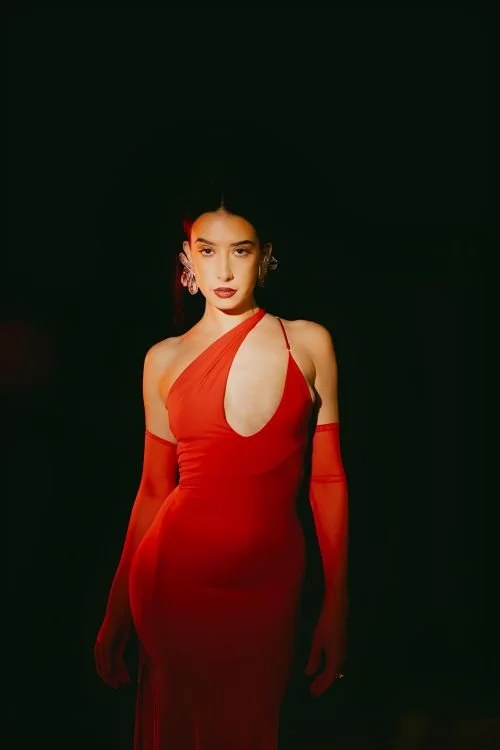
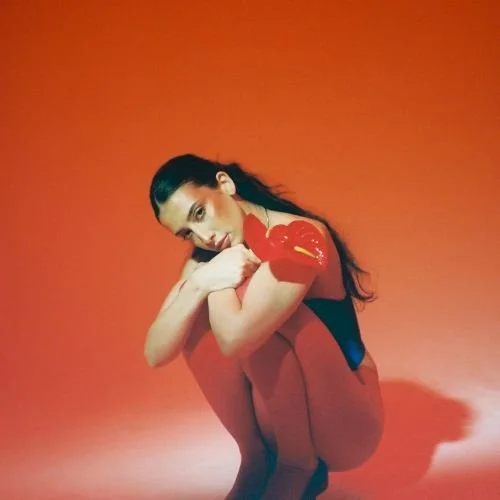
so it is a perfect time to discover and bond with Naïka. ECLESIA is an amazing and major statement from one of the most promising artists in music. I have said that about a couple of other artists recently, though I stand by those words. Naïka is someone that everyone needs to know! I am going to come to some interviews. However, first, here is some biography about an artist you will be hearing a lot more from in the coming year or two:
“Born to a French father and Haitian mother, Naïka embodies the new generation of global pop artists. Having lived and grown up between the Caribbean, South Pacific, Africa, France and the United States, Naïka has developed a sound that bridges cultures, a vibrant blend of Pop, R&B, and Afro-Caribbean influences anchored by her powerful voice and emotional storytelling.
Writing and singing in English, French, and Haitian Creole, Naïka brings a unique multicultural perspective to her art. Her music celebrates identity, resilience, and unity, turning her story into a symbol of connection across borders. As an independent artist, Naïka has built a worldwide community of over 2 million+ fans and surpassed 270 million streams across her three EPs Lost in Paradïse Pt. 1 (2020), Lost in Paradïse Pt. 2 (2021), and TRANSITIONS (2022). Her key tracks include Sauce (featured in an Apple commercial), Water (FIFA 21 soundtrack), 1+1, and 6:45.
Her upcoming debut album ECLESIA opens a new cinematic chapter, previewed by singles BLOOM, BLESSINGS, MATADOR, and ONE TRACK MIND.
Naïka’s rise has been exponentially building worldwide, with viral singles amassing hundreds of millions of streams, sold-out headline tours across Europe, North America and MENA, and major festival appearances. Her recent international tour sold out within 2 weeks of announcement in nearly every city, requiring venue upgrades and additional dates added in every city. Her influence continues to grow globally. Naïka was named Caribbean Fusion Artist of the Year at the 2025 Caribbean Music Awards, and her Grammy Reimagined cover of Doja Cat’s Woman became the most-viewed performance within 24 hours. Her music has charted on Spotify Viral and Shazam in over 40 territories, earning strong editorial support and covers on major DSP playlists.
Beyond music, Naïka is a dynamic force in fashion and visual storytelling. Known for her bold, eclectic aesthetic, she has collaborated with major luxury brands and cultural platforms including Jimmy Choo, Fendi, Jean Paul Gaultier, Burberry, Maison Margiela, Elle, Jamalouki Magazine, and more, building a visual universe as distinctive as her sound.
Furthermore, Naïka is deeply committed to giving back. She collaborates with organizations like Fleur de Vie, a Haitian NGO that focuses on improving education for children, with her ultimate goal of building a school in Haiti.
Naïka isn’t just an artist. She’s a world-builder, a storyteller, and the voice of a new global generation”.
In an interview from last year, The Line of Best Fit note how Naïka “used to see her multinational upbringing as a dilemma but in her seamless blend of pop, afrobeats and R&B sung in three languages she’s crafting anthems for a generation that finds home in a shared feeling”. I am bringing in parts of the interview where we learn about Naïka’s upbringing. Some of the lead-up to the remarkable ECLESIA:
“Born to a Haitian mother and French father, Naïka’s location was dictated by her father's work in renewable energy, which has seen her move between the Caribbean, Kenya, France, and South Africa. Every few years meant packing up and leaving to embark on a journey in a new country, as she tells me. Settling into a new school, learning a new language, and making new friends. "That's all I knew my whole life," she recalls. "We'd get somewhere, live there for three to four years, and then pack up and start over somewhere else." Unbeknownst to Naïka at the time, each move would add another layer to her identity, which she would ultimately come to appreciate wholly.
However, this all changed when Naïka’s father unexpectedly lost his job during her mid-teens. Her family settled in Miami, where Naïka was born but had never actually lived. Although Miami should have offered some level of familiarity, Naïka admits that it felt like arriving somewhere completely foreign. "For the first time, I had to come face to face with the question of my identity," she explains. "I was in a place that I was supposed to be from, and I felt so disconnected to and felt so lost and alien in."
"From that point on, there was always a bit of inner turmoil about where I belong, and who my community is. I never felt like I was enough of anything to be from somewhere,” she continues. “When I started making music, that was a bit of a stressful time, because I strive to be authentic. So, I was trying to figure out what angle I would take with my artistry and music. But little by little, with time, I started realising that instead of trying to find this one thing that doesn’t exist, I should just embrace all of it.”
Naïka’s desire to embrace every part of her experience has ultimately culminated in her debut album, ECLESIA, due for release in February. The name — suggested by her father — comes from an ancient Greek word meaning "a gathering, coming together of people,” as she tells me. “I thought that was so beautiful, and exactly the type of sentiment that I want to bring,” she smiles.
It’s fitting, as the album is eclectic by design. Across thirteen tracks, Naïka offers a thoughtful blend of pop sensibilities steeped in multicultural influences, sung across English, French, and Haitian Creole. "The album has a wide spectrum of different sounds, topics, and energies that fit so perfectly with who I am. ECLESIA is an introduction to what I truly have to bring to the table.”
The singles alone paint a vivid picture of the range within Naïka’s world. The smooth percussion of “Bloom” is punctuated by an almost buzzy key note against Naïka’s collected vocalising, creating something slightly off-kilter and engaging, an ode to her appreciation for subtle details. “Blessings” is drenched in tropical warmth, the production tinged with afrobeats influence. When Naïka sings, ”I should take my time, trust the signs, I decide all the blessings,” it feels meditative — a contrast to ”Matador”, which serves as a snappy, enticing curveball. It’s sung entirely in French, moving with quick, sleek rhythms.
Hearing Naïka navigate the language through her sound with such cool ease emphasises the artistry within her code-switching. It requires an intuitive gaze. Naïka’s multilingual approach to songwriting is organic; she doesn’t sit down and decide when a verse needs to be expressed in a different language in a calculated, organised way, but she lets the language emerge naturally from the emotion. Sometimes French captures a romantic inflection that English can't quite reach. Other times, a line demands the depth of Haitian Creole. "Different languages have their essence in a way," Naïka tells me. "Sometimes you can paint a more impactful picture with one language versus the other”.
I want to include parts of this interview from YUNG. They spotlighted Naïka because she was YUNG’s Breakthrough Artist of the Year in THE LIST 2025. Even though these are still early days for Naïka, I do feel like she is going to continue to rise and be this truly major artist touring the world and playing enormous stages:
“Her sound, a melting pot of pop, R&B, and global influences, reflects that emotional openness. Pop forms the foundation, she explains, but it’s shaped by the rhythms and textures she grew up with. “World music is quite a broad term,” she notes, “it’s the category my sound often falls into, even though what I’m actually doing is pulling from the cultures that shaped me.”
She keeps playlists not just of songs, but of sounds; percussions, synths, textures that spark something visceral. “Sometimes it’s like, why don’t we try this element? Or that rhythm?” she says. The process is experimental, intuitive, moving by feeling rather than the rigid grammar of genre. Trial and error is the point.
There are a few references she keeps close, not as influences in the traditional sense, but as markers she checks in with. Bob Marley, for the way his music could hold joy and grief at the same time without ever forcing either. Cesária Évora, for the softness, for how longing could exist inside something almost bare. Somewhere between them sits the Haitian saying “konpa synth”, it surfaces instinctively. Together, they don’t point her in one direction so much as keep her oriented.
And what anchors it all is trust. Trust in her instincts, in her collaborators, and in the idea that emotion, when followed honestly, will always find its form. However, that wasn’t always the case for the singer. When she first moved to Los Angeles in 2018, she entered an industry that spoke in numbers, formulas, and expectations. It was a world where success came pre-packaged, melodies engineered for virality, songs built to fit radio logic, creativity measured by outcome.
“At the time, it felt very mathematical,” she recalls. “Everything was geared toward making hits, toward cookie-cutter success.” For someone whose process was rooted in instinct and emotion, the environment felt constricting. “I felt really caged,” she says. “What felt authentic to me didn’t feel like what was going to make money.”
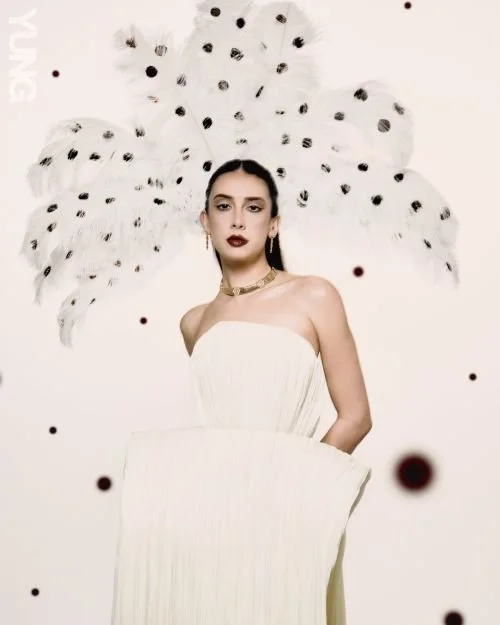
PHOTO CREDIT: Fouad Tadros
She tried to adapt. Like many young artists finding their footing, she questioned her instincts, wondering whether they were too personal, too risky, too untranslatable. “Back then, I didn’t trust myself,” she admits. “I didn’t know what I was doing on my own.” The doubt lingered; not because her vision lacked clarity, but because it hadn’t yet found support. “I also didn’t grow up in an environment that celebrated this kind of career.”
What changed wasn’t a single breakthrough, but a slow recalibration. Naïka began paying closer attention to what felt real rather than what felt acceptable. She stopped chasing validation and started listening inward. “Over time, I learned to really rely on my authenticity,” she says. “To trust what feels honest and true to me.”
Risk stopped feeling like a gamble and started feeling like honesty. The music she wanted to make was always capable of reaching people — it just didn’t arrive neatly pre-approved, wearing the right instructions. The EPs she released during that period became acts of exploration rather than destination points. They were spaces in which to experiment, to fail safely, to discover her sound in public. “That’s why I made EPs,” she explains. “I was figuring myself out — discovering who I was and how I wanted to present myself to the world.”
When Naïka speaks about Eclesia, her debut album, she’s quick to correct one assumption. This isn’t a pivot. It isn’t a new era manufactured for momentum. “It’s funny you mention that,” she tells YUNG, when the idea of reinvention comes up. “It’s not a different era. It’s me finally being able to show people that I’m here.”
The album’s foundation arrived early, long before the final tracklist took shape. It began with a single word. “The title came first,” she reveals. Eclesia. From the outset, she knew what the project needed to be: an introduction. Not just to her sound, but to her interior world. “I knew it was going to encapsulate all the different elements that make up who I am.”
Releasing in February of 2026, the album unfolds like a journey, moving through textures, moods, and emotional registers without asking for cohesion in the traditional sense. “It feels like travelling,” she says. “Different places, different topics, different sounds.”
If there’s a throughline that carries Naïka across cultures, genres, and phases, it’s that very same curiosity. Not ambition. Not certainty. Curiosity. “I’m a big observer,” she says. Having lived across drastically different environments, she learned early that no place — and no person — can be reduced to a single story. “Everywhere has layers, duality, contrast,” she explains. “There’s always a spectrum.”
That belief extends to faith. Naïka doesn’t follow a specific religion, but she maintains a strong spiritual grounding. “My biggest connection is with the universe, and with God,” she says. “I respect all religions, but I trust in energy, in a higher power. I can’t pretend to understand it — and that’s what grounds me”.
I am going to end with a new interview from NME. They write how Naïka pours herself into “her joyfully multicultural music to create a “universe” for herself and her community”. I am new to her music, though I did instantly connect with her music. Even if there are a lot of influences and sounds coming together, it all sounds so distinct and whole. A spectacular artist with a sound like no other:
‘Eclesia’ shifts seamlessly between Afro-Caribbean beats, Haitian konpa and South Pacific drums, between French, Creole and English throughout 13 vibrant and vulnerable tracks. On lead single ‘Bloom’ she declares “Island girls are blessing ‘til nobody can reach them” over a glitchy dance beat. The alluring ‘Matador’ explores what it means to defy societal standards imposed on women. In ‘Blessings’, she casts spells of positive affirmation, and atop the deceptively calming rhythm of ‘What A Day!’, she sings about war and injustice: “What a day for crime/ Kids are dying in Palestine/ Blood is paving Congolese mines/ And the world keeps going.”
For Naïka, responding to the violence in the world as an artist is natural, necessary and a basic responsibility. “I’m a human being and I care about other human beings’ lives and protection and freedom and basic rights,” she says. “I’ve always written songs about the world and how it’s affected me. It’s how I process what’s happening. Whether it’s ‘My Body, My Choice’ [that] I wrote about women’s rights, or ‘Before He Falls’, I wrote about the war in Syria, it’s something I’ve always done.”
Outside of her music, she also works as an ambassador for Fleur de Vie, a Haitian NGO focused on education and building safer schools. “I grew up in countries where I would see extreme poverty, and kids my age didn’t have shoes on and were in the street when I was on my way to school. I’ve been aware of the lottery of life from a very young age.” For Naïka, art may be a form of resistance, but it’s also how she heals. “Music has really strong frequencies. It’s a powerful art form,” she explains. “When I see songs I’ve created to express how I was feeling and my vulnerabilities, my emotions, my thoughts resonate with other people in a way that’s stuck with them, that’s the biggest thing in the world for me. Truly.”
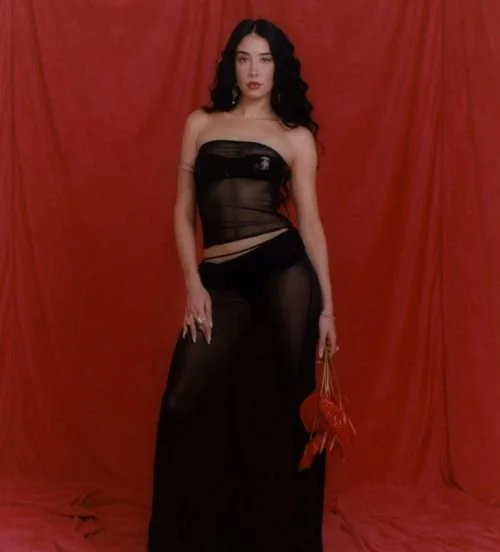
PHOTO CREDIT: Tom J. Johnson
NME sees firsthand just how deeply Naïka’s music resonates with fans in a small room in New York City a month before the album’s release. Anthurium flowers decorate the microphone stand. A vintage rug, small couch, rattan furniture, and plants fill the compact stage. Naïka dances barefoot on the bar, to fans’ enthusiastic cheers, before gracefully moving to an ornamental platform inspired by a picture of her childhood apartment and her mother’s style, which she describes as “tropical vintage glam”. ‘Eclesia’ was always meant to be performed in a room full of people. “When I found the name, I looked up what it meant,” she says. “In ancient Greece, it meant a coming together of people. That was the ‘click’ for me. This is what I want this album to be called, because that’s really what I hope to do with my music.
“I feel like I’ve never belonged to one community. To see the audience and to see people from all different walks of life, all different religions, different genders… When I see this diversity, it really makes me feel at home.” Through her music, she wanted to create her own world, and her fans have joyfully joined her there. “I was like, ‘I’m not fully going to be accepted anywhere, so let me just make my own universe for my [feelings] and for others who feel the same way.’”
The ‘Eclesia’ tour’s last stop is in Miami, where both Naïka’s musical life and career began. “I didn’t even think about that until you just said it,” she says of the full-circle moment where she’ll play at the Miami Beach Bandshell next month. “What’s so funny is that it’s at a venue that every time we would drive past it, my dad would say, ‘One day I want to see you play there,’” she remembers. “The universe works in crazy ways sometimes”.
If you have not heard ECLESIA and are new to Naïka, then do go and follow her. There are artists who are proclaimed and heralded who then fade away. However, when it comes to this remarkable artist, you know that she is going to be putting out the very best music for…
YEARS more.
__________
Follow Naïka
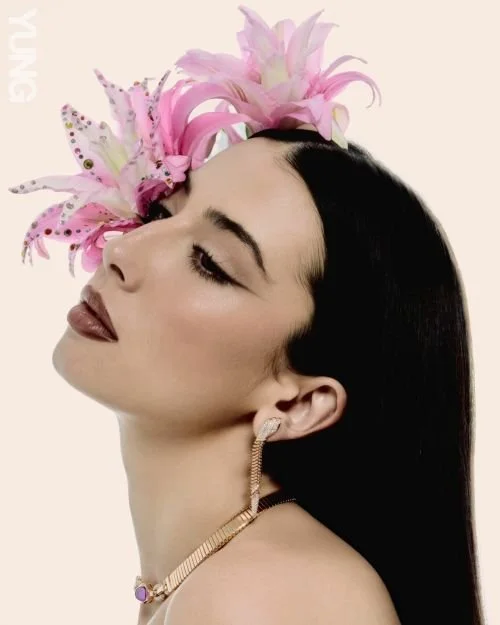
PHOTO CREDIT: Fouad Tadros
Official:
https://www.naikaofficial.com/
Instagram:
https://www.instagram.com/naika/
TikTok:
Twitter:
YouTube:
https://www.youtube.com/channel/UCMvZ4lsFM9kLYciwiB1Xq-w
Spotify:
https://open.spotify.com/artist/4tk2WUKBOS9nKZj7bPQIXT?si=wkSemk9KQfmonRv97FT-Uw