FEATURE:
Spotlight
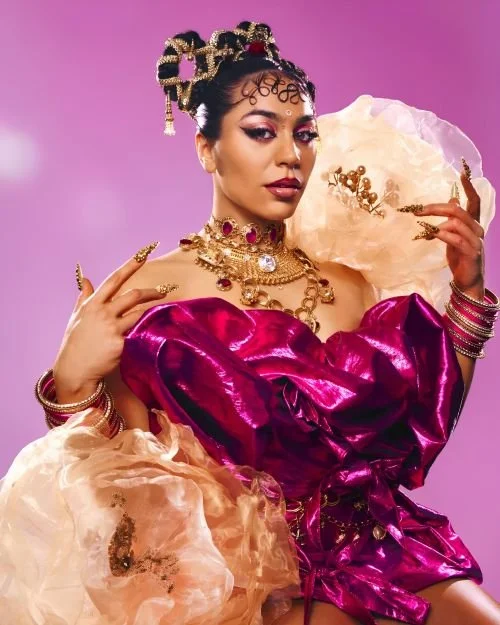
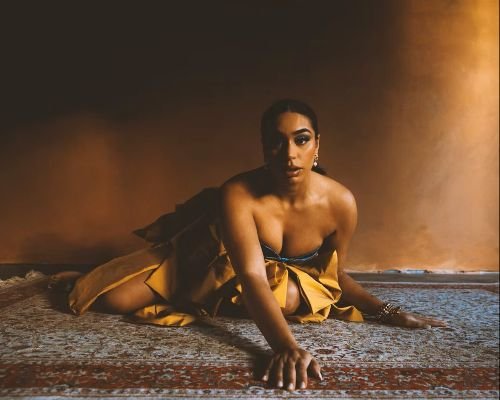
PHOTO CREDIT: Haya Studios
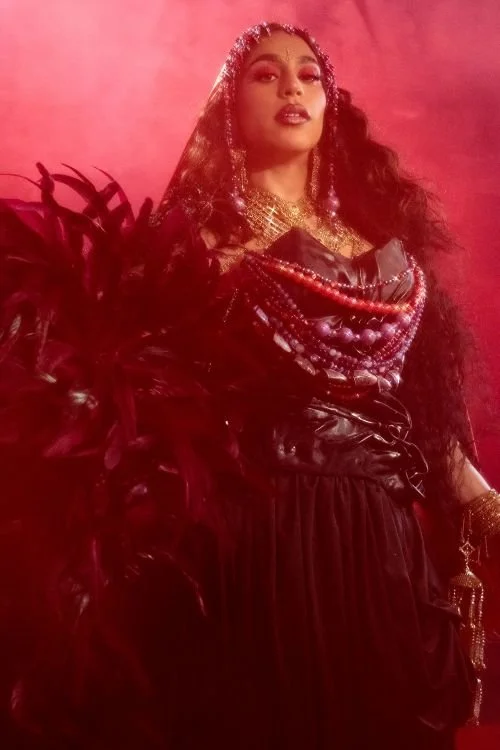
album, Peaceful Attitude, came out today (17th April). If you have not discovered BombayMami, then now is the absolute perfect moment. I am going to include some songs that are on Peaceful Attitude. I am going to head back to last year and some interviews then before carrying on. In terms of what you need to know: “BombayMami is an Indo-Swiss artist known for her viral hit Fire in Delhi, blending Indian classical music with R&B and pop. Her bold visuals—like snowboarding the Swiss Alps in a red lehenga—have earned millions of views. Raised between India and Switzerland, her upcoming album Peaceful Attitude fuses Bollywood and Western sounds. With genre-defying music, multilingual lyrics, and striking style, BombayMami is redefining global culture”. I actually want to start out with this 2024 interview, where the artist formerly known as Ta’Shan talked about her reinvention:
“The artist formerly known as Ta’Shan is ready to re-introduce herself, and there are many reasons for her to do so. Since her last release under her previous moniker she’s been tapping into and honing in on the parts of her artistry that relate to her individuality most. Being both half Indian and half Swiss, her sound and all things associated with her music are at one with her identity now in a way they haven’t been before. And so BombayMami was born, “honoring both my Indian and Swiss roots, my femininity, and the evolution I’ve gone through as a person and an artist,” as she tells me herself.
Early 2023 was the last time she released music, and that time since has been filled with learning and re-imagining both the soundscape and visual world for her upcoming album, Peaceful Attitude. She began to study Hindustani classical music just a few years back as well as has recently begun learning the tabla, something she sees as a lifelong practice to fully get to know and master it. “I’m still a student and I guess I will be forever… The challenge comes when I try to bring those classical elements into modern soundscapes. It’s about staying authentic to the source material while making it accessible and relatable to the audience . The tabla, for instance, doesn’t just provide rhythm, it carries a heartbeat.” The way she describes the training and the practice makes it obvious that these are things incredibly close to her due to how they allow her to self-express when in the studio or writing music.
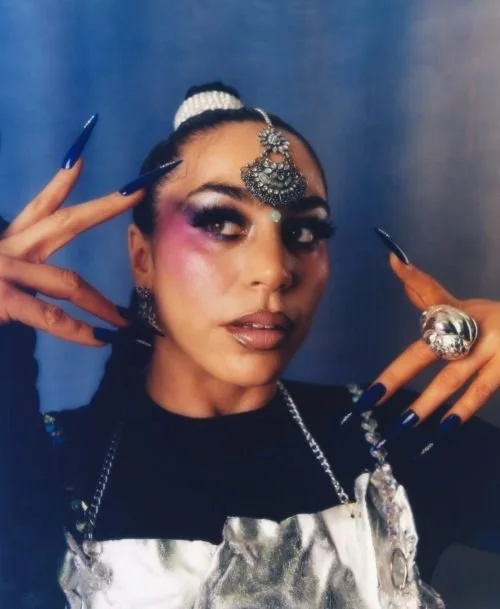
PHOTO CREDIT: Alia Romagnoli
You’ve stated that your upcoming project is all about honouring your roots, both Swiss and Indian. Can you tell us a little about your upbringing between these two cultures and countries?
Growing up between these two really opposite cultures was the most normal thing for me. It was exciting as my parents used to be tour guides, so we used to spend our winters in India and the summers in Switzerland. I feel I am a proper blend between the chaos, wildness, bling and spirituality of India and somehow the Swiss drive to make everything to a high standard and my dedication. We used to live in Delhi in an area called GK2 and there used to be snake charmers that used to play the flute or the man with the little monkeys in front of our house, that used to be my highlight of the day. As my parents loved to host parties and invite artists, painters and writers, my growing up was definitely infused by all this creativity. I remember us going to Hindustani classical concerts late at night and me getting on stage as a 5 year old. ( Indian classical concerts tend to go all through the night. My Dada Ji ( grandfather) used to live with us when we were in India and I loved spending time with him. He always gave me a couple Rupees to buy KitKats and Mango Bites.
DhinDhinDhaa is the first single to introduce your new sound. How would you describe the sound you’ve curated and how has it been combining so many influences? What felt right about releasing DhinDhinDhaa as the first single?
DhinDhinDha is really a fusion of the world that I enjoy. Bringing in the tabla bols which are the rhythmic syllables in Indian classical music is something that I do so naturally now that I am learning the tabla and blending it with RnB and Two step just made a lot of sense. When we initially started making the song I wanted to make a really emotional RnB song but the drop into Two Step just made so much sense so we just ran with it. Alex Naim who produced it is also half Desi so it was nice for us to dive into these sounds together. Kemi Ade who is my bestie and my favorite person to write with could tell you that I was at a very low phase of my life when we wrote this song and I guess when you really listen to what I am saying you can sense that sadness. As I knew that this song was not going to be on the album it made sense for me to release it as a single first.
As a Swiss-Indian artist, how do you balance reflecting both of your cultural heritages in your work and in the way you present yourself to the world, such as through fashion?
I feel when it comes to the creative direction of my music and my image I tend to lean more into my Indian heritage. I am definitely more inspired by Desi culture and I am obsessed with our fashion. The blinger the bling the better. The way I love going to Green Street and Southall! When Jonni Boi (Miau..Rawr) and I started working on the creative direction of this project we took many trips there and as we both lived in India we just always felt like going home. If BombayMami was a moodboard it would give: Indian Goddess in an 2000 R&B video.When it comes to my fashion line SHAVA that I am working on I tend to pair clean minimalist Swiss-inspired silhouettes with Indian inspired cuts.
What can people expect from the album after hearing DhinDhinDhaa? What is both expected and perhaps unexpected?
After hearing DhinDhinDhaa, people can expect the album to offer more of that rich blend of classical Indian roots and contemporary sounds, but there will definitely be surprises. Some tracks will be intimate and stripped back, letting the raw emotion shine through, while others will be bold and experimental. I’m blending genres and traditions in ways that push me creatively, so I hope listeners come in open-minded. Expect a deeply personal album, but also expect to be taken to places you didn’t anticipate. It is a reflection of my evolution, and I think it’ll resonate with anyone who’s ever grown through life’s complexities”.
Apologies if these are quite random selections, but I like this interview, and I feel we learn more about BombayMami. As she has a new album out now, it is interesting looking back and seeing how she has evolved and talked about future music. Someone that definitely needs to be on your radar. In terms of music in the mainstream, we need to encourage BombayMami and her blend of sounds and cultures:
“We hear and feel auras of body positivity, seduction, and femininity emanating from BombayMami's captivating choruses and slick rap flow. They are filled with other cultures, as seen by her work with individuals from Nigeria, the United States, India, London, and elsewhere. BombayMami's catalog, which ranges from Sorry to Yoga, demonstrates her musical aptitude and dedication to her craft. She exposes her expressive and creative personality to future and current admirers whilst touching on topics such as heritage, creativity, dreams, and her career. We go into what makes her, such as her current favorite tunes, her inspirations, her motto, and her devotion to female empowerment in the industry.
BombayMami is a hardworking artist who enjoys bringing talented and ambitious people to the stage. Dreaming big is not common in Switzerland, so doing what she does highlights her personality as a "sensitive but bossy girl." BombayMami has been a music enthusiast since the age of eleven. She has been in the studio since she was 14 years old, and she quickly realized that music was her calling. "It became something I really enjoyed; being in the zone and doing my thing, you know." I had no idea that making music could be a vocation. There isn't much of a scene in Switzerland, and there's rarely anyone to look up to. Then, in 2012, I went to Los Angeles and told myself, OK, music is something I want to do." I returned to Switzerland after that decision, and TASHAN was born. "
A perfect environment is required when creating music. The studio allows BombayMami to flourish. The place to be and learn is with the main producers, people who help her write music, her friends and mutuals. Furthermore, travelling to different parts of the world, such as Germany and London, provides a new perspective on producing music. It enables BombayMami to begin again. Going to different countries also makes her feel more at ease because these experiences allow her to bring new flavours to a new scene while also allowing her to absorb the culture that surrounds her. Her upcoming song "Popping," which has some French lyrics and will be released on June 3rd this year, is an example of this outcome.
Her parents are her life inspirations since they have worked hard their entire lives and created everything from nothing. For example, they now have a business. When it comes to music, Missy Elliot's unapologetic looks and flows make BombayMami "fall in love with her," along with other female rappers and singers from the 1990s and 2000s, such as Alicia Keys. Sadhguru is a yoga teacher to whom BombayMami listens on a spiritual level. He is extremely encouraging to her because his energies bleed into her songs. "When it comes to being an artist, everything is tied to what you do in life, what you listen to, and so on."
After asking her about a defining moment in her career, we get an insight into BombayMami’s motto: "To listen to your gut and just do what you want to do." Embrace that natural feeling! That’s how life is: If it feels right, it feels right. You can’t always change the things you feel, so to conquer that, you need to adapt and live life to the fullest! " This comes from her experiencing a defining moment within her career, where the single "This Time" did really well in numbers. "It’s funny that it did so well because I never wanted to place it on my EP, BombayMami, Vol. 1. From this, I learnt that you can’t always expect things to always go the right way if you plan them. Taking a leap into something that I feel is right is more of a suitable route for me, I think." Making music in a different language is not something you would expect your usual artist to do, but because of what BombayMami does for the music, the art, and herself, she takes on the challenge that's given to her.
Such an amazingly empowering, inspiring and immensely talented artist, I will move to a new interview soon. However, I will get to this interview, that notes how BombayMami, “Through her music, visuals, and fashion, she celebrates womanhood, duality, and identity in all its forms”. I am quite new to her music, but I am really invested in it now. Someone who needs to get a lot more focus and celebration:
“Latina Bohemian: How does it feel shifting into a musical path full of courage and one that inspires not just women but individuals in the LGBTQ community as well?
BombayMami: It feels like coming home to myself. Finally. I used to play it safe, thinking I had to fit into something that already existed. But now, I’m building my own lane. I’ve always been surrounded by powerful queer and femme energy, and I think that’s why I create the way I do. It’s about freedom, self-expression, and radical love. Courage is contagious, you know?
LB: You found purpose in your art after a period of trial. How did your Indian roots influence the transition?
BM: My roots brought me back to my truth. When I started reconnecting with my Indian side—the music, spirituality, and rituals—I found a peace I didn’t know I needed. It grounded me. Indian culture has this way of reminding you that beauty and pain are part of the same dance. That understanding really shaped how I create now. With more intention, more surrender, and more fire.
LB: Why is it important for South Asian women to be expressive with their creativity and body image?
BM: Because we’ve been told to shrink for too long. From our bodies, our voices, and our desires. All of it has been policed or misunderstood. But expression is sacred, whether it’s through dance, fashion, or music. It’s about reclaiming ownership of how we exist in the world. South Asian women deserve to see themselves as art, not just as tradition.
LB: Self-love is a theme in your music. When was your golden moment of finding beauty in heartbreak?
BM: When I stopped trying to fix what broke me and started thanking it. I realized heartbreak didn’t destroy me; it refined me. That was my golden moment. You start moving differently when you understand that love, even when it hurts, is still a gift.
LB: You have a new single out soon. What’s the impact you want to make in diverse societies?
BM: I want people to feel seen, whether they’re brown, queer, mixed, spiritual, or just different. My music is for the ones who never fully fit in. I want to create soundtracks for healing, empowerment, and having fun while doing it”.
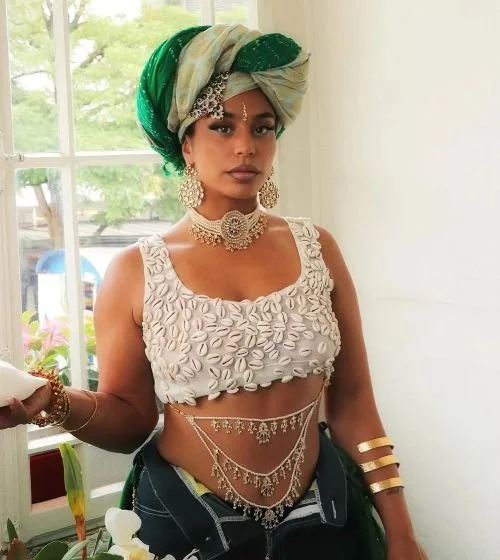
PHOTO CREDIT: Alma amala (via Vogue)
Prior to ending with an interview from Glamour, I want to drop in this from Rolling Stone India. BombayMami “opened up about how a group of rural feminists inspired her to create a women’s day track and merchandise drop as part of her upcoming album, ‘Peaceful Attitude’”. This is undoubtably one of the most distinct and powerful albums of this year. I do hope that BombayMami gets a lot more elevation and exposure:
“The Indo-Swiss songstress has been on a lore-laden run lately. One second, she’s riding a horse, wearing a turban with a veil tucked under it, the next she’s floating across a lake in a pink, princess-esque tub as she serenades the audience with her soaring voice.
Turns out, it’s all part of the visual universe she’s threading together for her upcoming thirteen-track EP, Peaceful Attitude, out on Apr. 17, 2026, which sees the singer and creative director carving out a third space of feminine co-existence. “The album title is almost ironic. It’s like, I have a peaceful attitude…until you test my boundaries,” the multi-hyphenate tells Rolling Stone India.
And in keeping with that, her second drop off the upcoming album, “Gulabi Mantra,” is inspired by valiant stories of the Gulabi Gang, a resistance-led collective of female vigilantes from rural Uttar Pradesh, who, armed with bamboo sticks, fight against domestic abuse, sexual violence, and systemic injustice.
“I remember seeing images of women in bright pink sarees holding sticks and at first I thought, “Is this a film still?” she recalls, explaining how a research rabbit hole to build an audio-visual framework around “divine femininity” led her to discover the powerful all-female group. Dressed in a stereotypically “girly” color, pink, the lathi-wielding, saree-clad women truly embodied “divine feminine” by taking matters into their own hands, and responding to injustice with a seething rage.
Inspired by their vigor and courage, “Gulabi Mantra” became BombayMami’s way of navigating autonomy. Infused with afro-beat rhythms and syncopating Carnatic riffs, the two-minute track echoes a message loud and clear through its catchy hook: “My Body. My Voice. My Kitty. My Choice.”
“Bodily autonomy means I decide the terms,” the singer affirmed. “I don’t want to be reduced to a hypersexual fantasy. But I’m also not afraid of being sexual. I love feeling sexy. I love expressing that part of myself. That’s not weakness…that’s power. The difference is choice,” she elaborates.
Reduced to objects, burdened by stereotypes, and caged by conservative dogmas, women are far too often pushed into socio-political submission. Be it governments waging war on bodily autonomy, law enforcers “normalizing” sexual assault and violence, or social media popularizing problematic trends like “trad-wife” and “body facism,” the freedom of choice has historically been out of grasp for most women.
“Growing up, you learn very early that your body is watched. Commented on. Protected. Judged. Desired. Sometimes all at once. And as a performer, that becomes amplified. People feel entitled to your image, your sexuality, your energy,” she reflected.
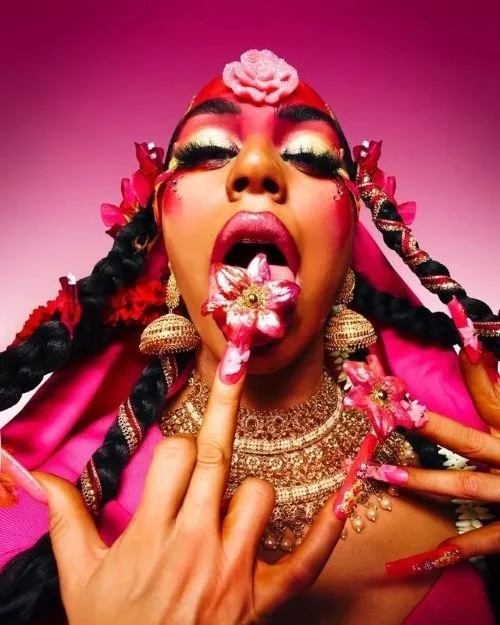
PHOTO CREDIT: Lily Lytton
Rage, anger, defiance, and ownership; these are all aspects of the female emotional spectrum that have been contorted into a villainized lens. And that’s exactly what BombayMami is trying to challenge. “There’s this expectation, especially in South Asian culture, that women should be calm, graceful, forgiving. Like Lakshmi all the time. But we forget that the same culture also gave us Kali,” she states. “For me, as a Swiss-Indian woman moving between worlds, that duality hit deeply. The softness of pink. The hardness of resistance.”
Set against a bubblegum pink sunset, the cover art for “Gulabi Mantra” has the artist sitting atop a tiger, trishul in hand, serving celestial bombshell realness. “Visually, I drew inspiration from Durga and her symbolism: Strength with serenity, beauty with danger, stillness with power. The tiger represents instinct and raw force. Sitting on it represents mastery. Controlled fire. It felt important to embody that instead of just referencing it.” she mentions.
Slated for release on International Women’s Day, the anthemic single also comes with a limited-edition merch drop consisting of “kitty” printed socks, Om-shaped bindis, and a matching tote bag. “Everything, from the cover art to the merch, carries that same energy: Feminine, but not fragile,” she pointed out. Even the tiniest details, such as typography, were used to create artistic semblance, rather than divergence: “I didn’t want the visuals to feel separate from the music. It’s one universe,” she vocalizes. Proceeds from the same will be going to UK-based and Indian women’s rights charities like SHEWISE and ActionAid India.
Tying it back to her Gulabi beginnings, the singer seeks strength in tales of female infallibility: “There’s something extremely powerful about rural women, often dismissed, often underestimated, becoming their own protection system,” she observes. Dismantling hypersexual fantasies, she hopes to spotlight the female gaze, which reveres sexuality rather than fetishizing it, “I can embody goddess energy…strength, protection, fierceness and I can move my hips and feel sensual. Those things are not contradictions. They coexist”.
I am finishing with Glamour, and their interview from March. It is said how, “the genre-blending artist is turning personal healing into powerful music”. I am not sure whether BombayMami has any tour dates planned for the U.K., as she would be warmly welcomed here. I know she is playing BBC Radio 1’s Big Weekend next month, but what comes after that? I would love to see her play live:
“She speaks of how it’s imperative to be strong, especially when your art is so personal. Striking that balance between being open and strong is also how she takes care of her mental health. She centres herself by returning to movement when criticism and the unpredictability of the music business become too much – a grounding that helps her steer the highs and lows of creative life with equanimity and ease.
“I feel better the more I push myself. When I stop moving forward, that’s when I get uncomfortable.”
That forward-thinking helped her finish her next album, Peaceful Attitude, conceived and recorded during a challenging time in her life when she walked out of a toxic relationship. This paved the way for a reformed personal life and the music that followed.
“Choosing myself meant learning to say no. Not playing small to make other people feel better.”
The song Fire in Delhi, driven by electrifying beats and a sultry groove, encapsulates it best. It’s more about the aftermath than the heartbreak, about picking yourself up and putting yourself back together. A feeling that resonates with many women reclaiming themselves.
Writing the album was therapeutic for her. “When something happens to you personally, you suddenly see how many women are going through the same thing. And so many can’t let go.” Her voice tightens when she discusses the systemic issues domestic abuse survivors face.
Shanti has raised funds for an organisation supporting domestic abuse survivors in India. “I want to do more. But everyone has to pull their weight where they can.” Using her platform this way feels like an organic extension of her beliefs into her work. And this is just the beginning, she affirms with unmistakable ardour.
Success isn’t always about streaming numbers; it’s about connection. She reflects on her early collaborators and the queer clubs and nightlife spaces that shaped her as an artist, sharing how the community pushed her when she wasn’t sure she could continue, providing both artistic liberty and acceptance.
She recalls that at a recent shoot, many brown women came up to her just to be part of the moment. “That feeling,” she says after a pause, “is everything” – nudging the importance of representation and the hushed but commanding effect it can have.
Her album, she hopes, will leave listeners empowered with a fresh way of perceiving things. “Life isn’t a straight line. There will always be ups and downs.” And, as the name suggests, it’s about learning to let go and approaching life with a shant (peaceful) attitude.
Before we ring off, I ask what message she wants young women to take from her story, and the answer comes immediately: “You don’t have to change who you are to meet anyone’s expectations.”
We log out of Zoom as Mumbai’s chaos continues its restless hum outside my window, and I hit resume on her track Gulabi Mantra – an homage to the legendary Gulabi Gang, the pink (gulabi)-sari-clad sisterhood that rose up against gender-based violence in India. Turning the song into a battle cry that lingers long after the music fades”.
Such a phenomenal artist who it has been incredible learning more about, I feel everyone should hear Peaceful Attitude. It is one of the standout albums of this year. She does have fans here in the U.K., though I don’t feel there has been as much press attention as there should be. I hope that changes, as the stunning BombayMami…
IS a music goddess.
____________
Follow BombayMami