
FEATURE:
Stronger Than Me
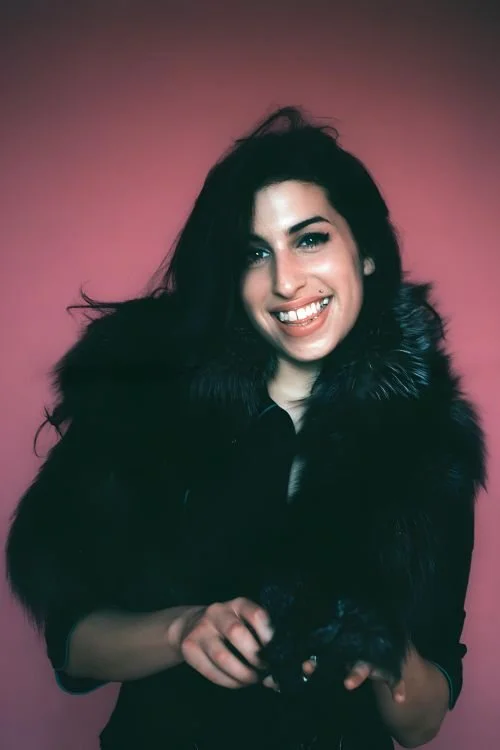
IN THIS PHOTO: Amy Winehouse in January 2004/PHOTO CREDIT: Karen Robinson
The Legacy of the Wonderful Amy Winehouse
__________
IN October…
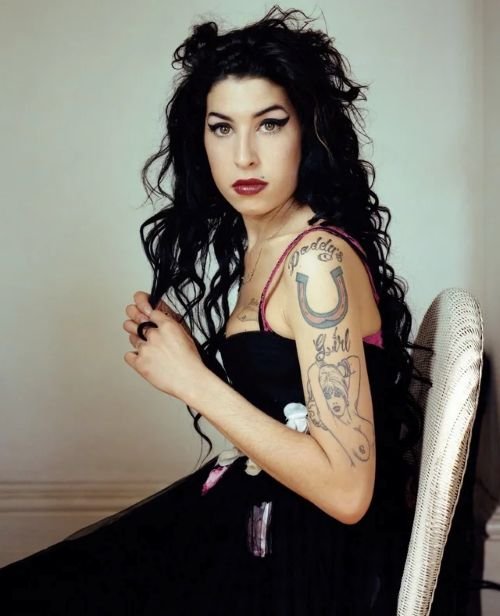
IN THIS PHOTO: Amy Winehouse photographed in 2006/PHOTO CREDIT: Broomberg & Chanarin
the world will mark twenty years of Amy Winehouse’s Back to Black. Her second and final studio album, it was a magnificent final release from an artist that we lost too soon. Back to Black is one of the most remarkable albums ever released. Amy Winehouse’s debut album, Frank, arrived in 2003. On 23rd July, 2011, we received the news that Winehouse had died. She was twenty-seven. Rather than make this a morbid feature, I did want to remember Amy Winehouse fifteen years since she died. Celebrate her music. You can see the artists today who clearly have been influenced by her. Including RAYE, Winehouse’s legacy is huge. Olivia Dean, Sienna Spiro and Jorja Smith either have cited Winehouse as an influence or have been compared to her. In terms of her voice and the gravitas it held, there has been nobody like her since. I don’t think there ever will be. Winehouse was also so honest and real. I will end this feature with a mixtape feature songs from her two studio albums and some other selections. I do want to start off with this article that discusses the legacy of Amy Winehouse. It is not just her impact on the overall music scene. People who met her and recall her fondly. So funny and always memorable, she had such humour and character. Whilst many will associate Amy Wineouse’s legacy with controversy and addiction issues, we need to remember her phenomenal music. Someone who left an impression on everyone she met:
“What would the music world look like today if we had never been introduced to Amy Winehouse? Would artists like Adele, Florence Welch, Elle Goulding, Lady Gaga, Lana Del Rey and Halsey have experienced the same rise to prominence? Amy’s unconventional style and incredible voice showed that female pop artists didn’t need to look or sound a certain way. Like Amy, they could be whoever they wanted to be and still be successful.
As well as her amazing vocal range, modern female stars have also taken inspiration from Amy’s authenticity. Amy never once shied away from talking about any personal struggle and she always told the heartbreaking truth in her music, no matter how tough. We see this a lot today with female stars singing their own truth and relating to so many othersaround the world. Artists are using their music as the same type of outlet that Amy did, and listeners are relating more to this honestly and individuality.
When Amy released her debut album Frank she was only 20 years old, but showed that she had talent beyond her years. The album was the only one she ever made while completely sober and it was so well received it earned her an Ivor Novello Award for composition and songwriting. It was also the first and last jazz album she made. Amy never wanted to confine herself to one genre and instead used all of her musical inspirations to combine multiple genres and create a sound so unique it would stay relatable and adored for years.
Her second and final recorded album Back To Black won her six Grammy’s, making her the first British woman to do so in just one night. The album combined R&B, soul, funk and rock elements to produce mega hits such as ‘Rehab,’ ‘Love Is A Losing Game,’ ‘Tears Dry On Their Own,’ and ‘Back To Black.’ All of which documented her personal struggles with substance abuse and toxic relationships. Back To Black has been regarded as one of the greatest albums of all time and the most personal of Amy’s work. The album told her story in a raw and beautifully troubled way that made the world really understand just who Amy Winehouse was. Strip everything else away and you find that she was just a broken girl who loved too much, and there’s something admirable in that.
There are many things to remember about Amy. Her powerful voice, her lyrical poetry, her symbolic thick winged eyeliner and beehive hairdo. Although her musical career was short, she definitely made an impact on the world. An impact that you can still see today with female artists. Amy was more than extraordinary. She was a visionary who used her truth to create something memorable. Her life was filled with many different tragedies but perhaps the biggest of all was that it took her death to make the world realise just how incredible she was”.
In July 2021, NME ran a feature ten years after Amy Winehouse died. They spoke with family, fans and celebrity peers about this hugely missed icon. They recall and pay tribute to a “force of nature with a fierce sense of humour”:
“Along with Winehouse’s ‘Frank’ collaborator Salaam Remi, Ronson produced half of Amy Winehouse’s landmark second album, 2006’s ‘Back to Black’. Together, they made for a formidable pairing – from the parping ‘Rehab’ to the smoke-stained regret of ‘Love is a Losing Game’, they forged a pop sound that dabbled in retro influences, and would influence the entire musical landscape after the album’s release.
Though Winehouse counted ‘60s girl groups, Motown and classic soul as influences – and enlisted Sharon Jones’ band The Dap-Kings to back her – the record veers away from being derivative, instead centring around Winehouse’s unmistakable vocal and vibrant lyrical voice. “He left no time to regret,” she sings in the opening lines of the title-track, her voice cracking with anger. “Kept his dick wet / With his same old safe bet.” It was cutting, fiercely witty, and unmistakably Winehouse – and across ‘Back to Black’, the searing one-liners kept coming.
“I can sometimes hear ‘Back To Black’ in some restaurant in the background and it does nothing, and then I’ll hear it on another occasion in, like, the lobby of a hotel, and it has a really heavy effect on me,” Mark Ronson told NME in 2019. “She kinda put me on the map, so all of my success and everything I’ve had since is somehow linked back to this thing.”
“‘Valerie’ doesn’t feel like it’s our song any more; it’s its own world” – The Zutons’ Dave McCabe
Though ‘Back To Black’ was Winehouse’s masterpiece, her slightly lighter debut album ‘Frank’ still established Winehouse as a fearsomely talented songwriter. ‘I Heard Love Is Blind’ finds Winehouse’s narrator bluntly defending infidelity with increasingly creative twists of logic: “Baby, you weren’t there,” she insists, “and I was thinking of you when I came”. And the matter-of-fact ‘Fuck Me Pumps’ is both biting and hilarious, meticulously mocking a woman and her garish shoes.
“Her legacy is beyond comprehension,” singer-songwriter Laura Mvula tells NME. “I think people will still be unfolding it for decades to come.” The Birmingham artist, who recently melded her love of soul, jazz and blues music with bright, disco-tinged pop on latest album ‘Pink Noise’, cites Winehouse as a huge influence – “particularly her vocal style”.
Mvula explains: “I think I was subconsciously imitating her when I was younger and first started to sing – not even as a solo artist, but just when I was learning what my voice was. If you listen to ‘Frank’, that’s the music that raised me, this neo-soul expression that she managed to birth in the UK and give its own identity. That is huge – no one’s done that since; not as authentically, transcending and also celebrating race at the same time.”
Enormously influenced by a huge number of Black musicians, Winehouse covered the likes of Sam Cooke, Billie Holiday, Thelonious Monk and The Shirelles. ”You could say that it’s inherently Black music,” Mvula says, “but to me she is her music. 100 per cent.”
While forging a new kind of neo-soul, it’s also fair to say that Winehouse rarely minced her words – and had little patience when she was compared to less innovative artists releasing music around the same time. Case in point: her slightly tongue-in-cheek dislike of Dido – which culminated in the singer pelting a billboard for the singer’s album ‘Life for Rent’ with an apple during an appearance on Popworld in 2004. When Amy Winehouse did feel passionately about a new artist’s talent, however, she supported it relentlessly.
“She was really supportive,” says singer Dionne Bromfield, Winehouse’s goddaughter and a MOBO-nominated singer. “I think she really saw a lot that I didn’t really see in myself at that age.” The best advice Winehouse gave her? “Be true to yourself,” Bromfield says. “Amy was someone who wore her heart on her sleeve. I think that is probably why she connected so well with people: people felt like they were almost talking to their friend or hearing their friend talk when listening to Amy.”
Bromfield has been working on a documentary about her relationship with Winehouse: Amy Winehouse and Me: Dionne’s Story airs on MTV UK on July 26. Though various other tributes are set to come out to mark 10 years since Winehouse’s death – the BBC are releasing Amy Winehouse: 10 Years On, while her mother Janis Winehouse has also made her own film, Reclaiming Amy – Bromfield hopes that her own personal celebration of a friend and mentor can show her own unique relationship with the singer.
“Amy was a very very funny person and I really wanted that to come across,” she says, adding with a laugh: “She was a really good cook if you could actually manage to get her to finish what she was cooking, because she always used to want to potter around a bit. She was really good at meatballs, and she used to do a really banging chicken soup. I mean, that’s a proper Jewish woman there with her chicken soup.
“She loved comedy stuff: when I watch The Fresh Prince of Bel-Air now I actually just remember all of the times watching it with her, and can almost actually hear her laughing at certain gag lines. And – oh my God – she would kill if I didn’t call her ‘Auntie Amy’. Jesus Christ! I really wanted to allow people to see this side to her.”
Bromfield sang with Amy Winehouse on several occasions, but their final performance at London’s 3,000-capacity Roundhouse – just a couple of days before the singer tragically died in 2011 – stands out as a treasured moment: “It was the last time that I actually saw her, and the last time that she was seen by the public. I really wasn’t expecting her to be there. She was at the side of the stage, and was just like: ‘I wanna come on and dance’. It was just really nice. It was the first time she’d ever actually seen me perform properly, but it was also the last time that she’d see me.”
Pondering why Amy Winehouse continues to be so influential a decade after her passing, Bromfield puts it down to one rare quality that so few artists have in such staggering abundance. “I just think it’s the honesty,” she says. “Her personality came through with her music, and I think that is really what people love about her. I honestly don’t think we’ll ever get another Amy”.
There is another feature I am keen to come to, before finishing up with an interview with Amy Winehouse. One of the biggest and most important parts of her legacy is the Amy Winehouse Foundation. “The Amy Winehouse Foundation helps thousands of young people to feel supported and informed, so that they are better able to manage their emotional wellbeing and make informed choices around things that can affect their lives”. I think that there is this distortion when it comes to remembering Amy Winehouse today. Some associating her only with her death and her darker moments. Far bigger than her relationship troubles, Grazia published a feature in April that explored Winehouse’s true legacy. How her voice, music and fashion has influenced so many. “Following Blake Fielder-Civil’s tell-all interview about his marriage to Amy Winehouse, her friend Naomi Parry sets the record straight”:
“Amy and I had a sisterly bond. While I was there for her during her darkest moments, she was there for me, too. When I left my partner, Amy put me up at her house. When my niece was being badly bullied, she suggested we go and talk to her school (can you imagine?). And when I walked into a lamppost and gave myself an almighty black eye, Amy threatened to track down the offending lamppost and give it a piece of her mind. She was sharp, compassionate, and had a mouth on her that she’d use to defend others.
She supported me in my career too, giving me a foothold in a tough industry and championing my work as a stylist. That was typical of her – she lifted up those in whom she recognized talent. Every show, she would introduce her band one by one, giving everyone their moment to shine. She sent her goddaughter and protégé, Dionne, to the Sylvia Young Theatre School and later performed as Dionne’s backing singer on Strictly Come Dancing. She spotlighted lesser-known artists and wore pieces from emerging designers because she understood how much that visibility meant.
Ultimately, Amy was a normal person who happened to become extremely famous. She had loving friendships and some unhealthy relationships, and fame magnified both. Every shady character and every bad decision was exacerbated by her circumstances – and the ripple effects were felt by all of us who loved her.
So when I saw headlines about her ex-husband claiming in a recent interview that he and Amy had discussed reconciling in 2009, I wasn’t surprised. Not because there was ever any real chance of it happening, but because it likely reflected how low Amy felt at that time. If she had truly wanted that reconciliation, it would have happened, but it didn’t. And who hasn’t, in a dark moment, thought about going back to an ex?
What I do know is that by 2011 she was in a very different place. I remember her sauntering into the kitchen at her Camden Square home one morning while I was staying with her, singing to herself as she made breakfast. She told me how good she felt and, when I asked why, she said, “You know that feeling when you’re completely over someone and it doesn’t hurt when you hear their name anymore?” She followed it up with something along the lines of wishing him well.
Recently, Mark Ronson paid a beautiful tribute to Amy at the BRITs. He honoured Amy’s role in his success and highlighted the positive, creative force she truly was. That’s exactly how she should be remembered. For me, she’ll always be my little friend with the big voice and the hair to match – the one who gave the best hugs, who loved fiercely, encouraged relentlessly, and never stopped championing the people around her”.
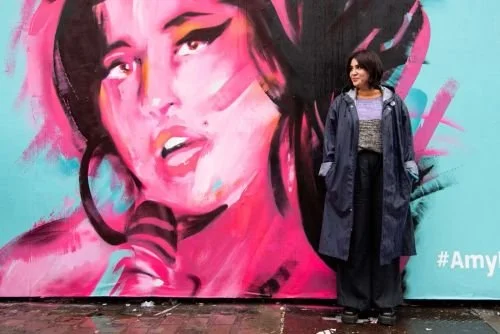
IN THIS PHOTO: Naomi Parry attends a mural unveiling to mark the Design Museum's Amy Winehouse exhibition announcement in Camden on 14th September, 2021 in London/PHOTO CREDIT: Jeff Spicer/Getty Images
I am going to end with a 2004 interview. This was right near the start of her career. Paul Du Noyer chatted with Amy Winehouse in a London café. Frank had come out by then and was well received, though this huge fame and focus was not on her at this time. You can feel and hear a less incumbered and a more natural person coming through. You get to see this humble and very honest young woman. Winehouse at her best:
“Winehouse came into the Big Top of Pop following a stint in the National Youth Jazz Orchestra. She signed at 17 to a branch of Simon Fuller’s management empire and after that to Island Records. But she was already a showbiz kid, whose turbulent education had taken in a few stage schools. One of these was the Sylvia Young Theatre School in Marylebone: it’s almost the Eton of the Pop Idol generation, giving us sundry Spice Girls, Appletons, S Clubs and Busteds. Winehouse, one is unsurprised to learn, got expelled.
Did stage school make you a performer, Amy?
“Well,” she ponders, “that school is not a shit school, the Sylvia Young. They’ve got a reputation because they are the best. It’s not a pop star factory, they channel your creativity and you learn to use it. That’s what I did. For every precocious kid there were kids who really worked. They sent you out to work. Stage school is a job. You learn how to get the fuck on with it. I learned a lot of important things.”
But you didn’t get along with it?
“No, but I’ve never been to a school that I came away happily from, ever. With Sylvia Young’s it wasn’t a monstrous, call-my-parents-in, scream the school down thing. It was quiet and under-handed. I was devastated leaving there. Of all the schools, I would have stayed there happily.”
Winehouse was raised in the north London suburb of Southgate. Her mother is from Brooklyn and her father, a taxi driver, is an East Ender. Her parents separated when Amy was nine, though her father remains in close touch. “He’s a great man, my Dad,” she says. “I love him. I love my Mum, but me and my Dad are two peas in a pod. We’re really impulsive people. It’s good that my Dad moved out when I was growing up, or we would have had some terrible clashes.”
On her American mother’s side of the family she has relatives in Miami and Atlanta, though she rarely had the chance to visit: “We didn’t have that kind of money. I’m sure the family would have paid for us, but we’re proud people.”
It’s the norm now for young musicians to be weaned on their parents’ record collections. But Winehouse denies her jazz buff Dad was a formative influence. “Not really. There was what he had in his car. And there were tapes at home. I would go to sleep listening to things like Sinatra and James Taylor. But that’s as far as my parents went. You discover music the most when it’s music that no one tells you to listen to, that you find out for yourself.”
So you weren’t sat down and told, Listen, this is good for you?
“Ha! I’d have told them to fuck off. I’ve always been a rebellious person. The only music that truly spoke to me was jazz and hip hop.”
It’s often said that first novels are autobiographical. People use up their life’s experiences. Did you do that with your first album? Could that be a danger for the second?
“Yeah but… I dunno. Life is inspiring, regardless. I don’t want to make a second album talking about record companies and stuff. The thing that always drove me with Frank was human interaction and that will always drive me. Relationships and how fucked up they can get. I guess that’ll always inspire me.”
I like the way that CDs are used as reference points in your lyrics. (There is even a photo of her collection on the album’s artwork.) Is the title Frank a reference to Sinatra? In Take The Box you’re splitting up with a boyfriend and dividing the spoils.
“Yes. When I say ‘Frank’s in there and I don’t care,’ that is literally a Frank Sinatra CD. He bought me it for Christmas and I was putting all his stuff in a box, like his T-shirt that I used to sleep in. He bought me Frank Sinatra’s In The Wee Small Hours – ironically, cos it’s one of the classic heartbreak albums of all time. Frank as a title for the album is a good word, It is frank… Dunno. Maybe with more time I would have come up with a better title.”
Well, if you have to name your album after someone, who better than Frank Sinatra? (I intend this in the blandly upbeat way you adopt to keep your interviewee on side. She’s having none of it.)
“I don’t agree. There’s a whole mess of people better than Sinatra.”
Are there? Really?
“Sinatra had an emotional connection with music. That was his thing. He had the tone in his voice. But singers? I know a hundred singers that piss on Frank. And musicians. And just as a person: he was an arsehole. But he had an emotional connection to songs that touched everyone, women, men, soldiers. So… Er, sorry, I’ll have to write down a lyric or I’ll go mad.” (She delves into a little pink handbag – keys, fags, mobile, make-up – and rummages for notebook and pen.) “I’m always getting ideas for concept albums!”
If you had to give up either singing or songwriting, which would it be?
“I’d cut my throat out. Singing is singing. If I couldn’t sing a song, and express it, which – ” (her expression darkens) “ – which I haven’t been able to for the past five months but that’s OK it comes from me, I understand that – if I couldn’t do that, I’d be fucked. Singing and writing go hand in hand for me, it comes from one place.”
Do you enjoy singing?
“Yeah, I’ve always sung. I always assumed that everyone could sing, that that’s what they do when they’re happy or sad. And when I was growing up and having the pain and suffering that teenagers do, when you think the world hates you because you’re 15, I could sing like a little bird. I can’t sing like that no more. I’m too complacent. They gave me too much free shit…”
(She sighs deeply and stares at her tapas.) What do you mean, they gave you too much free shit?
“They put it all on a plate. I feel like I’ve got nothing to work for sometimes, even though I’ve got lots to work for.”
(She lights a cigarette.) Of course you have, surely.
“Yeah. Anyway… Amy, chill the fuck out. I’m sorry.”
Do you feel pressurised by all the weight of expectation around you?
“A little bit. But that’s myself. No one could be a harsher critic than myself. I am feeling that pressure. There are days when I wish I could just take a break from my own head.”
What are you up to with your new music? Have you started yet?
(She sulks like a 12-year-old. Blows out hard, hot cigarette smoke.) “Not at all. Writing the album seemed hard but once it was done I thought, that wasn’t hard. It’s doing all this promo shit that is the really hard work. The only thing you have to remember when writing is, Be honest, always. But with promo it’s always, Shut your mouth, Amy! Smile!”
(She suddenly seems 65 years old.) “There’s nothing real in it, nothing real. Which really drains me. But you know what? It’s gotta be done.”
This year’s girl gives me a tired, trouper’s smile and walks back out into Camden Town”.
23rd July will be a sad day. It will be fifteen years since Amy Winehouse died. However, more than see it is a black and tragic thing, we need to look back and remember her warmly. The incredible music she left behind. Her true legacy. How she impacted the people she met. How her music has transformed lives. Artists today who are influenced by her. Back to Black turns twenty later in the year, so there will be a lot of attention around that. Truly, there was nobody quite like Amy Winehouse. We will never see another. This Camden queen was…
A true original.