
FEATURE:
Under African Skies
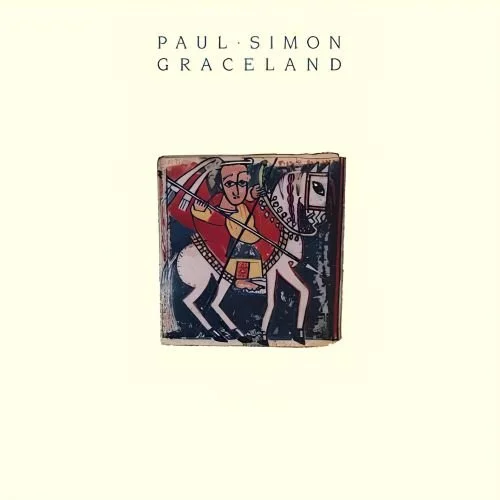
Paul Simon’s Graceland at Forty
__________
I am writing this…
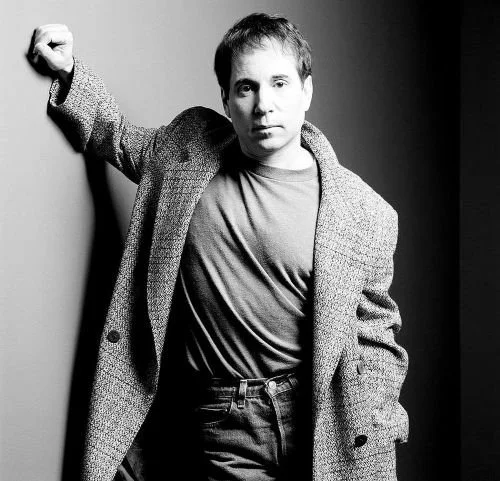
IN THIS PHOTO: Paul Simon in 1986
quite far ahead of its fortieth anniversary. Though I am excited to write about Paul Simon’s Graceland. It was released on 25th August, 1986. This was one of the biggest leaps in terms of Simon’s career. 1983’s Hearts and Bones is not a disappointing album, though it wasn’t a big commercial success. It has gained more retrospective acclaim. Some critics at the time feeling it was not one of Paul Simon’s best. I did want to come to some features and reviews around Graceland, as its fortieth anniversary is an important one. This is one of the best albums ever released. So many Paul Simon classics. Diamonds on the Soles of Her Shoes, Graceland, The Boy in the Bubble, and You Can Call Me Al. There are some controversies around Graceland. Paul Simon faced backlash and criticism from organisations like Artists United Against Apartheid, who felt that Simon was breaking the cultural boycott on South Africa imposed for its policy of apartheid. Some felt that Simon was appropriating African culture on the album. Simon had to come out and say that Graceland was a political statement that showcased collaboration between Black and white people. One that was intended to raise international awareness of apartheid. It is one of these albums that did get some criticism in 1986, and in years since there has been this reappraisal. Seen as a landmark album and one of the most important albums ever, I wonder how Graceland’s fortieth will be marked. I want to start out with The Guardian and their feature from 2012. It coincided with Paul Simon’s decision to play Graceland in London, and the release of the documentary, Under African Skies:
“There had already been a batch of songs attacking the brutality of apartheid, from Stevie Wonder’s It’s Wrong to Peter Gabriels’ powerful Biko and Jerry Dammers and the Special AKA’s classic protest song, (Free) Nelson Mandela. And there were campaigns to stop musicians performing in South Africa, with the likes of Dylan, Springsteen and Bono joining Steve Van Zandt in the recording of Sun City, attacking those who performed in the South African entertainment complex in the so-called “homeland” of Bophuthatswana.
Those who did so were accused of breaking a UN-approved cultural boycott, which had been in effect since December 1980. After all, the wording of Resolution 35/206 was surely clear: “The United Nations General Assembly request all states to prevent all cultural, academic, sporting and other exchanges with South Africa. Appeals to writers, artists, musicians and other personalities to boycott South Africa. Urges all academic and cultural institutions to terminate all links with South Africa.”
The resolution was enthusiastically endorsed by the Artists Against Apartheid movement, and offending musicians including Rod Stewart and Queen, who had been attracted by generous fees to play at Sun City, all promised not to return. Simon’s reasons for working in the country were very different, but surely he had still broken the boycott?
That was the question he would inevitably be asked at the Mayfair launch, but he clearly wasn’t happy about it. He had no regrets, he told us, because he hadn’t gone there to perform – indeed, he had turned down a lucrative request to play Sun City. But after hearing Gumboots Accordion Jive Vol 2, a bootleg tape of South African musicians, he was eager that “such rich music” should be introduced to the rest of the world.
That, surely, didn’t answer the question, and so I then asked him whether he had taken any advice before making the decision to go. He replied that he had checked with the veteran civil rights campaigner Harry Belafonte, who “had mixed feelings ... it was the first time that he had dealt with someone not going to perform but to bring back the music”. It later became clear that Belafonte had told Simon to “go and talk to the ANC”, advice he clearly didn’t take.
When I pressed him further, he suddenly came out with a quite remarkable outburst, explaining his view on music and politics.
“Personally, I feel I’m with the musicians,” he said. “I’m with the artists. I didn’t ask the permission of the ANC. I didn’t ask permission of Buthelezi, or Desmond Tutu, or the Pretoria government. And to tell you the truth, I have a feeling that when there are radical transfers of power on either the left or the right, the artists always get screwed. The guys with the guns say, ‘This is important’, and the guys with guitars don’t have a chance.” I remember him looking round the hall as he added: “I haven’t said that before.”
The result, predictably enough, was that the row rapidly escalated. Dammers, then heavily involved with Artists Against Apartheid, was among those to react furiously, asking: “Who does he think he is? He’s helping maybe 30 people and he’s damaging solidarity over sanctions. He thinks he’s helping the cause of freedom, but he’s naive. He’s doing far more harm than good.”
Further twists followed in the months after Graceland was released. In early 1987, Simon announced that he had been cleared by the ANC, but Dali Tambo, the founder of Artists Against Apartheid and son of ANC president Oliver Tambo, replied by saying that no such clearance had been given.
Then the PR battle swung the other way, thanks not to the ANC, but to leading black South African musicians who had been closely associated with the anti-apartheid struggle. Hugh Masekela, exiled from South Africa because of his attacks on the apartheid regime, had known Simon since the 60s; he had appeared alongside Simon and Garfunkel at the 1967 Monterey Pop Festival. He suggested that they tour together, in a show that would include an array of black South African musicians, including the country’s finest female singer Miriam Makeba, and that songs from Graceland should be performed alongside black South African music.
It was an inspired idea, and when I went along to the rehearsals in a former warehouse near London’s Pentonville prison, it became instantly clear that this was going to be something special. In one room, Masekela was rehearsing a female chorus that included Makeba, his former wife, while in another studio, the 10-man vocal team Ladysmith Black Mambazo were practising their spine-chilling harmonies and dance steps, backed by members of another South African band, Stimela, while Simon watched and made suggestions.
Masekela, always an outspoken rebel, explained why he was co-operating with Simon and not condemning him. He was delighted that the Graceland tour was bringing black South African musicians together and giving their music global exposure. “South African music has been in limbo because of apartheid,” he told me. “Exile and the laws have parted us and caused a lack of growth. If we’d been free and together all these years, who knows what we could have done?”.
There is not a load written about Graceland. In terms of the story behind it and how it was made. You would feel there would be an extensive feature collecting interviews with those involved in making the album. There doesn’t seem to be. I did want to lead to this 1986 interview with the Los Angeles Times. He talks about Graceland. It comes out of a period of commercial downturn and personal unhappiness. Personal struggles and a studio album, Heart and Bones, that was not as acclaimed as his best:
“The backbone of the 11 cuts on “Graceland” is the bright, up-tempo rhythms of the supporting South African musicians whom Simon enlisted to help shape the album.
“On a certain level this is really the evolution of an idea that began with ‘El Condor Pasa,’ ” Simon said. “It was then that I thought there was no reason why music from another culture couldn’t be popular music. ‘Condor’ was Peruvian--I don’t think there were any Peruvian hits before that--but I liked it.
“With ‘Mother and Child Reunion,’ I went to Jamaica to record; I realized that if I want to write in that genre, for it to really work I had to go to the place and work with the musicians. That’s what happened with the South African music.”
Simon was hooked a couple of years ago by a record called “Gumboots,” “which sounded to me like ‘50s rock ‘n’ roll, but a little bit odder.” Loaded with accordions, dense drums and electric guitars, the structures of the music came out of the streets of Soweto, where it is called “township jive.”
Simon, who has never been more than vague in song about his politics, made contacts in South Africa, but he was concerned that a trip there “would be making some kind of statement I didn’t want to be making. Simon & Garfunkel had been asked to play Sun City, and we refused.
“I called Quincy Jones, who is a friend, and said, ‘How does this sound to you? Do you think it’s all right?’ And he said, ‘Yeah, I think it’s all right, just make sure everybody gets paid right and that everybody likes you.’ ”
Simon found after he arrived that a black musicians’ union had voted to work with him, in part because Simon was an international outlet for cultural exchange.
“Politics inevitably inserts itself into everything in South Africa,” he said. “And by making big political statements, you could be in a position of danger from the government on the right and the radicals on the left.”
Simon kept his opinions private and stifled any urge to inject into “Graceland” any statements that might reflect on the people who worked with him. “For one thing,” he said, “I’ve no reason to assume they’d all hold the same political opinions.”
The title cut, by the way, isn’t about Elvis, “and I hadn’t been to Graceland. I don’t know why I began to write that song, but I kept singing those lyrics. Now, I’ve reached a point in my writing where, if it won’t go away, I just accept it because I just can’t get it out of my head. Sometimes I don’t really like that. But it just won’t go away, and that’s that.”
In structure, Simon crafted most of the album in reverse order, first laying down backing tracks and then writing the melodies and lyrics.
“It’s not unheard of to write this way,” said Simon, who used the same method with “Cecilia” and “Late in the Evening.”
Simon recorded in London, Louisiana and Los Angeles (where the East L.A. band Los Lobos joined Simon to cut “All Around the World”) and then went into the studio with producer Roy Halee, using digital technology and electronics “to create a larger sound.”
Whether “Graceland” hits or misses, Simon expects he’ll move on. “I find repetition doesn’t make for better work. If you have to stretch and twist yourself up a little bit, the problem becomes more interesting to solve, and anyway, you always learn something.
“There are other forms of writing I fool around with, some poetry and a play . . . but poetry on a page has to sing just as strong as the poetry in a song, and the poetry in a song has the enormous advantage of music underneath it. In songs, I try to make the right mix of conversational speech, cliches and enriched language. On a page, the language has to be more exact, more right.
“In a song, if I have to make a choice between fitting in a really good phrase and making the melody contort to hold the phrase--or losing the phrase and keeping the melody--I’ll pick the melody. I haven’t always, but that’s my thinking now.”
For all of his musical maturation and experimentation, Simon still adheres to a basic tenet that goes all the way back to “Homeward Bound” and “Sounds of Silence”: Keep it simple.
“A song is better off being easy, always easy,” Simon said, pushing back his round eyeglasses. “And when the lines that are special come out, they have to fit. If you have a really special line and it doesn’t fit, save it, because it won’t be what people remember. It’s the ease and naturalness of songs that people love”.
There are articles like this that look at a morally questionable side to Graceland. One that is ignored when we write these anniversary features. Some of the decisions Paul Simon made are not questioned or examined. Do we overlook these when we celebrate the album? It is interesting. I do want to finish off with a couple of reviews for Graceland. In 2012, Pitchfork reviewed the twenty-fifth anniversary edition of Graceland. It is an album that “gave a human face to the perception of South Africa during apartheid by synthesizing geographically disparate musical strains that turned out to be remarkably complementary”:
“The stories Simon tells on Graceland wouldn't have been told without the collaboration of the mostly South African musicians he worked with on the record. Their music sparked Simon's imagination after the commercial disappointment of 1983's Hearts and Bones, and the jam sessions he recorded with them in South Africa gave rise to all but a few of these songs. Simon learned to write differently by homing in on the ways guitarist Chikapa "Ray" Phiri varied his playing from verse to verse, and by grounding his vocal melodies on the basslines of Bagithi Khumalo. Khumalo's playing has such fluency and personality that, at least on the five songs he's a part of, this is nearly as much his record as anyone else's. On the brief disc of outtakes included in this set, there's a version of "Diamonds on the Soles of Her Shoes" that's stripped down to just vocals and bass, and his line so completely frames the song (rhythmically, harmonically, and melodically) that the other elements of the album version's arrangement are barely missed.
So we get songs where the groove came first, and the lyrics long after. Simon considered writing political songs about apartheid but quickly concluded that he wasn't very good at it and owed it to the other musicians involved to stick to his strengths. Still, the album's opening song, "The Boy in the Bubble", is a thriller that ties together threads of technological progress, medicine, terrorism, surveillance, pop music, inequality, and superstition with little more than a series of sentence fragments, all tossed off in the same deadpan delivery. The song sets a monumental stage on which the small dramas and comedies of the other songs can play out, and it also establishes the record's unsettled tone-- out of all these songs, only "That Was Your Mother" is sung from a settled place, and even that one is a reminiscence about itinerant life.
To have Simon's songs mingling with mbaqanga, township jive, shangaan music, zydeco and chicano rock, all played by their real practitioners, complemented the themes of dislocation, misplaced identity, and the meeting of worlds. "You Can Call Me Al" traces Simon's own arc on his trip to South Africa, beginning in confusion and ending in ecstatic realization-- he goes from"far away, in my well-lit home" to, "He sees angels in the architecture, spinning in infinity/ He says 'amen' and 'hallelujah.'"
Graceland was the first many of Simon's fans had heard of South Africa's black music. When I saw that this set included a two-hour documentary on the album, I wondered whether it would shy away from the issue of Simon's violation of the cultural boycott on South Africa, but to its credit, it doesn't. In fact, director Joe Berlinger uses a one-on-one conversation between Simon and Dali Tambo, the founder of Artists Against Apartheid and a one-time vocal critic of Simon, as a framing device for his story.
But more than Simon's single-minded devotion to his art and Tambo's ideological politics, the experience surrounding this album is best conveyed by the musicians who made it. They were violating the boycott, too, just by participating in a dialogue with non-South African musicians, and there's a moment where Ray Phiri describes a meeting he was called to in London with African National Congress officials while touring to support the album that speaks volumes. The ANC officials told Phiri that he was violating the boycott and had to go home, and his response was that he was already a victim of apartheid, and to force him to go home would make him a victim twice. In the end, Simon's assertion that Graceland helped put an emotional, human face on black South Africans for millions of people around the world doesn't seem off the mark. This set also comes with a DVD of the concert Simon and these musicians played with South African exiles Hugh Masekela and Miriam Makeba in Harare, Zimbabwe, in 1987, and the joy visible on stage and in the audience certainly speaks to that.
It's easy to overstate what Graceland was. It wasn't the first world-music album, as some critics claim. But it was unique in its total, and totally natural, synthesis of musical strains that turned out to be not nearly as different from each other as its listeners might have expected, and the result resonated strongly around the world and across generations”.
I am going to finish with Rolling Stone and their 1997 review of Graceland.. There are a range of different approaches to Graceland. Focusing on its politics and controversy. The legacy it has now. Whilst it is a masterpiece, are there too many issues associated with Graceland that mean we cannot see it as this perfect work? It will be interesting seeing how people approach Graceland ahead of its fortieth anniversary on 25th August:
“In his typically understated way, Paul Simon has been an ardent musical explorer since he went solo in 1972. His songs have incorporated almost every style of American music, including doo-wop, gospel, blues and jazz, as well as reggae, minimalism, salsa and South American folk. But because he’s never based an entire album on any one of these, Simon is probably best known for pop hits like “50 Ways to Leave Your Lover.” On Graceland, his first album in three years, Simon completes his decade-long drift away from the pop mainstream with a topical dive into South African music, politics and controversy.
Nine of the eleven songs emanate from Simon’s interest in mbaqanga, a broad category of South African pop music; much of the recording was done with South African musicians, often in Johannesburg. (The other two songs feature the romping zydeco two-step of Good Rockin’ Dopsie and the Mexican rock of Los Lobos, but these tracks play like afterthoughts.) The African contributions fuse easily with overdubs by American musicians, including the Everly Brothers and Adrian Belew. But the music is not a westernized hybrid; it’s dominated by mbaqanga, and those who aren’t interested in foreign rhythms and chants shouldn’t waste time looking for another “Sounds of Silence.”
Although Simon’s lyrics avoid the accusatory stance of Sun City or UB40’s new album, his engagement with black musicians who are ruled by apartheid is inherently political. In the liner notes, Simon explains that he was initially attracted to mbaqanga because of its similarity to Fifties R&B, and that music’s exuberance suffuses the album. In the most moving track, the a capella “Homeless,” Simon’s soft, ageless voice harmonizes with the vocal group Lady-smith Black Mambazo in a way that suggests a natural link with doo-wop. The unity of their voices expresses beauty, strength and endurance, despite the song’s grim subject. Simon’s goal is not to rouse further conflict over apartheid but to provide a hopeful tonic.
Examples of blind faith recur in these familiar, often mirthful songs. In “Gumboots,” Simon simply declares, “You don’t feel you could love me/But I feel you could,” as though the strength of his belief could change the facts. And in the brilliant “Graceland” (a peak in Simon’s career), Elvis Presley’s gaudy, impenetrable home stands as a glorious symbol of redemption. The narrator, who’s running from a broken relationship, announces he has “reason to believe” he’ll be welcomed in Graceland. The knowledge that Presley died bloated, addicted and isolated doesn’t deter the song’s giddy faith in his legend.
But even as a musical diplomat, Simon courts controversy.
Both he and his collaborators have technically violated the United Nations cultural boycott of South Africa, the same resolution behind the musical ban on playing Sun City. And although Simon has twice rejected offers to appear at that South African resort, Graceland features an appearance by Linda Ronstadt, who has unapologetically played there. Simon has already begun to respond to these issues. But politics should not color one’s appreciation of an album as lovely, daring and accomplished as this”.
I hope that I have done some justice to Graceland. In terms of its story and importance. Whilst many will go deeper and there will be more balance, I did want to highlight this incredible album. Graceland is one of my favourite albums. I think that it does have a slightly complicated legacy, though in terms of its music and production, it is this wonderful masterpiece. Graceland is widely seen as Paul Simon’s peak…
FORTY years on.