
FEATURE:
After the Glitter Fades

Stevie Nicks’s Bella Donna at Forty-Five
__________
THE debut…
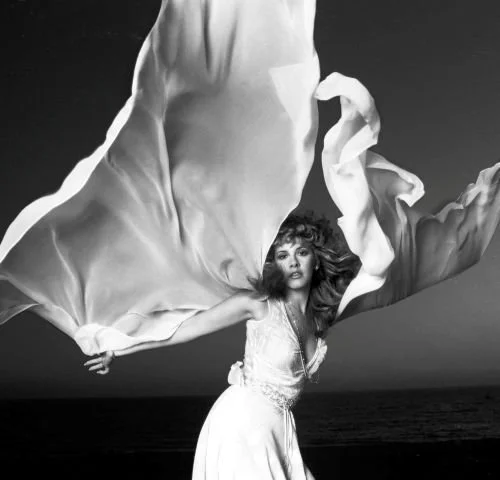
PHOTO CREDIT: Neal Preston
album from Stevie Nicks turns forty-five on 27th July. Bella Donna was released whilst she was still part of Fleetwood Mac. Technically, she still is part of the band, though I am not sure they will ever record any material and they have ruled out touring. It was a big deal recording a debut album. By 1981, Fleetwood Mac had arguably gone past their peak. Rumours came out in 1977. Tusk in 1979. Two huge albums. Mirage would arrive in 1982. It is a great album, though Stevie Nicks contributes only a couple of songs. I think that she was perhaps feeling that there was competitiveness between Nicks and Lindsey Buckingham. Certainly when it came to the trajectory of Rumours and Tusk. Bella Donna was a massive success, so life in Fleetwood Mac must have felt different at this point. Nicks enjoying solo work more. There were strains within the band. Bella Donna was a huge commercial and critical success. Reaching number one in the U.S., Bella Donna spent nearly three years on the Billboard 200, from July 1981 to June 1984. Last year, Classic Rock looked inside Bella Donna. At a moment when Nicks was not feeling stabled, valued or great about being in Fleetwood Mac, Bella Donna was her chance to work on her own terms:
“It’s September 1980. From the deck of the Pacific Palisades home that Stevie Nicks was sharing with her new boyfriend, producer Jimmy Iovine, you could hear the hypnotic push and pull of the ocean.
Inside, among the tropical plants, Persian rugs and paintings of dragons and gypsies, there was the even more alluring sound of three siren voices dovetailing in perfect harmony. Stevie and Lori Perry and Sharon Celani, her two closest friends, would spend hours around the upright piano, singing everything from old country and western covers to Stevie’s new songs.
It was here that the seeds took root for Bella Donna, the breakout solo record that forever changed both the dynamic in Fleetwood Mac and Nicks’s life as an artist. Exhausted from the previous two years of high-stakes drama around the recording and touring of Fleetwood Mac’s epic double album Tusk, the 32-year-old singer welcomed the laid-back setting and easy camaraderie with her girlfriends.
“In Fleetwood Mac there’s always a chaos,” Nicks told me in 2003. “It’s not easy for us. It never will be. It hasn’t ever been. Whenever we get back into a room together and start working, we don’t agree on a lot of stuff. And we’ve fought through every single record we have ever made.”
Part of that fight was getting songs on a record. Having three songwriters in Mac meant that after six years in the band Nicks had built up a backlog of unused top-drawer material.
“When we’d do an album, they’d hear fifteen of my songs and invariably pick the two that were my least favourite,” she complained. “Some of my favourite songs wouldn’t get used.”
Iovine agreed to work with her on a solo project with an approach that would replace the Mac’s careful deliberations with a more live sound. His previous credits included John Lennon, Meat Loaf and Bruce Springsteen. But it was Iovine’s records with Tom Petty & The Heartbreakers that really grabbed Nicks. She told him she wanted a “girl version” of Petty’s sound.
Outside of Fleetwood Mac, Nicks had been flirting with a few projects. She wrote a song cycle around the Welsh mythological goddess Rhiannon for a film (despite having the screenwriter for The Man Who Fell To Earth attached, it never got made). She also sang on Kenny Loggins’s Whenever I Call You Friend and Walter Egan’s Magnet And Steel, both hits. But the idea of releasing an album under her name was still somewhat scary.
“It’s a big deal the first time you do a solo record,” Benmont Tench tells Classic Rock. The Heartbreakers’ keyboard player was tapped by Iovine to act as “musical director” for Bella Donna. “And remember, back then, if somebody in a huge band made a solo record, your first thought was: ‘Wow, is the band breaking up?’ It was really unusual and risky to step away.
"But Stevie may have just gone: ‘Look, I’ve got these songs, let’s do a record without the family baggage there was around Fleetwood Mac.’ Stevie, Christine [McVie] and Lindsey [Buckingham] only got three songs per record. That’s why Silver Springs didn’t make it on to Rumours. Give the woman a fourth song, for God’s sake! [laughs]”
Tench had met Nicks briefly when the Heartbreakers backed her on a recording of Outside The Rain the year before (the track ended up on Bella Donna). But he admits he revised his first impression of her.
“I had seen Fleetwood Mac play, and with Stevie I just didn’t get it,” he says. “She could sing, oh hell yes. But I didn’t know what was going on with the top hat and the twirling and the witchy stuff. But then I bought the single to Go Your Own Way and flipped it over, and there’s Silver Springs. Good Lord, what a song. The second I heard that, I went: ‘Now I get it. That’s Stevie. She’s not faking. She’s for real. She’s not a poser in the least. She’s a creative perpetual-motion machine. This is somebody I’d really love to play music with.’”
For two months, Tench, Nicks and her girlfriends rehearsed five days a week. “We were like Joni Mitchell and Crosby, Stills And Nash, living in this great house and making music,” Nicks remembers. “It was one of those real rock’n’roll experiences that you can never forget.”
“It was song after song after great song,” Tench recalls. “I think she had enough for her first three solo albums and beyond. Lori and Sharon were so instinctive and so intuitive. They were all so tuned in to each other. At the drop of a hat they’d break into a cappella versions of old songs like Chapel Of Love. They loved each other and loved to harmonise. They stood behind me at the piano, and when I heard their three voices together it was just: ‘Wow’, goosebumps.”
With most of the songs chosen, recording sessions started in November at Studio 55 in Los Angeles. Built in the 1940s by Decca Records, it was the studio where Bing Crosby recorded White Christmas. Working from late afternoons into the small hours, Tench settled in with the all-star team that Iovine had assembled, full of what Iovine called “band guys” rather than session players: E Street Band pianist Roy Bittan, Elton John’s guitarist Davey Johnstone, and Linda Ronstadt’s drummer Russ Kunkel, bassist Lee Sklar and guitarist Waddy Wachtel.
“Jimmy pulled members from all these iconic bands to come and make music for Stevie,” Russ Kunkel tells Classic Rock. “What a genius idea. He was the first producer I ever worked with who came out on the floor with the musicians during the rehearsals, sat there with headphones, dialling in a great mix for us. That inspired us and brought us to the take quicker.
"Even during the take he stayed in the room with us, dancing around. He was part of the vibe. So there was never that pregnant pause after a take, where you wait for the producer’s voice from the other side of the glass, saying: ‘Let’s do another one,’ and you’re immediately rejected [laughs]. Jimmy was out there with us. That’s a huge thing.”
“Jimmy knew how to run sessions, and make things happen quickly,” Waddy Wachtel adds. “The luxuriant approach of taking a year to make a record like Tusk is kind of an aberration. And I think Stevie was glad to be working in a more spontaneous way. Jimmy was great at getting performances out of the band and out of Stevie. He had a really intuitive sense about songs, lots of enthusiasm and energy.”
“We recorded all the songs essentially live,” Tench says, “with the whole band cutting at the same time, and Stevie, Lori and Sharon singing with us on the floor. We captured a beautiful feel. The ambience of the studio was gorgeous, aesthetically pleasing. Stevie brought the ambience, not necessarily in items from her house, but just the spirit. The same mood that was in her house made it to the vocal booth.”
At the heart of the sessions was the flowering personal relationship between artist and producer. “Jimmy and I were totally in love,” Nicks wrote in the sleeve-notes for the Bella Donna reissue. “The record was our love story unfolding.”
The feeling and camaraderie came through on the title track’s moody, ribbon-like reverie, the top-down West Coast pop of Think About It, the Nashville twang of After The Glitter Fades, and Leather And Lace, a chart-topping tender-but-tough romantic duet with the Eagles’ Don Henley (Nicks originally wrote it for Waylon Jennings and Jessi Colter).
The two monster hits that made Bella Donna a juggernaut arrived late in the sessions. And one almost didn’t make the album. It was no secret that Nicks was a Heartbreakers fan. She’d even fantasised in the press about quitting Fleetwood Mac and joining them. Short of being in the band, Nicks convinced Petty to write her a song. He came up with Insider. But after they recorded it together, Petty liked it so much he decided he didn’t want to give it away. Nicks understood. Out of what Petty called “terrible guilt”, he played her a few cast-offs from the album he was making, Hard Promises, and she jumped at Stop Draggin’ My Heart Around.
Of the shaded meanings of the album title, Nicks wrote: “It meant beautiful woman, but also poisonous root. People use it [the belladonna plant, aka deadly nightshade] for healing, but if you take too much you can die. I thought: ‘This is the perfect double-edged sword title for the record.’ And there was another double-edged sword: would I have a successful solo career and would that make Fleetwood Mac look good, or would I have an unsuccessful solo career and would that make them look bad? Or would they be petty enough to want it to not go well so they’d know they’d always have me?”
Bella Donna was released in July 1981 on Nicks’s own imprint Modern Records, via Atlantic (set up by her manager Irving Azoff, it was a forward-thinking move), to mostly positive reviews and tons of airplay. Within three months it was a platinum-selling No.1 album. With Tench and Wachtel in her band, Nicks did a 14-date tour full of what she called “spectacular moments”, but then was yanked back into Fleetwood Mac world when they started recording Mirage in France.
“I woke up three days later, in France, with no ice, no air-conditioning, in this stupid castle, and I’m thinking: ‘What just happened? Did I dream the entirety of that record?’” Nicks wrote. “And Lindsey was not in a very good humour because I’d just made this solo record and I’ve brought my new producer boyfriend with me. They almost got in a fight. Jimmy was meant to be there for ten days but he left the next morning, he was so pissed off.”
The first of Nicks’s seven solo albums, Bella Donna remains the most influential and resonant. Its ripples can be felt in records by Lana Del Rey, Florence And The Machine and Belle Brigade. And whenever female musicians fight for creative independence – think Kelly Clarkson overruling Clive Davis to make My December, or Taylor Swift breaking out of her country box with 1989 – Nicks is there as a guiding light”.
I do want to bring in a sizeable chunk of The New Yorker and their 2016 piece around Stevie Nicks and Bella Donna. Even though the album has inspired many modern Pop artists, they argue how (Bella Donna’s ) “generous songs provide an antidote to today’s often embattled pop music”:
“The cover of “Bella Donna,” Stevie Nicks’s first solo album, shows the artist looking slender and wide-eyed, wearing a white gown, a gold bracelet, and a pair of ruched, knee-high platform boots. One arm is bent at an improbable angle; a sizable cockatoo sits on her hand. Behind her, next to a small crystal ball, is a tambourine threaded with three long-stemmed white roses. Nicks did not invent this storefront-psychic aesthetic—it is indebted, in varying degrees, to Hans Christian Andersen’s Thumbelina, de Troyes’s Guinevere, and Cher—but, beginning in the mid-nineteen-seventies, she came to embody it. The image was girlish and delicate, yet inscrutable, as if Nicks were suggesting that the world might not know everything she’s capable of.
This intimation is newly germane: a vague but feminine mysticism is in. Lorde, Azealia Banks, FKA Twigs, CHVRCHES, Grimes, and Beyoncé have all incorporated bits of pagan-influenced iconography into their music videos and performances. Young women are now embracing benign occult representations, reclaiming the rites and ceremonies that women were once chastised (or worse) for performing. On runways, on the streets, and in thriving Etsy shops, you can find an assortment of cloaks, crescent-moon pendants, flared chiffon skirts, and the occasional jewelled headdress.
While Nicks’s sartorial choices have been widely mimicked, it’s rare to hear echoes of her magnanimity in modern pop songs, which are frequently defensive and embattled, preaching self-sufficiency at any cost. It’s difficult to imagine Nicks singing a lyric like “Middle fingers up, put them hands high / Wave it in his face, tell him, boy, bye,” as Beyoncé does in “Sorry,” a song from her newest album, “Lemonade.” Nicks’s default response to betrayal is more introspective than aggressive. Her music has long been considered a balm for certain stubborn strains of heartache; her songs are unsparing regarding the brutality of loss, yet they are buoyed by a kind of subtle optimism. It’s as if, by the time Nicks got around to singing about something, she already knew that she would survive it.
This month, “Bella Donna,” from 1981, and Nicks’s second solo album, “The Wild Heart,” from 1983, are being reissued. Nicks was thirty-three when “Bella Donna” was released. Though its cover might not suggest an excess of reason, in its songs she is a sagacious and measured presence. Her acknowledgment of the heart’s capriciousness is gentle, if not grandmotherly. There’s surely no kinder summation of love’s petulance than the chorus of “Think About It,” a jangling folk song about taking a breath before hurling yourself off a metaphorical cliff. “And the heart says, ‘Danger!’ ” Nicks sings. She pauses briefly. “And the heart says, ‘Whatever.’ ” For anyone busy self-flagellating over an error in judgment, this can feel like a rope ladder thrown from above—an invitation to scramble up and out of despair. It is generous and knowing, and offers a clear-eyed conclusion: some things can’t be helped.
In 2012, Tavi Gevinson, the young founder of Rookie, an online magazine concerned chiefly with the complexities of teen-age girlhood, ended a TEDX talk with some blunt advice: “Just be Stevie Nicks. That’s all you have to do.” What does it mean to be Stevie Nicks? To understand loss and longing as being merely the cost of doing business? To acknowledge the bottomless nature of certain aches, yet to know, in some instinctive way, that you’ll keep going? Nicks evokes Byron, in spirit and in certitude: “The heart will break, but broken live on.”
Nicks was born in 1948, in Phoenix. Her paternal grandfather, A. J. Nicks, Sr., was a struggling country musician, and he taught Nicks how to sing when she was four years old. She was given an acoustic guitar for her sixteenth birthday, and immediately wrote a song called “I’ve Loved and I’ve Lost and I’m Sad but Not Blue.” The title is a surprisingly succinct encapsulation of Nicks’s lyrical alchemy: a combination of acceptance (I am hurting) and perspective (I will not hurt forever).
In 1966, when Nicks was in her senior year of high school and living in Atherton, California—her father, an executive at a meatpacking company, had been relocated there—she met the guitarist Lindsey Buckingham at a party. He was sitting cross-legged on the floor—bearded, curly-haired, and strumming the Mamas and the Papas’ “California Dreamin’.” Uninvited, she joined him in harmony. (“How brazen!” she later said.) Buckingham asked Nicks to join his band, Fritz. By 1971, the two were romantically involved. They eventually took off for Los Angeles, where they tried to make it as a duo, called Buckingham Nicks, releasing one album, in 1973, to very little acclaim. Not long afterward, Buckingham was asked to join Fleetwood Mac, a British blues band featuring the singer and keyboard player Christine McVie, the bassist John McVie, and the drummer Mick Fleetwood; the group was being rebooted as an American soft-rock act. Buckingham insisted that Nicks be invited, too. She ended up writing two of the band’s biggest early hits, “Landslide” and “Rhiannon.”
Extraordinary success often leads to spiritual dissolution, and Fleetwood Mac had its share of psychic turmoil. In 1975, Fleetwood divorced his wife, the model Jenny Boyd, after she had an affair with one of his former bandmates. Nicks and Buckingham broke up the following year. Around the same time, John and Christine McVie’s marriage collapsed. There was an ungodly amount of brandy and cocaine on hand to help nullify the despair. Still, in 1977, Fleetwood Mac—now five wild-eyed, newly single people—released “Rumours,” a collection of yearning songs about love and devotion. The record spent thirty-one weeks at the top of the charts, and is one of the best-selling albums in American history.
“Tusk,” which the group released two years later, was a bombastic double LP that cost a million dollars to produce. The critic Stephen Holden, in his review of the album for Rolling Stone, suggested that Nicks sounded “more than ever like a West Coast Patti Smith.” Superficially, at least, Nicks and Smith aren’t obvious analogues. Nicks is hyperfeminine, intuitive, and bohemian; Smith is androgynous, cerebral, and gritty. But both are unusually perceptive chroniclers of their time and place.
If Smith is obliged to the Lower East Side of Manhattan—and the punk scene that included the Ramones, Television, and Suicide—Nicks’s debt is to Laurel Canyon, and to the sentimental, silky-voiced artists who emerged from L.A. in the late sixties and early seventies. Some of those acts—James Taylor, the Eagles—are now considered, fairly or not, irrelevant to the Zeitgeist: too mellow, too affluent, too sexless, too white. Candles and incense and macramé plant hangers; wistful thoughts about weather. Nicks’s lyrics often worry over domestic or earthly concerns—gardens, mountains, flowers, the seasons—and how they might affect the whims of her heart. “It makes no difference at all / ’Cause I wear boots all summer long,” she sings in “Nightbird.” When compared with the dissonant and provocative music coming out of downtown New York, the California sound could seem limp. But the scene in Laurel Canyon was tumultuous. Many of its artists—including, at various times, Nicks—were wrecked by drug addiction. Nicks’s voice, a strange, quivering contralto, gives her songs unexpected weight. Its tone reminds me of the gloaming—that lambent, transitional moment between night and day.
“Bella Donna” was produced by Jimmy Iovine, a Brooklyn-born audio engineer who worked on Bruce Springsteen’s “Born to Run” and produced the Patti Smith Group’s “Easter” and Tom Petty and the Heartbreakers’ “Damn the Torpedoes.” Iovine spent time in California, but his sensibility was tougher and more plainly that of the East Coast. He later became a co-founder of Interscope Records, where he helped to establish the career of the rapper Tupac Shakur, and, for a period, he oversaw the hip-hop label Death Row Records. Iovine was aware of concerns that Nicks was too coddled and immature to make a solo record as good as the records she’d made with Fleetwood Mac. Regardless, there was romantic chemistry. “This record was our love story unfolding,” she has said.
“Bella Donna” reached No. 1 on the Billboard chart, and produced four hit singles: “Stop Draggin’ My Heart Around,” a duet with Petty; “Leather and Lace,” with Don Henley; “Edge of Seventeen”; and “After the Glitter Fades.” The last, a country song about the travails of stardom—Nicks wrote it just after she and Buckingham moved to Los Angeles, long before she had a record deal, showing either hubris or prescience—contains organ, pedal steel, and reassurances. “The dream keeps coming even when you forget to feel,” she sings.
Nicks, like most artists, culls inspiration from disparate sources. She is prone to saying things like “ ‘Edge of Seventeen’ was about Tom Petty and his wife, Jane, my uncle dying, and the assassination of John Lennon.” But her personal life—a tangle of love affairs, often with her collaborators—informs her work in explicit ways. “Heartbreak of the moment isn’t endless,” she sings, in “Think About It.” This might seem like a billowy platitude, but if you are someone who does not think that every flubbed decision is fodder for personal growth, it is comforting to hear someone assert that nearly all mistakes can be neutralized, if not conquered. If “Bella Donna” contains a single directive, it’s to love freely, love fully, and hang on”.
I do wonder whether Stevie Nicks will mark forty-five years of Bella Donna. In 2021, on its fortieth anniversary, Nicks wrote about Bella Donna and how proud she is of the songs. Uncut shared the post that she made. You can sense that Bella Donna was Nicks at her most uninhibited at that point. Even though she loved Fleetwood Mac, Nicks did need to have her own voice and album. One that was very much her own work and her voice:
“Posting an excerpt of her journal on Instagram, the singer-songwriter said she teamed up with backing vocalists Lori Perry-Nicks and Sharon Celani to create the record, aspiring to be the “girl version” of Crosby, Stills and Nash and to sound nothing like Fleetwood Mac.
According to Nicks, the title track was written “about my boyfriend’s mother who was involved with a man in Chile during the coup that happened there in 1973.”
“The man she loved was banished to France,” Nicks wrote.
“Banished or imprisoned, that was the choice. The love story never really ended – but she never saw him again.
“I was so touched by this story of lost love that I wrote Bella Donna – the moment the poem and then the song was finished, I knew I had the basis for my first solo record.”
Nicks said she “never doubted for a moment” this track would be the album’s title. Bella Donna went on to top the US charts and, in Nicks’ words, “open the doors of the Rock and Roll Hall of Fame”.
“It was ours – it defined how I would feel about love forever,” she continued.
“It broke my heart and gave me the strength to fight for it. It was a fine line to walk between love and hate and passion and the girls and I loved it. We never looked back.
“I could not have been more proud of those songs or the three months it took me, the girls and [producer] Jimmy Iovine to craft it. It did not break up Fleetwood Mac. If anything, it kept us together”.
Let’s end there. On 27th July, Bella Donna turns forty-five. One of the greatest albums ever, you can still feel its beauty and brilliance. It has not aged at all. I do wonder whether Stevie Nicks will release another solo album. There are so many artists who would love to collaborate with her. Someone whose voice, especially in modern America under Donald Trump, is powerful and inspiring. In any case, We need to mark forty-five years of Bella Donna. A wonderful album that…
EVERYBODY should hear.